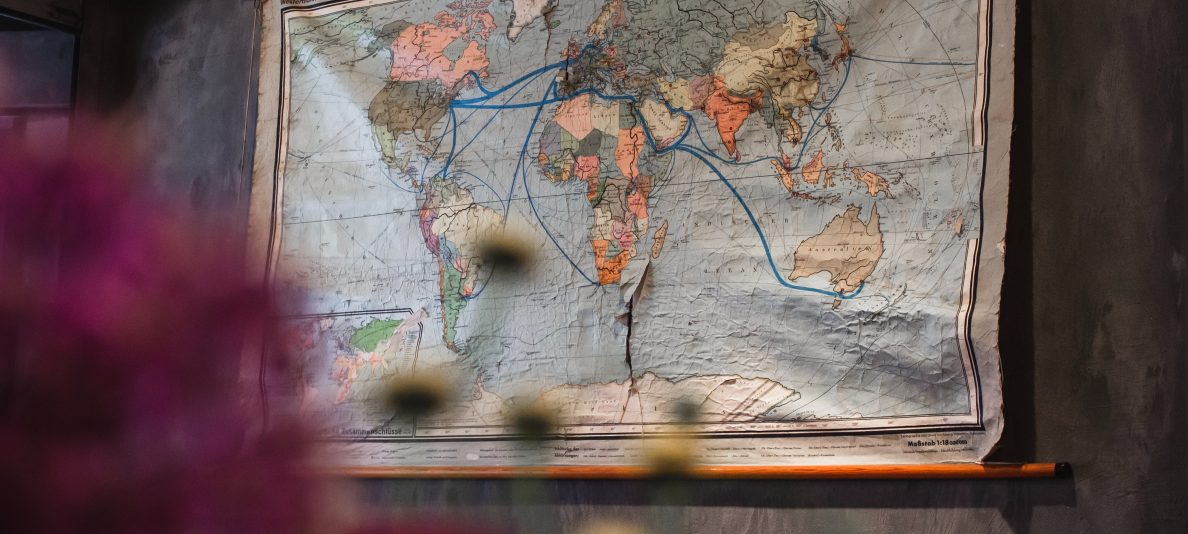
Repost: 11 Ways Moving Abroad Is like Skiing to the North Pole

In May of 2004, explorer Ben Saunders completed a solo, unsupported trek to the North Pole—on foot. He set out on his trip from the Russian side on March 5, reached the Pole on May 11, and was picked up by plane on the Canadian side on May 14. So here’s a repost, in honor of the thirteenth anniversary of his return.

Also, today is notable because it’s Mother’s Day, and point #9 below is a shout-out to moms, including a very emotional and very long-distance telephone call. Have you called your mum today?
 

34961051_5302f8458a
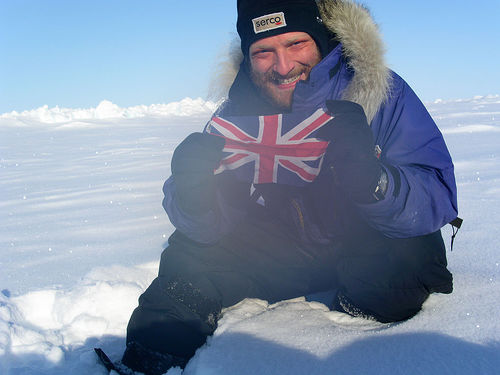
Ben Saunders sits on top of the world, the youngest person to reach the North Pole alone and by foot.

In 2004, 26-year-old Briton Ben Saunders became only the third person, and the youngest ever, to ski unaccompanied to the North Pole. As it turns out, there are a lot of ways that making a solo trek to the North Pole is a like moving to another country. Here are 11 things that the two adventures have in common, all taken from Saunder’s February 2005 TED Talk, “Why Did I Ski to the North Pole?”

  1. Luggage is a drag
    Saunders describes his specialty as “dragging heavy things around cold places.” He says, for his trip to the North Pole, “I was dragging all the food I needed, the supplies, the equipment, sleeping bag, one change of underwear—everything I needed for nearly three months.” That sounds like trying to put every necessary item in your carry-on bag, just in case your checked luggage gets lost. (If you think your bags are heavy, Saunder’s supply of food and fuel weighed 400 pounds.) Sometimes your destination has harsh conditions. And sometimes it doesn’t have chocolate chips. How many bags of those should you bring? Can’t be too prepared.
  2. It can be lonely out there
    One of the challenges of Saunder’s voyage was that he had to make it alone. Very alone. When he arrived at the northern-most point on the globe, he was the only “human being in an area one-and-a-half times the size of America, five-and-a-half thousand square miles.” Most of us don’t go to such remote places, but even if you’re in the biggest city, surrounded by millions of other souls, you can easily feel all by yourself.
  3. No, Virginia, there isn’t a Santa Claus
    When Saunders got to the top of the world, he didn’t find Santa. No Santa’s workshop. No elves. In fact, he says, “There isn’t even a pole at the Pole. There’s nothing there, purely because it’s sea ice.” When you go to another country, expect the unexpected. Don’t be surprised when what you find doesn’t match the photos in the magazine article. “I’d read lots of books,” says Saunders. “I studied maps and charts. But I realized on the morning of day one that I had no idea exactly what I’d let myself in for.” Photoshopped and cropped pics don’t do us any favors. If GPS and street signs say we’re in the right place, don’t waste time—or emotions—trying to find something that doesn’t exist.
  4. Sometimes it’s one step forward, two steps back
    According to NASA, during the year of Saunders journey, the ice conditions were the worst on record. Ninety percent of the time he was skiing into headwinds and the drifting ice pulled him backwards. “My record,” he says, “was minus 2.5 miles. I got up in the morning, took the tent down, skied north for seven-and-a-half hours, put the tent up, and I was two and a half miles further back than when I’d started. I literally couldn’t keep up with the drift of the ice.” When you’re in a new place, learning the language and culture, get used to those backward drifts. But always keep your compass set on your true north.
  5. The only constant is change
    Because the ice is constantly drifting over the North Pole, Saunders says that if he’d planted a flag there, it wouldn’t be long before it would be heading toward Canada or Greenland. Like Saunders, don’t be surprised when the emotional flags you plant aren’t permanent. The ground may not move under your feet (earthquakes not withstanding), but other kinds of landscapes certainly will. Find a special restaurant that serves your favorite dishes? Wake up the next day and it’s become a plumber’s shop. Make friends with some other expats? You may soon have to say goodbye. But, repeat after me, “Change can be good. Change can be good. Change can be good.” Maybe, just maybe, that plumber’s shop will end up being exactly what you need.
  6. Culture stress can be a bear
    Literally. On his first try at the North Pole, Saunders went with a partner, but they failed to reach their goal. Saunders says that from the outset “almost everything that could have gone wrong did go wrong. We were attacked by a polar bear on day two. I had frostbite in my left big toe. We started running very low on food. We were both pretty hungry, losing lots of weight.” Yup. Sounds like culture stress to me.
  7. Coming back can feel like the bear wins
    When his first attempt fell short, Saunders says he “was physically exhausted, mentally an absolute wreck, considered myself a failure, in a huge amount of debt personally to this expedition, and lying on my mum’s sofa, day in day out, watching daytime TV.” His brother texted him an encouraging quotation from Homer Simpson:
    “You tried your hardest and failed miserably. The lesson is: don’t even try.” Repatriation can feel that way. Maybe all the people who’d said you shouldn’t go were right. But Saunders didn’t let his failure define him. Instead, three years later he made history.
  8. People aren’t sitting around waiting to hear your stories
    When Saunders reached the North Pole, he got out his satellite phone. After warming up the battery in his armpit, he made three calls: “I dialed my mum. I dialed my girlfriend. I dialed the CEO of my sponsor. And I got three voicemails.” OK, that’s unfair to say they didn’t want to hear what he’d done. They were just busy at the time, that’s all. But . . .
  9. Some people really do want to listen
    “I finally got through to my mum,” says Saunders. “She was at the queue of the supermarket. She started crying. She asked me to call her back.” There are special people who will make time to listen—when they can focus on your story without distractions. Thanks, Mum.
  10. Don’t let others draw boundaries on your map
    When Saunders was 13, he got a school report that said, “Ben lacks sufficient impetus to achieve anything worthwhile.” Saunder’s response—”I think if I’ve learned anything, it’s this: that no one else is the authority on your potential. You’re the only person that decides how far you go and what you’re capable of.”
  11.  One of the three most important questions will always be “Where is the bathroom?”
    Saunders gave his TED Talk to answer three questions:
    (1 ) Why?
    (2) How do you go to the loo at minus 40?
    (3) What’s next?
    That second question is very important at the North Pole, because it seems that “at minus 40, exposed skin becomes frostbitten in less than a minute.” Your question number two will be more like “Where’s the bathroom?” or just “Bathroom? Bathroom?” Then, once you see the facilities, you may ask yourself, “How?”

As for the answers to those question, in short, Saunder’s responses go something like this:

(1) “For me,” says Saunders, “this is about exploring human limits, about exploring the limits of physiology, of psychology, and of technology. They’re the things that excite me. And it’s also about potential, on a personal level. This, for me, is a chance to explore the limits—really push the limits of my own potential, see how far they stretch.”
(2) That’s a trade secret, no answer here.
(3) Antarctica. Saunders and Tarka L’Herpiniere are currently on the first leg of their trek from the coast of Antarctica to the South Pole and back again—1,800 miles in all—unsupported and on foot. You can follow Saunder’s daily blog posts here. Why the South Pole? See answer number one above. Somebody’s got a severe case of wanderlust. [Saunders and L’Herpiniere completed their expedition on February 7, 2014.]

[photo: “North Pole (3),” by Ben Saunders, used under a Creative Commons license]
Empathy at a Cultural Threshold

3774209963_b6f0b1029c_z

Empathy has taken somewhat of a beating lately, as Paul Bloom’s Against Empathy: The Case for Rational Compassion has made the rounds. I’ve not read the book, so what I know of it comes from third-party reactions, not enough for me to make any intelligent critique or defense. After all is said and done, though, I would guess that most of us would champion empathy, even if we agree that it can have a negative impact when misguided.

Christopher O’Shaughnessy is author of the book Arrivals, Departures and the Adventures In-Between. He’s also, per his website, an “international speaker and globetrotting adventurer” and, per the video below—an excerpt from his keynote address at last year’s Families in Global Transition (FIGT) conference—an empathy advocate. In fact, the video begins with him saying,

I want to tell you a story that emphasizes for me when I first sort of imprinted how important empathy was.

His story takes place after he entered a new school as an eighth grader and met an Eastern European girl who had just made her first international move. O’Shaugnessy, who was born in England to US military parents and spent chunks of his growing-up years on alternating sides of “the pond,” understood what she was going through and befriended her while others made her the object of their bullying.

His first story ends with a second story that takes place years later, in a bank, with a suspicious character, a note passed to a teller, annoying hope, and leaping tears.

It’s worth a listen.

This video is posted at Youtube in the Culturs.guru channel, which says that “CULTURS is a global multicultural philanthropic brand that brings lifestyle content to liminal identities.” I wasn’t familiar with the word liminal, but quick Google search told me that it means “occupying a position at, or on both sides of, a boundary or threshold.” I like that. There’s plenty of room for empathy in that place.

[photo: “Empathy Picture,” by The Shopping Sherpa, used under a Creative Commons license]

Culture Stress, when There’s No Hook to Hang It On [—at A Life Overseas]

Head over to A Life Overseas to read my complete post.

6854846176_3b16e91b22_k

When most people open up their closets in the morning, they usually ignore the out-of-style shirts on the edge, the wrong-color sweaters, the too-tight pants. Instead, as much as they can, they grab something that looks right, something that fits right, something that feels right.

When you transition between countries, your cultural closets get switched. Your choices become limited, and you often have to put on things you’d rather not wear. You’ve given up comfort for other purposes. Some of this discomfort is just an annoyance, like a scratchy tag inside the collar of your shirt. But some can seem unworkable, like that same shirt two sizes too small.

It’s the Water and the Dirt

When I and my family moved overseas, we weren’t surprised by culture stress. We may not have been fully prepared, but we weren’t surprised. What did surprise us, though, was that we couldn’t always identify the causes of our irritation and pain.

For many stressors, you know just what hook to hang them on. Singing at church feels a little off? It’s because everybody’s clapping on a different beat than you are. Can’t sleep? That’s because of the all-night traffic outside your window. Nagging cough? Pollution.

Being able to name a problem helps us sort things out. It gives us vocabulary for talking about it with others. It helps us better understand our new home and ourselves. It helps us find solutions. It helps us cope.

But sometimes, there is no hook, at least not an obvious one.

A few months after we landed in Taipei, my wife developed a “cold,” a cold that lasted on and off for over a year. Our doctor couldn’t find a solution and none of his remedies helped (one medicine caused her heart to race). Finally, he diagnosed her with shui tu bu fu, which can be translated as “not acclimated to the water and soil.” That’s odd, because we didn’t drink the water, and with all the concrete, and we rarely saw the soil. . . .

Continue reading . . .

[photo: “038,” by glassghost, used under a Creative Commons license]

Paddington: A Fish out of . . . um . . . A Bear out of the Jungle

15810316086_62a83999d1_zPaddington is one of my favorite movies that I saw last year. Much more than just a kids’ movie, it was nominated for best film at the UK’s 2015 Empire Awards, and won for best comedy. It also carries a 98% rating at Rotten Tomatoes.

The story in a nutshell is this: When Paddington comes to London, it’s not quite what he’s heard it would be. And as if it weren’t enough of a culture clash for an orphan bear to arrive in the big city, this cub comes from “Darkest Peru.”

If you haven’t seen the movie yet, you should. It’s a great family film for Christmas time. And if you have seen it, here are some clips to refresh your memory.

First Contact: Meeting the Brown Family

BSL: Bear as a Second Language

Bathroom Etiquette: Those Aren’t Ear Brushes.

Sign Language: Why Do I Need a Dog for the Escalator?

[photo: “Paddington Bear Trail, Special Delivery By Ben Whishaw,” by Martin Pettitt, used under a Creative Commons license]

A Modest List of Invented Expatisms, Inspired by the Dictionary of Obscure Sorrows

822518337_839b806a79_z

My son pointed me to The Dictionary of Obscure Sorrows, where John Koenig creates words to name before-unnamed emotions and ideas. Many of them are melancholy, such as amenuerosis, “the half-forlorn, half-escapist ache of a train whistle calling in the distance at night”; and chrysalism the amniotic tranquility of being indoors during a thunderstorm. . . .”

Others are more on the humorous side. For instance, a reverse shibboleth, is “the practice of answering a cellphone with a generic ‘Hello?’ as if you didn’t already know exactly who was calling . . .”; and lalalalia is “the realization while talking to yourself that someone else is within earshot, which leads you to crossfade into mumbled singing. . . .”

Expats have their own feelings and experiences that are yet to be named, and I think this needs to be remedied. So while I don’t have Koenig’s talent, here are a few of my offerings:

dyslistening
the condition by which your over preparation for answering an expected question in another language overwhelms your auditory senses and you answer the query you’ve anticipated, no matter what is actually said, as in responding to “How many would you like?” with “Yes, but no ice, please.”

welwelwel-ke-come
the glorious sound of the immigration agent thumbing through your passport looking for an empty page—and then adding the stamp that says you’re free to enter.

altivism
gazing out of an airplane window, seeing the new landscape below, and feeling joyfully overcome with the real and imagined possibilities.

visatrig
the act of trying to predict which agent in the office will be the most likely to give you your visa or other important document and then conducting complex calculations concerning the number of people in line in front of you to see if you will get the agent you hope for. A domestic version of this is sometimes encountered in the DMV.

unchewing
the physical and mental reaction that occurs when you realize that the chocolate-covered, cream-filled donut that you just took a bite of is in fact not a donut and that’s not chocolate and the filling might very well have gristle in it.

Finally, here’s one more from Koenig: onism

[photo: “The Dictionary,” by Bethany King, used under a Creative Commons license]
What Is a Bridge but a Paradox?

5078301307_31b7f7a46a_z

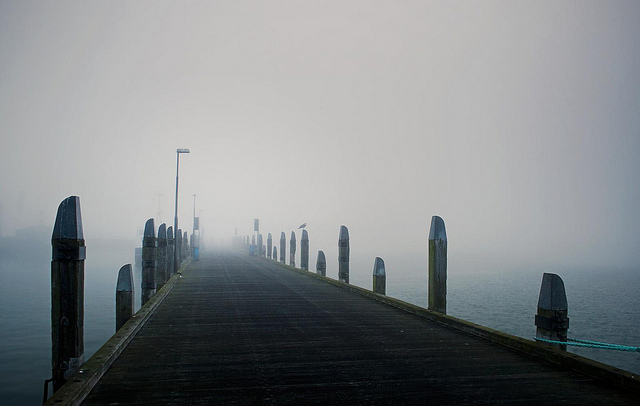
What do you see when you see a dock?

A place for studying the horizon?
For dipping a toe in the water?
For casting off?

Or a place for lowering your sails?
For stepping onto dry land?
For coming ashore?

Is it a place for setting out or coming back? Much depends on the compass of your heart.

If for you, the dock is too short, out of desire or necessity, you build it forward, step by step, plank by plank, as you go—through the spray and the mist and the fog. And when you’ve built till you’re more coming than going, you see another shore—build, step, build, step. You are there.

This is crossing cultures. This is creating a bridge. This is going from home to home.

Then, at some point, out of desire or necessity, you step back onto the bridge. You must have been gone a long time, because what was once a complete span is now incomplete. You need to build to close the gaps. And at times you’re simply on a dock again, building to a shore you cannot yet see. Strange. It was a bridge before.

This time while you’re crossing, you find that in the mist there are others with you, and when they talk, you understand them, because they are speaking your language.

“Where are you from?” you hear someone ask, and the answer, “That’s an interesting question.” “You, too?” one says. “Me, too,” another replies. You understand them, not because you use the same words, but because when you speak those words you agree on the impreciseness of their meanings: near, far, hot, cold, friends, enemies, rich, poor, family, strangershere, there, hello, goodbye. Their meanings are slippery, like the damp boards beneath your feet. And the slipperiness is comfortable.

In time, you cross the bridge again and again, sharing familiar greetings with those in the misty middle. But never do you set out without having to repair what was built before. You continue . . . build, step, build, step.

What is a bridge, but a paradox, leading from home to home, from not-home to not-home? Your heart’s compass spins. The shores, they push and pull, they give hugs at arms length, they don’t plan on changing, but they do. The same can be said of you.

And then, out of desire or necessity, you settle down farther inland. You put down roots in loose soil. There’s a dock over the next, next hill. You go to visit from time to time and walk its length. You listen to the slap of the waves. You breathe in the smell of the ocean. You taste the salt in the air . . . and you remember the sounds and the smells and the bitter-sweet flavors of where you used to be.

What do you see when you see a dock?

You put down roots in loose soil, but you still speak the language of the bridge.


These thoughts are inspired by Mission Training International‘s “Pair of Ducks.” MTI uses two rubber ducks—a “yay duck” and a “yuck duck”—to show cross-cultural workers and their kids that all the places where they’ve lived have their good and bad parts.

[photo: “Harbour Bridge,” by D.Reichardt, used under a Creative Commons license]

TCKs as Prototypical Citizens and Culture Shock as Exaggerated Poop: Ted Ward’s Views on Growing Up Abroad

16241388115_fec39f427a_zQuotation tracing. It’s almost as exhilarating as tracing a river.

According to the Taipei Times, the sport of river tracing may have been birthed in Taiwan in 1982. That year, a Japanese expedition team representing the Osaka Grassshoes Society traced the Nantsi River to the top of Taiwan’s Jade Mountain. (How’s that for an epic-sounding adventure?) Years ago I got to chaperone a group of junior-high-school students in a much less demanding trek, hiking in and up a fast-moving mountain river in northern Taiwan. We had a great time wading, swimming, crawling, and climbing. Not only did we find the spring that was the river’s source, but we also enjoyed—and discovered a lot during—the getting there.

So it is with quotation tracing, finding the origin and context of well-known, though often misquoted and misattributed, quotations. There’s much to be learned from tracking down quotations, and now that I’m older, I find that quotation tracing is more suited to a more sedentary lifestyle, as well.

My target quotation this time is one that we read often in literature about Third Culture Kids. And just like river tracing in Taiwan, it comes from the 80s. It’s Ted Ward’s

TCKs are the prototype citizens of the future.

I used this form of the quotation a few years ago in a blog post that I wrote. Sadly, at the time, I hadn’t checked the source. Had I done so, I would have seen that the original comes from page 57 of “The MK’s Advantage: Three Cultural Contexts,” in Understanding and Nurturing the Missionary Family. The chapter from Ward is an abridged version of a presentation he made in Quito, Ecuador, at the International Conference on Missionary Kids, held in 1987. (David Pollock and Ruth Van Reken, in Third Culture Kids: Growing Up among Worlds, are two who point to this source.) I would have also seen that the quotation has been paraphrased over time.

Speaking about the qualities that define Missionary Kids (MKs) as world Christians, Ward says,

Another characteristic is the loyalty to Christian values, even above the social pragmatics that we deal with in any society. There are characteristics of the internationalizing community of Christ that may very well, in this increasingly shrunken world, become characteristic of the church in general in the twenty-first century. One of my propositions is that the missionary kid of the nineties will be the prototype of the Christian of the twenty-first century [emphasis mine].

Because Missionary Kids are a subset of Third Culture Kids, it’s not a stretch to apply what Ward said to the larger group as a whole, but it’s interesting that his comments in this context refer not to general global citizens but to citizens of the community of Christians. This is understandable, though, as Ward’s audience was missionary families, and if he were talking to expat families in general, I would think it logical that he would apply the same principle to the broader category of all TCKs.

But looking at Ward’s presentation as a whole, I find something even more interesting. It’s his strong pronouncements of how MKs should embrace the advantages of their lives abroad and should not focus on the perceived negatives. “I view the MK growing up experience,” he says, “as very positive and very valuable, in comparison with the experiences available to their cousins who are stuck back home.”

To combat negative stereotypes applied to MKs, Ward uses somewhat blunt language, language that grates against my way of thinking. But one of his goals seems to be to shake up our assumptions, and my discomfort shows that he has been successful in that with me.

At the time that he spoke at the Quito conference, Ward was serving as dean of International Studies, Mission, and Education at Trinity Evangelical Divinity School. Before that, he spent 30 years at Michigan State University, teaching in the areas of education and curriculum research, and taking a leading role in the field of theological education.

While at Michigan State, Ward was a colleague of Ruth Hill Useem, the sociologist and anthropologist who coined the term Third Culture Kid. Ward describes Useem’s technical usage of TCK as being in the context of

cultural variables that are not definable in terms of ours and theirs. She was talking about the dynamic of that which is different because people from outside settings residing in an inside setting do not take their primary identities ultimately from either, but they take it from the commonness that they have with others who are doing the same thing.

But Ward goes on to point out that Useem’s definition of third culture is based on her study of “the overseas intellectual communities of Western European and American people in the sciences and technology.” And he writes that the paper in which she coins the term Third Culture Kid has “no reference to anything like what we would call the MK.” Therefore, he believes that today’s use (or “misuse”) of TCK has made it a “static term,” with “standard values” and “generalizations about it which lead us to the wrong questions.” (edited 5/11/21*)

What are some of the wrong questions? They are nonsense questions. “Is it OK to be an MK?” “What are the problems of being an MK?” They’re dumb questions, but they’re the questions that a static view of culture leads you to.

Then you get preoccupied by rootlessness. Oh, come on. Millions of people in the world are rootless. Don’t get paranoid about thirty thousand kids when ten percent of them are rootless.

It is this kind of negative thinking, especially by parents of MKs, that Ward opposes. For instance, in the area of culture shock:

Words like culture shock—good grief! Talk about popularization of some bad research! Culture shock—for the most part largely exaggerated poop! Incompetency, yes, but incompetency comes in all kinds of forms.

And about American expat parents who are concerned about their children’s lack of understanding of US culture, he responds,

I find more MKs understanding the nature of American society than people who are raised wholly within it. Would that we could get that message across to parents. Paranoid parents have got to be helped.

Ward also laments missionary parents’ worries about reverse culture shock. Years ago, it wasn’t so easy for missionaries or their children to return “home,” so they weren’t so apt to influence their children towards the inevitability of going back. One qualification of MKs as prototypical world Christians, says Ward, is their ability to serve God anywhere, without being tied down to a particular country or culture, especially the one from which they came.

Ward believes that the long-term work of missionaries has changed. “A career missionary today does not get buried in China at age forty-seven under great mounds of Chinese soil,” he states. “He gets buried at age forty-seven at a North American mission office desk under mounds of paper.” Ward doesn’t want this sort of mindset to be passed on to Missionary Kids.

Ward has given me, a former missionary and current parent of several MKs, a lot to think about, and I wonder how I would have responded if I had been in his audience 27 years ago.

While tracing Ward’s quotation to its source, I’ve been challenged, affirmed, and stretched. I’ve learned a few things and I’ve read some things that I’ll be pondering for a while. I’m grateful for the work that Ted Ward has done for and with cross-cultural workers and their families. And while I’m not on board with everything he’s said (for instance, I don’t think that culture shock is “largely exaggerated poop”), I do understand that there can be a tendency toward paranoia and excessive navel gazing.

We need balance. It’s good to look inward, with caution. But it’s also good to look up and out and aim for some mountaintops, to hike some rivers, to look with optimism at the path ahead, and to see the landscape from a different perspective.

(*In my original post, I misunderstood Ward’s view of how Useem defines the term Third Culture Kid, writing “According to Ward, Hill Useem applied it to particular new cultures—new communities in a distinct time and place—that expats form inside their host country. This is different from how we currently use TCK (or MK) to describe a broad group of people raised overseas.” I have rewritten the paragraph above to better express Ward’s objections to today’s usage of TCK.)

(Ian Bartholomew, “Taiwan’s Rivers Offer Vast Potential for Adventure,” Taipei Times, August 19, 2001; Ted Ward, “The MK’s Advantage: Three Cultural Contexts,” Understanding and Nurturing the Missionary Family: Compendium of the International Conference on Missionary Kids, Quito, Ecuador, January 4-8, 1987, Volume I, Pam Echerd and Alice Arathoon, eds., William Carey, 1989.)

[photo: “Consumer Confidence!” by Chris & Karen Highland, used under a Creative Commons license]

Watching “The Dialogue”: A Cultural Bumper-Car Ride

15946836_a846e28a57_zCulture Shock.

“It’s like you’re driving in a car,” says one of the students in The Dialogue, “and the gas and the brakes switch.”

The Dialogue is German director Arnd Wächter’s feature documentary that follows eight college students traveling to Hong Kong and southwest China. As they interact with the world around them and interact with each other, they explore cultural differences and the way we communicate about those differences.

The students make up a rather diverse group: males, females, Americans seeing China for the first time, Chinese returning home, whites, an African American, and an Asian raised in the US . . . and their viewpoints are varied as well.

I got to watch The Dialogue at a screening held at the San Diego NAFSA conference in May. It was a great conference, and seeing the documentary and taking part in the discussion with Wachter afterward was a highlight for me.

My experience watching the film was—to borrow the student’s words—like driving in a car. But for me it was a bumper car. At several times throughout the documentary, I would identify with one of the students, but then something would happen to change my view: I look like him, but I don’t agree with what he just said. I agree with her, but then she went too far. I share her background, but what he said makes more sense. I identify with him, but I don’t think he’d identify with me.

My point of view kept bouncing from person to person, even country to country. It was jarring, but enjoyable. Thus the bumper-car ride. I liked the way it challenged me to think beyond stereotypes and easy answers. And that, getting viewers to think, is what Wachter’s Crossing Border Films and Michigan State University had in mind when they made the film. It’s what would make The Dialogue a great tool for cross-cultural training exercises.

The key to the documentary is the frank conversations that the students have on camera. And the key to these conversations is the work of facilitator Ana Rhodes Castro. She led the students through behind-the-scenes activities and debriefings that encouraged them to express their true feelings and talk about root issues. The result is on-camera interactions that get straight to the point and reveal topics and opinions that are normally skirted in everyday life.

Particularly interesting are discussions of how individual personalities, non-verbal communication, surroundings, and language affect how we offer and receive viewpoints. How often does the way people present themselves affect how we judge what they say? How do our expectations for non-verbal cues differ from culture to culture? Does the fact that the film’s discussions take place in China give the Chinese a disadvantage? And does using English as the mode of communication give an advantage to the native speakers?

There’s a partner education site at National Geographic that addresses these issues using clips from The Dialogue. The site also includes questions for discussion and additional resources for use in the classroom.

The Dialogue, along with two other Wachter productions, is part of a trilogy of cross-cultural films. The others are Crossing Borders, which follows the same model as The Dialogue, but this time with four Moroccan and four American students traveling to Morocco, and American Textures, which listens in on the discussions of six young Americans—Latino, Caucasian, and African-American—as they travel to three cities in the southeast United States and talk about race, class, and culture.

[photo: “Bumper Cars,” by Bill Frazzetto, used under a Creative Commons license]