Here’s a repost of something I wrote back in March of 2012—it was only my fifth entry—back when I had no followers and very few readers. It’s an interesting and timely story, and helps give me a break during the busyness of the holidays. May you enjoy the blessings of Christmas, wherever you are in the world.
In the early 1970s, a Christian missionary school in Tokyo was looking for turkey for Christmas dinner. Finding none, a representative contacted the local Kentucky Fried Chicken and ordered chicken instead. A KFC employee suggested the company turn the request into an ad campaign, and Japan has never been the same since. Today, KFC’s Christmas Party Barrels are so popular that sales for December 23rd, 24th, and 25th usually equal half of what is sold during a normal month, and Christmastime customers wait in long lines to pick up their orders, placed as early as October. Very few in Japan celebrate Christmas for its religious meaning, as less than 2% of Japanese even call themselves Christian. Instead, consumerism is emphasized, and the focus is on gifts, decorations . . . and chicken from the Colonel.
It’s not easy being shortlisted for the Academy Awards, but that’s what Rahul Gandotra did in 2011 with his live-action short film, The Road Home.
A Hidden-Immigrant Story
Gandotra was born in Belfast, Northern Ireland, and grew up in eight countries, spending time in Europe, the Middle East, Asia, and the US. He attended the University of Michigan and then got an MA in film directing from The London Film School. For his master’s thesis, he returned to Woodstock, a boarding school in the Himalayas, to shoot The Road Home. When Gandotra attended school there in the 10th grade, his class of 52 had students from 26 countries.
The Road Home tells the story of Pico, a Woodstock student who runs away from the school, hoping to get to the airport and return to London. Pico looks Indian on the outside, but on the inside, he is British. He doesn’t speak Hindi, and the culture is foreign to him. He is a “hidden immigrant” who desperately wants to escape this assault on his identity.
In an interview with Jedda Blog, Gandotra says that while he was filming in India, he was introduced to David Pollock and Ruth Van Reken’s book Third Culture Kids: Growing Up among Worlds. “That book described me really well,” he says.
I realized these are the type of people I am making the film for and that this film is for anyone who questions where they are from, at any time of their life. Any one who has had an outsider experience or has left their country can relate to this movie.
Later, when Van Reken previewed The Road Home, she wrote the following on the film’s IMDb site:
Just three weeks ago, I watched as two people watched this with tears of both joy and sadness streamed down their faces. Joy that what they had felt but been unable to articulate for their whole lives was finally given voice. Sadness as they identified so deeply with the pain Pico feels when others assume who he is by outward appearance rather than by his life experiences.
They also understood only too well how the frustration Pico felt of not being known by other [sic] as he knows himself to be and how that frustration comes out in a way others see as anger instead of pain. . . .
Best of all, The Road Home reminds us of one of the most fundamental truths for our globalizing world: until we know each person’s story, we cannot make judgments of who that person is regardless of skin color or apparent ethnicity. That’s why this film is so needed and important.
Watch The Road Home for Free
At the film’s website, you can enter your email address to receive a “sampler” packet of commentaries, interviews, web resources, and—best of all—a link to watch the entire 23-minute film online.
In Gandotra’s “Welcome” clip, he tells how Van Reken was instrumental in getting the packet put together. When he sent the video to her, he was, he says, “floored and shocked by what she said.” She wanted him to put the film on DVD so everyone could see it, and even though he was busy with the film-festival circuit she persisted. “She felt,” he says, “that she had the right to literally push and harass me into making this DVD. . . .”
He demurred, but it did no good. On her own, Van Reken recruited people from around the world who created a set of resources for the sampler packet. The final result is the full professional version of the DVD (available for purchase here).
One of the highlights of the packet is a 5-minute commentary on the film, with Van Reken, Gandotra, and Third Culture Kid expert Heidi Tunberg talking about TCKs. The professional DVD includes an additional 92 minutes of commentary.
Gandotra is currently working on a feature-lengh film based on the story of The Road Home, calling it a “a coming-of-age, adventure road movie.” In the new version, Pico runs away from Woodstock with Rachel, an American female classmate. The two come to the attention of a terrorist organization that wants to kidnap them. As they are pursued across India, Rachel discovers the nation, while Pico discovers his own identity.
Gandotra’s “Feature Preview” page says, “Although the feature script is faster paced than the short, it stays true to the ‘flavor’ and themes of the original film.” I look forward to hearing more about this longer version, and I hope to see it someday.
I also hope that amid the chase scenes it does, in fact, hold on to The Road Home‘s poignant insights. Because it is Pico’s inner journey—as he tries to reach the airport—that brings the most power to his search for home.
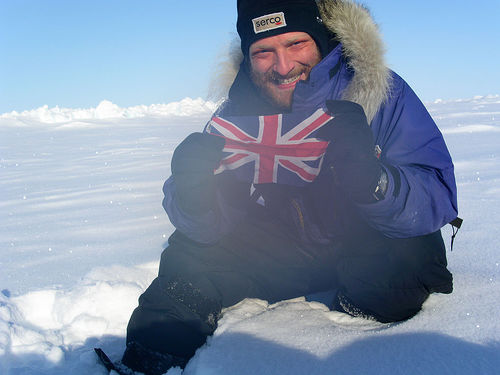
Ben Saunders sits on top of the world, the youngest person to reach the North Pole alone and by foot.
In 2004, 26-year-old Briton Ben Saunders became only the third person, and the youngest ever, to ski unaccompanied to the North Pole. As it turns out, there are a lot of ways that making a solo trek to the North Pole is a like moving to another country. Here are 11 things that the two adventures have in common, all taken from Saunder’s February 2005 TED Talk, “Why Did I Ski to the North Pole?”
Luggage is a drag
Saunders describes his specialty as “dragging heavy things around cold places.” He says, for his trip to the North Pole, “I was dragging all the food I needed, the supplies, the equipment, sleeping bag, one change of underwear—everything I needed for nearly three months.” That sounds like trying to put every necessary item in your carry-on bag, just in case your checked luggage gets lost. (If you think your bags are heavy, Saunder’s supply of food and fuel weighed 400 pounds.) Sometimes your destination has harsh conditions. And sometimes it doesn’t have chocolate chips. How many bags of those should you bring? Can’t be too prepared.
It can be lonely out there
One of the challenges of Saunder’s voyage was that he had to make it alone. Very alone. When he arrived at the northern-most point on the globe, he was the only “human being in an area one-and-a-half times the size of America, five-and-a-half thousand square miles.” Most of us don’t go to such remote places, but even if you’re in the biggest city, surrounded by millions of other souls, you can easily feel all by yourself.
No, Virginia, there isn’t a Santa Claus When Saunders got to the top of the world, he didn’t find Santa. No Santa’s workshop. No elves. In fact, he says, “There isn’t even a pole at the Pole. There’s nothing there, purely because it’s sea ice.” When you go to another country, expect the unexpected. Don’t be surprised when what you find doesn’t match the photos in the magazine article. “I’d read lots of books,” says Saunders. “I studied maps and charts. But I realized on the morning of day one that I had no idea exactly what I’d let myself in for.” Photoshopped and cropped pics don’t do us any favors. If GPS and street signs say we’re in the right place, don’t waste time—or emotions—trying to find something that doesn’t exist.
Sometimes it’s one step forward, two steps back According to NASA, during the year of Saunders journey, the ice conditions were the worst on record. Ninety percent of the time he was skiing into headwinds and the drifting ice pulled him backwards. “My record,” he says, “was minus 2.5 miles. I got up in the morning, took the tent down, skied north for seven-and-a-half hours, put the tent up, and I was two and a half miles further back than when I’d started. I literally couldn’t keep up with the drift of the ice.” When you’re in a new place, learning the language and culture, get used to those backward drifts. But always keep your compass set on your true north.
The only constant is change
Because the ice is constantly drifting over the North Pole, Saunders says that if he’d planted a flag there, it wouldn’t be long before it would be heading toward Canada or Greenland. Like Saunders, don’t be surprised when the emotional flags you plant aren’t permanent. The ground may not move under your feet (earthquakes not withstanding), but other kinds of landscapes certainly will. Find a special restaurant that serves your favorite dishes? Wake up the next day and it’s become a plumber’s shop. Make friends with some other expats? You may soon have to say goodbye. But, repeat after me, “Change can be good. Change can be good. Change can be good.” Maybe, just maybe, that plumber’s shop will end up being exactly what you need.
Culture stress can be a bear
Literally. On his first try at the North Pole, Saunders went with a partner, but they failed to reach their goal. Saunders says that from the outset “almost everything that could have gone wrong did go wrong. We were attacked by a polar bear on day two. I had frostbite in my left big toe. We started running very low on food. We were both pretty hungry, losing lots of weight.” Yup. Sounds like culture stress to me.
Coming back can feel like the bear wins When his first attempt fell short, Saunders says he “was physically exhausted, mentally an absolute wreck, considered myself a failure, in a huge amount of debt personally to this expedition, and lying on my mum’s sofa, day in day out, watching daytime TV.” His brother texted him an encouraging quotation from Homer Simpson: “You tried your hardest and failed miserably. The lesson is: don’t even try.” Repatriation can feel that way. Maybe all the people who’d said you shouldn’t go were right. But Saunders didn’t let his failure define him. Instead, three years later he made history.
People aren’t sitting around waiting to hear your stories
When Saunders reached the North Pole, he got out his satellite phone. After warming up the battery in his armpit, he made three calls: “I dialed my mum. I dialed my girlfriend. I dialed the CEO of my sponsor. And I got three voicemails.” OK, that’s unfair to say they didn’t want to hear what he’d done. They were just busy at the time, that’s all. But . . .
Some people really do want to listen “I finally got through to my mum,” says Saunders. “She was at the queue of the supermarket. She started crying. She asked me to call her back.” There are special people who will make time to listen—when they can focus on your story without distractions. Thanks, Mum.
Don’t let others draw boundaries on your map
When Saunders was 13, he got a school report that said, “Ben lacks sufficient impetus to achieve anything worthwhile.” Saunder’s response—”I think if I’ve learned anything, it’s this: that no one else is the authority on your potential. You’re the only person that decides how far you go and what you’re capable of.”
One of the three most important questions will always be “Where is the bathroom?” Saunders gave his TED Talk to answer three questions:
(1 ) Why?
(2) How do you go to the loo at minus 40?
(3) What’s next?
That second question is very important at the North Pole, because it seems that “at minus 40, exposed skin becomes frostbitten in less than a minute.” Your question number two will be more like “Where’s the bathroom?” or just “Bathroom? Bathroom?” Then, once you see the facilities, you may ask yourself, “How?”
As for the answers to those question, in short, Saunder’s responses go something like this:
(1) “For me,” says Saunders, “this is about exploring human limits, about exploring the limits of physiology, of psychology, and of technology. They’re the things that excite me. And it’s also about potential, on a personal level. This, for me, is a chance to explore the limits—really push the limits of my own potential, see how far they stretch.”
(2) That’s a trade secret, no answer here.
(3) Antarctica. Saunders and Tarka L’Herpiniere are currently on the first leg of their trek from the coast of Antarctica to the South Pole and back again—1,800 miles in all—unsupported and on foot. You can follow Saunder’s daily blog posts here. Why the South Pole? See answer number one above.
The logo for The Expat Survey 2013 is a hummingbird, “because just like human beings each one has its own migratory flight pattern.”
If you’re an expatriate, the Expat Survey wants to hear about your migrations, as well as your “remarkable diversity of habitats.”
The survey is made up of three parts, each rolled out separately, with the final section going live tomorrow (update: the third section went live November 27). All portions of the survey will remain available online until December 31.
The three sections are
Migration & Lifestyle
“[H]ave you found it easy to integrate, what do you like or dislike about your adopted home, has life changed considerably and how do you stay in touch with family, friends and the outside world?”
Retail & Finance “Whether you are working or not, what are your important considerations when it comes to personal or household expenditure, banking and investments; and what information resources do you now tend to turn to when making these decisions and future fiscal planning?”
Travel & Health
“Has your move to a warmer or colder climate changed your perspective of the world and the places and people you choose to visit; and what modes of transport do you use to get there? Do you enjoy a better diet and benefit from improved health and if you have had cause to call upon your local medical services were they sufficient?”
Besides having their voices heard, expats who fill out all three portions of the survey will be entered into a drawing for £1,000.
An independent London organization, i-World Research Limited, is conducting The Expat Survey, and it’s being promoted by 10 “collaborative partners.” One of those partners, Max Media International, calls the survey “the largest and most extensive independent global research programme ever conducted on those residing outside of their country of origin.”
Here’s another article from my son Peter. It’s about his time at the Summer Peace Institute in San José, Costa Rica, and also about his post-graduation plans. Peter spent nearly half his life overseas before graduating from high school, so another trip to another culture should have been a piece of cake, right? And heading back to Asia with the Peace Corps shouldn’t be a problem, either. Here, Peter shares about how it can be hard to cross cultures alone, even for a TCK.
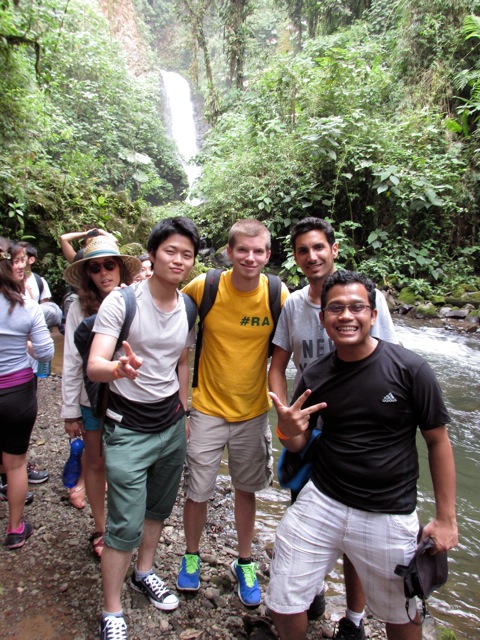
Peter (in yellow shirt) enjoys the Costa Rican outdoors with some of his friends in the Summer Peace Institute.
In 1999, my family and I left Joplin, Mo., for the other side of the world—Taipei, Taiwan. Before that, I’d never been outside the Midwest, let alone the United States.
If you are not familiar with Taiwan, it is a small tobacco-leaf-shaped island off the southeast coast of China, having about one-fifth the land area of Missouri with four times the population.
When we took our first trip to Taiwan, my parents were in the process of considering whether they wanted to become missionaries there. We spent two weeks traveling around the island, sightseeing and meeting Taiwanese friends who had once been international students at Pittsburg State University and at my father’s alma mater, the University of Missouri.
Two years later, my family and I left Joplin again for Taiwan. This time, I stayed for eight years.
After I graduated high school, I returned to Joplin to attend MSSU. I have enjoyed my time at this university more than any other time in my life, but now I am near the end. I will graduate this December with two bachelor’s degrees and, like many of you, still have no idea what I want to do next.
Well, I should not say, “No idea.”
Ever since returning from Taiwan, I have been fascinated by the world outside Joplin, outside Missouri, outside the US. I had tasted another culture—Taiwanese food is delicious, by the way—and I was ready to experience more.
When I heard about the Peace Corps, it sounded like a perfect fit. Started in 1958, the Peace Corps is a US government-run volunteer program that sends American citizens out into the world to learn about other cultures and serve the people of developing countries. Volunteers spend two year stints anywhere from Zambia to China to Peru to Jordan.
About six months ago, I submitted an application for the Peace Corps. Even before that, I had watched as two friends, fellow MSSU students and past McCaleb winners Luke and Caitlan Smith, were sent off by the Peace Corps to Rwanda.
By the time I left for Costa Rica, I was several months into the Peace Corps application process.
During the UPEACE-Berkeley program, I got to talk with two people who have experience with the Peace Corps: Dr. Jerry Sanders, a former Peace Corps volunteer [and co-founder of World Policy Journal and director of the Summer Peace Institute], and Manuel Davila, a former employee of the Honduran Peace Corps office. I asked them about their thoughts on the Peace Corps.
Sanders volunteered in Colombia in the 1970s and became disenchanted with the Peace Corps halfway through his two years there.
“I wasn’t any more satisfied with [the Peace Corps’s] policies—so-called development policies—than I was with the war in Vietnam,” he said.
Sanders felt the policies prevented efficiency. He encouraged me to go into the Peace Corps with a willingness to criticize the system.
Davila said the volunteers he met had great experiences, and he became friends with some of them. He told me the Peace Corps takes very good care of its volunteers.
I thought my time in Costa Rica would make me more excited for the Peace Corps. Instead, it made me realize how hard the Peace Corps would be. Though I had lived and traveled internationally, I had always done it with family or friends.
By the end of my first day in Costa Rica, I had already faced several difficulties.
My luggage was held up in Houston, Texas, so I lacked a change of clothes, toiletries, and even cleaning solution for my contacts. I was overwhelmed by 30 students whom I had never met before and who already seemed to know each other. I could not keep up the lectures on topics I had never studied. I could not speak Spanish. I did not know my way around town and got myself lost wandering home from the bus stop.
As I familiarized myself with my host town, learned a few Spanish phrases and befriended—and was befriended by—the other students, I felt more and more comfortable in Costa Rica.
Some of my favorite moments of the trip were whitewater rafting down the Pecuare River, learning how to say “God bless you” in Spanish, taking walks around my host town, visiting the Caribbean coast, trying new Costa Rican dishes, having intellectual and non-intellectual discussions with fellow students and watching soccer on television with my host family.
Nevertheless, being away from my family, my church community and my other close friends in Joplin was difficult throughout the trip.
While I truly enjoyed my time in Costa Rica, it did open my eyes to the realities of living overseas by myself.
In a Facebook message about the Peace Corps, Luke Smith writes, “The hardest part for me though has just been being away from my family. Diet and living conditions are a cake walk compared to not being able to see the people you love.”
Two weeks into this semester, I received a Peace Corps invitation to volunteer in Indonesia as a secondary English teacher, with a March starting date. I was given seven days to make my decision.
About an hour later, I decided to decline it. It feels like the coward’s move. But right now, I am not ready for the Peace Corps, and that is okay.
Now I am trying to figure out what is next. I will still graduate in December, and I still have no jobs waiting for me. Though I am not yet ready to live in Indonesia for two years, I am ready to explore more of the US, especially her big cities.
I do not plan to give up my aspirations of international studies. I know if I do move somewhere like Chicago or Philadelphia, I will meet people from other countries and cultural backgrounds, and that is exciting.
Maybe I will pursue a master’s degree in international relations. I am still very interested in cross-cultural issues. I follow global current events in my free time, and I try to pick up bits and pieces of other languages.
My thirst for cultural diversity will never be quenched. The Peace Corps may still be in my future, but I am not looking that far ahead. I am looking at what is next, one decision at a time.
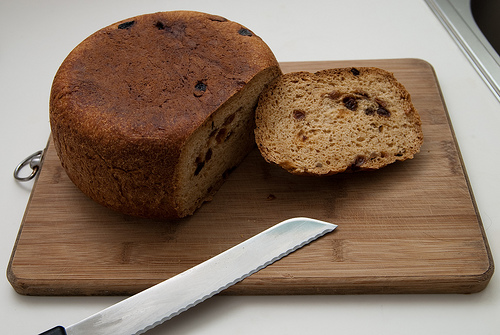
Yes, a loaf of bread can be baked in a rice cooker
So you need to make a cake or bake some bread, but you don’t have a full-size oven. How about using a roaster or a rice cooker instead?
It can be done. And while they may not be your top choices, in some countries, these small appliances may be your best options.
We used a roaster similar to this one while we were in Taipei.
The Roaster Oven In Taiwan, most meals are built around things cooked on top of a burner, rather than in the belly of an oven: There aren’t too many nationals cooking a pot roast or broiling steaks. The Taiwanese aren’t big on sweets, like us Americans, so there’s not a lot of cookie and pie baking either. With great bakeries scattered throughout most cities, there’s little need to whip up a cake on your own. And besides all that, the typical Taiwanese kitchen is pretty small, without room for any “extra” appliances.
Before we moved to Taiwan, we considered our options: Bringing over a Western-style range-oven combo and finding a place for it on a balcony of an apartment that we hadn’t found yet would have been troublesome. Besides that, the oven we had at the time wasn’t worth shipping over. Buying a used oven from another expat family who was leaving would have been unpredictable. And buying a new oven there would have been expensive. In the end, we decided on the roaster-oven option.
Turns out, it worked pretty well. In fact, my wife used ours nearly every day for four years—until it wore out and quit heating up. She used it for cakes, cheesecakes, cookies, pies, dinner rolls, casseroles, and, of course, several types of meat. Probably the trickiest project was an angel food cake, but she met even that challenge. (As I recall, the hardest part wasn’t the baking. It was finding something to invert the pan on, since we didn’t have any glass soda bottles.)
Mostly through trial and error, here are some things that she learned:
You’ll probably have to leave your food in the roaster longer than the recipe calls for. And lifting the lid to check on your progress releases a lot of heat and adds more time.
A small metal rack, or something else that lifts up the baking/cooking pan, will keep foods from burning on the bottom. If you don’t have a rack, you can use an upside-down cake pan.
If you can find a rack with legs, you can cook on two levels, with a pan above and one below.
It can be difficult to get large pans into and out of the roaster. There’s not a lot of wiggle room, so be extra careful not to burn your hands.
After our roaster gave out, some generous friends bought us a countertop convection oven. We brought it back from the States with our checked baggage, and it worked great for the rest of our time in Taipei. It wasn’t long before we saw a similar oven for sale in a shop near our neighborhood, so if we were to go back to Asia again, we’d probably plan on locating one there.
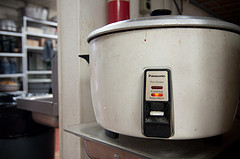
The Rice Cooker But what if a roaster oven is out of the question? What if your kitchen countertop space is all full? Or what if you don’t even have a kitchen? Don’t despair. A rice cooker can save the day. And if you’re in Asia, you certainly won’t have any trouble finding one to buy.
If you’d like to find recipes and how-to’s for baking with a rice cooker, just do a search on the Internet. You’ll see that it’s not a problem, as the even the simplest model can bake cakes, cheesecakes, and breads.
I’ve never baked with one myself, but here’s some bits of advice I’ve gathered from the sites I looked at:
Most recipes will work in a rice cooker without being modified, but you may need to cut back on the size. Cakes won’t cook evenly if they are too deep, and breads will work best if they’re no more than a few inches thick.
Bread will need to be flipped over several times during the baking process so that it won’t burn underneath.
If it takes more than one cooking cycle to complete a recipe, then let the cooker cool down and start it again. Another option is to wedge something under the switch to prevent it from flipping to “warm.” Be careful with this second method. You’re bypassing the cooker’s automatic shutoff, so it can get too hot if left unattended, and it might shorten the life of your cooker.
When it comes to choosing a rice cooker, Roger Ebert suggests, “Nothing Fancy.”
Of course, one way to make things easier is to buy a modern rice cooker with a “bake” or “cake” setting. (I didn’t know those existed until I started writing this.) But if you’re old school in your rice-cooker preferences, you’ll go with a more traditional style.
Roger Ebert, the Pulitzer Prize-winning movie critic, was one such devotee of the simple elegance of the basic “Pot.” In fact he was such a fan that he wrote a book dedicated to its multiple uses: The Pot and How to Use It: The Mystery and Romance of the Rice Cooker. In it he advises,
Have nothing to do with anything “Micom Programmable.” Nothing to do with words like “Neuro Fuzzy.” No dials or “settings.” Nothing fancy. You will only cost yourself money and mess things up. If a rice cooker comes with more than two pages of instructions, you’ve overspent. I am saving us money. What you want is your basic Pot with two speeds: Cook and Warm. Maybe it will say it in Japanese. You’ll figure it out.
Though Ebert doesn’t stray into the realm of baking, he does enthusiastically praise the rice cooker for its abilities in preparing such things as vegetables, stews, soups, sauces, and oatmeal.
And the Crockpot, Too
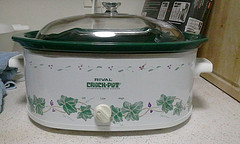
There are crockpots, and then there’s the Rival Crock-Pot®, “The Original Slow Cooker.”
I was about to finish up this post when I had a thought: I wonder if you can bake with a crockpot (slow cooker). Sure enough, you can do that, too.
I don’t have any experience with this—cooking or eating—but I can point you to a couple sites that give some details. The first one is from Better Homes and Gardens, entitled “Easy Slow Cooker Dessert Recipes.” There you’ll find directions on making cheesecake, pudding cake, brownies, and cobbler, along with the kind of almost-too-good-to-be-true photos you see in magazines like . . . well . . . Better Homes and Gardens.
The second is from Carroll Pellegrinelli at About.com—”Crockpot Baking: Making Breads and Desserts in the Slowcooker.” If you don’t have a slow cooker with a baking insert (again, who knew there was such a thing?), you can use a coffee can, paper towels, and aluminum foil. It’s not fast—it is a slow cooker—but, according to Pellegrinelli, it’s easy.
So . . . what else can you use a roaster oven, rice cooker, and crockpot for? Or what else can you use to bake a cake? Well, that’s up to you.
Experiment.
Try. Fail. Try again.
And remember these two important phrases: “Necessity is the mother of invention,” and “You don’t know how far you can go until you’ve gone too far.”
PS: It Ain’t Over Yet A friend, former coworker, and long-time missionary to Taiwan, Bev Skiles, commented below that she’s used a rice cooker for cakes and a crockpot for bread. Not only that, but she’s baked cakes in an electric skillet and in cookware on top of the stove. Want more info? Check out these two sites from eHow: “How Do I Bake Bread in an Electric Skillet?” and “How to Bake in an Electric Frying Pan.”
Thanks to Bev for her input. She’s been a great help to expats in Taiwan for many years, showing them how to adjust their Western recipes to Eastern kitchens and cupboards. She even helped helped put together a cookbook in 1981, “Tips ‘n’ Treats” on Taiwan. If I’d looked in my wife’s copy before I wrote this post, I would have seen several recipes for baking with a rice cooker. I should have consulted her as an expert.
(Roger Ebert, The Pot and How to Use It: The Mystery and Romance of the Rice Cooker, Kansas City, MO: Andrews McMeel, 2010)
In an increasingly globalized world, there are several ways to use multi-cultural experiences to help your children get a leg up as they move toward adulthood and future careers. Here are four of them.
None are easy, but the first may be the most difficult.
1. Be an Immigrant to the US
Sociologists at Johns Hopkins University, Lingxin Hao and Han S. Woo, found that children of immigrants in America achieve more academically and have better transitions into adulthood than their peers with native-born parents. The advantage is highest for foreign-born children whose parents move to the States, followed closely by American-born children of immigrants. Hao and Woo’s findings appear in the September/October 2012 issue of Child Development (“Distinct Trajectories in the Transition to Adulthood: Are Children of Immigrants Advantaged?“)
Explaining the difference,
Hao suggests that there is a greater sense of community among immigrants out of necessity—newcomers often need a lot of assistance when they first arrive in the United States. But Hao, who is from China, thinks there is also a great deal of inspiration to be found among the immigrant community: Parents might be working multiple low-level jobs and encourage their children to seek a better life for themselves. The success stories of immigrants who have “made it” are also held up as role models for immigrant children, something other native-born groups might be lacking, Hao said.
This one might go under the category of cultural lessons on what not to do.
Regardless of what Amy Chua writes in her book Battle Hymn of the Tiger Mother, “Chinese-style” tiger parenting is not the best model for raising children. This is according to researchers Su Yeong Kim, Yijie Wang, Diana Orozco-Lapray, Yishan Shen, and Mohammed Murtuza. They compared the developmental outcomes of children from 444 Chinese-American families in northern California, using eight parenting dimensions—”parental warmth,” “democratic parenting,” “parental monitoring,” “inductive reasoning,” “parental hostility,” “psychological control,” “punitive parenting,” and “shaming”—to categorize four parenting styles. In order, from the style that produces the best developmental outcomes to the least, they are “supporting,” “easygoing,” “tiger,” and “harsh.”
Compared with the supportive parenting profile, a tiger parenting profile was associated with lower GPA and educational attainment, as well as less of a sense of family obligation; it was also associated with more academic pressure, more depressive symptoms, and a greater sense of alienation. The current study suggests that, contrary to the common perception, tiger parenting is not the most typical parenting profile in Chinese American families, nor does it lead to optimal adjustment among Chinese American adolescents.
3. Make sure your children learn a foreign language
Bronwyn Fryer, a senior editor at the Harvard Business Review, trumpets the need for “soft skills,” things like “emotional intelligence,” “listening,” and “authenticity,” for global leaders. But, he writes, the top soft skill for executives in global organizations is “sensitivity to culture,” also known as “cultural empathy.” According to Frye,
True cultural empathy springs from personality, early nurturing, curiosity, and appreciation of diversity. But, very importantly, it also springs from deep exposure to more than one language. And this is where American executives fall short.
Learning another language, he says, not only helps in communication, but opens up one’s thinking:
As anyone who has ever learned to speak a foreign language fluently notices how each language shifts one’s consciousness. One day, you wake up and you realize you have been dreaming in the new language. Eventually you realize you are thinking in that language. And when you shift back and forth between, say, your native tongue and the acquired language, you feel like you are driving a car with a stick-shift; you are more involved and engaged in the experience. You take in more; you hear more. And you literally feel different; you are “more than yourself.”
4. Encourage your children to add overseas work experience to their educations
This one comes a little later in their lives, but they’re always your kids, right?
In 2010, Susan Adams, of Forbes, gathered the views of several hiring experts on the value of work experience overseas. She writes that foreign postings, including the Peace Corps, internships, and other types of jobs, give an advantage to people looking for work. One of the reasons is that living and working overseas exposes people to differing leadership styles.
And some who move overseas find opportunities for long-term employment there. Adams talked with Mary Anne Walsh, a global-leaders coach based in New York, and learned that Walsh’s clients “who moved overseas shortly after college and graduate school . . . advanced much more quickly than if they had tried to climb the career ladder in the U.S.”
Others had this to say:
Dan Black, Americas director of recruiting for Ernst & Young—
We definitely see overseas experience as an advantage. Our clients are demanding more of us these days. They want diversity of thought and diversity of values, and many of our clients are multinationals.
Gary Baker, U.S. global mobility leader for PricewaterhouseCoopers—
[Being part of a minority group in another country] gives you a greater respect for other cultures, and you learn to be better at managing teams that are diverse.
Not only does working overseas build character, writes Adams, but being successful in a foreign country also increases one’s confidence. “If you can make your way in Mexico City, Abuja or Sao Paulo, then traditional U.S. organizational issues will be a snap for you.”
One of my favorite cross-cultural stories comes from a former colleague in campus ministry at a university. He had taken a group of international students to tour the state capitol building, and when they arrived, they were surprised to see that a wedding was taking place on the capitol lawn. What an opportunity to see up close an American tradition in a beautiful setting.
How “up close”? Well, two students from Korea wanted to get some good pictures, and before my friend could stop them, they walked straight up to the wedding party and sat down in the audience. And of course, the row that had the most available seats was the one in the front, next to the bride’s mother and father. So they sat there through the ceremony, nearly front and center. Best of all was that when it was over, as the usher’s dismissed the crowd row by row, the students followed protocol and walked down the aisle behind the parents.
No word on whether they took a place in the receiving line.
 In the early 1970s, a Christian missionary school in Tokyo was looking for turkey for Christmas dinner. Finding none, a representative contacted the local Kentucky Fried Chicken and ordered chicken instead. A KFC employee suggested the company turn the request into an ad campaign, and Japan has never been the same since. Today, KFC’s Christmas Party Barrels are so popular that sales for December 23rd, 24th, and 25th usually equal half of what is sold during a normal month, and Christmastime customers wait in long lines to pick up their orders, placed as early as October. Very few in Japan celebrate Christmas for its religious meaning, as less than 2% of Japanese even call themselves Christian. Instead, consumerism is emphasized, and the focus is on gifts, decorations . . . and chicken from the Colonel.



 Clearing Customs