POYi, the Best Show-and-Tell of the Year

2847121492_6f780597fc_n
The bust of Donald W. Reynolds is displayed in the Reynolds Journalism Institute at MU.

Last week, Pictures of the Year International completed its slate of winners for 2013, marking its 70th annual competition. POYi, “the oldest and most prestigious photojournalism program in the world,” is sponsored by the Reynolds Journalism Institute at the University of Missouri School of Journalism.

Below is a list of 14 winning photo collections that offer a great show-and-tell of global and cross-cultural issues. There’s a lot here, but it’s still only a small part of this year’s entire POYi gallery. It’s well worth your time to settle down with a cup (or a pot) of coffee and click through all the winners, including the work of Paul Hansen, who was awarded Photographer of the Year honors in the newspaper division. Earlier in February, Hansen’s “Gaza Burial,” was named World Press Photo of the Year.

If, after looking at these photos, you’re inspired to try the challenging life of an international photojournalist yourself, watch the video at the end of this post. It’s Ed Kashi’s Photojournalisms, the third-place multimedia documentary winner. A companion to his book Witness #8: Photojournalisms, the short video was made from a compilation of Kashi’s photos and nearly 20 year of journal entries and emails addressed to his wife. “Home for me,” he writes, “has always been a shifting term, with shifting people and shifting objects vying for my attention.”

Here, in no particular order, are some of the people and objects that caught the attention of some very talented and dedicated photographers in 2012:

Life without Lights, Peter DiCampo
+++1.5 billion people around the globe don’t have access to electricity.

The Siege of Aleppo, Javier Manzano (includes graphic images of war)
+++The U.N. recently reported that nearly 70,000 have died in Syria’s civil war.

Beyond 7 Billion, Rick Loomis, et al.
+++“The biggest generation in history is just entering its childbearing years.”

North Korea—Collectivism, Vincent Yu
+++While the majority of North Koreans suffer, the government presents a “glossy” image to the world.

Water Is Personal, Brent Stirton
+++Drought, floods, and lack of clean water affect people all over the world.

A Long Walk, Shannon Jensen
+++These are the shoes of refugees who fled northern Sudan.

Paris Suburbs, Arnau Bach
+++Poverty and drug trafficking are prevalent in the neighborhoods surrounding Paris.

Dark Isolation, Tokyo, Salvi Danés Vernedas
+++“It is easy to find oneself isolated and alone among a crowd.”

Labor Movement, Alejandro Cargagena
+++From an overpass above a highway in Monterrey, Mexico, one can see laborers traveling to work in the open beds of pickup trucks.

Uncounted Casualties, Jay Janner
+++“They survived the battlefields of Iraq and Afghanistan. But they did not survive the homecoming.”

In the Devil’s Footsteps, Tyler Anderson
+++The people of Northern Uganda try to recover from the devastation left by Joseph Kony and his Lord’s Resistance Army.

Buzkashi, Casper Hedberg
+++North of Kabul, thousands gather to watch Afghanistan’s national sport in which men on horseback fight over an animal carcass.

Zone of Absolute Discomfort, Justin Jin
+++Few people live in the frozen tundra of the Russian Arctic.

Fukushima: Taking Back a Nuclear No-Man’s Land, James Whitlow Delano
+++Japan’s 2011 nuclear disaster left “a vast network of nuclear ghost towns” waiting to be reclaimed.

[photo: “Reynolds Statue, Reynolds Journalism Institute,” by moohappy, used under a Creative Commons license]

‘Tis the Season for International Photo Awards

2865183436_189dee1a69_mNot only is it the month for the Oscars, but February is also a busy time for selecting the prize winners in international photography. The judges have hard work wading through the thousands of photos, but we are the beneficiaries, as we get to browse through the best of the best.

Sony World Photography Awards
On the 6th of this month, the World Photography Organisation announced the shortlist winners for its 2013 Sony World Photography Awards. The finalists, in the professional, open, and youth categories, were selected from 122,000 entries representing 170 countries.

Lens Culture has a high-resolution slideshow of 45 of the shortlisted photos, or you can click through the galleries at the WPO site here. Final winners will be announced in April.

56th World Press Photo Contest
On February 15, World Press Photo announced the winner of its “Photo of the Year” for 2012. It is Paul Hansen’s “Gaza Burial,”  an image of men carrying the bodies of a young brother and sister to be buried after the two were killed by an Israeli missile strike.

Galleries containing all the winning photos, selected from the work of 5,666 photographers from 124 countries, are on display here.

Coinciding with the photo contest is World Press Photo’s third annual multimedia competition. The gallery of winners is here, including the following videos covering subjects outside the US (viewer discretion advised):

Into the Shadows, Pep Bonet, dir. (1st prize, Online Short)
Desperate Africans who migrate to Johannesburg face terrible circumstances.

Aleppo Battleground, Clément Saccomani, ed. dir. (3rd prize, Online Short)
A photojournalist joins the Free Syria Army at the front lines.

Too Young to Wed, Jessica Dimmock, dir. (1st prize, Online Feature)
Destaye was 11 when she married a priest in Ethiopia. Now 15, she has a 6-month-old son.

Dreams on FreewheelsYang Enze, dir. (3rd prize, Online Feature)
The seven members of the China Disabled Track Cycling Team train for the 2012 London Paralympic Games.
(This video not available for embedding.)

Pictures of the Year International
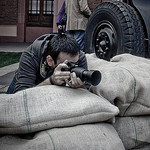
POYi started announcing their latest winners on February 5, with the final group announced today. I figured I’d wait until they were finished to start working my way through the results—it does take a while. And after I’m done, I plan to post again with links to some of their photos that tell stories from around the world.

[photo: “Flickr Photographers : Mauronster,” by Sergio Bertolini, used under a Creative Commons license]

Sorry You Weren’t the One to Buy “Afghan Girl”

My apologies.

It’s been more than two months since the National Geographic auction at Christie’s, and I need to set something right.

It’s quite likely that at least one of you, dear readers, saw my post about the sale of Steve McCurry’s Afghan Girl at auction, arrived at Christie’s on December 6 with only $12,000 in your pocket, and watched in horror as other bidders immediately left you behind . . . far behind . . . so far behind that you weren’t able to lift your paddle even once.

The pre-auction estimate that I quoted for McCurry’s iconic photo was indeed cited at $8,000 to $12,000 in October, but the estimate listed on Christie’s website, where the photo was displayed, was $30,000 to $50,000. Not that that would have helped a lot anyway, as the print’s winning bid came in at a whopping $178,900 (with the buyer’s premium added to the “hammer price”).

And Afghan Girl wasn’t the only item to bring in an enormous amount of money. N.C. Wyeth’s Duel on the Beach topped the sale at $1,082,500. The entire auction brought in $3,776,587.

I was wondering what would make a print of a photograph worth so much. The anonymous buyer didn’t get the original Kodachrome slide. He didn’t purchase future licensing rights. And he didn’t buy the last copy of the photo ever made.

I think I’ve figured it out, though. The print is signed, of course, and dated. But then comes the really special part. Next to the signature is the marking “1/1.”

That does it for me. Not 1 of 200 or 1 of 10 . . . but 1 of 1.

Afghan Girl truly is an iconic photo. Monica Hess of The Washington Post calls it “the photograph of photographs of photographs” and then describes “the ragged red scarf, the scissors-sharp green eyes, the hungry, hunted, haunted beauty.”

Ah, yes, the eyes.

If you’d like to get a better view of what $178,900 got for one bidder, do this: Go to this link—which will bring you a larger-than-life image of Christie’s “Sale 2603 / Lot 194″—and click on the zoom-in symbol a few times. Re-center the photo and look into those “scissors-sharp green eyes.”

Those eyes. Two of two.

(Monica Hess, “National Geographic’s Auction of Images Fetches $3.8 million,” The Washington Post, December 6, 2012)

[photo: “Steve McCurry: On the Outside Looking In,” by Steve Evans, used under a Creative Commons license]
Get Steve McCurry’s “Afghan Girl” for $8,000 or More, or How about Much, Much Less?

Most online introductions of Steve McCurry say something like “He’s the guy who took the photo of the Afghan girl.” Yes, his portrait of Sharbat Gula, a girl in a refugee camp, was featured on the cover of National Geographic in 1985—and became one of the most recognized photographs of all time. But it should also go without saying that McCurry has produced many, many more remarkable photos over his career. He continues to travel the world, capturing the images as they develop before him. As reported in the blog CNN Photos, his philosophy is “travel to a place, work with the locals, and see what emerges.”

If you’d like to own some of McCurry’s photos, including Afghan Girl, there are numerous ways to acquire them, covering a wide range of budgets—from really, really expensive to free. Just in time for Christmas, here are your pricing options, arranged for your convenience from highest to lowest:

$8,000 to $12,000 (estimate)
For the first time, the National Geographic Society is auctioning off some of its vast collection of 11.5 million photographs and illustrations. The sale will take place December 6, at Christie’s, and will include a special print of McCurry’s Afghan Girl. The 240 pieces offered are expected to bring a total of about $3 million, so don’t expect too many bargain-basement prices. (For an update on the auction, see “Sorry You Weren’t the One to Buy ‘Afghan Girl.’“)

Something less than $8,000, I presume
McCurry offers signed fine-art prints of his work at his website. A pdf catalog is available, but prices aren’t included. If you want to find out how much a print costs, you’ll need to contact a lady named Bonnie.

$65
Also available at McCurry’s site. At this price you can get a 20 x 24 inch poster of one of ten McCurry photos. Proceeds go to Imagine Asia.

$37.46
McCurry has just published a new book, titled Steve McCurry: The Iconic Photographs. It covers his best of the best (165 images) from the last 30 years. Amazon sells the standard hardback at the above price, but if you absolutely have to spend more, there’s the deluxe edition for $248.85 and a signed edition at Phaidon for $79.99.

Free
If you’re like me, then browsing the photos on the Internet will have to do for now. But it’s not a bad alternative. It certainly gives you the best selection. Several of the links above can get you started, but for the most images, go to the galleries at stevemccurry.com. Wow, he definitely has had some amazing things “emerge” in front of his lens.

Hear McCurry tell how he captured the photo Beggar Girl, Bombay, India:

(Elizabeth I. Johnson, “Curiosity Inspires Iconic Photographer,” CNN Photos; Ula Ilnytzky, “National Geographic to Auction Famous Photos, Art,” San Francisco Chronicle, October 23, 2012)

[top photo: “Steve McCurry Exhibit,” by Steve Evans, used under a Creative Commons license; Bottom photo: “Occhi che scrutano” (Eyes that stare), by Giuseppe Nicoloro, used under a Creative Commons license]
6 Sites for Great Global Photos

If you’re someone who likes good photography from around the world, here are six websites I’ve run across that will give you a daily or weekly fix. All are for your viewing enjoyment, and some are hoping for your contributions:

  1. National Geographic photo of the day
  2. National Geographic travel photo of the week
  3. Smithsonian Magazine photo of the day
  4. CNN travel photo of the day
  5. Condé Nast photo of the day
  6. Lonely Planet photo of the week contest

The accompanying photo is of the Empire State Building, named by Cornell University scientists the most photographed landmark in the most photographed city on earth. Number 2 on the list is London and Trafalgar Square, which, given the drawing power of the Olympics, is probably solidifying its position over San Francisco and Union Square, at number 3.

Go here for Budget Travel’s slideshow of the complete top-25 places, with tips on how to capture the best photographs of them.

[photo: “Sun Falls on New York City,” by Thomas Hawk, used under a Creative Commons license]
Two Books for Helping Us Picture the Kids of the World

When people miss home, they often say they wish they could be back in their own beds. Children, especially, find comfort underneath familiar covers. Of course, there is a great variety of beds, and bedrooms, around the world. That’s the theme of James Mollison’s Where Children Sleep (2010), “stories of diverse children around the world, told through portraits and pictures of their bedrooms.” It’s aimed a 9-13 year olds, but the photos of the bedrooms and portraits of the children are engaging for adults, as well. See for yourself at the author’s site, where you can view 27 of the photo/portrait pairs.

And another book that shows the diversity of children around the globe is Children of the World: How We Live, Learn, and Play in Poems, Drawings, and Photographs (2011). Authored by Anthony Asael and Stephanie Rabemiafara, founders of Art in All of Us, the book helps us “learn a little of the geography, traditions, and peoples of 192 countries around the globe—including our cultural similarities and differences—ultimately discovering that children everywhere draw, smile, play, and rejoice in their different backgrounds and in their universal friendship.” More information about Art in All of Us and a gallery of children’s artwork and photos is at the organization’s site.

[photo: “Portrait two boys – Sri Lanka,” by World Bank Photo Collection, used under a Creative Commons license]

Let Your Day Be Part of “A Day in the World”

Are your photos not good enough for Pictures of the Year? Well, how about Pictures of the Day? The folks at ADAY.org invite you to join them on May 15th to “photograph what our lives look like.” Their website says the project is for everyone, all around the world, using any kind of camera:

Professionals, amateurs, school children, farmers, social media fans, astronauts, office workers and you. Cell phone camera, Hasselblad, home made or borrowed. We are looking for the perspectives of everyone who enjoys photography!

The final product?

All images will be displayed online for you and everyone to explore. Some of them will be selected for a book, A Day In the World, others in digital exhibitions. Every single one will be saved for future research and inspiration.

Got to ADAY.org for instructions on how to participate. You’ll need to sign up and get details before the 15th, so you’ll want to get on board soon.

[photo: “The Photographer,” by Elvis Kennedy, used under a Creative Commons license]

Powerful Images from Pictures of the Year International

I never remember when the selections are made, but sometime each year I track down the POYi (Pictures of the Year International) website, set aside some time, and click my way through hundreds of outstanding photos from around the world. This year, I wasn’t too far off, as the awards for 2011 were handed out in February. The Winners’ Gallery is a front door to links for all the winning photos and collections. Or if you’d like a few side doors, below are just some of the collections that focus on global and cross-cultural topics.

And for those of you who figure that the Pulitzer Prize winners are the best of the best, they’re in the POYi collection, too. Just announced yesterday, the Pulitzer for Breaking News Photography went to Massoud Hossaini, for his heartbreaking photo “Kabul Bombing,” and the award for Feature Photography went to Craig F. Walker, for “Welcome Home: The Story of Scott Ostrom,” which tells the story of an Iraq war veteran with PTSD who has returned to the States.

There’s so much at POYi to see. Not only does it take a while to wander around the links and look at the photos, there’s plenty of descriptive text, and then sometimes you just have to take some time to let the images sink in. Powerful images. Poignant images. And sometimes shocking images (so viewer discretion is advised).

Here are those side doors:

[photo: “Behind the Enemy Lines,” by Mauricio Ulloa, used under a Creative Commons license]