The Top Baby Names of 2014: There’s Poetry in the Meanings

5317791293_7fc9b47ff6_zIn some languages, most names carry an understood meaning. For instance, the name of the president of Taiwan is Ma Ying-jeou, which literally means Horse Brave-nine.

While some given names in English have recognizable meanings (e.g., Hope, Pearl, Colt), for most, the definitions come from non-English origins and are long forgotten.

So when we look at the list of top-ten baby names for 2014, announced yesterday by the Social Security Administration, we don’t think much about the meanings behind them. We’re more inclined to think about their sounds or the feelings they evoke or maybe people we know of with the same names.

But the meanings are meaningful, so here’s the list from the SSA . . . with a twist. Instead of showing the names themselves, I’ve lined up those meanings.

The Boys’ names are first, then the girls’.

It’s rather poetic.

(If this reverese-look-up-style list leaves you in the dark, I’ve got the actual names and their languages of origin, too. Just use your cursor to highlight the list, and they’ll magically appear.)

Rest     Hebrew: Noah
Will and protection    Irish, Germanic: Liam
Stoneworker     French: Mason
Deceiver     Hebrew: Jacob
Desire and helmet     Germanic: William
Enduring     Hebrew: Ethan
Who is like God?     Hebrew: Michael
Defender of man     Greek: Alexander
Supplanter    Hebrew:  James
God’s judgment     Hebrew: Daniel

Universal     Germanic: Emma
Olive     Latin: Olivia
Wisdom     Greek: Sophia
God is her oath     Hebrew: Isabella
Giver of life     Hebrew: Ava
Rebellious     Hebrew: Mia
Rival     Latin: Emily
Father’s joy     Hebrew:Abigail
Child of God’s gift     English: Madison
Man     Germanic: Charlotte

(Doug Walker, “Two New Arrivals: Our New Blog and Top Ten Baby Names for 2014,” Social Security Matters, May 8, 2015)

[photo: “Baby N – 5 Days New,” by RebeccaVC1, used under a Creative Commons license]

Let’s Hear It for Mundaneness!

4524690685_6a89580df5_z

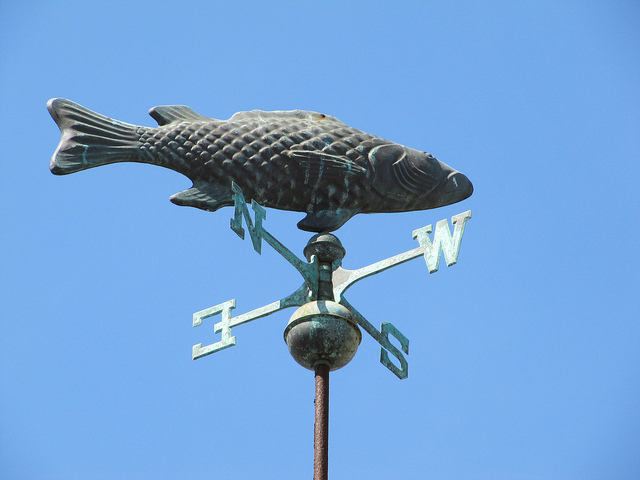
You’ve seen those images of all the fish swimming in one direction with one fish swimming agains the flow. The message: That one fish is the only one going the right way, despite the crowd.

It’s not always a lot of fun being that fish, especially when it seems as if you’re the one going in the wrong direction.

During what would become our last State-side service, I and my wife had decided that our time as missionaries would come to an end. But before making that public, I attended a missionary convention held by our fellowship of churches. I remember sitting with several thousand others in Lexington’s Rupp Arena, listening to a plenary speaker give a passionate call to the audience of potential missionaries. “Let someone else build the houses,” he said. “You follow Christ, go into ministry.”

Let someone else be a doctor or an attorney and argue cases in court. You go follow Christ. Let someone else teach in the public schools. You follow Christ. Listen, there will always be people who will go into all those other occupations. But there are a rare few who will say, “I’ll follow my Christ wherever he leads me.”

I’d said similar things, at least to myself. I should be on the front lines. Others would fill in behind. I’d told myself I could never settle for regular work. How could I ever be satisfied living a commonplace life in the US?

And yet, here I was traveling in the opposite direction, burned up and burned out. I was leaving the mission field, not heading to it. I was stepping away, hoping someone might hire me to build that house or teach that class. . . and in time, hoping just to get hired, for just about any job.

Five years ago, David Platt, mega-church pastor and now president of the Southern Baptist Convention’s International Mission Board, wrote Radical: Taking Back Your Faith from the American Dream. I have a copy on my bookshelf, but I’ve never read it. I’ve heard good things about Platt’s book, and I’m sure it’s challenging. But it’s not the kind of challenge I’m looking for right now. The book I chose to read instead has a different kind of title. It’s The God of the Mundane: Reflections on Ordinary Life for Ordinary People.

Pastor Matt B. Redmond wrote The God of the Mundane as a response to what he had heard himself preach many times:

Change your world. Change the world of someone. Anyone. Sell everything. Sell anything. Give it away. Do something crazy. Be radical. Make people stand up and notice. Take a risk. Jesus moved from heaven to earth and gave up his life and yet you—you just go about your daily life.

But in time, his ponderings, expressed in his blog, Echoes and Stars, led him to ask if there is a God for the bulk of people who live out their lives performing mundane tasks. “Is there a God, for instance, for those who are not changing anything but diapers?”

In his book, Redmond answers the question with a “Yes,” writing to and about stay-at-home moms, dental hygienists, plumbers, children taking care of elderly parents, and bankers. In a blog post, he addresses the youth of a church where he once ministered:

Don’t be afraid of being small. Too often I probably made it sound like if you were really serious about your faith, you should think about ministry. Being a teacher or doctor or farmer was not worthy of your time. Well, that’s just stupid. Don’t be afraid to be in a “small” part of the kingdom. Be ordinary and unknown and be content. That’s more radical than anything else you will hear in the church today.

When he wrote The God of the Mundane, one of the images in Redmond’s mind was of a banker, frustrated and stuck in a job he doesn’t love. After writing his book, he left his career in ministry and became that frustrated banker.

Before reading his book, I had left my position as a missionary and had become frustrated, too. So often in Christian circles, the missionary life is considered the opposite of mundaneness. Redmond refers to it that way, too. But he doesn’t believe that a mundane life, lived in devotion to God, is unimportant.

Neither does he believe that we should stop asking people if they are “willing to give it all and go overseas as a missionary.” “It’s not a bad question to ask,” he says. “There is no question in my mind that this question needs to be out there.” But he also wants other questions asked:

[A]re you willing to be numbered among the nameless believers in history who lived in obscurity? Do you have the courage to be forgotten by everyone but God and the heavenly host? Are you willing to be found only by God as faithful right where you are? Are you willing to have no one write a book about you and what you did in the name of Christ?

When someone studying for a non-missionary career asked him his advice on selecting a missionary biography, Redmond suggested she begin by reading one about a Christian banker.

By that I meant she needed to read a book about a Christian living a mundane life. She told me she could not find one. Figures.

I would characterize Redmond as someone who is trying to be content in his present occupation, but who is not satisfied. He struggles with wanting to do something that better fits who he is, but he doesn’t want to turn his back on those like him who are not doing the BIG THING. He admits that it’s often hard for him to accept his own advice with confidence.

I find myself in the same place. I miss so much of being a missionary and still want to be a part of that work and community. And yet I don’t believe that God loved me more, valued me more then than he does now.

I still have my copy of Radical. I plan to read it someday. Someday, but not today. Today I’m reading and rereading Redmond’s book.

Maybe he’s written the closest thing you’ll find to a biography about a “Christian banker.” But rather than writing about something he’d lived, he wrote it first and now he’s living it. And as he’s been writing in his blog, it’s the living of it that has given him a real understanding of his own words.

Life often works out that way. Figures.

(Barry Cameron, closing session, National Missionary Convention, Lexington, KY, November 21, 2010; Matt B. Redmond, The God of the Mundane: Reflections on Ordinary Life for Ordinary People, Kalos, 2012; Matt B. Redmond, “Tuesday’s 10: What I’d Like to Tell My Former Youth,” Echoes and Stars, August 13, 2012)

[photo: “Fish Vane,” by Mike Gifford, used under a Creative Commons license]
What Is a Bridge but a Paradox?

5078301307_31b7f7a46a_z

What do you see when you see a dock?

A place for studying the horizon?
For dipping a toe in the water?
For casting off?

Or a place for lowering your sails?
For stepping onto dry land?
For coming ashore?

Is it a place for setting out or coming back? Much depends on the compass of your heart.

If for you, the dock is too short, out of desire or necessity, you build it forward, step by step, plank by plank, as you go—through the spray and the mist and the fog. And when you’ve built till you’re more coming than going, you see another shore—build, step, build, step. You are there.

This is crossing cultures. This is creating a bridge. This is going from home to home.

Then, at some point, out of desire or necessity, you step back onto the bridge. You must have been gone a long time, because what was once a complete span is now incomplete. You need to build to close the gaps. And at times you’re simply on a dock again, building to a shore you cannot yet see. Strange. It was a bridge before.

This time while you’re crossing, you find that in the mist there are others with you, and when they talk, you understand them, because they are speaking your language.

“Where are you from?” you hear someone ask, and the answer, “That’s an interesting question.” “You, too?” one says. “Me, too,” another replies. You understand them, not because you use the same words, but because when you speak those words you agree on the impreciseness of their meanings: near, far, hot, cold, friends, enemies, rich, poor, family, strangers, here, there, hello, goodbye. Their meanings are slippery, like the damp boards beneath your feet. And the slipperiness is comfortable.

In time, you cross the bridge again and again, sharing familiar greetings with those in the misty middle. But never do you set out without having to repair what was built before. You continue . . . build, step, build, step.

What is a bridge, but a paradox, leading from home to home, from not-home to not-home? Your heart’s compass spins. The shores, they push and pull, they give hugs at arms length, they don’t plan on changing, but they do. The same can be said of you.

And then, out of desire or necessity, you settle down farther inland. You put down roots in loose soil. There’s a dock over the next, next hill. You go to visit from time to time and walk its length. You listen to the slap of the waves. You breathe in the smell of the ocean. You taste the salt in the air . . . and you remember the sounds and the smells and the bitter-sweet flavors of where you used to be.

What do you see when you see a dock?

You put down roots in loose soil, but you still speak the language of the bridge.


These thoughts are inspired by Mission Training International‘s “Pair of Ducks.” MTI uses two rubber ducks—a “yay duck” and a “yuck duck”—to show cross-cultural workers and their kids that all the places where they’ve lived have their good and bad parts.

[photo: “Harbour Bridge,” by D.Reichardt, used under a Creative Commons license]

Global Statistics: You Probably Don’t Know What You Don’t Know, You Know?

7658298768_e4c2c2635e_zFinals. In just a few short weeks comes that time of the school year when students sit down to tests that have the sole purpose of showing how much they know. Or as some would put it, the purpose of the tests is to show how much they don’t know. Gapminder’s “Ignorance Survey” fits into this second way of thinking.

Gapminder is a foundation that promotes a better understanding of statistics to aid in global development. It’s cofounder, and most visible spokesperson, is Hans Rosling, a Swedish medical doctor, statistician, and professor of global health. (To see Rosling and his statistics very much in action, go to “5 Stat Sites That Eat Pie Charts for Lunch.”)

If you’re not worried about finding out what you don’t know, click over to The Guardian‘s “Population Quiz: How Well Do You Know the World?” It’s an interactive collection of 9 questions from Gapminder’s “Ignorance Project,” covering such topics as life expectancy, education, and income.

After you’re done, come back and watch Hans Rosling and his son, Ola, explain in a TED Talk how our intuition has been hijacked—to the point where most people, including educators and the media, score worse on Rosling’s tests than if they’d picked the answers at random. Or as the Roslings put it, they do worse than chimps grabbing at bananas. “Only preconceived ideas can make us perform worse than random,” says the elder Rosling, at the “Ignorance Project” page.

At the end of their talk, they give four “practical tricks” for overcoming those preconceived ideas. But before you jump ahead, if you haven’t done it already, you really should try the “Population Quiz.” If you don’t know what you don’t know, you won’t know what you need to know.

(The “Population Quiz” will calculate your score, and if you don’t get 100% right, click on “Show Answers” at the bottom of the results page.)

(Hans Rosling, “Population Quiz: How Well Do You Know the World?” The Guardian, November 7, 2013)

[photo: “Confused,” by CollegeDegrees360, used under a Creative Commons license]

Food for the Soul, Just around the Corner

32175260_17a1662ace_o-2

I may have to stop reading Dave Lewis’s blog at Paracletos.org. Sure, it’s an amazing resource for gleaning insights from around the Web on member care and cross-cultural life, but it’s starting to get in the way of my originality. I’m particularly frustrated with his “Casual Friday Resources.” Lately, it seems as if when I come up with a new idea to write about, the same idea pops up on Casual Friday, and I see that others have thought my thoughts before me . . . often in more complete and coherent ways.

Take for instance, my last post on missionary expectations. Since I was focusing on Sue Eenigenburg and Robynn Bliss’s Expectations and Burnout: Women Surviving the Great Commission, I knew that what I had to say would more or less be a reworking of their research and observations. But I wanted to bring attention to the topic and their book, because, you know, not enough people are getting the word out.

As I was putting my thoughts together, Dave linked to a post by Bliss on the blog Velvet Ashes, “an online community of women serving overseas.” In “Burnout: A Retrospect,” Bliss writes, “Looking back on it now, I can honestly say that burnout is the best thing that ever happened to me.” That link inspired me. The folks at Velvet Ashes and I are thinking in the same direction.

But then, just yesterday, Dave linked to Velvet Ashes again, this time to an interview with Eenigenburg, the other author of Expectations and Burnout. Come to find out, Velvet Ashes is doing a two-month series on the book as they read through it one or two chapters at a time. Come on, guys! What am I going to do?

All joking aside, here is what I’m going to do.

Many times I’ve heard variations on the well-known words of D. T. Niles, a Methodist evangelist from Ceylon, who wrote,

Evangelism is witness. It is one beggar telling another beggar where to get food. The Christian does not offer out of his bounty. He has no bounty. He is simply a guest at his Master’s table, and, as evangelist, he calls others, too.

I figure it’s much the same with promoting member care. I’m just a beggar letting other beggars know that food is out there for hungry souls. So head on over to Paracletos.org and Velvet Ashes. There’s some great feasting going on at each of these. And as I find more resources, I’ll continue to let you know about them, joining others who are doing the same.

And as far as originality goes, there can be all sorts of room for creativity in how we point others in the right direction.


(Robynn Bliss, “Burnout: A Retrospect,” Velvet Ashes, March 8, 2015; D. T. Niles, That They May Have Life, Harper, 1951)

[photo: “EAT,” by mst7022, used under a Creative Commons license]

Missionaries, Don’t Let Your Expectations Weigh You Down

2186726069_711fd402f4_z

Remember the good old days when you could pack 70 pounds into each of your two checked bags on international flights? That meant that when our family of six moved overseas as missionaries, we could take 840 pounds of clothes, books, sheets, cake mixes, and the like. And we used just about every ounce of it.

It could be argued that we didn’t need to take that much with us, but we’re Americans, after all, and we Americans don’t often pack light. I’ve traveled with people from other countries, and even on short trips, I invariably seem to end up lugging the largest pieces of luggage. What if there’s a pool nearby? Better bring swimming trunks, and a towel. What if it snows? What if I spill something on my Friday jeans? What if I need work shoes? What if somebody throws a formal party?

There’s also another set of luggage that missionaries tend to overpack. It’s the bags that hold our assumptions, our plans . . . our expectations.

A few years ago, Sue Eenigenburg and Robynn Bliss surveyed 323 female missionaries on how their expectations corresponded to reality on the mission field. The results form the backbone of their excellent book Expectations and Burnout: Women Surviving the Great Commission. What they found is that our pre-field predictions often don’t measure up to our on-field experiences. (I say “our” because though the book is written for and about women, most of its insights and lessons easily apply to both sexes.)

The authors gave the women a list of 34 expectations, and asked them to rate each one on the degree to which it applied to them. Then the respondents went back and evaluated the list against what actually came to be in their lives as missionaries.

In 14 of the areas, the women reported that their expectations exceeded what they found in real life. The 10 with the highest percentage of expectations greater than reality include some very deep, personal issues:

75.4% Am fruitful
70.4% Am a prayer warrior
67.6% Am growing spiritually continually
62.7% Am spiritually dynamic
65.8% Continually trust God for everything
57.5% Have a daily quiet time
56.5% Have a successful quiet time
56% Am well balanced in areas of ministry in and out of home
55.1% Have miraculous stories to tell of how God is using me
50.9% Embrace my new host culture

The disconnect between expectations and reality often leads to disappointment and guilt. And as the authors point out, this can lead to burnout. It is difficult to move steadily forward when we are dragged down by the weight of our overpacked luggage.

So how can we pack less? How can we lighten our load? Here are some suggestions.

  •  Read fewer biographies, read more people.
    Stories about missionaries can be very inspirational, but when inspiration is the main goal, they can often leave out the flaws and shortcomings. When we assume that real missionaries are superhuman, then we are discouraged when we don’t measure up. That’s why we need to have honest conversations to find out the good and the bad, the easy and the hard. But not everyone will give you the unvarnished truth. It usually takes time to earn someone’s trust. And you’ll need to ask questions that get people rethinking their responses, to speak beyond the safe and familiar answers. Try asking a missionary, “What do you wish you’d known before you moved overseas?” “What have you learned?” “What would you tell yourself as a younger missionary candidate if you could?” “What are some of your unmet expectations?” (For other examples, see the questions asked of missionaries in Eenigenburg and Bliss’s survey, printed in the appendix of their book.)
  • And when you read, read between and outside the lines.
    As Eenigenburg and Bliss discuss, too many books on the lives of past missionaries paint a picture of spiritual perfection. One of the best-known missionary legacies is that of William Carey, who is often called “the father of modern missions.” In 1792, a sermon he delivered gave us the words, “Expect great things; attempt great things.” But I doubt that all of his expectations were met in his later life as a missionary in India, during which a five-year-old son died, his wife, Dorothy, went insane and died, and another son, after becoming a missionary himself, suffered tragedy and walked away from God. In Expectations and Burnout, the authors report that James R. Beck, in his book Dorothy Carey: The Tragic and Untold Story of Mrs. William Carey, writes that Carey has often been portrayed as “never discouraged and never complaining.” But Carey wrote in his journal, “I don’t love to be always complaining—yet I always complain.” The context for “Expect great things; attempt great things” is the life and work of Carey, not a Pinterest board or a poster of a snow-capped mountain range. But just as some books—and missionaries—are only completely positive, some are entirely negative. Be cautious in drawing conclusions based on either side. When you hear what sounds like cynicism and despair, be slow to judge. Context is important here, too. Find out the whole story. And don’t say, “That will never happen to me . . . not with my faith, my preparation, and my plans.”
  • Remember that short stories can be good literature, too.
    Before packing your bags, talk to those missionaries who have failed and come home early. I say “failed” only to grab your attention. I don’t really count those missionaries as failures. Instead, I understand that most are people who have struggled with some great disappointments and have made the extremely difficult decision to return. What can they teach you about packing? Know that “ex missionaries” who left under less-than-ideal situations often fade into the woodwork and aren’t often sought out for their expertise. But they just may be the ones with the most to offer.
  • Don’t book a ride on the magic plane.
    A ride on the magic plane is the one in which you fall asleep half way across the ocean and wake up “A Missionary,” with all the super powers that that entails. You may arrive at your destination with increased confidence, but you’ll still be the same person who stepped onto the plane. You’ll still need to deal with the same issues and weaknesses that vexed you back home. In fact, you’ll probably see your struggles increase in the crucible of cross-cultural service. Simply taking on the title missionary doesn’t change who you are on the inside, in the same way it didn’t change those missionaries you’ve idolized in the past, or those teammates you’re traveling to join.
  • Pack your own bags.
    Here’s another throwback to days gone by. Before 9/11 and TSA protocols, ticket agents would ask, “Did you pack your bags yourself?” That question isn’t asked much anymore, but it’s an important one for missionaries. Yes, getting input from those who have gone before is important, but the luggage holding your expectations needs to be filled by you, not by your sending agency, supporting churches, supervisors, teammates, or even other members of your missionary family. Get clarity on other’s expectations and work out disagreements before disillusionment is allowed to set in. And don’t set yourself up for failure in their eyes by over predicting the positives in order to gain support—or to convince yourself. Sometimes you’ll find that others’ assumptions are unreasonable and need to be corrected. Sometimes you’ll find that you’re trying to please voices that exist nowhere except in your own head.

Before you set out for the mission field, prepare thoroughly and pack carefully. When it comes to packing your expectations, it isn’t just about seeing how much you can get into a suitcase and still get the zipper closed. It’s also about being discerning and knowing what to leave behind.

But you don’t want to go empty-handed, either. Hopes, dreams, and plans are important. Don’t forget your underwear and socks. And if you’ve got room, you might want to take that swimsuit, too. Just in case.

(Sue Eenigenburg and Robynn Bliss, Expectations and Burnout: Women Surviving the Great Commission, William Carey, 2010; “Expect Great Things; Attempt Great Things,” Center for Study of the Life and Work of William Carey, D. D. [1761-1834], updated November 22, 2013)

[photo: “Suitcases,” by Tom Godber, used under a Creative Commons license]

It Can Rain on My Parade

6677854125_b6671e2b79_z

Is rain a good or bad thing? It depends, you’d probably say, on what you’re doing at the time.

But when we hear “The rain falls on the just and the unjust,” we usually interpret it as “Bad things happen to good and bad people.”

I don’t think that’s what Jesus meant when he said, in the Sermon on the Mount,

You have heard that it was said, “Love your neighbor and hate your enemy.” But I tell you, love your enemies and pray for those who persecute you, that you may be children of your Father in heaven. He causes his sun to rise on the evil and the good, and sends rain on the righteous and the unrighteous. (Matthew 5:43-45 NIV)

In context, Jesus is talking about how we should give something good (love) to bad people, in the same way God gives the sunshine and rain to them. There certainly are places in the Bible that talk about bad things happening to good people, but I don’t think this is one of them.

E. Randolph Richards and Brandon J. O’Brien, in Misreading Scripture with Western Eyes, point out that we often miss the meaning of Bible passages when we don’t see from the point of view of the authors and audiences of Bible times. (I’ve written about that here.) This seems to be one of those passages.

In our modern American culture, we often pray for nice, sunny days. We want good weather for an outdoor wedding, for a trip to the lake, or for a long drive. And by good weather, we usually mean the absence of rain—and warm, but not too warm, temperatures are great, too.

If all of our prayers were answered, we’d probably have the longest drought in history. Of course, then our attitude would change and we’d think of rain as a blessing. That’s the way farmers most often see it. Of course, an ill-timed rain can keep them out of the fields, and over saturation and flooding can ruin a harvest. But it’s the lack of rain that causes the most problems.

Last year, the UN reported that the majority of the world’s population, 54%, now live in urban areas. According to the World Health Organization, 55 years ago, the urban population accounted for just 34% of the total. Two thousand years ago, that percentage was much less.

In Jesus’ day, the people had a direct tie to the land and the goods that it produced. Think of all the agricultural metaphors Jesus used to get his message across. But today, living and working in air-conditioned buildings with drinkable water only a faucet handle away, much of my thinking about rain centers around my walk to and from the car.

I try to pray less about the weather than I used to. Rather, I want to pray that I will be able to make the best of my day regardless of whether it rains or not. I realize that God is not going to tailor every weather pattern to my scheduled activities, in part because my wishes for that day may be just the opposite of what others want or need. As C. S. Lewis puts it, my downhill could be someone else’s uphill:

Yet again, if the fixed nature of matter prevents it from being always, and in all its dispositions, equally agreeable even to a single soul, much less is it possible for the matter of the universe at any moment to be distributed so that it is equally convenient and pleasurable to each member of a society. If a man travelling in one direction is having a journey down hill, a man going in the opposite direction must be going up hill. If even a pebble lies where I want it to lie, it cannot, except by a coincidence, be where you want it to lie. And this is very far from being an evil: on the contrary, it furnishes occasion for all those acts of courtesy, respect, and unselfishness by which love and good humour and modesty express themselves.

Yes, I pray fervently when tornados touch down or typhoons threaten or droughts bring about famine. But I pray less for weather variations simply to enhance my day. Actually, let me restate that first part: I pray fervently when severe weather threatens me, but my sporadic prayers are less than fervent when it comes to famine or flooding half a world away.

We all need to pray less for our corners of the world and more for the huge swaths of people who face disastrous weather each day. We need to pray that those of us with much will help those with little who are at the mercy of the elements. We need to pray that our down-hill walk does not cause someone else a more difficult journey. We need to pray less for our will and more for God’s will to be done, “on earth as it is in heaven.”

(“World’s Population Increasingly Urban with More than Half Living in Urban Areas,” United Nations, July 10, 2014; “Global Health Observatory (GHO) Data: Urban Population Growth,” World Health Organization; C. S. Lewis, The Problem of Pain, Centenary Press, 1940)

[photo: “Face à Face,” by D. Julien, used under a Creative Commons license]

Three Ads: Pretentious Pronunciations, a Never-Before-Seen Oz, and a Lying Dad (get a Kleenex for the last one)

6088059547_f927b9db32_zI don’t have much of an intro for this—just that I saw these three commercials on Adweek, and I like them.

The first one gives us the “correct” pronunciations of some brand names—many are foreign, and expensive. I sometimes pronounce Adidas as “Ah-dee-dahs” just as a joke, because it rhymes with la dee das and sounds so highfalutin. Didn’t know how cultured I am. After hearing several of the “right” pronunciations, my eight year old said, “Yeah, I think people are going to stick with the old ones.”

The next one is an extended commercial that gives the back story for Comcast’s XFINITY, a system that lets blind people select their own movies. Watching this is a step beyond seeing the world through other’s eyes—especially since that world is Oz.

And this last one is from MetLife Hong Kong. Made me cry . . . each of the four times I’ve watched it so far.

[photo: “Old Philips TV,” by King-of-Herrings, used under a Creative Commons license]