11 Ways Moving Abroad Is like Skiing to the North Pole

34961051_5302f8458a
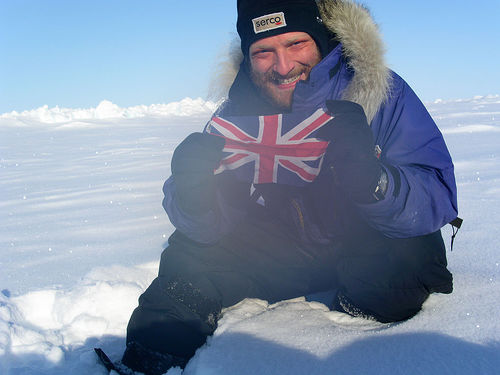
Ben Saunders sits on top of the world, the youngest person to reach the North Pole alone and by foot.

In 2004, 26-year-old Briton Ben Saunders became only the third person, and the youngest ever, to ski unaccompanied to the North Pole. As it turns out, there are a lot of ways that making a solo trek to the North Pole is a like moving to another country. Here are 11 things that the two adventures have in common, all taken from Saunder’s February 2005 TED Talk, “Why Did I Ski to the North Pole?”

  1. Luggage is a drag
    Saunders describes his specialty as “dragging heavy things around cold places.” He says, for his trip to the North Pole, “I was dragging all the food I needed, the supplies, the equipment, sleeping bag, one change of underwear—everything I needed for nearly three months.” That sounds like trying to put every necessary item in your carry-on bag, just in case your checked luggage gets lost. (If you think your bags are heavy, Saunder’s supply of food and fuel weighed 400 pounds.) Sometimes your destination has harsh conditions. And sometimes it doesn’t have chocolate chips. How many bags of those should you bring? Can’t be too prepared.
  2. It can be lonely out there
    One of the challenges of Saunder’s voyage was that he had to make it alone. Very alone. When he arrived at the northern-most point on the globe, he was the only “human being in an area one-and-a-half times the size of America, five-and-a-half thousand square miles.” Most of us don’t go to such remote places, but even if you’re in the biggest city, surrounded by millions of other souls, you can easily feel all by yourself.
  3. No, Virginia, there isn’t a Santa Claus
    When Saunders got to the top of the world, he didn’t find Santa. No Santa’s workshop. No elves. In fact, he says, “There isn’t even a pole at the Pole. There’s nothing there, purely because it’s sea ice.” When you go to another country, expect the unexpected. Don’t be surprised when what you find doesn’t match the photos in the magazine article. “I’d read lots of books,” says Saunders. “I studied maps and charts. But I realized on the morning of day one that I had no idea exactly what I’d let myself in for.” Photoshopped and cropped pics don’t do us any favors. If GPS and street signs say we’re in the right place, don’t waste time—or emotions—trying to find something that doesn’t exist.
  4. Sometimes it’s one step forward, two steps back
    According to NASA, during the year of Saunders journey, the ice conditions were the worst on record. Ninety percent of the time he was skiing into headwinds and the drifting ice pulled him backwards. “My record,” he says, “was minus 2.5 miles. I got up in the morning, took the tent down, skied north for seven-and-a-half hours, put the tent up, and I was two and a half miles further back than when I’d started. I literally couldn’t keep up with the drift of the ice.” When you’re in a new place, learning the language and culture, get used to those backward drifts. But always keep your compass set on your true north.
  5. The only constant is change
    Because the ice is constantly drifting over the North Pole, Saunders says that if he’d planted a flag there, it wouldn’t be long before it would be heading toward Canada or Greenland. Like Saunders, don’t be surprised when the emotional flags you plant aren’t permanent. The ground may not move under your feet (earthquakes not withstanding), but other kinds of landscapes certainly will. Find a special restaurant that serves your favorite dishes? Wake up the next day and it’s become a plumber’s shop. Make friends with some other expats? You may soon have to say goodbye. But, repeat after me, “Change can be good. Change can be good. Change can be good.” Maybe, just maybe, that plumber’s shop will end up being exactly what you need.
  6. Culture stress can be a bear
    Literally. On his first try at the North Pole, Saunders went with a partner, but they failed to reach their goal. Saunders says that from the outset “almost everything that could have gone wrong did go wrong. We were attacked by a polar bear on day two. I had frostbite in my left big toe. We started running very low on food. We were both pretty hungry, losing lots of weight.” Yup. Sounds like culture stress to me.
  7. Coming back can feel like the bear wins
    When his first attempt fell short, Saunders says he “was physically exhausted, mentally an absolute wreck, considered myself a failure, in a huge amount of debt personally to this expedition, and lying on my mum’s sofa, day in day out, watching daytime TV.” His brother texted him an encouraging quotation from Homer Simpson:
    “You tried your hardest and failed miserably. The lesson is: don’t even try.” Repatriation can feel that way. Maybe all the people who’d said you shouldn’t go were right. But Saunders didn’t let his failure define him. Instead, three years later he made history.
  8. People aren’t sitting around waiting to hear your stories
    When Saunders reached the North Pole, he got out his satellite phone. After warming up the battery in his armpit, he made three calls: “I dialed my mum. I dialed my girlfriend. I dialed the CEO of my sponsor. And I got three voicemails.” OK, that’s unfair to say they didn’t want to hear what he’d done. They were just busy at the time, that’s all. But . . .
  9. Some people really do want to listen
    “I finally got through to my mum,” says Saunders. “She was at the queue of the supermarket. She started crying. She asked me to call her back.” There are special people who will make time to listen—when they can focus on your story without distractions. Thanks, Mum.
  10. Don’t let others draw boundaries on your map
    When Saunders was 13, he got a school report that said, “Ben lacks sufficient impetus to achieve anything worthwhile.” Saunder’s response—”I think if I’ve learned anything, it’s this: that no one else is the authority on your potential. You’re the only person that decides how far you go and what you’re capable of.”
  11.  One of the three most important questions will always be “Where is the bathroom?”
    Saunders gave his TED Talk to answer three questions:
    (1 ) Why?
    (2) How do you go to the loo at minus 40?
    (3) What’s next?
    That second question is very important at the North Pole, because it seems that “at minus 40, exposed skin becomes frostbitten in less than a minute.” Your question number two will be more like “Where’s the bathroom?” or just “Bathroom? Bathroom?” Then, once you see the facilities, you may ask yourself, “How?”

As for the answers to those question, in short, Saunder’s responses go something like this:

(1) “For me,” says Saunders, “this is about exploring human limits, about exploring the limits of physiology, of psychology, and of technology. They’re the things that excite me. And it’s also about potential, on a personal level. This, for me, is a chance to explore the limits—really push the limits of my own potential, see how far they stretch.”
(2) That’s a trade secret, no answer here.
(3) Antarctica. Saunders and Tarka L’Herpiniere are currently on the first leg of their trek from the coast of Antarctica to the South Pole and back again—1,800 miles in all—unsupported and on foot. You can follow Saunder’s daily blog posts here. Why the South Pole? See answer number one above.

Somebody’s got a severe case of wanderlust.

[photo: “North Pole (3),” by Ben Saunders, used under a Creative Commons license]

Farewell to “The Story,” with Listening Lessons from Mr. Gordon and Some Maasai Visitors

OLYMPUS DIGITAL CAMERA

On October 11, Dick Gordon recorded his last episode of The Story. He’s moving back to Canada to be closer to family, and so ends the radio show’s 8-year run.

As I’ve written before, I’m a big fan of Gordon’s interviewing and listening skills, and I’ll miss catching his new installments from time to time.

After his last segment, Gordon recorded about 4 minutes on his philosophy of getting people to share their stories. The piece is entitled “Goodbye.” In it he talks about listening with patience:

There is a natural pause after the first part of an answer to a question. I ask you what it was like going for a walk with your grandfather, and you say, “It was nice. Not too cold. We had a good talk.” And if I wait, and if I don’t feel like I have to fill that pause and jump in with something else, that’s when you’re most likely to say, “He told me this story that I’d never heard before.”

“So that’s my conclusion,” he says, “after more than 36 years of talking on the radio, that the best thing I can do is not talk but listen. That’s when you hear the best stories.”

In another short audio post for The Story, this one from December 11 of last year, radio producer Marika Partridge talks about what she learned from a group of Maasai performers. As a child, she had spent a month camping with her family among the Maasai on the plains of Kenya. Years later, she was asked to interrupt her harried routine and host a group of Maasai singers and dancers coming to her home town of Takoma Park, Maryland. She consented and was glad she did. The experience broke through the busyness of her daily life and taught her about “conversation and caring”:

“Our way of life is really very strong on adhering to the word of mouth,” says the leader of the performing group. “When we speak to one another, we say we feed each other. We nourish each other spiritually.”

In “Saying Yes to Visitors,” Partridge shares the new perspective she gained:

Do I connect with the people I meet every day? Most of the time, other people seem like stumbling blocks, preventing me from getting to my next appointment. If I slowed things down and connected in this Maasai way maybe I could rediscover how to experience humanity as more than a series of interruptions.

Goodbye to The Story.

Goodbye Mr. Gordon. Enjoy your long conversations with family and friends—old and new—in Canada.

The Story is dead. Long live the stories.

[photo: “Listen,” by Jay Morrison, used under a Creative Commons license]

Air Safety: The Musical, the Comedy, and the Reality Show

Several airlines have decided that typical, stodgy air safety videos aren’t getting the job done, so they’ve gone to great lengths to punch them up with some flair and pinache. And some of those airlines are upping the ante by making their creativity a trend.

I’ve already written about six previous attention-grabbing videos, and here’s a look at three more—the newest offerings from Virgin America and Air New Zealand:

  • Virgin America Safety Video
    A music/dance video featuring past contestants from American Idol and So You Think You Can Dance (with a couple contortionists, too), it’s directed by John M. Chu, the director of Step Up 2, Step Up 3, and Justin Beiber’s  Never Say Never. Future inflight-dancer wannabes can Instagram their best moves with #VXsafetydance to audition for a sequel.
  • Safety Old School Style
    Air New Zealand’s latest offering stars Betty White and Gavin MacLeod (of The Love Boatlook here if you’re too young to remember). It’s set at the “Second Wind Retirement Resort” and has lots of one-liners and sight gags poking fun at the senior-citizen set.
  • The Bear Essentials of Safety
    Man vs. Wild‘s Bear Grylls takes this Air New Zealand video to the great outdoors—New Zealand’s Routeburn Track, to be exact. Take a look if you’d like to see what exit-row lighting would look like if the plane were a cave and glow worms lit the way.

I think it’s time that someone started a set of awards for all these videos. We have the Emmies. We have the Razzies. How about the Safeties?

(Frances Cha, “Step Up’ Meets Robot Dancers in Virgin America’s New Over-the-Top Safety Video,” CNN, October 30, 2013)

Fair Trade: This Christmas, Give a Gift That Comes with a Story

4947581304_acf10471ff
A handmade nativity set from Ten Thousand Villages is an example of fair-trade gifts available online.

Tasha Simons tells about meeting Tavi, cofounder—along with Center for Global Impact—of byTavi, a “faith-based micro-enterprise initiative . . . [that] teaches at-risk, impoverished women how to sew handbags and other accessories”:

She shared her heart, telling me how she lost both her husband and daughter to AIDS and how Center for Global Impact (CGI) had helped her learn a skill. Now with the income from making purses, she could send each of her kids to school and purchase needed medicine to help her stay well as she also has AIDS. Tavi also shared about the pride she has in her home. She was able to replace her mud floor with a cement one, which significantly improved her living conditions. When we finished talking, she asked: “Will you be my sister?”

Along with Tavi, there are currently over 40 Cambodian women in the byTavi workshop. Another one of them is Sreymao, who serves as a manager and designer. One of her creations is the “Wave Bag,” a large multi-purpose bag with four slip pockets hidden in a colorful wave design.

I learned about byTavi last week when I spent a day at the International Conference on Missions (ICOM) in Kansas City and got to see some of their products firsthand. It is certainly not the largest organization selling “fair-trade” gifts and crafts online, but it’s on my list of online retailers with which I’ve had some sort of personal connection. Maybe you’ll see something you like, or maybe you’ll be spurred on to look for other outlets. (If you want something much more extensive—and maybe a little overwhelming—try the Fair Trade Federation’s searchable online shopping site.)

So here you go, four sources for gifts with stories:

  • byTavi
    Besides the Wave Bag, byTavi also sells handcrafted elephant coin purses, scarves, totes, and quite a bit more. You can even see photos of the Cambodian seamstresses—and read about many of them—at their site.
  • Rapha House’s Freedom Store
    Rapha House International is a ministry that fights child trafficking and sexual exploitation by, among other things, providing safehouses for girls in southeast Asia and by helping them move beyond residential care through emotional support and vocational training. Rapha House’s first safehouse was established in Cambodia, and their home office is located in Joplin, Missouri (where I live). Their Freedom Store includes such items as bracelets, cosmetic bags, and backpacks.
  • Saffron Coffee
    The Saffron Coffee Company sells “100% shade grown organic Arabica coffee” from the mountains of northern Laos and processed outside the city of Luang Prabang. It was started by a friend of mine and his Laotian wife (whom I just met at ICOM) to give hilltribe farmers a sustainable cash crop, replacing the opium poppies that they used to grow. The company sells bags of several types of coffee—ground and as beans—as well as green coffee beans by the pound.
  • Ten Thousand Villages
    OK, this is one of the largest fair-trade organizations.. But I’d never heard about it until I read that a group of college students and academic and business leaders in nearby (to me) Pittsburg, Kansas, had opened up a store selling their wares from around the globe. Started in 1946, Ten Thousand Villages offers a wide variety of  “unique handmade gifts, jewelry, home decor, art and sculpture, textiles, serveware and personal accessories,” fashioned by “disadvantaged artisans” in 38 countries. (Info about these artisans is included throughout their Website.) They even have a clearance section, featuring more Christmas ornaments than you can shake a handmade chopstick at.

(Tasha Simons, “My Sister Tavi,” byTavi, May 2, 2013; Kristen Baynai, “byTavi Spurs Creativity,” byTavi, May 21, 2013)

 [photo: “Village Festival 7,” by pennstatenews, used under a Creative Commons license]

It Won’t Be the Same without You: Join The Expat Survey 2013

2444717300_abb533fa6d_mThe logo for The Expat Survey 2013 is a hummingbird, “because just like human beings each one has its own migratory flight pattern.”

If you’re an expatriate, the Expat Survey wants to hear about your migrations, as well as your “remarkable diversity of habitats.”

The survey is made up of three parts, each rolled out separately, with the final section going live tomorrow (update: the third section went live November 27). All portions of the survey will remain available online until December 31.

The three sections are

  • Migration & Lifestyle
    “[H]ave you found it easy to integrate, what do you like or dislike about your adopted home, has life changed considerably and how do you stay in touch with family, friends and the outside world?”
  • Retail & Finance
    “Whether you are working or not, what are your important considerations when it comes to personal or household expenditure, banking and investments; and what information resources do you now tend to turn to when making these decisions and future fiscal planning?”
  • Travel & Health
    “Has your move to a warmer or colder climate changed your perspective of the world and the places and people you choose to visit; and what modes of transport do you use to get there? Do you enjoy a better diet and benefit from improved health and if you have had cause to call upon your local medical services were they sufficient?”

Besides having their voices heard, expats who fill out all three portions of the survey will be entered into a drawing for £1,000.

An independent London organization, i-World Research Limited, is conducting The Expat Survey, and it’s being promoted by 10 “collaborative partners.” One of those partners, Max Media International, calls the survey “the largest and most extensive independent global research programme ever conducted on those residing outside of their country of origin.”

To take part, go to The Expat Survey 2013.

(“Expatriate Specialism Agency Joins Expat Survey 2013,” Max Media International, July 10, 2013)

[photo: “Rufous Hummingbird—All fired up to impress the ladies!,” by Rick Leche, used under a Creative Commons license]

Steve Saint and Elisabeth Elliot and the Revealing Epilogues to Their Stories

2325686115_9baa8eafd4_nIn doing research on Scott Wallace’s work with isolated tribes of the Amazon, I came across his March report about two Waorani Indians who had been killed by members of an “uncontacted” tribe. According to witnesses, “the assailants belonged to a clan of Taromenane, a branch of the Waorani who spurned contact with evangelical missionaries in the 1950s and continue to roam the forests of Yasuní as nomads.”

I knew about the Waorani (Woadani, Huaorani, Auca) story, that their original contact with Western Christians had resulted in the spearing death of five missionaries in 1956, but I hadn’t updated myself on what was currently going on with the tribe. I also knew that the son of one of those missionaries, Steve Saint, had continued the work with the Waorani and that last year an accident had left him partially paralyzed. Again, I hadn’t kept up with his situation and assumed that his recovery was complete.

Following through a number of links, here is what I found: Steve Saint and Elisabeth Elliot (wife of one of the slain missionaries) living out their lives after tragedy, grabbing hold of their all-too-often idealized stories, stripping away the neatly tied bows, and letting the loose ends speak.

Our stories are part of God’s story, and by adding their epilogues, Saint and Elliot show that all our stories are best told completely, fairly, and honestly.

Steve Saint: All Is Not Good, but Let God Write Your Story

One year ago this past June, an accident left Steve Saint partially paralyzed from the neck down. Saint, the founder of the Indigenous Peoples Technology and Education Center (I-TEC), was testing an aluminum wing when it became unmounted from its stand, striking him in the head.

Steve Saint was five years old when his father, Nate Saint, was killed by the Waorani Indians in Ecuador. The story of their deaths is told in Elisabeth Elliot’s book Through Gates of Splendor and in the film End of the Spear.

Due to the continued efforts of Saint’s Aunt Rachel and Elliot—wife of Jim Elliot, another of the five killed—many of the Waorani became Christians. And as teenagers, Steve and his sister, Kathy, were baptized by two of the men who had killed their father—in the Curaray River next to the beach where the killings had taken place.

After Rachel Saint’s death, Steve Saint was invited by the Waorani to come live with them, which he, his wife, and children did, for a year and a half. Later, he started I-TEC to “enabl[e] indigenous churches to overcome the technological and educational hurdles that stand in the way of their independence.” I-TEC’s most famous invention is the Maverick, a “flying car” developed to help Christian workers reach “frontier” areas.

Since his accident, Saint has produced a series of six videos, called “The Next Chapter,” telling about his injury and recovery. The first was filmed a week after the accident, with Steve speaking from his hospital bed. The last came a year later. In it, Saint begins, over footage of him struggling to get up in the morning,

I think, maybe in some of the recordings we made earlier on, what I wanted to show was, you know, how wonderful things were, and I think we gave the impression that, you know, all is good now. And there is good now, but not all is good. . . . You know, stand up, and that’s the worst, standing up is just agony in the morning, you know, trying to get these stilts, ’cause I can’t feel from my waist on down . . . and I can’t feel most of my arms, and I certainly can’t feel my hands. . . .

I was privileged to meet Saint and his good friend Mincaye several years ago when they gave an interview at a ministry I worked for. Mincaye, now a Christian, was part of the group that speared Saint’s father. I am encouraged by Saint’s faith and dedication. Despite his current condition, he has kept his trust in God. Three months after his injury, he told the Ocala StarBanner, using much of the same language that is part of the video above:

My motto has been, “Let God write your story,” and that’s what I have always done. Opportunity comes in strange formats. You have a lot of people, nowadays, who want to write their own story and have God be their editor, when something goes wrong. I decided long ago to let God write my story.

Elisabeth Elliot: We Are Buffoons, but the Work is God’s

It’s been a long time since I read Elisabeth Elliot’s Shadow of the Almighty: The Life and Testament of Jim Elliot. I remember being inspired by Jim and Elisabeth’s lives, but also discouraged. It seemed that their level of faith was unattainable for someone like me. If they were the definition of missionary, then I probably shouldn’t even try.

I’ve had trouble in the past putting missionaries on pedestals. But experience has taught me that missionaries are imperfect people, too, especially my experience living out my own far-from-perfect missionary life.

In 1961, Elliot wrote The Savage My Kinsman, chronicling her two years working with the Waorani. Twenty years later, she penned an epilogue that includes a brief explanation of why she left them: because she wanted to provide a better education for her daughter and because the “differences” between her and her fellow missionary, Rachel Saint, meant that they were “not in any strictly truthful sense really working together.”

“One of us, it appeared, must go,” she writes. “My decision was a painful one.”

But while Elliot doesn’t want to gloss over the difficulties of her story, neither does she want to “magnify the trivial.” According to Elliot, there are two “dangerous” extremes in the way Christians interpret life, and the stories we tell:

One is the sheer triumphalism which is the coin of much religious telecasting. Make it appealing. Make it cheap. Make it easy. Be a Christian and watch your difficulties dissolve. Obey God and everything you touch will turn to gold. The other is the exposé. Out of a very muddy notion of something called equality, and perhaps also out of an exaggerated fear of hero-worship or cultism, springs an urge to spy out all weaknesses and inconsistencies and thereby discredit practically all human effort, especially when its intention is an unselfish one.

To be sure, the life of a missionary—the life of a Christian—is a natural mix of victories and defeats. Elliot saw this in her team’s contact with the Waorani: the highs (“the Auca Indians were finally reached”) and lows (“nine children were left fatherless”), the joys (“the Aucas heard the gospel”) and sorrows (“they also got polio”). And her list goes on.

How we long to point to something—anything—and say, “This works! This is sure!” But if it is something other than God Himself we are destined for disappointment. There is only one ultimate guarantee. It is the love of Christ. The love of Christ. . . .

God keep us from sitting in the seat of the scornful, concentrating solely on the mistakes, the paltriness of our efforts, the width of the gap between what we hoped for and what we got. How shall we call this “Christian” work? What are we to make of it?

Elliot continues with these thoughts in another epilogue, this one added to Through Gates of Splendor in 1996, marking the 40th anniversary of the missionaries’ deaths:

[W]e are tempted to assume a simple equation here. Five men died. This will mean x-number of Waorani Christians.

Perhaps so. Perhaps not. Cause and effect are in God’s hands. Is it not the part of faith simply to let them rest there? God is God. I dethrone Him in my heart if I demand that He act in ways that satisfy my idea of justice. . . .

The massacre . . . was interpreted according to the measure of one’s faith or faithlessness—full of meaning or empty. . . . The beginning of a great work, a demonstration of the power of God, a sorrowful first act that would lead to a beautifully predictable third act in which all puzzles would be solved, God would vindicate Himself, Waoranis would be converted, and we could all “feel good” about our faith. Bulletins about progress were hailed with joy and a certain amount of “Ah! You see!” But the danger lies in seizing upon the immediate and hoped-for, as though God’s justice is thereby verified, and glossing over as neatly as possible certain other consequences, some of them inevitable, others simply the result of a botched job. In short, in the Waorani story as in other stories, we are consoled as long as we do not examine too closely the unpalatable data. By this evasion we are willing still to call the work “ours,” to arrogate to ourselves whatever there is of success, and to deny all failure. . . .

I think back to the five men themselves, remembering Pete’s agony of indecision as to whether he should join the others in the venture; Ed’s eagerness to go even though Marilou was eight months pregnant, his strong assurance that all would be well; Roj’s depression and deep sense of failure as a missionary; Nate’s extreme caution and determination; Jim’s nearly reckless exuberance. . . .

[W]e are sinners. And we are buffoons. . . .

It is not the level of our spirituality that we can depend on. It is God and nothing less than God, for the work is God’s and the call is God’s and everything is summoned by Him and to His purposes, the whole scene, the whole mess, the whole package—our bravery and our cowardice, our love and our selfishness, our strengths and our weaknesses.

(Scott Wallace, “Uncontacted Group Kills Two Natives in Ecuador,” National Geographic News Watch, March 11, 2013; Doug Engle, “Partially Paralyzed, Inventor and Missionary Saint Letting God Write His Story,” Ocala StarBanner, September 2, 2012; Shadow of the Almighty: The Life and Testament of Jim Elliot, Grand Rapids, MI: Zondervan, 2009; Elisabeth Elliot, The Savage My Kinsman, Ventura, CA: Regal, 1996; Elisabeth Elliot, Through Gates of Splendor, Carol Stream, IL: Tyndale House, 2002)

[photo: “Humility,” by Toni Verdú Carbó, used under a Creative Commons license]
Our TCK Makes Plans for the Peace Corps—Wait, Not So Fast

Here’s another article from my son Peter. It’s about his time at the Summer Peace Institute in San José, Costa Rica, and also about his post-graduation plans. Peter spent nearly half his life overseas before graduating from high school, so another trip to another culture should have been a piece of cake, right? And heading back to Asia with the Peace Corps shouldn’t be a problem, either. Here, Peter shares about how it can be hard to cross cultures alone, even for a TCK.

IMG_0167
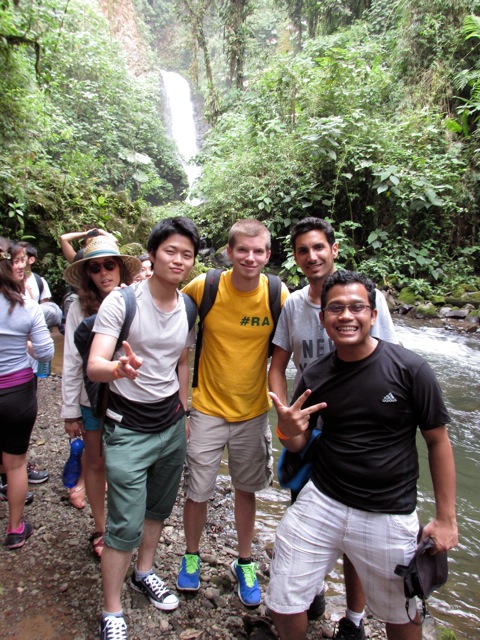
Peter (in yellow shirt) enjoys the Costa Rican outdoors with some of his friends in the Summer Peace Institute.

In 1999, my family and I left Joplin, Mo., for the other side of the world—Taipei, Taiwan. Before that, I’d never been outside the Midwest, let alone the United States.

If you are not familiar with Taiwan, it is a small tobacco-leaf-shaped island off the southeast coast of China, having about one-fifth the land area of Missouri with four times the population.

When we took our first trip to Taiwan, my parents were in the process of considering whether they wanted to become missionaries there. We spent two weeks traveling around the island, sightseeing and meeting Taiwanese friends who had once been international students at Pittsburg State University and at my father’s alma mater, the University of Missouri.

Two years later, my family and I left Joplin again for Taiwan. This time, I stayed for eight years.

After I graduated high school, I returned to Joplin to attend MSSU. I have enjoyed my time at this university more than any other time in my life, but now I am near the end. I will graduate this December with two bachelor’s degrees and, like many of you, still have no idea what I want to do next.

Well, I should not say, “No idea.”

Ever since returning from Taiwan, I have been fascinated by the world outside Joplin, outside Missouri, outside the US. I had tasted another culture—Taiwanese food is delicious, by the way—and I was ready to experience more.

When I heard about the Peace Corps, it sounded like a perfect fit. Started in 1958, the Peace Corps is a US government-run volunteer program that sends American citizens out into the world to learn about other cultures and serve the people of developing countries. Volunteers spend two year stints anywhere from Zambia to China to Peru to Jordan.

About six months ago, I submitted an application for the Peace Corps. Even before that, I had watched as two friends, fellow MSSU students and past McCaleb winners Luke and Caitlan Smith, were sent off by the Peace Corps to Rwanda.

By the time I left for Costa Rica, I was several months into the Peace Corps application process.

During the UPEACE-Berkeley program, I got to talk with two people who have experience with the Peace Corps: Dr. Jerry Sanders, a former Peace Corps volunteer [and co-founder of World Policy Journal and director of the Summer Peace Institute], and Manuel Davila, a former employee of the Honduran Peace Corps office. I asked them about their thoughts on the Peace Corps.

Sanders volunteered in Colombia in the 1970s and became disenchanted with the Peace Corps halfway through his two years there.

“I wasn’t any more satisfied with [the Peace Corps’s] policies—so-called development policies—than I was with the war in Vietnam,” he said.

Sanders felt the policies prevented efficiency. He encouraged me to go into the Peace Corps with a willingness to criticize the system.

Davila said the volunteers he met had great experiences, and he became friends with some of them. He told me the Peace Corps takes very good care of its volunteers.

I thought my time in Costa Rica would make me more excited for the Peace Corps. Instead, it made me realize how hard the Peace Corps would be. Though I had lived and traveled internationally, I had always done it with family or friends.

By the end of my first day in Costa Rica, I had already faced several difficulties.

My luggage was held up in Houston, Texas, so I lacked a change of clothes, toiletries, and even cleaning solution for my contacts. I was overwhelmed by 30 students whom I had never met before and who already seemed to know each other. I could not keep up the lectures on topics I had never studied. I could not speak Spanish. I did not know my way around town and got myself lost wandering home from the bus stop.

As I familiarized myself with my host town, learned a few Spanish phrases and befriended—and was befriended by—the other students, I felt more and more comfortable in Costa Rica.

Some of my favorite moments of the trip were whitewater rafting down the Pecuare River, learning how to say “God bless you” in Spanish, taking walks around my host town, visiting the Caribbean coast, trying new Costa Rican dishes, having intellectual and non-intellectual discussions with fellow students and watching soccer on television with my host family.

Nevertheless, being away from my family, my church community and my other close friends in Joplin was difficult throughout the trip.

While I truly enjoyed my time in Costa Rica, it did open my eyes to the realities of living overseas by myself.

In a Facebook message about the Peace Corps, Luke Smith writes, “The hardest part for me though has just been being away from my family. Diet and living conditions are a cake walk compared to not being able to see the people you love.”

Two weeks into this semester, I received a Peace Corps invitation to volunteer in Indonesia as a secondary English teacher, with a March starting date. I was given seven days to make my decision.

About an hour later, I decided to decline it. It feels like the coward’s move. But right now, I am not ready for the Peace Corps, and that is okay.

Now I am trying to figure out what is next. I will still graduate in December, and I still have no jobs waiting for me. Though I am not yet ready to live in Indonesia for two years, I am ready to explore more of the US, especially her big cities.

I do not plan to give up my aspirations of international studies. I know if I do move somewhere like Chicago or Philadelphia, I will meet people from other countries and cultural backgrounds, and that is exciting.

Maybe I will pursue a master’s degree in international relations. I am still very interested in cross-cultural issues. I follow global current events in my free time, and I try to pick up bits and pieces of other languages.

My thirst for cultural diversity will never be quenched. The Peace Corps may still be in my future, but I am not looking that far ahead. I am looking at what is next, one decision at a time.

From Fukushima to Costa Rica: A Rocket Scientist’s Quest for World Peace

Next month, my son Peter will graduate from Missouri Southern State University. As part of his education, this past summer he attended the Summer Peace Institute at the UN-mandated University for Peace in San José, Costa Rica. As a recipient of MSSU’s McCaleb Initiative for Peace, he reported on his experience for the university’s student-run newspaper, The Chart. Following is one of the eight articles he wrote for the paper. I will post another of his articles on Tuesday.

IMG_0129
Satoshi Miyatani, from Japan, takes a break from classes at this year’s UPEACE Summer Peace Institute in Costa Rica.

Most of the students at the UPEACE-Berkeley summer program came from backgrounds in subjects like peace and conflict studies, economics, politics, sociology, law and anthropology.

Satoshi Miyatani, a rocket scientist, was one of the exceptions.

A recent graduate of aerospace engineering at the University of Tokyo, Miyatani now hopes to attend graduate school at the Massachusetts Institute of Technology.

But why did Miyatani choose to attend a program focused on peace?

Miyatani’s reasoning goes back two years to an event that was significant for him and for Japan.

On the afternoon of March 11, 2011, a magnitude 9.0 earthquake struck off the coast of Fukushima, Japan.

Miyatani was staying at a hotel in Fukushima at the time of the earthquake.

“I have never experienced such a big earthquake,” he says. “The ground was shaking. Everything was shaking.”

Tsunami waves caused by the earthquake battered Fukushima’s coast, even reaching Miyatani’s hotel. The hotel owner drove Miyatani to safety. Thirty minutes after they left the hotel, it was destroyed by the tsunami.

“I almost lost my life,” recalls Miyatani.

For the next week, he slept on a gymnasium floor made cold by the Japanese winter and ate only dry, tasteless cookies.

Before this near-death experience, Miyatani was only interested in developing machines, as most of his fellow engineering students still are. After this experience, he wanted to help victims of natural disasters such as he had endured. He resolved to study the environment and contribute to peace by applying his specialty in aerospace engineering.

Miyatani speaks humbly about his 100-page bachelor’s thesis, which addresses his change of thinking. He describes how satellites can be used to monitor the effects of natural disasters and inform disaster response.

His thesis focuses on the use of many satellites to maximize the information gathered and minimize the time of response.

For the first portion of the UPEACE-Berkeley program, Miyatani says, “Every day I can get a new idea from the lecture.”

His favorite lecture was given by Dr. Bryan Down-Uribe about the environment and climate change. Down-Uribe employed a more scientific approach than previous lecturers, using more statistics, graphs and charts. Miyatani says he was “used to this type of lecture.”

During the field work portion of the UPEACE-Berkeley program, Miyatani went with four other students to work with an indigenous Costa Rican family in Kéköldi.

After a long bus ride toward the Caribbean side of Costa Rica, he and his group hiked an hour into the jungle to reach the research center where they stayed during the field work.

Miyatani says the group worked hard every day— digging and building trails, counting frogs and repairing a bird observation tower.

They also had no electricity during the day time, but “we could survive,” Miyatani says, chuckling.

Drawing a larger lesson from his experience in Kéköldi, Miyatani says, “In the city, there are a lot of things such as supermarkets, Internet, electricity. Everything is useful, but, actually, I don’t think we need to use it.”

Miyatani feels the tension between what he is learning in Japan and what he has learned in Costa Rica: “My major is aerospace engineering, so every day I also study about technology, but there is no technology in Kéköldi.”

“I have no idea how to apply the idea to my life. I have to think more,” he says.

While he is thinking about how to apply his experience in Costa Rica to his life, Miyatani is also planning to commemorate the experience with his work.

As a rocket scientist, Miyatani has launched a satellite into a space and talks excitedly about launching more, proudly declaring what the name of the next satellite will be: Kéköldi.