Our TCK Makes Plans for the Peace Corps—Wait, Not So Fast

Here’s another article from my son Peter. It’s about his time at the Summer Peace Institute in San José, Costa Rica, and also about his post-graduation plans. Peter spent nearly half his life overseas before graduating from high school, so another trip to another culture should have been a piece of cake, right? And heading back to Asia with the Peace Corps shouldn’t be a problem, either. Here, Peter shares about how it can be hard to cross cultures alone, even for a TCK.
IMG_0167
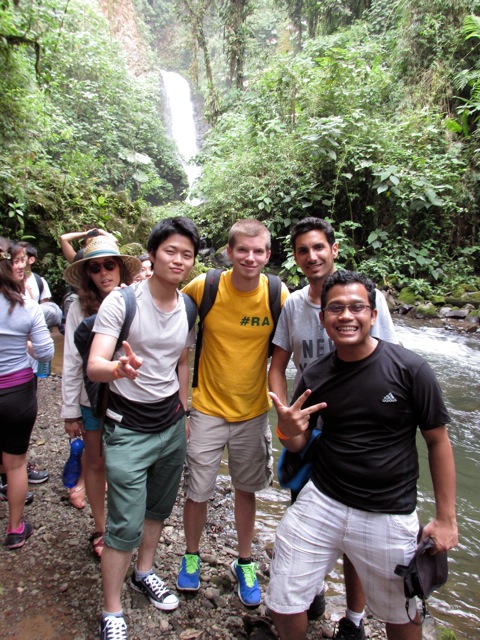
Peter (in yellow shirt) enjoys the Costa Rican outdoors with some of his friends in the Summer Peace Institute.

In 1999, my family and I left Joplin, Mo., for the other side of the world—Taipei, Taiwan. Before that, I’d never been outside the Midwest, let alone the United States.

If you are not familiar with Taiwan, it is a small tobacco-leaf-shaped island off the southeast coast of China, having about one-fifth the land area of Missouri with four times the population.

When we took our first trip to Taiwan, my parents were in the process of considering whether they wanted to become missionaries there. We spent two weeks traveling around the island, sightseeing and meeting Taiwanese friends who had once been international students at Pittsburg State University and at my father’s alma mater, the University of Missouri.

Two years later, my family and I left Joplin again for Taiwan. This time, I stayed for eight years.

After I graduated high school, I returned to Joplin to attend MSSU. I have enjoyed my time at this university more than any other time in my life, but now I am near the end. I will graduate this December with two bachelor’s degrees and, like many of you, still have no idea what I want to do next.

Well, I should not say, “No idea.”

Ever since returning from Taiwan, I have been fascinated by the world outside Joplin, outside Missouri, outside the US. I had tasted another culture—Taiwanese food is delicious, by the way—and I was ready to experience more.

When I heard about the Peace Corps, it sounded like a perfect fit. Started in 1958, the Peace Corps is a US government-run volunteer program that sends American citizens out into the world to learn about other cultures and serve the people of developing countries. Volunteers spend two year stints anywhere from Zambia to China to Peru to Jordan.

About six months ago, I submitted an application for the Peace Corps. Even before that, I had watched as two friends, fellow MSSU students and past McCaleb winners Luke and Caitlan Smith, were sent off by the Peace Corps to Rwanda.

By the time I left for Costa Rica, I was several months into the Peace Corps application process.

During the UPEACE-Berkeley program, I got to talk with two people who have experience with the Peace Corps: Dr. Jerry Sanders, a former Peace Corps volunteer [and co-founder of World Policy Journal and director of the Summer Peace Institute], and Manuel Davila, a former employee of the Honduran Peace Corps office. I asked them about their thoughts on the Peace Corps.

Sanders volunteered in Colombia in the 1970s and became disenchanted with the Peace Corps halfway through his two years there.

“I wasn’t any more satisfied with [the Peace Corps’s] policies—so-called development policies—than I was with the war in Vietnam,” he said.

Sanders felt the policies prevented efficiency. He encouraged me to go into the Peace Corps with a willingness to criticize the system.

Davila said the volunteers he met had great experiences, and he became friends with some of them. He told me the Peace Corps takes very good care of its volunteers.

I thought my time in Costa Rica would make me more excited for the Peace Corps. Instead, it made me realize how hard the Peace Corps would be. Though I had lived and traveled internationally, I had always done it with family or friends.

By the end of my first day in Costa Rica, I had already faced several difficulties.

My luggage was held up in Houston, Texas, so I lacked a change of clothes, toiletries, and even cleaning solution for my contacts. I was overwhelmed by 30 students whom I had never met before and who already seemed to know each other. I could not keep up the lectures on topics I had never studied. I could not speak Spanish. I did not know my way around town and got myself lost wandering home from the bus stop.

As I familiarized myself with my host town, learned a few Spanish phrases and befriended—and was befriended by—the other students, I felt more and more comfortable in Costa Rica.

Some of my favorite moments of the trip were whitewater rafting down the Pecuare River, learning how to say “God bless you” in Spanish, taking walks around my host town, visiting the Caribbean coast, trying new Costa Rican dishes, having intellectual and non-intellectual discussions with fellow students and watching soccer on television with my host family.

Nevertheless, being away from my family, my church community and my other close friends in Joplin was difficult throughout the trip.

While I truly enjoyed my time in Costa Rica, it did open my eyes to the realities of living overseas by myself.

In a Facebook message about the Peace Corps, Luke Smith writes, “The hardest part for me though has just been being away from my family. Diet and living conditions are a cake walk compared to not being able to see the people you love.”

Two weeks into this semester, I received a Peace Corps invitation to volunteer in Indonesia as a secondary English teacher, with a March starting date. I was given seven days to make my decision.

About an hour later, I decided to decline it. It feels like the coward’s move. But right now, I am not ready for the Peace Corps, and that is okay.

Now I am trying to figure out what is next. I will still graduate in December, and I still have no jobs waiting for me. Though I am not yet ready to live in Indonesia for two years, I am ready to explore more of the US, especially her big cities.

I do not plan to give up my aspirations of international studies. I know if I do move somewhere like Chicago or Philadelphia, I will meet people from other countries and cultural backgrounds, and that is exciting.

Maybe I will pursue a master’s degree in international relations. I am still very interested in cross-cultural issues. I follow global current events in my free time, and I try to pick up bits and pieces of other languages.

My thirst for cultural diversity will never be quenched. The Peace Corps may still be in my future, but I am not looking that far ahead. I am looking at what is next, one decision at a time.

From Fukushima to Costa Rica: A Rocket Scientist’s Quest for World Peace

Next month, my son Peter will graduate from Missouri Southern State University. As part of his education, this past summer he attended the Summer Peace Institute at the UN-mandated University for Peace in San José, Costa Rica. As a recipient of MSSU’s McCaleb Initiative for Peace, he reported on his experience for the university’s student-run newspaper, The Chart. Following is one of the eight articles he wrote for the paper. I will post another of his articles on Tuesday.

IMG_0129
Satoshi Miyatani, from Japan, takes a break from classes at this year’s UPEACE Summer Peace Institute in Costa Rica.

Most of the students at the UPEACE-Berkeley summer program came from backgrounds in subjects like peace and conflict studies, economics, politics, sociology, law and anthropology.

Satoshi Miyatani, a rocket scientist, was one of the exceptions.

A recent graduate of aerospace engineering at the University of Tokyo, Miyatani now hopes to attend graduate school at the Massachusetts Institute of Technology.

But why did Miyatani choose to attend a program focused on peace?

Miyatani’s reasoning goes back two years to an event that was significant for him and for Japan.

On the afternoon of March 11, 2011, a magnitude 9.0 earthquake struck off the coast of Fukushima, Japan.

Miyatani was staying at a hotel in Fukushima at the time of the earthquake.

“I have never experienced such a big earthquake,” he says. “The ground was shaking. Everything was shaking.”

Tsunami waves caused by the earthquake battered Fukushima’s coast, even reaching Miyatani’s hotel. The hotel owner drove Miyatani to safety. Thirty minutes after they left the hotel, it was destroyed by the tsunami.

“I almost lost my life,” recalls Miyatani.

For the next week, he slept on a gymnasium floor made cold by the Japanese winter and ate only dry, tasteless cookies.

Before this near-death experience, Miyatani was only interested in developing machines, as most of his fellow engineering students still are. After this experience, he wanted to help victims of natural disasters such as he had endured. He resolved to study the environment and contribute to peace by applying his specialty in aerospace engineering.

Miyatani speaks humbly about his 100-page bachelor’s thesis, which addresses his change of thinking. He describes how satellites can be used to monitor the effects of natural disasters and inform disaster response.

His thesis focuses on the use of many satellites to maximize the information gathered and minimize the time of response.

For the first portion of the UPEACE-Berkeley program, Miyatani says, “Every day I can get a new idea from the lecture.”

His favorite lecture was given by Dr. Bryan Down-Uribe about the environment and climate change. Down-Uribe employed a more scientific approach than previous lecturers, using more statistics, graphs and charts. Miyatani says he was “used to this type of lecture.”

During the field work portion of the UPEACE-Berkeley program, Miyatani went with four other students to work with an indigenous Costa Rican family in Kéköldi.

After a long bus ride toward the Caribbean side of Costa Rica, he and his group hiked an hour into the jungle to reach the research center where they stayed during the field work.

Miyatani says the group worked hard every day— digging and building trails, counting frogs and repairing a bird observation tower.

They also had no electricity during the day time, but “we could survive,” Miyatani says, chuckling.

Drawing a larger lesson from his experience in Kéköldi, Miyatani says, “In the city, there are a lot of things such as supermarkets, Internet, electricity. Everything is useful, but, actually, I don’t think we need to use it.”

Miyatani feels the tension between what he is learning in Japan and what he has learned in Costa Rica: “My major is aerospace engineering, so every day I also study about technology, but there is no technology in Kéköldi.”

“I have no idea how to apply the idea to my life. I have to think more,” he says.

While he is thinking about how to apply his experience in Costa Rica to his life, Miyatani is also planning to commemorate the experience with his work.

As a rocket scientist, Miyatani has launched a satellite into a space and talks excitedly about launching more, proudly declaring what the name of the next satellite will be: Kéköldi.

Dialogue of Cultures: Free International Films Online for Next 9 Days

8315397336_2a1fd9706a_mThis year, the Dialogue of Cultures International Film Festival is being held online. That means you don’t have to travel to someplace like Tokyo or New York to watch the entries, since all are available for online viewing at MUBI.com from November 1-14—for free.

According to the festival site at MUBI, the event is “dedicated to the worldwide phenomenon of people in search of their identity in the era of mass migration and globalisation. Its goal is to jumpstart a dialogue between cultures through the universal language of cinema.”

The 23 films, from 14 countries, are in the running for the Audience Award Grand Prix, which carries an award of $5,000.  Vote for your favorites by clicking their “Become a Fan” buttons.

An example of the global diversity represented in the entries is Old Is the New, a film from Switzerland about a Chinese tourism worker who visits a Greek-speaking region of southern Italy.

The festival is also calling for submissions for its short-film competition. Entries must be no longer than seven minutes, and the deadline for submitting a film is February 1, 2014. The winner of the competition will receive $3,000.

[photo: “Old Theater Seats,” by Joey Lax-Salinas, used under a Creative Commons license]

Monolinguals Unite: You Can Translate, Too

613445810_2249c2d193

Luis von Ahn, computer-science professor at Carnegie Mellon University, has a goal. It’s to translate the entire Web into every major language, for free. Sound impossible? Not to von Ahn. But he does see two obstacles: not enough bilinguals and not enough translator motivation.

So when it comes to translation, what can turn those obstacles from mountains into molehills? Von Ahn is working on an answer, and so is Chang Hu.

It Takes a Crowd

The Guatemalan-born von Ahn is best known for helping to invent CAPTCHAs. If you don’t know what a CAPTCHA is, it’s that image of distorted letters you see on a lot of Website forms. You’re required to type in those letters to prove that you’re a human, which keeps computer programs from fooling the system.

As he told the crowd at a TEDx Talk in 2011 (embedded below), Von Ahn estimates that each day, about 200 million CAPTCHAs are typed around the globe. With every CAPTCHA taking about 10 seconds to key in, that’s around 500,000 hours a day. Von Ahn wondered how he could redeem this “wasted” time and came up with reCAPTCHA.

Now owned by Google, reCAPTCHA replaces the often random characters of a CAPTCHA with actual words from books that are being digitized. The reason this is a good thing is because the text-scanning software used to digitize printed text can’t recognize every word, especially when dealing with books over 50 years old. But these hard-for-computers-to-read words aren’t hard for human’s at all. So when you’re typing in a CAPTCHA on one of over 350,000 sites using reCAPTCHA—including Facebook, Twitter, and Ticketmaster—you’re helping digitize books.

So what does this have to do with translation? Well, another of von Ahn’s projects, based on the same kind of crowd-sourced “human computing” as reCAPTCHA, is Duolingo. It’s a free language-learning site, currently teaching six languages. What makes Duolingo unique is that while you’re learning a language, you’re joining 10 million other users in translating text on the Web, because the phrases used by Duolingo come from real Websites.

For instance, after you learn some basic Spanish vocabulary, you’ll be able to test your skills by translating simple phrases to and from Spanish. And as you do so, you’ll be helping translate some English Websites into Spanish, or vice versa. Success earns you “skill points,” unlocking new lessons, while mistakes take away one of your hearts. Lose all of your hearts and you have to redo the level. As you learn more, you translate more-complex sentences, and, as your attempts are compared with those of others, useful, accurate translations are produced.

According to von Ahn, two great things about Duolingo are, “People really can learn a language with it, and they learn it about as well as the leading language-learning software,” and, “The translations that we get from people using the site, even though they’re just beginners . . . are as accurate as those of professional language translators.”

Oh, yeah, and did I mention it’s free? That’s possible because the sites that submit their text for translation are paying the tab—sites like Buzzfeed and CNN, which, von Ahn announced just a couple weeks ago, are the first to come on board.

Of course, even when there’s no monetary cost, not everyone wants to invest his time into the hours that are required for learning a language. If there could be a way for monolinguals to help out with just a few seconds—kind of like with the reCAPTCHAs—that might bring more people in.

Enter MonoTrans.

The Power of Widgets

MonoTrans (named MonoTrans2 in its newer version) is a process that combines machine translation with help from monolingual humans to produce accurate translations. A team from the University of Maryland’s Department of Computer Science, led by Chang Hu—a PhD candidate at UMD—proposed the process in 2010 to overcome the problem of not having enough bilingual translators to work on (a) texts in rare languages, and (b) huge amounts of text that would require enormous amounts of human effort.

MonoTrans starts with a computer translation of a passage, which is notorious for producing flawed (and often humorous) results. The output is then passed on to a person who speaks the target language. She then makes a guess as to the correct meaning and phrasing of the sentence, and her efforts are back-translated into the source language. Then a speaker of that language compares the results to the original passage, and the process between the two speakers is repeated until a satisfactory translation is produced. Along the way, the two monolinguals can help each other by including annotations, such as images and Web links, and multiple participants can vote on results.

While the process doesn’t necessarily take a large number of steps, it can be complicated and time consuming. MonoTrans2 addresses this problem by breaking the process into smaller, individual “microtasks,” so that many more people will take part in a translation, with each one handling only a small part of the whole process.

This new method was tested using children’s books at the International Children’s Digital Library. Visitors to the Website were presented with “widgets,” windows on a page that run a simple program. These widgets allowed users to edit or paraphrase a sentence, identify errors, or vote for the sentence they think is best.

The results of the trial show that using the MonoTrans Widgets in conjunction with Google Translate is a significant improvement over using Google Translate alone. And while this method also introduced some inherent problems, it indicates that the future of crowd-based computation by monolingual humans is very promising.

A Match Made in Cyberspace

Luis von Ahn coined the term human computation to describe using people to accomplish tasks that computers usually perform. Hu, in a blog post, sums up the relationship of human computation to translation in this way:

[H]uman computation presents a unique opportunity to significantly lower the threshold to do translation. At the same time, translation provides a set of interesting problems for human computation.

It sounds as if the relationship is something like a dance, with the dancers figuring out the steps as they go. Or maybe it’s more like a marriage, where both partners aid and challenge each other at the same time.

It’s a good union, and I’m glad there are people like von Ahn and Hu to serve as matchmakers.

(Luis von Ahn, “3,2,1 Takeoff! And We’re Translating the Web!“ Official Duolingo Blog, October 14, 2013; Chang Hu et al., “Translation by Iterative Collaboration between Monolingual Users,” University of Maryland Department of Computer Science, July 25, 2010; Chang Hu et al., “Deploying MonoTrans Widgets in the Wild,” University of Maryland, May 2012) 

[photo: “Crowd,” by James Cridland, used under a Creative Commons license]

Thanks for That #Epicfail

Those Canadians. So admirable. So multi-cultural. So modest. So polite. So non-controversial.*

Head in Hands
#facepalm

Such failures.

OK. Maybe I should say they’re successful at failing . . . and by “successful,” I mean they’re leading the way in admitting their failures.

Realizing that you’ve failed and knowing what you learned from it is considered a necessary trait by business recruiters. In fact, some say that the most important interview question is “When have you failed?”

But the Canadians I have in mind aren’t part of the business world. They come from the non-profit sector—specifically, Engineers Without Borders (EWB) Canada.

Since 2008, EWB has published its annual Failure Reports. Here’s their rationale:

EWB believes that success in development is not possible without taking risks and innovating—which inevitably means failing sometimes. We also believe that it’s important to publicly celebrate these failures, which allows us to share the lessons more broadly and create a culture that encourages creativity and calculated risk taking.

Without a doubt, it’s a tricky strategy. What will donors think when they hear that the money they gave last year went towards a failed project? And what will they think when they know that this year’s projects may appear in a Failure Report next year? My hope is that many already understand that things don’t always work out as planned, and that they also recognize that it’s not the lack of failure but what it’s members learn from that failure that makes an organization successful.

DIY Failure Reporting

In order to get more people on board, Ashley Good, editor of the Failure Report and EWB’s “Head of Failure,” founded Admitting Failure and Fail Forward. Admitting Failure is a website for sharing failure stories, and Fail Forward is a consulting firm that helps businesses, funders, and non-profits “learn, innovate and build resilience.”

Good’s efforts have garnered a lot of attention from the media, and in 2012, because of her work with Fail Forward, she was a winner of the Harvard Business Review/McKinsey M-Prize: Innovating Innovation Challenge. That’s a long way from the Failure Report‘s humble beginnings. I guess you could say it’s quit the . . . uh . . . success story.

Telling the Fail Forward story at the M-Prize site, Goode writes that the idea for the Failure Reports came from Nick Jimenez. While in a pre-departure training session before joining an EWB project in Ghana, Jimenez asked the organization’s co-founder “how EWB could claim humility while often bragging about greatness and virtually never talking about mistakes or failures.”

Then, about a year later, Jimenez and his fellow staff members in Africa took matters into their own hands and collected their stories of failure, and the first, grassroots, Failure Report was born. Since then, the report has grown to the point that the forward for the 2010 edition was written by Bill Gates, and other organizations have followed suit, sharing their own stories of failure, and gleaning lessons from them.

So how about you? Would you like to join them? Are you itching to see your own failures in print? No problem. Just download Fail Forward’s Failure Reports: A How-To Guide, and you’ll be on your way.

And if you still need inspiration, here’s EWB’s David Damberger:

Face-to-Face Fail Sharing

Maybe you need to be around fellow failers to get the ball rolling. If so, you can attend a FailFaire. In fact, there’s one in Rome, going on today. Sponsored by the UN agency The International Fund for Agricultural Development (IFAD). the faire’s title is “How to Make Failure a Stepping Stone to Success.”

638302179The folks at FailFaire (as far as I can tell, they’re not related to EWB, nor are they Canadians) are a generous lot, so if you’d like to go so far as to host your own faire, they’ve made their concept open source, with the name, logo, and website contents available for duplication under a Creative Commons License. Also, at “How To: Roll Your Own FailFaire,” they give seven guidelines for making a faire work, including the necessity of creating a safe environment, or “Having the Right People in the Room”:

You want people who are there to learn, not to be voyeuristic; there to be constructive, not to be snarky or malevolent. People who genuinely care about their work and want to do better. People who are ok with some irreverence and humor, because failure is hard to talk about without it.

So there you have it. The idea’s out there. It’s just up to the rest of us to stand up and acknowledge where we’ve fallen down, sometimes in spectacular ways. My first thought is “Sounds great. You go first.” But that’s already been taken care of . . . by those Canadians.

Thanks to them, and to all the others, who are blazing the trail and setting the tone. Here’s to more organizations—and people—who will model and promote cultures of safety, humility, and transparency.

Those are pretty good goals in my book.

*If my list of Canadian attributes doesn’t strike your fancy, try out this article from the January 1913 issue of The Annals of the American Academy of Political and Social Science, “Some Canadian Traits.” The author, a W. A. Chapple of London, describes Canadians as, among other things, frank, open, generous, busy, trying to make money, kind, friendly, having no class distinctions, corruptors of the English language, apathetic in business, respecters of law and order, diligent, prejudiced against Americans, having integrity, lacking spiteful rivalry, and loyal. According to Chapple, the biggest threat to their character comes not from within their own borders but from their neighbors to the south. “There is one danger ahead,” he writes. “The States will spread over Canada. They may Americanize her.”

(David Smooke, “Most Important Job Interview Question—’When Have You Failed,’” SmartRecruiters; Ashley Good, “Story: Fail Forward,” MIX M-Prize, December 21, 2012; Anne Ryan Heatwole, “How To: Roll Your Own FailFaire,” FAILFaire, January 24, 2012)

[photo: “Head in Hands,” by Alex E. Proimos, used under a Creative Commons license]

Race, Culture, and Ethnicity in America: Checking Boxes and Switching Codes

In many ways race is about difference and how those differences are codified through language, categories, boxes, segmentation, and even the implicit sorting that goes on in our heads in terms of the way we label others and even ourselves.

—Michele Norris, The Race Card Project

Here’s Proof

4443977630_3b27ef0eb5
The results from the 2010 US Census include six single-race and 57 multiple-race groups.

This month’s issue of National Geographic marks the magazine’s 125th anniversary. That’s quite an accomplishment, and it represents thousands and thousands of pages of amazing photographs and stories. But National Geographic has more to share, and last month it opened up a new avenue: Proof, a blog “launched to engage ongoing conversations about photography, art, and journalism.”

Proof‘s first post is “Visualizing Race, Identity, and Change.” It features photographic portraits by Martin Schoeller (I wouldn’t have recognized that name before writing my last post) and discusses the dilemma faced by so many multi-racial Americans who find it difficult or impossible to check only one box on the census.

The post is a companion piece to a feature article in National Geographic, entitled “Changing Faces.” It’s written by Michele Norris, host and special correspondent for NPR, and curator of The Race Card Project, a site that collects views on the topic of race, all expressed in sentences of only six words. And you thought Tweets were short and to the point.

Of course, quite a few of the boxes were checked in the 2010 Census, and the results show a multi-colored collage of racial diversity across the American landscape. You can see that collage at The Racial Dot Map, created by Dustin Cable of the University of Virginia’s Weldon Cooper Center for Public Service. With one dot per person, the zoomed-out map shows a blending of colors representing the five categories of White, Black, Asian, Hispanic, and Other/Multi-Racial. But by zooming in, you can see the distinct contrasts at the neighborhood level, both intermixed and segregated.

Speaking in Code

NPR has started a new blog this year, too. It’s on race, ethnicity, and culture.

“Remember,” write the blog’s authors, “when folks used to talk about being ‘post-racial’?”

Well, we’re definitely not that. We’re a team of journalists fascinated by the overlapping themes of race, ethnicity and culture, how they play out in our lives and communities, and how all of this is shifting.

They call the blog Code Switching. In linguistics, code switching is when a multi-lingual speaker switches between languages within a conversation. More loosely defined, it can also include moving from one dialect, set of vocabulary, accent, or speaking style to another because of a number of factors, such as setting, relationship to the listener, and expectations.

Imagine that the doorbell rings. You answer the door and see that it’s your boss at the ad agency or your grandmother from Mexico or your childhood friend from the city or your ESL student or an acquaintance from the gym or a policeman. How might you talk differently to each of them? We all do it to one extent or another. But it’s an even bigger factor for those who move between races and cultures.

Gene Demby, host of the blog, calls this movement “hop-scotching between different cultural and linguistic spaces and different parts of our own identities.” Code Switching goes well beyond just methods of expression. It also covers news, info, and opinions on race relations and cultural interaction within America’s borders.

One of the things I like about Code Switching is its broad range of topics, from pop culture—”Why Black Heroes Make Zombie Stories More Interesting“—to historical—”The History of How a Shogun’s Boat Made Lincoln a ‘Tycoon’“—to current issues—”It Takes a Classroom to Learn the Family Language.” When it comes to race, culture, and ethnicity in America, they’re covering it all.

If only the staff here at Clearing Customs had the resources of NPR.

(Michele Norris, “Visualizing Race, Identity, and Change,” Proof, September 17, 2013)

[photo: “Question#9—Multiracial ID’s,” by Spot.us, used under a Creative Commons license]

Hyper Realism: A Russian Farmer Lands an Esquire Cover and a Trip to New York

9168908261_6e344e2bb4_n
Evan Penny’s Old Self, Variation #2, an example of hyper-realistic art

Ever since, as a child, I saw Duane Hanson’s lifelike sculpture Janitor at the Milwaukee Art Museum, I’ve loved hyper-realistic art. Then last month, when I visited Crystal Bridges Museum of Modern Art, in Bentonville, Arkansas, I was surprised to see another Hanson work, Man on a Bench. (I really was surprised, since it looked for all the world like a museum visitor taking a break from his tour.) And in a room close by, there was an oversized bust by Evan Penny, Old Self, Variation #2. Unlike with Hanson’s pieces, no one will mistake Old Self for an actual person—it’s only a head with shoulders, and it’s way too big. But still, it just looks so real.

Martin Schoeller is another artist in the same vein, except he doesn’t exactly create hyper realism, he captures it—with a camera. Born in Germany, but now based out of New York, Schoeller is best known for his “hyper-detailed” large-scale portraits of celebrities, which have appeared in magazines such as GQ, The New Yorker, and Entertainment Weekly.

But his photographic subjects also include common people, like you and me. In fact, if you’d like to see what you’d look like in a Schoeller portrait, next time you’re in Bed Bath & Beyond, do like I did and take a look at yourself in the 10x-magnification of the Zadro Dimmable Florescent Dual-Sided Mirror. (That’s hyper realism.)

Schoeller recently took a cover photo for Esquire Russia of Vasiliy Ilyn, a retired farmer from Russia, who’s featured in this month’s magazine. Ilyn is one of Schoeller’s non-celebrity subjects, as the September Esquire is devoted to the rules that govern the lives of ordinary Russians.

For three days, Ilyn was something more than ordinary, as he was flown to New York for the photo shoot. His encounter with the city is chronicled in the 20-minute film Vasily, from Stereotactic. (Thanks to Carla Williams for telling me about the video.)

The film shows Ilyn’s first trip outside the Kursk region of Russia, his first time to see the ocean, and, of course, his first visit to America. As he looks around New York, he’s a fish out of water, but he’s an ordinary fish. And I’m not sure that his reactions are much different from those many retired farmers in the flyover portions of the US would have.

Ilyn narrates the documentary, and he has a lot to say about Russia, the US, and life in general. He thinks of himself as a joker, but much of what he says shows a solemn acceptance of the way things are. He’s pretty straightforward and plain spoken. At one point, while talking about his disdain for past Russian leaders, Ilyn drops an F-bomb. Actually, it’s more of an F-hand grenade since we read it in the subtitles.

When he gets back to his home, he tells a woman about the 80,000 Russians who live in New York. “I wish a flood would come and they would die,” she says. “Let the locals survive, but these traitors should die.”

Ilyn replies, “They were just looking for a better life. . . . Let them go.”

Shoeller’s type of hyper-realism doesn’t come from a lack of preparation and artistic manipulation. The lighting and focus has to be just right, and there’s a lot of time spent on Ilyn’s makeup. But the result is striking for its unglamorized detail.

That’s the way the documentary looks to me, too. I can tell a lot of work went into the making of Vasily, but it’s that work—the shot selection, the editing, the scoring of the music—that makes it feel more real . . . much more real than what usually passes for “reality” on TV today.

(“Russian Farmer Lands in Esquire and NYC,” Voices of NY, October 15, 2013)

[photo: “Old Self, Variation #2” by Nils Gore, used under a Creative Commons license]

Do You Hear What They Hear? Babies Are Listening Bilingually Even before They Can Speak

I remember having a conversation with an American raising his children in Taiwan. The father was fluent in Mandarin, and he’d started teaching that language to his son at a young age. He told me that it hadn’t worked for him and that he’d read that parents who speak more than one language to their small children only confuse them, as they aren’t able to tell one language from another.

It seemed like sound reasoning to me.

42052685_df923ad167So it surprised me to see new research showing that infants are better at becoming bilingual than I’d thought. As it turns out, by the age of seven months, babies can distinguish between languages by recognizing their different grammar structures.

The study, published in Nature Communications, focused on languages with opposite grammar patterns—such as English, which most often has the verb before the object, and Turkish, which follows the object-then-verb arrangement. Infants in bilingual environments pick up on these patterns and can distinguish between the languages, by listening to differences in pitch, duration, and word frequency.

Janet F. Werker, of the University of British Columbia, is co-author of the study, along with Judit Gervain, of the Université Paris Descartes. Werker reassures parents in bilingual households. “If you speak two languages at home, don’t be afraid, it’s not a zero-sum game,” she says. “Your baby is very equipped to keep these languages separate and they do so in remarkable ways.”

Mental Cartography

Werker and Gervain’s research is one more step forward in what we know about infants and language learning. In 2001, Patricia Kuhl, the director of the University of Washington’s Center for Mind, Brain, and Learning, told the Smithsonian magazine that six-to-eight-month olds can already distinguish between different vowel and consonant sounds in the languages they hear everyday and in languages “foreign” to them. But by their first birthday, they can no longer differentiate between sounds that are not part of a language that they’ve been exposed to. This is because they have developed a focus on familiar sounds, while “tuning out” unfamiliar ones. Then, later on in life, when the familiar competes against the unfamiliar, say, when learning a new language, the old sounds will usually win out. The result is a non-native accent.

To register what sounds infants can differentiate, Kuhl used a “head-turn” study (similar to that used by Werker and Gervain). In one example, two-thirds of both American and Japanese six-month olds could hear the difference between “la” and “ra.” But by the one-year mark, 80% of American children responded to the difference, while only 59% of the Japanese children did. Since the latter rate is only 9 percentage points above chance, this showed that the Japanese children had joined their parents in no longer being able to distinguish between the two sounds.

According to Kuhl,

The baby early begins to draw a kind of map of the sounds he hears. That map continues to develop and strengthen as the sounds are repeated. The sounds not heard, the synapses not used, are bypassed and pruned from the brain’s network. Eventually the sounds and accent of the language become automatic. You don’t think about it, like walking. [Familiar sounds] become more and more embedded into the map, until eventually they are almost ineradicable.

This accent map gets harder and harder to change as time goes by. On the other hand, if a child is exposed to multiple languages early enough—while the map is being drawn—the child can create more than one map at once.

Kuhl also has found (as shown in the TED Talk below) that if this exposure to languages is to have an effect on an infant, it must come from a live person. Listening to audio, even with an accompanying video of the speaker, does no good.

It’s Never Too Early to Learn

According to DNAinfo New York, some parents in the Big Apple are even learning a new language themselves in order to make sure that exposure to multiple languages happens for their children at an early age.

Take, for instance, Rhonda Ross, of Harlem, who went to a boarding school in a French-speaking area of Switzerland when she was a student. Later, when her son, Raif, turned one, she began speaking to him only in French. “I started with a French babysitter,” she said, “but a friend convinced me I would have to speak French to my son myself if I really wanted him to be fluent.”

Not being fluent herself, that means that Ross has to keep learning as she teaches her son. But she feels that the effort is worth it. In fact, she is so pleased with the outcome, that she’s introduced Raif to Mandarin and Spanish, as well.

Linguist Jennifer Wilkin, of Brooklyn, is another advocate of early bilingual education. In 2001, she founded Science, Language & Arts, where parents and children can learn French and Mandarin. “There is certainly a trend among New Yorkers to give a language to their children,” said Wiklin, who “knows several parents who are learning, and speaking, Spanish, Japanese, French and German to their children.”

While Wilkin’s school has students from preschool through fifth grade, Lyndsey St. John started Baby French in a Brooklyn ice-cream parlor and candy shop named The Candy Rush. The class caters to children who haven’t even learned to talk yet. “It’s really good to start those [language] pathways forming at a very early age,” said Wilkins. “Anywhere from 8 months to 3 years is when children are really sponges. They’re picking up everything.”

(Judit Gervain and Janet F. Werker, “Prosody Cues Word Order in 7-Month-Old Bilingual Infants,” Nature Communications, February 14, 2013; “Bilingual Babies Know Their Grammar by Seven Months,” The University of British Columbia Public Affairs, February 14, 2013; Edwin Kiester, Jr., “Accents Are Forever,” Smithsonian, January 2001; Julie Norwell, “New York Parents Learn Foreign Languages to Help Kids Become Fluent,” DNAinfo New York, March 6, 2013; “Even before They Utter First Words, Brooklyn Babies Take French Lessons,” DNAinfo New York, August 22, 2012)

[photo: “Mommy Tells a Story,” by Dan LaVange, used under a Creative Commons license]