

(Too) Many International Students in the US Have No Close American Friends

For several years, while I was serving as a campus minister to international students at the University of Missouri, I kept a photo of a young Taiwanese couple tucked in my Bible. It was one of the those glamour wedding pictures that are popular in Taiwan. The husband, a student at MU, had given me the photo before he and his wife returned to their country. On the back it said, “To Craig, my best friend in America.” The trouble was, I didn’t remember much about him at all.

Of course, I met a lot of students during my five years in campus ministry. But what made this student stand out was that he considered me his best friend. Maybe I had introduced myself to him shortly after his arrival. Maybe I had given him a Bible in Chinese. Maybe I had helped him find some free furniture. Maybe I was his best friend. But that doesn’t mean I was an especially good friend.

According to Open Doors, last year there were over 720,000 international students attending US universities and colleges, and this number doesn’t include dependents who accompanied them. This total was a record high, and the numbers will surely show another increase when new data are released next month.

More Than One in Three Claim No Strong Friendships with Americans

While more and more students are coming to the US for higher education, more and more of them are finding an environment without significant friendships. This is the finding of a recent study, “Intercultural Friendship: Effects of Home and Host Region,” published in the Journal of International and Intercultural Communication.

As reported in The Chronicle of Higher Education, the article’s author, Elisabeth Gareis, of City University of New York’s Baruch College, found that 38% of students she surveyed reported “no strong American friendships.” Students from East Asia (including China) were more likely than those from English-speaking countries to report a lack of friends, with over half of them claiming no close friendships with Americans.

Not only was there a notable difference between the students’ area of origin, but also with the place of their American university. The study, which included students studying at southern and northeastern institutions, showed that those in the Northeast were less satisfied with their friendship situation than those in the South. Likewise, students in larger metropolitan areas were less happy about their friendships than those in smaller towns.

As for the cause of the problem, 54% of the surveyed students believed that Americans were responsible for the lack of friendships, while 46% blamed their own “internal factors,” such as shyness or a lack of English skills. A report on the study in Inside Higher Ed adds that among East Asian students, nearly 80% blamed their own shortcomings.

(“Open Doors 2011 Fast Facts,” Institute of International Education; Karin Fischer, “Many Foreign Students Are Friendless in the U.S., Study Finds,” The Chronicle of Higher Education, June 14, 2012; Scott Jaschik, “Friendless in America,” Inside Higher Ed, June 14, 2012)

Students Disagree on Whether Americans Are Trying

Voice of America took an online survey of its Student Union readers, asking “about how American students view their international classmates (and how international students think their American classmates view them).” One hundred ten students responded—54 Americans and 56 internationals—giving the following results:

  • 60% of American students said they “relate to international students as well as or better than Americans”
  • 50% of international students in the survey reported that they “relate to Americans as well as or better than international students”
  • 45% of American respondents said that they try to get to know their international schoolmates, 20% said they do not try, and 35% said that extra effort isn’t needed*
  • 30% of international students answering the survey said that Americans try to get to know them, 50% said the Americans don’t try, and 20% said that no extra effort is needed by the Americans*
    *Results from these last two items are approximations, as they were read from a graph.

(Jessica Stahl, “Why Aren’t Americans and International Students Becoming Friends?The Student Union, Voice of America, June 19, 2012)

Feelings of Not Belonging in the US

Last year, researchers from Ohio University and CATS College in England asked international students a different set of questions, focusing on their feelings of belonging and what universities can do to help. Inside Higher Ed reports that most students in the survey “rated their sense of belonging as a five out of five and their overall satisfaction with their college as a four out of five.” But when it comes to “belonging in the U.S.”—a feeling that can be strongly influenced by friendships on and off campus—the  majority of students rated that only a two or three.

Many international students feel that their school’s student services can do more. One student said,

I had a difficult time adjusting to the U.S. culture and educational system. I thought it would be cheaper and I made no friends. I asked for help at the office of International students and I was sent to the counseling services. The counselor sent me to the psych ward because she thought I was suicidal—which was not true. It has been a very dramatic experience that schools should consider when having international students.

(Allie Grasgreen, “At Home on Campus, Not in Country,” Inside Higher Ed, April 6, 2011)

See also my post, “Can’t We Just Be Friends? Bridging the Cultural Divide on Campus

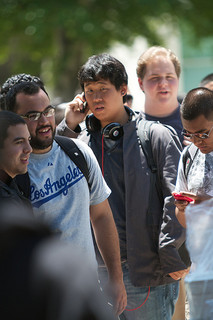
[photo: “CSUN BBQ 19,” by Parker Michael Knight, used under a Creative Commons license]
Three Quarters of World’s Population Live under High Religious Restrictions

From mid 2007 to mid 2010, the share of the world’s people living in areas of “high or very high” restrictions on religion grew from 68% to 75%. This is according to a recent report from The Pew Forum on Religion and Public Life. The report combines scores on government restrictions and social hostilities involving religion. Findings include the following:

  • The percentage of countries with combined high or very high restrictions rose from 29% to 37%.
  • Six countries scored “very high” in both categories (government and social), as of mid 2010:
    1. Afghanistan
    2. Egypt
    3. Indonesia
    4. Russia
    5. Saudi Arabia, and
    6. Yemen
  • In the year ending in mid-2010, 28% of countries showed “moderate” levels of government restrictions, while 35% were in the “low” category.
  • At the end of the four-year period, 19% of the global population lived in countries in the “moderate” range of social hostilities, with 6% living in “low” countries.
  • Overall, from 2009 to 2010, 66% of countries showed an increase in restrictions, while 28% showed decreases.
  • The three groups that were harassed in the highest number of countries were Christians (in 139 countries), Muslims (in 121), and Jews (in 85).

While the United States ended the four-year study in the “moderate” range in both categories, it was one of sixteen nations whose scores on both indexes rose by one or more points in the final year. This was a first for the US during the four-year period.

(Rising Tide of Restrictions on Religion, The Pew Forum on Religion and Public Life, September 20, 2012)

Are You Listening? Really Listening?

Finding good listeners is very important to missionaries. In fact, when member-care trainer Brenda Bosch surveyed missionaries about what they wanted from their mission agency, the top answer was “someone to listen to me.”

German theologian Dietrich Bonhoeffer writes that listening is necessary in Christian community. He calls it the “first service” that Christians owe each other:

Just as our love for God begins with listening to God’s Word, the beginning of love for other Christians is learning to listen to them. God’s love for us is shown by the fact that God not only gives us God’s Word, but also lends us God’s ear. We do God’s work for our brothers and sisters when we learn to listen to them. So often Christians, especially preachers, think that their only service is always to have to “offer” something when they are together with other people. They forget that listening can be a greater service than speaking. Many people seek a sympathetic ear and do not find it among Christians, because these Christians are talking even when they should be listening. But Christians who can no longer listen to one another will soon no longer be listening to God either; they will always be talking even in the presence of God. The death of the spiritual life starts here, and in the end there is nothing left but empty spiritual chatter and clerical condescension which chokes on pious words. Those who cannot listen long and patiently will always be talking past others, and finally no longer will even notice it. Those who think their time is too precious to spend listening will never really have time for God and others, but only for themselves and for their own words and plans.

For Christians, pastoral care differs essentially from preaching in that here the task of listening is joined to the task of speaking the Word. There is also a kind of listening with half an ear that presumes already to know what the other person has to say. This impatient, inattentive listening really despises the other Christian and finally is only waiting to get a chance to speak and thus to get rid of the other. This sort of listening is no fulfillment of our task. And it is certain that here, too, in our attitude toward other Christians we simply see reflected our own relationship to God.

In the latter paragraph, Bonhoeffer describes a false, inadequate kind of listening. In reading what is lacking there, we can see the qualities required of a good listener. Are you someone who listens in that way?

  • Do you listen with a “whole” ear?
  • Do you presume that you will hear something unique and valuable?
  • Are you patient?
  • Are you attentive?
  • Do you love the speaker?
  • Do you waive your right to speak?
  • Do you hope to keep the other person in your presence, sharing with you?
  • Are you fulfilling your task, to your neighbors and to God?

The New Testament records Jesus saying several times, “He who has ears to hear, let him hear.” In The Message, this is translated, “Are you listening to this? Really listening?”

Thanks to Brian Stankich at FULFILL for drawing my attention to the survey in his post “11 Types of Care Missionaries Want from Their Sending Agencies and Co-Workers.”

(Brenda Bosch, “Summary of Missionary Survey Outcomes,” Global Member Care Network Conference, April 2012; Dietrich Bonhoeffer, Life Together, Dietrich Bonhoeffer Works, Volume 5, Augsburg Fortress, 2004, 98-99)

[photo: “Listen carefully,” by Justin Lynham, used under a Creative Commons license]

Get Your Head out of the Sand . . . and into a Pillow

It’s a perfect example of function over form. It’s great for those long flights across the ocean and those layovers in the airport. It’s a head-sized space for a power nap. It’s the Ostrich Pillow.

Here’s a description from the press release by designers kawamura-ganjavian and Studio Banana Things:

Ostrich Pillow offers a microenvironment in which to take a warm and comfortable power nap at ease. It is neither a pillow, nor cushion, bed or garment, but a bit of each, all at the same time. It’s soothing cave-like interior shelters and isolates both your head and hands, perfect for a power nap. You can use the Ostrich Pillow at your desk, on a bench, on the train or while you wait at the airport to catch a flight. In fact, you can use the Ostrich Pillow whenever and wherever you feel like a nap is needed.

Now watch it in action, because the above paragraph just doesn’t do it justice:

The architecture and design studio kawamura-ganjavian is made up of a team of cross-cultural creative types. They seem like the kind of people who wonder how to make a better mousetrap and come up with a new kind of cheese. Among others, they are

Pablo Carrascal, from Spain, studied in Spain and Mexico
Maki Portilla Kawamura, Spanish-Japanese, studied in London, worked in Spain and Switzerland
Amir Afshar, British-Iranian, studied and works in London
Mónica Mejía, Colombian, studied in Colombia, USA, and Spain, works in Paris
Cornelia Tapparelli, Swiss-Italian, studied in Lausanne and Zurich, works in Lausanne

Other products from kawamura-ganjavian include the Twist&Brush, a toothbrush for travelers that has a built-in toothpaste dispenser, and Eat with Your Fingers, a knife-spoon-and-fork set that fits on the ends of your fingers.

I think the Ostrich Pillow is a great idea, but I’m just not daring enough to be the first one on my block to use one. So how about you go first and make it a trend? (It’s currently available by donation through Kickstarter. ) I’ll be right behind you.

[photo from Studio Banana Things, used with permission]

Conversation: noun, “a turning with”

Steve Smith, author of The Jesus Life and co-founder of Potter’s Inn, recently wrote in his blog,

[I]n the course of life’s seasons, we need to have spiritual conversations with people who are good listeners. Let me be clear here, most people are not good listeners. They listen for facts not feelings. They listen for what they hope to hear. They listen when it may not cost them something.

A spiritual conversation is a reciprocal dialogue between two people where thoughts, opinions and feelings are shared and received. It’s two-way. Not one way.

People who have gone through major transitions—and others who have encountered loss—need good listeners. But what is necessary to be someone who listens well, to be someone who nurtures spiritual conversations? How about compassion and empathy and comfort?

Following is a list of words that I associate with good listeners. We all know what the words mean, but we’ve become fairly complacent in using them. Therefore, as a way to jumpstart our thinking and to help us do a better job of living them out, I’m pairing them with the literal meanings from their origins (with the help of the  Online Etymology Dictionary and other resources). My intent is not to “correct” their modern definitions but simply to give depth to what we already know.

For instance, today a companion is a friend or partner. But the word companion is formed from two parts that originally meant “with” and “bread.” So a companion was someone who shared a meal with another. Even now we understand the link between sharing food and sharing our hearts. Here’s what Smith says about companionship:

I wrote in The Jesus Life that spiritual conversations take place at the table where we eat our meals. . . . It’s never an intent when you ask someone for lunch–to share protein, carbs and water with someone. No, when you ask someone for lunch, you’re really meaning, “Hey, let’s get together so we can share what’s been going on in our lives. It’s been too long. How about next Tuesday at noon at the deli?”  That’s the stuff of conversations where hearts connect and souls meet and people who are lonely become spiritual companions.

Now, here’s the rest of my list:

acknowledge: “to admit understanding or knowing”
from a blending of Old English on, “into,” and cnawan, “recognize,” with Middle English knowlechen “admit”

affirm: “to strengthen”
from Latin ad, “to,” plus firmare, “make firm”

advocate: “someone called to help or plead”
Latin ad plus vocare, for “to” and “to call”

comfort: “to strengthen much”
Late Latin com, “very,” and fortis, “strong”

commiserate: “to lament with”
from Latin com, “with,” and miserari, “to feel pity”

communicate: “to make common”
from Latin commun, “common,” plus the verb suffix icare

companion: “eating partner”
Latin com, “with,” and panis, “bread, food”

compassion: “a suffering with”
Latin com and pati, meaning “with” and “to suffer”

concern: “a sifting” or “comprehension”
from Latin com, “with,” and cernere, “to sift”

condolence: “a sorrowing with”
from Late Latin com, “with,” and dolere, “to grieve”

confide: “to trust strongly”
Latin com plus fidere, meaning “very” and “to trust”

console: “to give much comfort or solace”
from Latin com, “very,” and solari, “to comfort”

contact: “to touch with”
from Latin com, “together,” and tangere, “to touch”

conversation: “a turning with”
Latin com, meaning “with,” and vertare, meaning “turn about”

empathy: “a feeling in”
Greek en and pathos, meaning “in” and “feeling”

encourage: “to add heart or bravery”
Old French en, “make, put in,” and corage, “heart, innermost feelings”

sympathy: “a feeling together”
Greek syn, “together,” plus pathos, “feeling”

understand: “to stand in the midst of”
Old English under, “between, among,” plus stand

May we better understand these ideas and, in so doing, better understand each other. May we put them into practice. May we all become better companions . . . and better listeners.

(Steve Smith, “The Power of a Spiritual Conversation,” Steve and Gwen Smith, September 26, 2012)

[photo: “61098,” by Drew Herron, used under a Creative Commons license]

Google and YouTube Are Racing Forward in Translation (but the Finish Line Is Staying Ahead)

As the online community continues to grow, more and more languages are coming online, and power players like Google and its subsidiary YouTube are speeding ahead to keep up. Here are some of the numbers that illustrate this:

  • “To reach 90% of the world’s internet users required at least 19 languages in 2009 and 2010. In 2012, marketers will need 21 languages to achieve that mark. To hit 95%, the number of languages required has jumped from 27 to 34. Finally, to reach 98%, the number rocketed from 37 to 48.”

(Benjamin Sargent, “ROI Lifts the Long Tail of Languages in 2012,” Common Sense Advisory, June 26, 2012)

  • Google Translate currently works between 64 languages.
  • Over 92% of its more than 200 million monthly users come from outside the US.
  • “In a given day we translate roughly as much text as you’d find in 1 million books.”

(Franz Och, “Breaking Down the Language Barrier—Six Years In,” Official Google Blog, April 26, 2012)

  • “Sixty percent of all video views on Google-owned YouTube come from users who select a language other than English as the site’s display language”

(Janko Roettgers, “Most Youtube Views Come from Non-English Users,” GigaOM, November 3, 2011)

And now YouTube has launched a new interface to help in translating its videos into over 300 languages. The first step is to upload a transcript or caption file. Then the next step is to use the translation feature in the YouTube Video Manager to create a translation or invite other online users to help out. For the 64 languages available using Google’s machine translation technology, YouTube will provide a “first draft” to jump start the process. The interface also allows for translation into the 300 plus languages available in the Google Translator Toolkit.

(Jeff Chin and Brad Ellis, “Build a Global Audience on YouTube by Translating Your Captions,” Creators: The Official YouTube Partners & Creators Blog, September 24, 2012)

Those of you who have used Google’s translator in the past will know that the first draft of the translation may be a good starting point, but it will probably need quite a bit of tweaking. If you’re really brave, you can start with YouTube’s automatic captioning, which currently creates onscreen captions for English and Spanish, generating the text from the audio. (Access this feature by clicking the “cc” button at the bottom of the video viewer.) Google admits that all of this is a work in progress, and it often produces humorous results. Take a look at the video below to see Rhett and Link use YouTube for a modern take on the telephone (or gossip) game:

If you do need to create multi-language subtitles for a video project, and you find limitations in YouTube’s approach, take a look at dotSUB and Amara for more options.

[photo: “Race Hard,” by velo_city, used under a Creative Commons license]

Look, Ma, No Hands: An Engineer Brings His Cross-Cultural Creativity to the Ford Escape

While I was watching my alma mater, Mizzou, play South Carolina in football Saturday, a commercial caught my attention. (Actually, the commercial was one of the high points of the game for me, since the Tigers lost in convincing fashion.) The ad was for the 2013 Ford Escape and highlights its hands-free liftgate, which lets you open and close the back hatch by using your foot. This is possible because of a motion sensor under the rear bumper that is programmed to respond only to a kicking motion.

The feature is the brainchild of Ford exterior systems engineer, Vince Mahe, who was born in France and moved to the US at the age of 10. The Escape’s Facebook page says Mahe learned English from watching Sesame Street. Later, he became a fire fighter, then joined Ford, where he developed the “Open Sesame” feature. (Sesame Street. Open Sesame. Sounds like a theme.)

Chalk up another tally for creativity born from cross-cultural experiences. According to the commercial,

Vince Mahe grew up on two continents and noticed that wherever you go, people have their hands full but their feet free. The result, a liftgate you operate with your foot.

See here for yourself:

During a live chat, Mahe was asked how fighting fires helped him in is work at the auto maker. Mahe answered,

Being a fire fighter taught me how to keep calm under pressure and realize there is always a solution. You must keep your calm when collaborating with a team, especially under pressure. . . .

Another question concerned the transition between the two jobs. Mahe:

The transition to Ford was the same as other transitions I had in my life, like moving from France to the United States. It’s another adaptation I had to make in my life, but I have been happy with it. . . .

Of course, not all of the creative people at Ford used to be cross-cultural kids. (There are three other innovators who star in their commercials, with no mention of their backgrounds.) But it’s interesting how much Ford is stressing the effect that Mahe’s past experiences have had on his creativity and problem-solving skills. Here is Mahe explaining the relationship in his own words:

Ford is marketing the Escape outside the US, as well. But in other countries, it is being sold under the name Kuga. Their global strategy also means that Ford is paying attention to place-specific details in the Kuga’s design. One of these variables is color, and Ford is introducing a “global colour”—a “subtle green”—they’re calling Ginger Ale. “Choosing the right colours is crucial, wherever the car is being sold,” says Serife Celebi on Ford’s media site. Celebi, the colour and material design supervisor for Ford of Europe, adds, “Ginger Ale is stylish enough to suit urban landscapes across the world and still have a playful edge.”

Regional factors also affect the planning for interior colors: Ulrike Dahm, colour and trim supervisor, Ford of Europe, says,

In Asia, lighter interiors are more desirable. Many people live in huge cities where space is at a premium, so having a light and airy interior is seen as luxurious. In Europe, colours and trim take a lot of influence from the tech industry and are generally darker. Gloss black is a popular choice.

Maybe the same kind of attention to cultural tastes was not given to the SUV’s name, which has been used by Ford outside the US since 2008. I didn’t find any explanation from Ford for the origin of the name, but several sites point out that kuga is a Serbo-Croation word for “plague.” No word on whether that has affected sales in Serbia and Croatia.

(“Trend-Spotting on a Global Scale: How Ford Designers Tailored All-New Kuga to Suit Customers Worldwide,” media.ford.com, April 19, 2012)

[photo: “2013 Ford Escape,” by Automotive Rhythms, used under a Creative Commons license]

Roundball Diplomacy in Iran: A Documentary

Here’s another entry in the category of basketball diplomacy*. When director Till Schauder found Kevin Sheppard, a point guard from the US Virgin Islands, playing professionally in the Iranian Super League, he made him the focus of his documentary, The Iran Job. The film follows Sheppard’s season with his team, A.S. Shiraz, and his spirited interactions with the Iranian people. In particular, Sheppard forms a relationship with three women—who bravely face the cameras, remove their head coverings, and share their views about the current culture in Iran. Shauder writes:

Iran is often portrayed as a terrorist nation, a nuclear threat, and a charter member of the Axis of Evil bent on the destruction of Israel. But behind the headlines—and the aggressive rhetoric of Iran’s hard-line leaders—lies one of the most fascinating nations, as sensuous as it can be challenging, with a life-loving people. This film focuses on Iran’s people, rather than its government, and I hope it can challenge perceptions of Iran by providing an authentic perspective that may be crucial when choices are made between war and peace. It is probably safe to say that getting Iran “right” is as impossible as getting any culture “right.” Nonetheless, for their people and for ours, it should be a high priority. . . . More than a fish-out-of-water sports documentary this film focuses on social issues including women’s rights, political freedom and religious conflict, through the lens of a black American basketball player.

The Iran Job is being screened in selected US theaters, and DVDs are available at Kickstarter.

*For more examples of basketball diplomats, see my other posts on Stephon MarburyYao Ming, and Jeremy Lin.

[photo of a basketball goal in Varamin, Iran: “Retired hoop!” by Blake Amin Tabrizi, used under a Creative Commons license]