When we first moved to Taipei, we lived across the street from a park. One day, in that park, I was approached by three college-age students who asked me in English, “Do you know Jesus?”
“Yes,” I said.
“OK,” they replied. “But do you really know him?” This was a logical question, because while English has the one word for knowing someone, Chinese has two. The first would be the one in “I know who he is,” while the second means “I know him personally.”
I had the perfect response. Not only was I a Christian, but I was a missionary . . . and I’d been studying Chinese, too. So, I told them, somewhat smugly, in their language, “Yes, I know him. I’m a . . . bicycle.”
I wish I could say that the Chinese words for missionary and bicycle sound just alike, but they don’t. The first is chuan jiao shi, and the second is jiao ta che. I think I must have learned them on the same day, because they are forever confused in my mind. The young people in the park laughed with me and let me correct myself. “Chinese is hard,” they said. I didn’t argue.
Over the years, that encounter became a symbol to me for the good and bad times in Taiwan: Some days I was a missionary. Some days I was just a bicycle.
[T]he reason why I have Yeshua, my de-familiarized Christ, saying, “Far more can be mended than you know,” which I think is actually true to the New Testament, is that I want mending. Not flying free, not transformation, but humble, ordinary, everyday, get-you-back-on-your-feet mending, to be at the center of the Christian story.
When the book was being translated into Dutch, the translator sent me an email: “This word mend, I’ve looked it up in the dictionary, and it seems to be the same word you use for repairing bicycles. You must mean something else.”
I wrote back, “No. No. No. I want the bicycle-repair word.” What I absolutely want is to suggest that before it’s anything else, redemption is God mending the bicycle of our souls; God bringing out the puncture repair kit, re-inflating the tires, taking off the rust, making us roadworthy once more. Not so that we can take flight into ecstasy, but so that we can do the next needful mile of our lives.
We all need that kind of mending from God. I guess being a bicycle isn’t so far from being a Christian—and a missionary—after all.
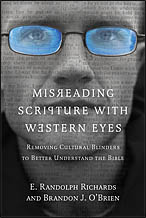
In modern America, the authors point out, we tend to associate missing teeth with lack of intelligence. But what would your smile look like without the luxury of modern and available dentistry? Would you have a full mouth of straight pearly whites? Did Jesus have all his teeth intact? The authors write, “It seems like heresy to suggest otherwise.” But for much of the world, a lack of teeth would be irrelevant—if not expected—in a carpenter who lived 2,000 years ago.
Richards (a former missionary to Indonesia) and O’Brien’s goal in Misreading Scripture is to get us to rethink our assumptions about what we read in the Bible. They’re not saying that non-Westerners can understand the Bible better, just that we all come to the text with our own cultural baggage that we need to lay down. (They offer that someone else could easily write Misreading Scripture with EasternEyes.)
The authors admit that they’ve had to oversimplify the topic, as there is way too much to cover in one book. But, they write, their purpose is to “unsettle you just enough that you remember biblical interpretation is a crosscultural experience and to help you be more aware of what you take for granted when you read.”
For instance, they open the book with the example of the hot, cold, and lukewarm waters of the church in Laodicea:
I know your deeds, that you are neither cold nor hot. I wish you were either one or the other!So, because you are lukewarm—neither hot nor cold—I am about to spit you out of my mouth. (Revelation 3:15,16 NIV)
Our assumptions lead us to think that hot means “on fire” with faith, while cold means that faith is absent. This reading says that God would rather us be non believing than to have a weak faith. But when O’Brien traveled to the site of Laodicea, he learned that nearby were the hot springs of Hierapolis and the cold springs of Colossae. Laodicea didn’t have any springs, so aqueducts brought water in. Both kinds of water, hot and cold, would have been welcome and refreshing to the people of Laodicea, but by the time the water arrived, it was only lukewarm. New insights bring new perspectives.
The story of David and Bathsheba gives another opportunity for us to see an “Eastern” viewpoint. The authors’ thought-provoking analysis suggests that David’s actions were motivated more by honor and shame than by feelings of guilt. In fact, they show how not only the king’s decisions, but also those of Bathsheba and Uriah, exemplify a culture where individual convictions of right and wrong are trumped by the weight of societal expectations.
Other topics covered in Misreading Scripture are the cultural differences of Individualism and Collectivism, Time, Rules and Relationships, Virtue and Vice, and Finding the Center of God’s Will. In the chapter covering this last subject, Richards and O’Brien discuss the common Western practice of a reader applying scriptures to himself, while non-Western readers—as with the Jews of the Old Testament—are more likely to apply it to the entire group. This is compounded, as the authors point out earlier in their book, by the lack of a plural you in the English language.
While I taught the Bible in Asia, it was a constant challenge to set aside my American presuppositions and allow my non-American friends to understand the Bible on their own terms. Instead, I was tempted to share my personal and cultural footnotes before they could be convicted of a “misguided” interpretation. This was especially dangerous when I found myself, as the authors call it, “arguing [them] to a lower standard.”
As I read through Misreading Scriptures, I wasn’t always convinced of the authors’ conclusions, but I was consistently “unsettled” enough to rethink my assumptions. And when I question those things that I take for granted, it makes me a better teacher and student. When I acknowledge my cultural biases, I am then better able to understand what the Bible says and less hindered by what I’m sure it should be saying.
(E. Randolph Richards and Brandon J. O’Brien, Misreading Scripture with Western Eyes: Removing Cultural Blinders to Better Understand the Bible, IVP, 2012)
[My family is moving across town this week, so I haven’t been able to work on the blog much lately. So here’s a repost from about a year and a half ago. This transition thing can feel like Frost’s “miles to go before I sleep.” But until that rest comes, I’ll look for a park bench along the way.]
Finding good listeners is very important to missionaries. In fact, when member-care trainer Brenda Bosch surveyed missionaries about what they wanted from their mission agency, the top answer was “someone to listen to me.”
German theologian Dietrich Bonhoeffer writes that listening is necessary in Christian community. He calls it the “first service” that Christians owe each other:
Just as our love for God begins with listening to God’s Word, the beginning of love for other Christians is learning to listen to them. God’s love for us is shown by the fact that God not only gives us God’s Word, but also lends us God’s ear. We do God’s work for our brothers and sisters when we learn to listen to them. So often Christians, especially preachers, think that their only service is always to have to “offer” something when they are together with other people. They forget that listening can be a greater service than speaking. Many people seek a sympathetic ear and do not find it among Christians, because these Christians are talking even when they should be listening. But Christians who can no longer listen to one another will soon no longer be listening to God either; they will always be talking even in the presence of God. The death of the spiritual life starts here, and in the end there is nothing left but empty spiritual chatter and clerical condescension which chokes on pious words. Those who cannot listen long and patiently will always be talking past others, and finally no longer will even notice it. Those who think their time is too precious to spend listening will never really have time for God and others, but only for themselves and for their own words and plans.
For Christians, pastoral care differs essentially from preaching in that here the task of listening is joined to the task of speaking the Word. There is also a kind of listening with half an ear that presumes already to know what the other person has to say. This impatient, inattentive listening really despises the other Christian and finally is only waiting to get a chance to speak and thus to get rid of the other. This sort of listening is no fulfillment of our task. And it is certain that here, too, in our attitude toward other Christians we simply see reflected our own relationship to God.
In the latter paragraph, Bonhoeffer describes a false, inadequate kind of listening. In reading what is lacking there, we can see the qualities required of a good listener. Are you someone who listens in that way?
Do you listen with a “whole” ear?
Do you presume that you will hear something unique and valuable?
Are you patient?
Are you attentive?
Do you love the speaker?
Do you waive your right to speak?
Do you hope to keep the other person in your presence, sharing with you?
Are you fulfilling your task, to your neighbors and to God?
The New Testament records Jesus saying several times, “He who has ears to hear, let him hear.” In The Message, this is translated, “Are you listening to this? Really listening?”
Here’s a repost of something I wrote back in March of 2012—it was only my fifth entry—back when I had no followers and very few readers. It’s an interesting and timely story, and helps give me a break during the busyness of the holidays. May you enjoy the blessings of Christmas, wherever you are in the world.
In the early 1970s, a Christian missionary school in Tokyo was looking for turkey for Christmas dinner. Finding none, a representative contacted the local Kentucky Fried Chicken and ordered chicken instead. A KFC employee suggested the company turn the request into an ad campaign, and Japan has never been the same since. Today, KFC’s Christmas Party Barrels are so popular that sales for December 23rd, 24th, and 25th usually equal half of what is sold during a normal month, and Christmastime customers wait in long lines to pick up their orders, placed as early as October. Very few in Japan celebrate Christmas for its religious meaning, as less than 2% of Japanese even call themselves Christian. Instead, consumerism is emphasized, and the focus is on gifts, decorations . . . and chicken from the Colonel.
The statures of thirteen saints adorn the roof of Montreal’s Cathédrale Marie-Reine-du-Monde.
According to the 1917 Catholic Encyclopedia, Simeon Stylites was the first “pillar hermit,” spending much of his life perched atop a column (stylos is Greek for pillar). Simeon began this practice to escape the constant crowds of pilgrims who sought his prayers, disrupting his personal devotions. His original pedestal held him around nine feet off the ground, but over time it was replaced by ever-taller versions, until it was some 50 feet high. Simeon remained on his pillar for 36 years, until his death.
While Simeon seems to have thrived living above the masses, most church leaders today find life atop a pedestal difficult at best. But that doesn’t stop many Christians from elevating them to greater and greater heights, and sometimes those leaders get quite comfortable with the view from above.
This is one of the topics addressed in this month’s issue of Christianity Today. The headline on the front cover is “New Life after the Fall,” referring to the seven-year recovery of Colorado Springs’ New Life Church following the scandals and resignation of its founder and pastor, Ted Haggard.
In a companion article, “Letting Pastors Be Real,” Mark Galli interviews Dale Pyne, president of Peacemakers Ministries, on how churches can help keep their leaders from falling. While Pyne’s advice is focused on pastors, I believe that it applies to missionaries, as well—not only concerning their pastoral role overseas, but also in their relationships with sending churches and supporters. Here is some of what he has to say:
Putting pastors up on pedestals, says Pyne, creates “minigods in our minds and hearts.”
We don’t hold pastors or missionaries accountable when we think we don’t know enough to address their adherence to “fundamental issues.” Pyne says he’s lost track of how many times he’s heard elders say, ‘I wanted to say something, but I thought, Who am I?'” If a pastor wants to “address or confess [a sin], his place on the pedestal sometimes facilitates pride and fear of man. So they die in silence and pain.”
When it comes to attendance, there is pressure on church leaders to “inflate or puff the numbers.” But Pyne says that “if we start managing shepherding by the numbers, we’re going to lose shepherding, and we’re going to focus on the numbers.”
“Jesus was perfect,” says Pyne, “pastors are not.” This is, of course, true for missionaries, as well. If either aren’t humble and honest, they “create distance and discourage connection.”
Pastors—and missionaries—need “a high-integrity accountability relationship with one or several spiritually mature individuals” to address personal issues. “And they must trust that the relationship is a confidential one.”
Pyne ends with a call for transparency. Here again, as in most of his responses in the article, pastor can be replaced with missionary. It’s a lesson that needs to be learned by everyone in Christian leadership and service:
If we’re too busy denying and protecting and putting on a church face, then the congregation perceives that the pastor has it all together. We say to ourselves, Wow, I am so far from that pastor. I am unworthy. Why isn’t God working in me the way God’s working in him? The people start to elevate them. It’s not all about the pastor, but that transparency releases the congregation. It helps the pastor be real. And releases the congregant to accept who they are and pursue hope in Christ.
Missionary Member Care I recently found out about an ebook by Ronald L. Koteskey, Missionary Member Care: An Introduction. Koteskey and his wife, Bonnie, have served in member care for over 16 years and share this and other “resources for missions and mental health” at the website Missionary Care.
There is a wealth of useful information in Missionary Member Care‘s 169 pages, but the parts that interested me the most were
An overview of the trials faced by the “father of modern missions,” William Carey, and his family. (I’d read about some of what they went through, but hadn’t known the full extent of it.)
The writings of other early missionaries, revealing their struggles and their need for member care.
Numerous books and websites dealing with member care.
Information on a number of member-care organizations.
A list of conferences for member-care givers.
Brigada And the second great resource? That’s where I heard about Missionary Member Care. In case you’ve never seen it, it’s Brigada, a weekly “web journal offering resources, strategy tips, tools and ‘hacks’ to Great Commission Christians.”
There are a couple ways to read Brigada, edited by Doug Lucas, founder and director of Team Expansion. One is to go to the website, where the newest issues are displayed, as well as a link to the archives, with issues dating back to 1994. The other way is to join thousands of other subscribers by signing up for weekly updates.
Brigada‘s information comes from a myriad of sources, and if you’d like to submit your own items for publication, you can do that, as well.
The passion fruit, with its leathery skin, slimy seeds, and great flavor, has always been something exotic (strange?) to me. I used to think that it got its name because people thought that eating it would produce passionate feelings. Wrong kind of passion. I now know that the name comes from the “passion,” or the suffering, of Christ.
When Spanish Jesuit missionaries found the plant in South America, they called it the “passion flower” because they saw in its bloom symbols of Jesus’ crucifixion. Specifically:
The 10 petals and sepals of the bloom represent the 10 disciples present at Christ’s crucifixion (the 12 minus Peter and Judas),
The fringe inside the flower represents the crown of thorns on Jesus’ head.
The five stamens represent Christ’s wounds (one in each hand and foot and one in his side).
The flower’s three styles represent the nails used for the crucifixion.
The plant’s tendrils represent the whips used to scourge Jesus.
The leaves represent the hands of those who killed Jesus.
And the flower’s colors, white and blue, represent purity and the heavens, respectively.
But that’s not all I’ve learned. I lately found out the origin of the name for birds of paradise. Again, I figured they were called that because of their exotic beauty—that would be found in a tropical paradise. Wrong again.
An article in a 1906 issue of Birds and Nature (the “only magazine in the world illustrated by color photography”) states that European traders first discovered birds of paradise when they visited islands in southeast Asia—some 300 years earlier—looking for spices. Some natives gave the explorers the dried skins of birds with beautiful plumage. The locals called the birds “God’s Birds,” and when they killed them, they cut off the legs and feet, burying them under the tree where the birds came from as an offering to heaven.
The dried bodies of the birds were exported as time went on, and as the people of Europe had never seen one alive, but always the skin without legs and feet, they came to consider them as heavenly birds, indeed, formed to float in the air as they dwelt in the Garden of Eden, resting occasionally by suspending themselves from the branches of trees by the feathers of their tails, and feeding on air, or the soft dews of heaven. Hence they called [them] the Birds of Paradise.
Those Europeans with their creativity and imaginations.
So what’s in a name? Obviously, a lot more than I thought.
In the world of Christian missions, statistics play a large role. How many people groups are “unreached”? What percentage of a country’s citizens are believers? How many languages still don’t have a Bible?
Here’s another question: What portion of protestant missionaries sent from the US are African-American?
Answer: less than 0.5%—even though blacks make up 20% of Americans affiliated with protestant denominations.*
That number is reflected in the Southern Baptist Convention, the largest protestant group in the US, where 0.6% of its missionaries (27 out or 4,900) are African American.
Last month, Christianity Today devoted an article to this situation, quoting Fred Luter, the current president of the Southern Baptist Convention, and the first African-American to serve in that role, and David Goatley, the executive secretary treasurer of the Lott Carey Baptist Foreign Mission Convention, named after the first African-American missionary sent out and supported by a mission agency.
Following is some of what they have to say, on why there are so few African-American missionaries and what can be done to increase their number, along with several other voices on the topic.
Fred Luter:
A lot of our African American churches are in the “hood.” It’s a daily fight every day. [People ask me], “Why do I need to go to Africa, Asia or Europe? We need to get people saved in this community.”
It’s a both/and approach. We need to reach the people in our neighborhoods and get African Americans out on the foreign field.
Granted, some (young people) want to be nurses, doctors or attorneys. Some want to be football players or basketball players, but a lot . . . can be missionaries. I never heard that all my life in the church I grew up in . . . I don’t hear it being said in the church I pastor now.
As SBC president, I will let African American churches know that we desperately need more African Americans on the mission field. I want to challenge pastor[s] to start with your young people.
Keith Jefferson: African-American Missional Church Strategist, International Mission Board (Southern Baptists)
Charity begins at home, but it doesn’t end there. The command begins in Jerusalem, but we don’t stop at the beginning.
Our ancestors didn’t say, “We’ve got to take care of Jerusalem before we go.” No, some of them had the call and they went.
The world is becoming smaller and smaller. African American professionals are traveling worldwide. Communication is becoming greater and greater. Younger people especially are communicating with people throughout the world, and they are more adventurous. They’re not “set.” They’re open to new things.
God is calling us, because like every other child of God, we have a responsibility. We don’t have any excuses.
On the difficulty of raising funds for mission work:
Whites have 20 times the wealth of African Americans. So when you go to raise support, it’s really hard because there’s so much less money going around.
David Goatley:
[African American] income is about 75 percent compared to our [Anglo American] siblings’—even when we have comparable education and experience. Our unemployment rate is also nearly twice their rate.
The prospect of African Americans being part of Christian organizations with sending capacity is small.
On the value that African Americans’ cultural history brings to missions:
[T]he experiences of racism and white supremacy . . . would teach them to avoid better the paternalism that too many Anglo Americans show toward Africans and other majority-world people.
Richard Coleman
Senior Director of Mobilization and Candidacy, The Mission Society
As a student at Oral Roberts University, Coleman went on a short-term trip to Uganda.
[W]hen I went to Africa, Africans would say “Where are the blacks? How come they don’t come?”
When you look at the civil rights movement, everyone had to focus inward and everybody was needed to deal with this big issue at home. They had to suspend other ventures.
And once we got the same rights and privileges as everybody else, human nature—and this is not a black thing or a white thing or any color thing—pursues security, comfort and equality. And so when the playing field became a lot more level, I think our pursuits changed toward building up the community and I don’t think we’ve really begun to look outward.
People around the world have heard that story and have seen the overcoming of struggles. Black churches have a message of encouragement for the world.
Leroy Barber: I’m the Jackie Robinson of missions, you know.
Soledad O’Brien, CNN special correspondent: Leroy Barber is a man with a calling, and he’s the president of Mission Year. It’s a year-long ministry and volunteer program for Christian young adults in the United States.
Barber: There is a goal for people coming to know Jesus. There is probably another strong goal of things are not right in the world, and I want to be part of making them right.
O’Brien: How many African-Americans are involved in Mission Year’s missionary work?
Barber: Generally about five percent a year or less sometimes.
O’Brien: So why does that matter?
Barber: I don’t think it’s good for a kid growing up in an urban neighborhood, to only see white faces coming to serve.
. . . . .
Jim Sutherland: In terms of the mission area percentage of African-Americans it’s less, far less than 1 percent.
O’Brien: Jim Sutherland studies missionary work and the black church.
Sutherland: Many black churches are—do a fairly good job of taking care of their own local communities but the vocation of missionary in the African-American church is essentially off the radar. It’s basically not there.
O’Brien: So why are there so few African-Americans who are involved in missionary work?
Barber: I think the way missions is traditionally done is you raise support to do it and—
O’Brien: Money.
Barber: Money. How you work out taking a year off which means not working, not earning an income.
* The African American Missions Manifesto, ratified in 2007 at Columbia International University, estimated the number of African-American missionaries to be around 500, though they admit the actual number is unknown and say that 500 “may be overestimated.” This would suggest that African Americans make up about 0.4% of the total number of missionaries. The percentage of protestants who are African American comes from numbers derived from the Pew Forum’s “Religious Portrait of African-Americans,” (January 30, 2009).



 In the early 1970s, a Christian missionary school in Tokyo was looking for turkey for Christmas dinner. Finding none, a representative contacted the local Kentucky Fried Chicken and ordered chicken instead. A KFC employee suggested the company turn the request into an ad campaign, and Japan has never been the same since. Today, KFC’s Christmas Party Barrels are so popular that sales for December 23rd, 24th, and 25th usually equal half of what is sold during a normal month, and Christmastime customers wait in long lines to pick up their orders, placed as early as October. Very few in Japan celebrate Christmas for its religious meaning, as less than 2% of Japanese even call themselves Christian. Instead, consumerism is emphasized, and the focus is on gifts, decorations . . . and chicken from the Colonel.





 Clearing Customs