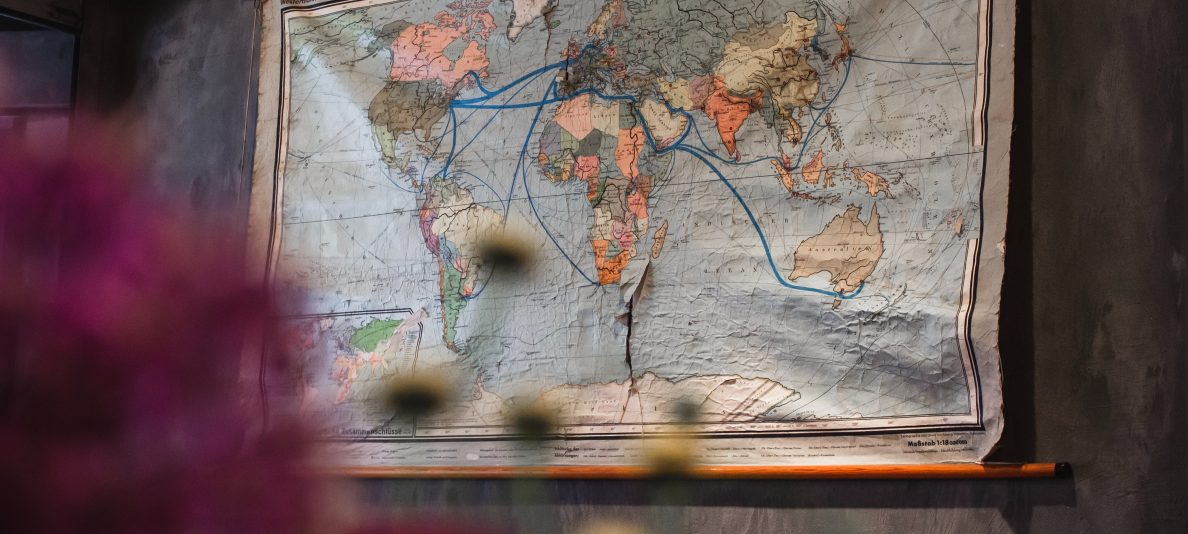
Noel, Missouri: Small-Town America and International City

10928762_e1b81e1c18_zFor many, strongman J. D. “The Ice Man” Anderson put Noel, Missouri, on the map. Leading up to his quarterfinals performance on America’s Got Talent this week, he talked about how the people in his hometown “wouldn’t even fill up the balcony at Radio City Music Hall.” He then went on to snap baseball bats in two, smash cinder blocks, and run headlong into blocks of ice.

Ask your grandparents and they might remember Noel’s heyday as a place to send holiday mail for its “Christmas City” postmark. With the help of singer Kate Smith telling the “Noel Story” on the radio in the 40s and 50s, more than half a million pieces of mail passed through Noel each year in the days leading up to Christmas.

Noel’s high point as “Christmas City” is probably behind it (the high point for mailing Christmas cards anywhere is probably in the past), and Anderson didn’t make it to the semifinals of America’s Got Talent.

But that doesn’t mean Noel’s time in the spotlight is gone. In fact, the small Ozark town can now stake a claim as an international city, with more per-capita cultural diversity than most metropolises hundreds of times its size.

The Joplin Globe reports that it all started when the Hudson Foods chicken plant in Noel recruited Hispanic workers from along the US-Mexican border. After Tyson bought the plant in 1998, more and more immigrants arrived, including refugees from Africa. Today, nearly two-thirds of the plants 1,500 workers are “minorities,” representing such places as Mexico, Somalia, Sudan, Micronesia, Kenya, Laos, Myanmar, and Ethiopia.

But the influx of immigrant workers to this town of 1,800 hasn’t always gone smoothly. A 2002 article in The Kansas City Star focuses on the difficulties—the graffiti, the stares, the shouted slurs. James Carroll, mayor of Noel, tells The Globe that when the Somalis came to town, a Mexican resident said to him, “I now know how you felt when we came here.”

According to a broadcast from Harvest Public Media, which was aired by NPR, in August of last year the tires on more than a dozen cars owned by Somalis were slashed. And Somali workers say they don’t feel welcome at Kathy’s Kountry Kitchen on Main Street, where servers wear t-shirts that say, “I got caught eating at the KKK.”

While it’s clear that some in the Noel community wish the immigrants and refugees hadn’t come, there are also many in Noel open to the changes and helpful to the new arrivals.

“If you want to know what America is,” Angie Brewer tells Harvest Public Media, “come sit in front of the feed store and watch people go by in a turban, in an island skirt and in their overalls, and they’re all just going to work.” Brewer is principal at Noel Elementary, where about 11 languages are spoken by the school’s 400 students. She says that the schools are the “government agency in town.” “People come here if they need shoes, if they need clothes, if they’re hungry. We send 37 backpacks home every weekend with kids that just don’t have enough food.”

The schools play a big part in the lives of the immigrant children because of the opportunities that education provides. This is a theme that we hear in comments, recorded by Harvest Public Media, of the children of the immigrant workers:

Soe Soe, 18, from Myanmar, grew up in refugee camp in Thailand. Instead of going to high school, he works at the plant to support his family, taking English classes in Noel offered by Crowder College. “I have problem,” he says. “I cannot speak English. I think one day, when my sister already 18, I can go school. She say, ‘Don’t worry my brother. I gonna support you.'”

Eighteen-year-old Oscar is from Mexico. He came to Noel with his mother when he was two and was a senior in high school at the time of the interview. “Right after high school, I will be going to college. I will be the first of my family to go to college. That’s what motivates me, right now, to finish high school.”

Brewer and her colleagues want to make sure that none of the children miss out on the benefits of a good education. They want to make sure that none miss out on having any of their needs met. “No one’s going to fall through a crack in Noel, Missouri,” she tells Harvest Public Media.

It’s not going to happen. I mean some of these are my own children’s friends and these are my friends. They’re real people and you’re not reading about them on TV or hearing about them. They’re people that I know. I’ve been to their house. I’ve sat on their couch. I’ve held their hand. They’re real people and they deserve the best.

(“Noel Christmas Postmarks,” Noel, MO; Wally Kennedy, “Somali Refugees Follow Mexican Immigration to Missouri Community,” The Joplin Globe, May 7, 2011; Donald Bradley, “In Small-Town Missouri, a Collision of Cultures,” The Kansas City Star, June 11, 2012; Abbie Fentress Swanson, “Noel, Mo.: Schools Build Safety Net for Immigrant Children,” Harvest Public Media, October 27, 2013; Peggy Lowe and Abbie Fentress Swanson, “Their Dreams, in Their Own Words,” Harvest Public Media)

[photo: “Immigrant Nation,” by Ruby Sinreich, used under a Creative Commons license]

Superwomen of the Philippines Teach in Baltimore

It’s a not-uncommon cross-cultural story: A child flies away from his home country and is adopted into a whole new world. He grows up trying to be like the people around him, but he’s different. Maybe he should deny his past and just fit in. But denying who he is comes with a price. Embracing his true identity and exploring his heritage comes with a price, too. It’s an epic struggle, and the non-stop battles threaten to become his identity.

It’s the story of Superman.*

This past week, my wife and I watched last year’s Man of Steel on DVD. Following a trend in super-hero cinema, it tells the gritty, complex, discordant story of a superhero. And, of course, there’s action—so much thunderous, building smashing, ground shaking, tank-fisted action. In fact, right before the umpteenth fight between equally matched super people, my wife said, “Oh, not again.” The movie is entertaining, but it’s nearly 2 1/2 hours long, and with battle after battle, with the ultimate outcome never in doubt, all the excitement became . . . uh . . . boring.

A few days later, we watched another film about people landing in a new cultural landscape, leaving friends and family to try to make a difference in their own lives and those around them. This one is a POV documentary from 2011 called The Learning. It’s about four women from the Philippines, some of the 600 Filipino teachers, recruited by the school district, who teach in inner-city Baltimore.

“I only see America in television movies, in pictures of books, or in magazines,” says Dorotea, one of the four. “I haven’t had a picture of what America really looks like. . . . So this is it. This is America, where the dollars are found.”

Yes, these teachers can earn up to 25 times their salaries back home. That means they can send money back to the spouses, children, and parents whom they’ve left behind.

When she returns to her family after the end of the school year, Angel takes her five brothers and sisters, mom, and dad on their first-ever shopping spree. The money doesn’t seem enough to buy all that they want.

Grace, who has stayed in touch with her infant son by video chat during her time in the States, returns to the Philippines to find a boy who looks away and doesn’t want her to hold him.

“I know in the long run I will be in a better position,” she says. “I really have to suffer the consequences of what I did and what I’m doing.”

Rhea, who shares victories with the students in her special-education classroom, faces setbacks in her family life. While she’s away, her husband is arrested for selling drugs and faces the possibility of life in prison.

“I had this dream, you know, of going into a far place, bringing him wherever I go, and we will start something new—just us, no parents, no friends,” says Rhea. But her world has changed. “This is defeat for me. It’s like I’ve been fighting for so long for nothing.”

With tears, Dorotea says that this, her 24th year of teaching, is “full of adjustments, full of disappointments, full of hurts, full of . . . full of ill feelings.”

One of her high-school students tells her, “I wouldn’t leave my family if I was you. I’d stay over there. . . . You like it in the Philippines?”

Dorotea nods her head.

“You like it over here better?”

Smiling, Dorotea says, “It’s a very tough question.”

The four ladies of The Learning are real-life superwomen, which means they’re strong, but they’re not made of steel. It means they’re not actually superwomen. They’re conflicted, vulnerable, less-than-perfect. They fight battles, in the classroom and in their thoughts. One battle comes after another. But the ultimate outcome is certainly in doubt . . . and it’s anything but boring.

Directed by Ramona S. Diaz, The Learning originally aired three years ago. It is currently making an encore appearance online and is available for viewing through May 12.

*For a deeper discussion of Superman as Third Culture Kid, see Katherine Alexander’s “Clark Kent and Third Culture Super Power.”

Death by Envelope, and Other Tragic Postal Tales

8029186137_cf6ca85955_zI was wanting to mail a letter to our friends back in the US, but I had a problem. I had just been to the front counter at the post office and told the postal worker my plans. She pointed over my shoulder and said something about “over there.” I turned around, trying to act as if I knew what she’d said. (I’d only been in Taipei a few weeks, and the only thing I understood clearly was her pointing.)

Behind me, against the wall, was a table with a couple bowls of what looked like wall-paper paste, with a small brush in each one. They were for sealing envelopes, since the envelope flaps in Taiwan—and I assume, most of Asia—don’t have adhesive on them. I’ve been told this is because in the high humidity, the envelopes would glue themselves shut while waiting to be used. That explanation sounds perfectly plausible to me.

Behind the paste were two slots in the table. Each had a sign with a few Chinese characters on it. I went to the table and pretended to sort my mail for a while, pondering what I should do. What did the signs say? “Local Mail”? “Air Mail”? But the only time I’d ever seen slots like those were in the tables at the bank where you can fill out deposit slips—you know, the slots for throwing away your trash. So maybe the signs said, “Place Wastepaper Here,” and “Not for Mail.”

Beside the table was the door. Maybe the postal worker had pointed outside—to some mailboxes I hadn’t seen.

I made my decision, tossing my letter into one of the slots. I didn’t look back. I didn’t want to see the lady at the counter shaking her head at me. Instead, I hurried home and emailed our friends: “Let me know if you get a letter from us. Either I mailed one to you or just threw it away.”

A week later, they wrote back and said it had arrived. Sometimes, in spite of myself, I got things right.

It took me quite a while to get over my nervousness going to the post office. For expats, it can be a pretty scary place—in large part because there’s so much at stake. You’re often sending important documents or valuable parcels (like hand-drawn pictures to Grandma and Grandpa). And once you stick on the postage and drop them in the mailbox, there’s no do over.

Lick at Your Own Risk

Not long ago, here in the safety of the US, I was helping a friend from Asia prepare some papers for mailing. I handed him the envelope, and seeing that there wasn’t any paste available, he tried to peel the backing off the self-stick flap. The trouble was, the flap wasn’t peel-and-seal. When he realized he needed to lick it, he laughed and said he’d heard about people putting poison on the adhesive. I told him that’s never happened, because . . . uh . . . that’s never happened . . . right?

Well, I did some research, and I’m sticking by my assertion, but it seems that my friend is more up on American pop-culture than I am. How about you?

First, there’s this cautionary tale that began circulating by email in 1999:

Whenever you go to an automatic teller machine to make deposits, make sure you don’t lick the deposit envelopes. A customer died after licking an envelope at a teller machine at Yonge & Eglinton. According to the police, Dr. Elliot at the Women’s college hospital found traces of cyanide in the lady’s mouth and digestive system and police traced the fatal poison to the glue on the envelope she deposited that day. They then did an inspection of other envelopes from other teller machines in the area and found six more. The glue is described as colourless and odourless. They suspect some sickco is targeting this particular bank and has been putting the envelopes beside machines at different locations. A spokesperson from the bank said their hands are tied unless they take away the deposit function from all machines. So watch out, and please forward this message to the people you care about . . . Thanks

Completely false, says the urban-legend site Snopes.com. But when has that ever stopped an internet fable from gaining traction?

Snopes also tackled another email that made its debut in 2000. It’s about poor lady number two falling victim to the dangers of envelope glue:

This lady was working in a post office in California, one day she licked the envelopes and postage stamps instead of using a sponge.

That very day the lady cut her tongue on the envelope. A week later, she noticed an abnormal swelling of her tongue. She went to the doctor, and they found nothing wrong. Her tongue was not sore or anything. A couple of days later, her tongue started to swell more, and it began to get really sore, so sore, that she could not eat. She went back to the hospital, and demanded something be done. The doctor, took an x-ray of her tongue, and noticed a lump. He prepared her for minor surgery.

When the doctor cut her tongue open, a live roach crawled out. There were roach eggs on the seal of the envelope. The egg was able to hatch inside of her tongue, because of her saliva. It was warm and moist. . . .

This is a true story. . . . Pass it on.

Actually not true, but extra points for the graphic detail.

The Website TV Tropes reports that over the years, the poison-envelope theme has occurred in several TV crime shows. But the most famous example was part of the comedy Seinfeld, when George’s fiancée died after licking the toxic adhesive on some 200 cheap wedding invitations.

So no wonder my friend didn’t want to lick the envelope. Oh, sure, I could tell him his fears are based on urban legends, ridiculous story lines, and misguided fear. I could tell him that expats are especially susceptible to rumors and fantastic stories. But still . . . there was Mr. Fechheimer, mentioned in the 1895 New York Times:

S. Fechheimer, formerly a merchant of New-York, died here yesterday from blood poisoning as a result of cutting his tongue while licking an envelope. He was a rich man until a few years ago, when the panic came and brought ruin. He was the senior member of the firm of Fechheimer, Rau & Co., New-York shirt manufacturers.

So please be careful. And the next time you have to mail a letter, you might want to use a sponge.

(Barbara Mikkelson, “Dial ATM for Murder,” Snopes.com, September 2, 2006; Barbara Mikkelson, “Cockroach Eggs,” Snopes.com, January 22, 2014; “Finger-Licking Poison,” TV Tropes; “Poisoned by Licking an Envelope,” The New York Times, May 4, 1895)

[illustration: “Lick the Envelope,” by Rick & Brenda Beerhorst, used under a Creative Commons license]
Peanut Butter and Nutella: A Tale of Two Spreads

6398248857_aefa147739_mA few days ago I was the only one in the house at lunch time and I couldn’t find the peanut butter to make a peanut-butter-and-jelly sandwich.

No peanut butter? Why, it seemed downright un-American. And not only that, but it was nothing less than a betrayal of my upbringing.

An American Staple

Writing in the Pacific Standard, Karina Martinez-Carter quotes Jon Krampner, author of Creamy and Crunchy: An Informal History of Peanut Butter, The All-American Food. “Peanut butter,” he says, “embodies the raw primordial heart of American childhood.”

PB&Js are so fundamental to our formative years that, according to the National Peanut Board, the average American will eat 1,500 before graduating from high school.

Peanut butter is part of what makes America America. Even those from outside our borders know it’s so.

While it’s not nearly so popular around the world, once people arrive in the US, they are pulled in by the gooey spread. After giving us another quotation from Krampner—“immigrant kids tend to take to it as a part of their Americanization process”—Martinez-Carter tells of her own experiences:

My father is a first-generation Mexican immigrant and my sister adopted from China, and our cupboard reliably contained a jar of peanut butter we dug into daily. Much like how my sister’s English as a Second Language class teacher screened the classic Disney movies for her kindergarten students to catch them up on cultural references, developing a taste for peanut butter is a component of the acculturation process in the U.S. It is sustenance for understanding America.

Peanuts have their own story to tell about immigrating to America. According to the National Peanut Board, Europeans first came across peanuts while exploring Brazil. Later, Spanish explorers brought peanuts back home from their excursions into the “new world.” From Spain, they were introduced to Asia and Africa. And finally, in the 1700s, Africans brought peanuts to what is now the US.

But it wasn’t until 1884 that Canadian Marcellus Gilmore Edson received a US patent for creating a peanut paste, which he used for making a type of peanut candy. In 1895, John Harvey Kellog invented his own version of peanut butter, a year after he and his brother invented corn flakes. And peanut butter got it’s public debut at the 1904 World’s Fair in St. Louis, when C. H. Sumner sold it at his concession stand.

Now, back to my can’t-find-the-peanut-butter dilemma. I’d already spread my jelly, and I had to eat. So I did what I had to do . . . and used Nutella instead.

The Hazelnut Alternative

6398251975_042c8b2e79_mThere it was, a jar of Nutella sitting where I thought the peanut butter should be. (Since we’re still unpacking from our move, there are a lot of things out of place.)

I don’t know where it had come from.

Well actually I do. It had come from all over the world.

According to the Organisation for Economic Co‑operation and Development (OECD), Nutella is such a good example of the “global value chain” that the group used the chocolate-flavored hazelnut spread as a case study for one of its policy papers.

Here’s the globality of Nutella: Ferrero, the Italian company that produces Nutella, is headquartered in Germany. The ten factories that make Nutella are located in the European Union, Russia, Turkey, North America, South America, and Australia. As for the ingredients, a list with their origins includes

  • hazelnuts mainly from Turkey
  • palm oil from Malaysia, Papua New Guinea, and Brazil
  • cocoa mainly from Ivory Coast, Ghana, Nigeria, and Ecuador
  • sugar mainly from Europe
  • vanilla flavor from Europe and the US

Put it all together and you have a product that’s sold in 75 countries. OECD even made a map to show Nutella’s main suppliers, factories, and main sales offices.

Invented by Pietro Ferrero in the 1940s, Nutella has become the self-proclaimed “number one spread in Europe.” And while it hasn’t yet become a major competitor to peanut butter in the US, it does have it’s devoted Stateside fans.

Take, for instance, the students of Columbia University. Last year, the Columbia Daily Spectator, the school’s newspaper, launched headlines around the country when it reported that in just the first week Nutella was added to the menu at two dining halls, students went through $5,000 worth of the spread. Dining Services said that students were consuming up to 100 pounds of Nutella daily. And by “consuming,” I mean eating it for meals and stealing jars to take home. It was what one student called “all you can eat, and all you can hide.”

If that rate held up, noted the Spectator, it would cost the dining halls $250,000 a year.

But, alas, the numbers didn’t quite hold up. Another article in the newspaper two days later reported that the first week’s Nutella demand actually cost Dining Services $2,500, not $5,000, and the amount quickly faded to $450 a week after that. But even with the revised numbers, that’s still a lot of hazelnut spread.

I guess I can see the appeal. Nutella isn’t necessarily my thing, but I’m sure I would have liked it when I was in college. My mother never let me eat chocolate frosting by the spoonful when I was growing up, but at college, with no Mom looking over my shoulder, I could have eaten all the frosting . . . uh . . . Nutella I’d wanted.

Well, my college days are now long behind me, and I have new voices in my ear (many of which sound a lot like Mom’s). I don’t think I’ll ever develop an extreme taste for Nutella. I do like a good peanut butter and jelly sandwich, though. You really are what you eat, or at least you are what you ate when you were a kid. And I sure did eat a lot of PB&J sandwiches.

PB&Js. What a strange thing, my friend from Asia once told me. She had never seen one, but she’d heard about them. Why, she asked, would Americans want a sandwich made from peanuts, butter, and jelly. Strange indeed.

(Karina Martinez-Carter, “As American as Peanut Butter,” Pacific Standard, February 14, 2014; “Fun Facts,” National Peanut Board; “History,” Peanut Butter Lovers; Koen D. Backer and Sébastien Miroudot, “Mapping Global Value Chains,” OECD Trade Policy Papers, No. 159, OECD Publishing,  2013; Cecilia Reyes, “Nutella in Ferris Booth Costs Dining $5,000 per Week, in Part Due to Dining Hall Thievery,” Columbia Daily Spectator, March 5, 2013; Finn Vigeland, “University Says Nutella Cost $2,500 in First Week, less than $500 After,” Columbia Daily Spectator, March 7, 2013)

[photos: “Jif Peanut Butter” and “Nutella,” by Brian Cantoni, used under a Creative Commons license]
A DIY Banquet of Global Proportions, $1 at a Time

B-E-R-Y-A-N-I

I had to go back a second time to get the spelling from the lady handing out servings of her dish. She was standing at the Middle East table, sponsored by the Islamic Society of Joplin, part of the World Cuisine and Music Festival at Missouri Southern State University.

The music included an African marimba band, a mariachi band, a Chinese ensemble, and a Caribbean steel drum group.

And the food . . . well here are the five  $1 dishes that I chose for my meal:

Iraqi Beryani

2448042544_34a53a326a_qFirst there was the Iraqi Beryani. There are many versions of beryani (also spelled biryani), depending on the area of the world, but the cook wanted to make sure I knew the one she was serving was the Iraqi variety. It had long-grain rice, chicken, peas, potatoes, and—a surprise to me—almonds and raisins. All the spices and flavors worked so well together that I came home and Googled how to make it on (that’s why I had to double-check the spelling).

I found several recipes, but the one that seems closest to the dish I sampled is from “Chef Zina,” highlighted on the website of CWS. Another recipe option is at the Nestlé Middle East site. More from Nestlé later.

Tea Eggs

8493882246_3ddc931fcb_qAt the Chinese table, I spotted some tea eggs (also called five-spice eggs). They’re not exactly a delicacy, but I couldn’t pass up the chance to have one. It had been a few years since I’d picked up my last one from the brown-stained rice cooker sitting on the counter of a 7-Eleven in Taipei. For those who aren’t familiar with tea eggs, they’re hard-boiled eggs soaked in tea seasoned with soy sauce and a mixture of spices. The shells are cracked, letting the tea soak into the eggs, flavoring them and giving them a marbled brown color. If you’d like to make your own, I found a fairly simple recipe at Kirbie’s Cravings. (It calls for Chinese five spice, which my wife says is easy to find.)

A Couple Dishes from the Pros

Along with the MSSU faculty, staff, and students who provided dishes for the festival were local restaurants. From M & M Bistro I got a snack-sized version of their “Mediterranean Platter.” Go to their page for photos from the event.

And from Flavors International Cuisine, specializing in Indian-Pakistani dishes, I got chicken curry and rice. (I see on their site that they also serve biryani at their restaurant. Need to give that a try.)

No recipes here, just recommendations for two good places to eat.

Chocolate Mousse 4248844482_20e315935d_q
Finally, my five-course meal was complete with a cup of chocolate mousse from the Belgian table. It was served in a small, clear plastic cup. I’m pretty sure that if I had been in a fancy restaurant, and the same dessert had been in a champagne flute, topped with whipped cream and a sprig of mint, it could have sold for 5 times as much as the $1 price tag.

So how can I make my own mousse to impress my friends and neighbors? The answer, it seems, is easier than I would have thought. NPR reported last month that the secret to authentic “rich, creamy, dark, dreamy, delicious chocolate mousse,” as Dorie Greenspan, author of Around My French Table, describes it, is not a secret at all. Greenspan, who has lived part time in Paris for 16 years, says that it took nearly all of one of those years to get a good friend to reveal her recipe. But finally she handed it over, literally. Her friend gave her a Nestlé chocolate bar, and on the back of the wrapper was “the recipe for the mousse every savvy French cook makes.” The ingredients are simple: bittersweet chocolate, eggs, salt, and sugar. That’s it.

Now that I have the recipes, I’m motivated to do some cooking, or at least see if I can beg my wife into doing it for me. It remains to be seen if I’ll actually get it done. I’m already looking forward to next years festival.

(“Paris Confidential: The Mystery Mousse behind the Chocolate Bar,” All Things Considered, NPR, February 13, 2014)

[photos: “Biryani Rice,” by Maria, used under a Creative Commons license; “Chinese Marbled Tea Egg,” by Kattebelletje, used under a Creative Commons license;  “Chocolate Mousse.” by Ulrika, used under a Creative Commons license]

Two Who Help International Students in Small Ways That Turn Out to Be Very Big

I’m going to brag on a couple friends of mine. Both of them are shining examples of devoted service to the international students who come to our communities. Both of them live in small cities in the Midwest: one in Pittsburg, Kansas, and the other in Joplin, Missouri. And while they are content to serve in quiet ways, each has recently been highlighted in local media.

Helping Students Get Around . . . on Two Wheels

1653027386_4dba5e754a_qFor over three decades, Don Smith—through Campus Christians—has been ministering to the students at Pittsburg State University in Pittsburg, Kansas. Throughout that time, more and more of those students have come from other countries.

In fact, today, a significant part of Don’s work is collecting, repairing, and distributing bicycles to the more than 450 international students at PSU. It was this bicycle ministry that caught the attention of The Joplin Globe, which ran a story about him.

Don told The Globe that he got the idea to loan bikes to international students 30 years ago, when he saw a similar program at the University of Missouri. That story means something to me, as I was a student at MU 30 years ago, living at the Christian Campus House, the place where Don got his inspiration. A few years later, I became the campus minister to inernationals at CCH and took over the bike ministry. But Don’s efforts go well beyond anything that I was able to do.

One of the first lessons he learned was how to keep bikes in the program. It was easy to give bicycles out. “But the first year,” Don told The Globe, “not one bike came back. Not one.”

The solution came in two parts: using stronger locks and charging a deposit of $35, which is refunded when the bike is returned. That’s increased the return rate to about 75%.

Since the beginning of July, Don has distributed 200 bikes. And as word has gotten around, American students are taking advantage of the ministry as well.

Word certainly has gotten around, not only about the bikes but about all the work that Don is doing. Two years ago, he received the Ralf J. Thomas Distinguished Service Award from PSU, and last month he and his wife were honored by Ozark Christian College, their alma mater, with the Seth Wilson Outstanding Alumnus Award.

(Andra Bryan Stefanoni, “Have Bike, Will Travel: Campus Minister Provides Wheels to Students,” The Joplin Globe, February 14, 2014)

A Mom to Many

2956042901_4e983192a0_q“Mom.” That’s what scores of international students at Joplin’s Missouri Southern State University call Linda Keifer. For nine years, she and her husband, Jerry, have invited guest from around the world into their home.

“It started with a few, and then they invited their friends,” Linda told The Chart, Missouri Southern’s student newspaper. “This is what God wanted us to do.”

Several students also shared in the article what they liked about being part of the Keifers’ extended “family”:

“It’s family Sunday: to eat, relax, listen to each other, to talk about worries, hopes, dreams and wishes,” said Stephanie Kiessling from Germany. “They are sharing the American tradition and the international students [are] sharing theirs as well.”

And Lei Lei, from China, said, “When I speak to them, I feel like I’m talking to a genuine mother and father. They make me feel appreciated, welcomed, and at home.”

Linda’s ministry came full circle last year when she and Jerry traveled to Asia, becoming the guests and receiving hospitality from the students and their families.

Being part of a family means sharing in the highs and lows. So when Linda was diagnosed with colon cancer last year, the students gathered around the Keifers and comforted them. That comfort has continued as Linda has gone through surgery and receives treatment.

Just a few weeks ago, Jerry told me how much the students’ kindness has meant to them. That’s often the way it is: When we reach out to help others, we often receive as much, if not more, than we give.

(Xiaoyu “Jamie” Wu, “Mom Opens Home to Students,” The Chart, October 31, 2013)

Don and Linda wouldn’t meet a strict definition of “globally famous,” but that doesn’t mean they haven’t gained international fame, at least among those who have been touched by their simple generosity, by those who call them friends . . . and sometimes “Mom” or “Dad.”

[photos: “Bicycle,” by JMC Photos, used under a Creative Commons license; “Door Knob,” by zizzybaloobah, used under a Creative Commons license]

Not All Ambassadors Start with Degrees in International Studies

2603281699_b8cfbb2d8c_n
The US Embassy in Prague, Czech Republic

Hearing about the death of Shirley Temple Black got me to wondering if any current US ambassadors have such a compelling background. Alas, it’s hard to match Temple Black, who became a film superstar at the age of six and went on to star in over 40 movies before becoming ambassador to Ghana and Czechoslovakia. But I did find several ambassadors whose lives before diplomatic service strike me as interesting.

I guess “interesting” sounds pretty bland. But saying something such as “fascinating,” “captivating,” or “spellbinding” would be a little over the top. If I were going for clicks (like some news sites that will remain nameless), I’d have titled this post “Twelve Ambassadors Whose Backgrounds Will Stun You.” While that’s pretty far from the truth, I really do think that their stories are still, well, interesting.

First, a word about my selections: I started with The American Foreign Service Association’s “List of Ambassadorial Appointments,” where I clicked on the names of people with links to US Department of State bios.

Most of those listed below are political appointees rather than career diplomats. The former seems to offer the larger amount of noteworthy backgrounds. Of course, getting an advanced degree in international relations, attending the National War College, or becoming a career member of  the Foreign Service is pretty impressive. For ambassadors, though, it’s just not uncommon enough to earn a mention here.

By the way, my definition of interesting is purely subjective. No offense to those who didn’t make the cut.

So here’s what it takes, in a roundabout way, to become an ambassador . . . that and the good favor of a sitting president:

Thomas Hart Armbruster
US ambassador to the Marshall Islands
Prior to joining the Foreign Service, Armbruster was a reporter for KGMB-TV, a CBS affiliate in Hawaii.

Matthew Barzun
US ambassador to the United Kingdom
Barzun was the fourth employee at CNET and later became executive vice president and chief strategy officer of the tech website. While there, he launched Download.com and led in the development of Shopper.com.

John Berry
US ambassador to Australia
Berry previously served as director of the National Fish and Wildlife Foundation as well as director of the National Zoo.

James Costos
US ambassador to Spain and Andorra
Before becoming an ambassador, Costos was vice president of global licensing and retail for HBO. Prior to that he served as a vice president for the Italian company Tod’s, seller of shoes and luxury leather goods, and for Hermès of Paris.

Caroline Kennedy
US ambassador to Japan
The daughter of President John F. Kennedy, Ambassador Kennedy is the author and editor of several books, an education advocate, and a supporter of the arts. As president and director of the John F. Kennedy Library Foundation, she helped create the Profile in Courage Award.

Alexandar Mark Laskaris
US ambassador to Guinea
Earlier in his career, Laskaris taught English and mathematics at St. Boniface High School in Galeshewe, Northern Cape Province, South Africa.

Jeffrey Levine
US ambassador to Estonia
Levine was previously a newspaper reporter for seven years and was a founding staff member of USA Today.

Bruce Oreck
US ambassador to Finland
For several years running, Oreck was the winner of the Colorado State men’s masters body building championship. He has also put together one of the leading fine-mineral collections in the US, and he and his wife donate mineral specimens to museums across the country.

David D. Pearce
US ambassador to Greece
Before joining the Foreign Service, Pearce was a journalist, working for the Associated Press in Ohio; the Rome Daily American in Italy; United Press International in Brussels, Lisbon, and Beirut; and the Washington Post. He also worked as a writer-editor in the book service of the National Geographic Society.

Samantha Power
US permanent representative to the United Nations
Born in Ireland, Power came to America when she was nine years old. She has been a journalist, contributing regularly to The Atlantic MonthlyThe New RepublicThe New York Review of Books, and The New Yorker Magazine, and she won the Pulitzer Prize for her book  “A Problem from Hell”: America and the Age of Genocide.

Theodore Sedgwick
US ambassador to Slovakia
Sedgwick founded Pasha Publications and Io Energy and was president of Red Hills Lumber Co., which produces pine flooring. He has also served on the boards of a wide range of organizations, including Inside Higher Ed; the Folger Shakespeare Library; the Shakespeare Theater Co.; the Gennadius Library in Athens, Greece; the Civil War Preservation Trust; and the Ducks Unlimited affiliate Wetlands America Trust.

Alexa L. Wesner
US ambassador to Austria
Wesner was born to a German mother and Latvian father who had immigrated to the United States. In high school she was an all-American in track and cross country, and in 2003 she qualified as a member of the US national team for the World Triathlon Championships.

[photo: “American Embassy in Prague,” by Matt Dell, used under a Creative Commons license]

Doing the Culture Slide: Living with the Confusing Effects of Globalization

5043651435_3d6a657c89
Donald McDonald at an iCon’Chicken event in Japan

The culture slide. It’s not a dance for expats—though sometimes it may feel like it.

Culture slide is the name I’ve given to the confusion and shifts in thinking brought about by globalization.

It’s when your kids grow up in Taipei and think that Giordano clothing stores must be from Italy (they’re actually from Hong Kong) and they must have outlets in the US (they don’t). Likewise, Napoli sounds Italian, but the pizza chain is Taiwanese. Then there’s NET (from Taiwan), Fnac (from France), and B&Q (from the UK). And as much as they may feel like GAP, Best Buy, and Home Depot, the kids didn’t find any of them when they traveled to the US.

It cuts the other way, too. Back in the States, we think we should be able to order corn soup and extra-spicy extra-crispy chicken at KFC. . . and tuna and peas should be available as toppings at Pizza Hut. And we’re pleasantly surprised to find out that IKEA and Yoshinoya are in the good ol’ US of A, too—even if they haven’t made it to our part of the country yet.

That last part reminds me of a story attributed to Den Fujita, founder of McDonald’s in Japan. In Asian Brand Strategy: How Asia Builds Strong Brands, Martin Roll writes about Fujita saying, “Once a group of Japanese Boy Scouts visited the United States and were asked by a local television station what their impression of America was. One boy replied, ‘I didn’t know that they had McDonald’s in the United States, too.’” Maybe you’ve heard that story before, but that time it was a Japanese boy in Florida or a Japanese girl in Los Angeles or a French girl in Times Square or a European boy or a little boy from Indonesia. It’s all so confusing.

Donald McDonald

Ahhh, McDonald’s, the king of globalization, and the instigator of so much culture slide.

Not only does McDonald’s localize their menus wherever they go—which might make Germans think that all the world’s restaurants have McCurrywurst—but they’re selections also cross borders in some fairly strange ways. A couple years ago, Germany’s McDonald’s introduced bubble tea, a drink with chewy tapioca balls that was invented in Taiwan. Here’s the commercial:

As others have pointed out, why is the actor yelling, “Bubblezzaaiii”? Is he trying to sound Japanese?

So that brings us back to Japan, the country with the second most McDonald’s restaurants, next to the US. Fujita brought “Donald McDonald” (it’s easier to pronounce that way) to his country in 1971, writes John Love in McDonald’s: Behind the Arches, with the idea that the restaurants would have to look “100 percent Japanese.” Love quotes Fujita as saying, “If I insisted that this was something that came from America, the Japanese would say, ‘This is American, and we don’t like it because we don’t like Americans.'” It seems that in Fujita’s eyes, they didn’t disdain all things Western, as he’s also credited in Love’s book with telling reporters,

The reason Japanese people are so short and have yellow skins is because they have eaten nothing but fish and rice for two thousand years. If we eat McDonald’s hamburgers and potatoes for a thousand years, we will become taller, our skin will become white, and our hair blond.

It will be some time before that can be proven or disproven, but it didn’t take nearly as long for McDonald’s in Japan to warm up to its American roots. Right now it’s in the middle of a campaign with throwback menus featuring “American Vintage” food from the ’50s, ’70s, and ’80s—or at least it features what some in Japan think is vintage American food. The offerings include a burger with two beef patties, an egg, and mashed potatoes between the buns (’50s), “Hot & Groovy” chicken sandwiches topped with salsa (’70s), and sandwiches with the addition of BBQ sauce (’80s).

Now that’s the way, uh-huh, uh-huh, I like it, uh-huh, uh-huh.

Sing Along with Me: “Baseball, Hot Dogs . . .”

I’m just glad that here in the US, we’ve got a pretty good handle on who we are and what is ours. We know that McDonald’s is a genuine American export, even if the menu changes around the globe. We also know that no matter how much the world tilts on its cultural axis, we’ll always be able to count on things like baseball, hot dogs, apple pie, and Chevrolet. Remember that chorus from the Chevy commercial in 1975?

To review, that’s baseball (where all the balls used in the Major Leagues are made in Costa Rica), hot dogs (which originated in Germany), apple pie (first made in England), and Chevrolet (which is the third-best-selling auto brand in the US, behind Toyota).

In 2006, Chevrolet came out with a new version of their song, once again advertising America’s “favorite brand.” The chorus was updated with several new versions, such as “stolen bases, goat-cheese pizza, bottled water, and Chevrolet.” The commercial ended with the tagline “The world has changed. But the love affair continues.”

I can’t attest to the love affair, but, boy, the world sure has changed.

Step, two, three, four. Doing the culture slide.

(Martin Roll, Asian Brand Strategy: How Asia Builds Strong Brands, New York: Palgrave Macmillan, 2006; John F. Love, McDonald’s: Behind the Arches, New York: Bantam, 1995; Michelle Lynn Dinh, “McDonald’s Japan Serving ‘American Vintage’ Burgers Starting This January,” RocketNews24, December 28, 2013)

[photo: “iCon’ Chiken FES._064,” by TAKA@P.P.R.S, used under a Creative Commons license]