Sorry—No Ifs, Sos, or Buts

139499559_0248586250_nIf you were following the news a couple weeks ago, you got to hear a great example of a straightforward, unequivocal apology from MSNBC host Melissa Harris-Perry. Earlier, on her show, she and her guests had made fun of a photograph showing Mitt and Ann Romney with their 21 grandchildren. The subject of their jokes was that everyone in the photo was white, except for the adopted African-American baby sitting on Mr. Romney’s knee.

In a tweet following the show, Harris-Perry wrote, “I am sorry. Without reservation or qualification. I apologize to the Romney family.”

That kind of an apology is hard to come by. It’s hard to get, and it’s hard to give. But it’s the kind of apology necessary for healthy repentance and healthy relationships—and for healthy good-byes.

R is for Reconciliation

In their book, Third Culture Kids: Growing Up among Worlds, Third Culture Kid experts David Pollock and Ruth Van Reken advise that those transitioning from one country to another should build a “RAFT.” The four parts of that raft are

  • Reconciliation
  • Affirmation
  • Farewells, and
  • Think Destination

“Reconciliation,” say the authors, “includes both the need to forgive and to be forgiven.” And this forgiveness is especially important preceding a move across time zones and oceans.

When transitions approach, those leaving—and those staying—have a small window of opportunity for a face-to-face healing of wounded relationships, a window that gets smaller as the departure gets closer. That’s why apologies become more and more necessary, even at a time when they may seem more and more difficult.

But simply deciding to say “I’m sorry” isn’t enough, because not all apologies are created equal. In fact, we live in the age of the “non-apology apology.” When you say, “I’m sorry,” do you add on any qualifiers? Do extra words reveal your true feelings?

Or do your words of remorse stand on their own, with no ifs, sos, or buts?

No Ifs

The “If” apology is probably the most popular way to get out of a full confession. It goes something like this: “I’m sorry if my choice of words offended you.” What that says is “If my words offended you, then you must be very thin skinned. You should not be offended by what I said, because it wasn’t really offensive. But because you are upset, I would like you to know that had I known I was dealing with someone as sensitive as you, I would not have said what I said . . in your presence.” When this kind of apology is given, is there any real doubt in the speaker’s mind that someone is offended, hurt, etc.?

No Sos

Sos aren’t usually spoken—unless we’re particularly brazen—but they appear when we require something in return for our apologies. If they were actually to emerge from the recesses of our hidden motives and be vocalized, we might say, “I’m sorry . . . so now I’ll listen while you tell me there’s nothing to apologize for,” or “I’m sorry . . . so you need to stop blaming me,” or “I’m sorry . . . so you’re sorry too, right? (I’m more than willing to meet you halfway. That is the way it works, isn’t it?)”

No Buts

By definition, but means that what comes second is going to contrast with what came first. Sometimes the I’m sorry is just a way to softly introduce the “truth”: “I’m sorry, but you had it coming to you.” The but can also announce excuses: “I’m sorry, but I was really tired.” It can spread around the blame: “I’m sorry, but I’m not the only guilty party here.” Or it can even pass the buck on to all of humanity: “I’m sorry, but anyone else in my situation would have done the same thing. (And any reasonable person would agree.)”

Sorry Does Seem to Be the Hardest Word

It’s difficult to apologize without tacking on a weasel word or two, to just let our “I’m sorry” resonate in silence. I should know, as I’m guilty of using every kind of disclaimer above myself, several times. I’ve also left apologies unsaid.

So why is it so hard?

Maybe it’s habit. It’s easy to fall into old patterns, in particular when we’re under stress. And few things are more stressful than voicing an apology that’s been a long time coming. If you don’t want it to come out wrong, you might need to practice beforehand.

Maybe it’s self preservation. A real apology leaves us truly vulnerable. We have to drop our guard and be willing to take our licks.

Or maybe it’s because of the word sorry itself, coming from the Old English sarig, meaning “full of sorrow.” Today, sorry can range from a deep, sorrowful regret over something said or done to a simple usage that means “excuse me,” such as when we’re walking through a crowded hallway. And we also use it to express our sympathy for someone else’s sorrow, as in “I’m sorry for your loss.” I think it’s this last usage, in the context of an apology, that often get’s us in trouble. As with several examples above, our words sound less like “I’m sorry that I wronged you” and more like “I’m sorry you feel that way.”

Regardless of why it’s hard, it’s worth the effort. We need to mend relationships, and we need to bring healing to our own hearts. And we need to do it as soon as possible, so we don’t have to try to work it in at the airport.

And one more thing. There’s no guarantee that the person on the other end of an apology will forgive us. In fact, the deepest apologies come when we don’t think we deserve to be forgiven. And the greatest relief comes when we receive forgiveness anyway.

A Final Disclaimer

Maybe I’ve stepped on some toes with this post. I apologize if you’re bothered by what I’ve written, but sometimes I have a hard time getting my real meaning across, so please don’t think that any of it was on purpose.

I guess what I’m trying to say is “I’m sorry.”

Well, no. Not really.

(Melissa Harris-Perry, “An Apology from Melissa Harris-Perry,” MSNBC, January 4, 2014; David C. Pollock and Ruth E. Van Reken, Third Culture Kids: Growing Up among Worlds, Boston: Nicholas Brealey, 2009)

[photo: “Sorry!” by Andrew Yee, used under a Creative Commons license]

“An Extraordinary Theory of Objects”: A TCK in Paris and the Things That Keep Her Sane, Sort of

31703109_4ad6f7ce2c_nI just finished reading a cool little book entitled An Extraordinary Theory of Objects: A Memoir of an Outsider in Paris. It was a Christmas gift from my son, the one who got a Moleskine Journal from me.

An Extraordinary Theory of Objects is a series of vignettes by Stephanie LaCava about her move to France as a twelve-year-old in 1993, her years there growing up, and then her visits back again after attending college in the States.

On the cover of my copy of the book are romantically filtered and tinted photos of the Eiffel Tower, and on the pages inside, her writing style evokes the same kind of mood. If stories could be sepia-toned, this is how they might sound.

Actually, the filter through which LaCava encounters the world is her attachment to things. First, there are the small, curious relics—a skeleton key, a mushroom, an opal necklace found in the mud—that she gathers and places on her windowsill. Initially they replace her old collection, “everything that represented [her] past life and its predictable ways,” which is on a container ship making its way across the ocean from New York.

And then there are the objects she encounters from day to day, common things that she illuminates in copious footnotes often taking up more than half a page. Cataloging these objects gives her security and makes sense of her life in a new city . . . as she faces depression and what she calls her own “kind of crazy.”

Some might find her footnotes distracting, but they cover just the kind of obscure topics that intrigue me, such as a Japanese smuggler of black-market butterflies, a photo book dedicated to Salvador Dali’s mustache, and the origins of the tea bag. And they are replete with references to a variety of figures, from Pliny the Elder to Kurt Cobain, from Anne Boylen to Kate Moss.

Much of LaCava’s narrative is about time spent with her father, often searching flea markets for items to fulfill their eccentric tastes. At other times, she talks about her classmates at the international school. She says she was “mostly alone” her first year there. Even among these other outsiders, she doesn’t fit in.

I rode the bus to school and listened to my Discman while the girl in the back row threw gum wrappers at my head. The girls at school didn’t like me very much. They had never given me a chance, decided immediately that I didn’t belong, which was funny, as they didn’t either—at least not in France. They made me feel as if I had done something wrong, and they spoke badly about me to each other. Through my own odd rationalization, I decided excommunicating me meant they belonged to something, simply because I did not. . . .

Come the new academic year, the old class would be replaced with another set of students who had just moved overseas. Only a few remained year after year—and still the same insensitivity.

One day, a classmate tells her that she looks like Angela from the TV series My So-Called Life.

“I haven’t seen it,” she replies.

“Everyone’s seen that show,” he says. “Don’t you have friends in the States? They can send it to you.”

In a footnote, LaCava delves into the significance of the series, quoting Matt Zoller Seitz of The New York Times, who writes, “What the series’ narration does best: it shows how teen-agers try to control their chaotic inner lives by naming things, defining them, generalizing about them.”

That’s what LaClava does, as well—controlling the inner chaos of her life in a Paris suburb by naming the objects she encounters. Then, years later, she examines them even more closely and writes about them so that she can share with us her own kind of strange . . . and her own kind of normal.

(Stephanie LaCava, An Extraordinary Theory of Objects: A Memoir of an Outsider in Paris, New York: Harper Perennial, 2013)
[photo: “Eiffel Tower,” by charley1965, used under a Creative Commons license]

Studying Abroad: The Who, the Why, and the Why Not

OT-Open-Doors-2013-US-study-abroad-Infographic
Click for the full infographic from Open Doors

When the  Institute of International Education (IIE) releases its yearly statistics on international education, those concerning international students in the US get the most buzz. But another set of numbers, those on American students studying abroad, should get our attention, as well.

In 2011/12, over 280,000 students from the US took classes overseas. While this is an all-time high, overall only 9% of US students study abroad during their time as undergraduates.

Who are these students, and why do they study abroad while most others do not? First, I’ll talk about the who, and then I’ll move on to the why.

Who Decides to Study Abroad?

A look at the groups that make up the biggest proportions of study-abroad students gives a snapshot of who they are. Here are some of the largest percentages, along with the group in second place:

  • Females – 65%
  • Whites – 76% (Asians, Native Hawaiians, or Other Pacific Islanders – 8%; Hispanics or Latinos – 8%)
  • Undergraduates – 86% (Graduate students—excluding doctoral students – 13%)
  • Juniors – 36% (Seniors – 24%)
  • Students in the social sciences – 22% (Business and management – 21%)

And here, for good measure, are some numbers on where and how long:

  • The United Kingdom as host country – 12% (Italy – 11%)
  • For the summer, or eight weeks or less – 59% (One quarter to one semester – 38%)

Why Do They Go, while Others Don’t?

Several factors affect students’ plans to study abroad and their follow through. As would be expected, several studies show that socio-economic status plays a large role. Mark Salisbury, et al., in his oft-referenced research, found that a student’s intention to study abroad is positively related to family income and parental education. Other qualities that have positive effects on a student’s study-abroad plans are a high interest in reading and writing, and an openness to diversity concerning ideas and people. He also found that Asian Pacific Islanders are less likely than other races to make plans to study abroad

In a doctoral dissertation at the University of Minnesota, Jinous Kasravi presents findings indicating that barriers to studying abroad include the cost of study-abroad programs and restrictions on the use of financial aid, family resistance and the restrictions of cultural norms, concerns about being able to transfer courses, and lack of parental experience traveling internationally. The main focus of Kasravi’s study was factors influencing students of color in study-abroad decisions. His findings indicate that, in spite of the obstacles, a key determining factor for non-white students is “personal internal drive and determination to have this type of overseas experience.”

A study by April Stroud further adds to the findings, showing that negative factors for studying abroad include having plans for a graduate degree, living with family while going to school, and having majors such as engineering, architecture, or medicine.” Positive factors include wanting to better understand other cultures and countries and attending a college or university over 100 miles from one’s home.

This last point, the distance school is away from home, is the topic of a recent New York Times article. It discusses whether students who attend college far away from their home are more likely to choose a more “challenging” country (say, Cambodia  vs England) as a study-abroad destination. Bruce Poch, former dean of admissions at California’s Pomona College, says that going to a challenging country requires a certain level of independence in a student, the same kind of independence that would cause a student to pick a college far from home. “And there’s still an adventuresomeness to students who choose that path,” he says, “There are just a lot of kids who don’t want to go to school with the same people they went to high school with, and they do that against a lot of pressure.”

Richard Bright is director of off-campus study at Grinnell, where most students come from out of state and 65% of juniors study abroad. “[W]e do know that most of our students are taking a flight here,” says Bright in the article. “So plenty of students are coming from distant parts of the country, and then they really go all over the world.”

Joseph Brockington is the director for the center for international programs at Kalamazoo College in Michigan. He brings the whole discussion—about choosing a country or even to go abroad at all—back to the importance of parental influence. Parents, Brockington tells The New York Times, are concerned “about whether their kids will be taken care of. So we try hard to dispel the rumors, but if Mom’s against it, it’s not going to happen.”

(Open Doors 2013: Report on International Educational Exchange, Institute of International Education, 2013; Mark H. Salisbury, “Going Global: Understanding the Choice Process of the Intent to Study Abroad,” June 2008; Jinous Kasravi, “Factors Influencing the Decision to Study Abroad for Students of Color: Moving beyond the Barriers,” August 2009; April H. Stroud, abstract of “Who Plans (Not) to Study Abroad? An Examination of U.S. Student Intent,” Journal of Studies in International Education, November 2010; Michael A. Wilner, “Are Students Who Go Far Away to College More Likely to Study Abroad?The New York Times, June 10, 2013)

[Infographic courtesy of Open Doors 2013: Report on International Educational Exchange, Institute of International education, 2013]

If You Can’t Take a Walk in Someone Else’s Shoes, Try Taking a Good Look at Them

111377949_149f00bba9
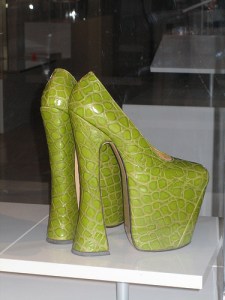
A pair of shoes on display at Toronto’s Bata Shoe Museum, which houses the world’s largest collection of shoes and footwear-related objects..

When my family first moved to Asia, I seemed to see Americans every time we rode the subway. Later, I lost some of my cultural myopia and realized that a lot of those “Americans” were Europeans, or South Africans, or . . . . Of course the biggest giveaway was to hear them speak. Hairstyles and clothing helped, too.

Then I started looking at shoes. There’s just something telling about our shoes. Maybe it’s flip-flops vs dress shoes, or Nikes vs a brand of indoor soccer shoes I’ve never heard of. I’m no expert on footwear, and I can’t always put my finger on what’s different, but I know it when I see it.

You can tell a lot by looking at people’s shoes.

Take, for instance, the “array of worn-down, ill-fitting, and jerry-rigged shoes” worn by refugees fleeing military campaigns in Sudan, escaping into South Sudan in 2012. Shannon Jensen chronicled their journey by photographing their shoes. Her series of photos, “A Long Walk,” won an Award of Excellence from Pictures of the Year International (POYi).

Take, for instance, Yuxin Horatio Han’s Unifold shoes. Han grew up in China and developed his “origami” shoes, inspired by Indian moccasins, at Pratt Institute’s School of Art and Design in Brooklyn. Each of Han’s shoes—he’s created two different prototypes—are made from a single piece of foam rubber. After the pattern is cut with a die, the shoe can be folded together in a two-minute process. Han is currently tinkering with the design and looking at alternate fabrics, and when he’s done, cheap, easily assembled shoes could become available to the world market.

Take, for instance, the thousands of pairs of footwear on display at the Bata Shoe Museum in Toronto. If you’re in the area, check out their exhibit “Collected in the Field: Shoemaking Traditions from around the World.” Or online, browse through “The Shoe Project,” a collection of stories by 14 women who have immigrated to Canada from several countries, including Nigeria, Panama, Pakistan, Afghanistan, and Turkey. Each contributor, aided by novelist Katherine Govier, writes about a significant pair of shoes and how they help give insight into a special occasion in her life.

Konsentrasjonsleiren KS Auschwitz I
Some of the over 110,000 shoes at the Auschwitz-Birkenau Memorial and Museum.

And take, for instance, the 110,000 shoes of Holocaust victims on display at the Auschwitz-Birkenau Memorial and Museum . . . or the pile of 4,000 shoes exhibited at Washington, D.C.’s United States Holocaust Memorial Museum—shoes collected by the Nazis in the concentration camp in Majdanek, Poland. According to the museum’s website, visitors often say that seeing the shoes and smelling the shoes “is the most searing memory from their time in the Permanent Exhibition.” Also from the site:

When Soviet troops liberated the Auschwitz-Birkenau and Majdanek camps, they discovered huge mounds of shoes, hundreds of thousands of pairs, but very few living prisoners. At the sight of these inanimate witnesses, veteran CBS News correspondent Edward R. Murrow commented, “One shoe, two shoes, a dozen shoes, yes. But how can you describe several thousand shoes?”

You can tell a lot by looking at people’s shoes.

(Andrew Lampard, “Check Out These New Origami Kicks!” Yahoo! News, November 22, 2013; Katherine Boyle)

[photos: “Crocodile Shoes,” by Sheila Thomson, used under a Creative Commons license; and “Shoes from Prisoners – Auschwitz I,” by Jorge Láscar , used under a Creative Commons license]
Repost – Merry Christmas, Colonel Sanders-san

Here’s a repost of something I wrote back in March of 2012—it was only my fifth entry—back when I had no followers and very few readers. It’s an interesting and timely story, and helps give me a break during the busyness of the holidays. May you enjoy the blessings of Christmas, wherever you are in the world.

SONY DSCIn the early 1970s, a Christian missionary school in Tokyo was looking for turkey for Christmas dinner. Finding none, a representative contacted the local Kentucky Fried Chicken and ordered chicken instead. A KFC employee suggested the company turn the request into an ad campaign, and Japan has never been the same since. Today, KFC’s Christmas Party Barrels are so popular that sales for December 23rd, 24th, and 25th usually equal half of what is sold during a normal month, and Christmastime customers wait in long lines to pick up their orders, placed as early as October. Very few in Japan celebrate Christmas for its religious meaning, as less than 2% of Japanese even call themselves Christian. Instead, consumerism is emphasized, and the focus is on gifts, decorations . . . and chicken from the Colonel.

(Lindsay Whipp, “All Japan Wants for Christmas Is Kentucky Fried Chicken,” Financial Times, Dec. 19, 2010)

[photo: “KFC Colonel Santa” by Kleemo, used under a Creative Commons license]

An Oscars’ Shortlisted Film on a TCK’s Long “Road Home”—Watch It Online

RoadHome

It’s not easy being shortlisted for the Academy Awards, but that’s what Rahul Gandotra did in 2011 with his live-action short film, The Road Home.

A Hidden-Immigrant Story

Gandotra was born in Belfast, Northern Ireland, and grew up in eight countries, spending time in Europe, the Middle East, Asia, and the US. He attended the University of Michigan and then got an MA in film directing from The London Film School. For his master’s thesis, he returned to Woodstock, a boarding school in the Himalayas, to shoot The Road Home. When Gandotra attended school there in the 10th grade, his class of 52 had students from 26 countries.

The Road Home tells the story of Pico, a Woodstock student who runs away from the school, hoping to get to the airport and return to London. Pico looks Indian on the outside, but on the inside, he is British. He doesn’t speak Hindi, and the culture is foreign to him. He is a “hidden immigrant” who desperately wants to escape this assault on his identity.

In an interview with Jedda Blog, Gandotra says that while he was filming in India, he was introduced to David Pollock and Ruth Van Reken’s book Third Culture Kids: Growing Up among Worlds. “That book described me really well,” he says.

I realized these are the type of people I am making the film for and that this film is for anyone who questions where they are from, at any time of their life. Any one who has had an outsider experience or has left their country can relate to this movie.

Later, when Van Reken previewed The Road Home, she wrote the following on the film’s IMDb site:

Just three weeks ago, I watched as two people watched this with tears of both joy and sadness streamed down their faces. Joy that what they had felt but been unable to articulate for their whole lives was finally given voice. Sadness as they identified so deeply with the pain Pico feels when others assume who he is by outward appearance rather than by his life experiences.

They also understood only too well how the frustration Pico felt of not being known by other [sic] as he knows himself to be and how that frustration comes out in a way others see as anger instead of pain. . . .

Best of all, The Road Home reminds us of one of the most fundamental truths for our globalizing world: until we know each person’s story, we cannot make judgments of who that person is regardless of skin color or apparent ethnicity. That’s why this film is so needed and important.

Watch The Road Home for Free

At the film’s website, you can enter your email address to receive a “sampler” packet of commentaries, interviews, web resources, and—best of all—a link to watch the entire 23-minute film online.

In Gandotra’s “Welcome” clip, he tells how Van Reken was instrumental in getting the packet put together. When he sent the video to her, he was, he says, “floored and shocked by what she said.” She wanted him to put the film on DVD so everyone could see it, and even though he was busy with the film-festival circuit she persisted. “She felt,” he says, “that she had the right to literally push and harass me into making this DVD. . . .”

He demurred, but it did no good. On her own, Van Reken recruited people from around the world who created a set of resources for the sampler packet. The final result is the full professional version of the DVD (available for purchase here).

One of the highlights of the packet is a 5-minute commentary on the film, with Van Reken, Gandotra, and Third Culture Kid expert Heidi Tunberg talking about TCKs. The professional DVD includes an additional 92 minutes of commentary.

Gandotra is currently working on a feature-lengh film based on the story of The Road Home, calling it a “a coming-of-age, adventure road movie.” In the new version, Pico runs away from Woodstock with Rachel, an American female classmate. The two come to the attention of a terrorist organization that wants to kidnap them. As they are pursued across India, Rachel discovers the nation, while Pico discovers his own identity.

Gandotra’s “Feature Preview” page says, “Although the feature script is faster paced than the short, it stays true to the ‘flavor’ and themes of the original film.” I look forward to hearing more about this longer version, and I hope to see it someday.

I also hope that amid the chase scenes it does, in fact, hold on to The Road Home‘s poignant insights. Because it is Pico’s inner journey—as he tries to reach the airport—that brings the most power to his search for home.

(Emily Rome, “Oscar Shorts: An Autobiographical Journey in ‘The Road Home,'” Los Angeles Times, January 14, 2012; Zareen Muzaffar, “The Road Home. An Exclusive Interview with Director and Film-maker Rahyl Gandotra,” Jedda Blog, October 2013; )

[photo courtesy of The Road Home / Rahul Gandotra]

11 Ways Moving Abroad Is like Skiing to the North Pole

34961051_5302f8458a
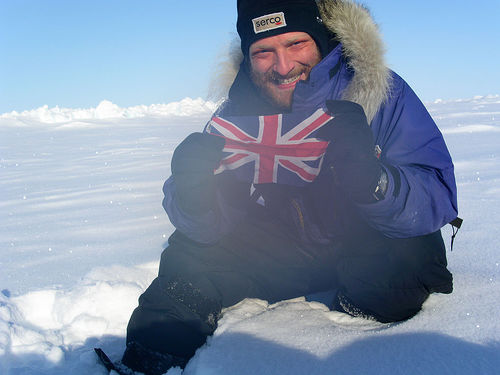
Ben Saunders sits on top of the world, the youngest person to reach the North Pole alone and by foot.

In 2004, 26-year-old Briton Ben Saunders became only the third person, and the youngest ever, to ski unaccompanied to the North Pole. As it turns out, there are a lot of ways that making a solo trek to the North Pole is a like moving to another country. Here are 11 things that the two adventures have in common, all taken from Saunder’s February 2005 TED Talk, “Why Did I Ski to the North Pole?”

  1. Luggage is a drag
    Saunders describes his specialty as “dragging heavy things around cold places.” He says, for his trip to the North Pole, “I was dragging all the food I needed, the supplies, the equipment, sleeping bag, one change of underwear—everything I needed for nearly three months.” That sounds like trying to put every necessary item in your carry-on bag, just in case your checked luggage gets lost. (If you think your bags are heavy, Saunder’s supply of food and fuel weighed 400 pounds.) Sometimes your destination has harsh conditions. And sometimes it doesn’t have chocolate chips. How many bags of those should you bring? Can’t be too prepared.
  2. It can be lonely out there
    One of the challenges of Saunder’s voyage was that he had to make it alone. Very alone. When he arrived at the northern-most point on the globe, he was the only “human being in an area one-and-a-half times the size of America, five-and-a-half thousand square miles.” Most of us don’t go to such remote places, but even if you’re in the biggest city, surrounded by millions of other souls, you can easily feel all by yourself.
  3. No, Virginia, there isn’t a Santa Claus
    When Saunders got to the top of the world, he didn’t find Santa. No Santa’s workshop. No elves. In fact, he says, “There isn’t even a pole at the Pole. There’s nothing there, purely because it’s sea ice.” When you go to another country, expect the unexpected. Don’t be surprised when what you find doesn’t match the photos in the magazine article. “I’d read lots of books,” says Saunders. “I studied maps and charts. But I realized on the morning of day one that I had no idea exactly what I’d let myself in for.” Photoshopped and cropped pics don’t do us any favors. If GPS and street signs say we’re in the right place, don’t waste time—or emotions—trying to find something that doesn’t exist.
  4. Sometimes it’s one step forward, two steps back
    According to NASA, during the year of Saunders journey, the ice conditions were the worst on record. Ninety percent of the time he was skiing into headwinds and the drifting ice pulled him backwards. “My record,” he says, “was minus 2.5 miles. I got up in the morning, took the tent down, skied north for seven-and-a-half hours, put the tent up, and I was two and a half miles further back than when I’d started. I literally couldn’t keep up with the drift of the ice.” When you’re in a new place, learning the language and culture, get used to those backward drifts. But always keep your compass set on your true north.
  5. The only constant is change
    Because the ice is constantly drifting over the North Pole, Saunders says that if he’d planted a flag there, it wouldn’t be long before it would be heading toward Canada or Greenland. Like Saunders, don’t be surprised when the emotional flags you plant aren’t permanent. The ground may not move under your feet (earthquakes not withstanding), but other kinds of landscapes certainly will. Find a special restaurant that serves your favorite dishes? Wake up the next day and it’s become a plumber’s shop. Make friends with some other expats? You may soon have to say goodbye. But, repeat after me, “Change can be good. Change can be good. Change can be good.” Maybe, just maybe, that plumber’s shop will end up being exactly what you need.
  6. Culture stress can be a bear
    Literally. On his first try at the North Pole, Saunders went with a partner, but they failed to reach their goal. Saunders says that from the outset “almost everything that could have gone wrong did go wrong. We were attacked by a polar bear on day two. I had frostbite in my left big toe. We started running very low on food. We were both pretty hungry, losing lots of weight.” Yup. Sounds like culture stress to me.
  7. Coming back can feel like the bear wins
    When his first attempt fell short, Saunders says he “was physically exhausted, mentally an absolute wreck, considered myself a failure, in a huge amount of debt personally to this expedition, and lying on my mum’s sofa, day in day out, watching daytime TV.” His brother texted him an encouraging quotation from Homer Simpson:
    “You tried your hardest and failed miserably. The lesson is: don’t even try.” Repatriation can feel that way. Maybe all the people who’d said you shouldn’t go were right. But Saunders didn’t let his failure define him. Instead, three years later he made history.
  8. People aren’t sitting around waiting to hear your stories
    When Saunders reached the North Pole, he got out his satellite phone. After warming up the battery in his armpit, he made three calls: “I dialed my mum. I dialed my girlfriend. I dialed the CEO of my sponsor. And I got three voicemails.” OK, that’s unfair to say they didn’t want to hear what he’d done. They were just busy at the time, that’s all. But . . .
  9. Some people really do want to listen
    “I finally got through to my mum,” says Saunders. “She was at the queue of the supermarket. She started crying. She asked me to call her back.” There are special people who will make time to listen—when they can focus on your story without distractions. Thanks, Mum.
  10. Don’t let others draw boundaries on your map
    When Saunders was 13, he got a school report that said, “Ben lacks sufficient impetus to achieve anything worthwhile.” Saunder’s response—”I think if I’ve learned anything, it’s this: that no one else is the authority on your potential. You’re the only person that decides how far you go and what you’re capable of.”
  11.  One of the three most important questions will always be “Where is the bathroom?”
    Saunders gave his TED Talk to answer three questions:
    (1 ) Why?
    (2) How do you go to the loo at minus 40?
    (3) What’s next?
    That second question is very important at the North Pole, because it seems that “at minus 40, exposed skin becomes frostbitten in less than a minute.” Your question number two will be more like “Where’s the bathroom?” or just “Bathroom? Bathroom?” Then, once you see the facilities, you may ask yourself, “How?”

As for the answers to those question, in short, Saunder’s responses go something like this:

(1) “For me,” says Saunders, “this is about exploring human limits, about exploring the limits of physiology, of psychology, and of technology. They’re the things that excite me. And it’s also about potential, on a personal level. This, for me, is a chance to explore the limits—really push the limits of my own potential, see how far they stretch.”
(2) That’s a trade secret, no answer here.
(3) Antarctica. Saunders and Tarka L’Herpiniere are currently on the first leg of their trek from the coast of Antarctica to the South Pole and back again—1,800 miles in all—unsupported and on foot. You can follow Saunder’s daily blog posts here. Why the South Pole? See answer number one above.

Somebody’s got a severe case of wanderlust.

[photo: “North Pole (3),” by Ben Saunders, used under a Creative Commons license]

It Won’t Be the Same without You: Join The Expat Survey 2013

2444717300_abb533fa6d_mThe logo for The Expat Survey 2013 is a hummingbird, “because just like human beings each one has its own migratory flight pattern.”

If you’re an expatriate, the Expat Survey wants to hear about your migrations, as well as your “remarkable diversity of habitats.”

The survey is made up of three parts, each rolled out separately, with the final section going live tomorrow (update: the third section went live November 27). All portions of the survey will remain available online until December 31.

The three sections are

  • Migration & Lifestyle
    “[H]ave you found it easy to integrate, what do you like or dislike about your adopted home, has life changed considerably and how do you stay in touch with family, friends and the outside world?”
  • Retail & Finance
    “Whether you are working or not, what are your important considerations when it comes to personal or household expenditure, banking and investments; and what information resources do you now tend to turn to when making these decisions and future fiscal planning?”
  • Travel & Health
    “Has your move to a warmer or colder climate changed your perspective of the world and the places and people you choose to visit; and what modes of transport do you use to get there? Do you enjoy a better diet and benefit from improved health and if you have had cause to call upon your local medical services were they sufficient?”

Besides having their voices heard, expats who fill out all three portions of the survey will be entered into a drawing for £1,000.

An independent London organization, i-World Research Limited, is conducting The Expat Survey, and it’s being promoted by 10 “collaborative partners.” One of those partners, Max Media International, calls the survey “the largest and most extensive independent global research programme ever conducted on those residing outside of their country of origin.”

To take part, go to The Expat Survey 2013.

(“Expatriate Specialism Agency Joins Expat Survey 2013,” Max Media International, July 10, 2013)

[photo: “Rufous Hummingbird—All fired up to impress the ladies!,” by Rick Leche, used under a Creative Commons license]