One Missionary’s Emotions . . . Honest, Unedited, and Unsanitized

I’ve been following Under the Big Topp for a while now. It’s from a missionary and mom who is committed to honestly blogging about what she calls her “very unremarkable journey in God’s remarkable mission.”

6032654897_d5d7b008cc_nI appreciate her willingness to let us hear her deep thoughts and feelings, and that is what she does in a recent post, “a secret reluctance of faith.” It’s a look back to the time this past May after her 16-month-old son (whom she calls Roo) pulled a cup of boiling water onto himself, giving him second- and third-degree burns over 25% of his body.

Her story tugs deeply at me, as it brings back memories of what happened to my own son while we were in Taiwan. When he was 14 months old, he grabbed a hot clothes iron, burning the palm of his hand. At first, the hospital staff thought it was not so serious, and we went home with his hand wrapped in bandages. But then he developed an infection and we found out that he had third-degree burns. That led to a hospital stay of over 40 days for him—and because in Taiwanese hospitals the family provides much of the day-to-day care, that meant that my wife spent more than 40 days there, as well. All of this led to several surgeries, skin grafts, and therapy sessions over the next two and a half years.

Mrs. BigTopp writes that her son was flown by air ambulance to a neighboring country for treatment. The surgeon there “predicted months of specialist care, a surgery or two and then more outpatient care. . . . But then suddenly, Roo was healed.”

She then shares what she wrote down the night before flying back to her host country, as she struggled with her emotions. As is often the case, the emotions surrounding trauma are confusing and seem to betray us. With the healing of her little boy came the reality that he would no longer need long-term care back home in Australia. But that also meant she would not be “rescued” from the difficulties she has faced as a missionary.

She apologizes for the “full on” nature of her words—unedited and, she says, unsanitized.

Man! I should just be happy. Happy that Roo is well and safe and healed, and I know I am happy…
….but I am not ready.
I scared again. Inwardly I’m screaming again.
I am hyperventilating and screaming.
I’m screaming, ‘No! No! No! Please God, please’
outwardly I’m quietly packing suitcases and booking flights.
We are going back.

I am so tired and scared and full of guilt and I’m hurting.

And then they flew back to the mission field.

Please go to her blog and read the full post here. What I have shared above is only a small, small taste of her story.

[photo: “Reisdagboek,” by Audringje, used under a Creative Commons license]

The Psychological Health of Missionaries—Adding to the Research

6903821997_e0a95ce498_nHere’s a quick question:

What percentage of returned missionaries and aid workers report psychological disorders during their time overseas or shortly after their return? What do you think? About a quarter, a third, half, two thirds, three quarters?

According to a 1997 study conducted by Debbie Lovell-Hawker of Oxford University, the answer is “about half.” More precisely, Lovell-Hawker’s findings show that among the returned missionaries and aid workers she studied,

46% reported that they had experienced a clinically diagnosed psychological disorder either while working overseas or shortly after returning to the United Kingdom.

Before I went overseas, I would have guessed much lower than half, but after I first heard this statistic referenced in a debriefing I attended, in my mind, the number began to grow much higher than 46%. Statistics have a way of doing that.

Lovell-Hawker’s research included 145 aid and development workers and missionaries from 62 organizations. Though not definitive, the findings are significant as a wake-up call to cross-cultural workers, sending agencies, NGOs, churches, and member-care givers. And they also can assure those repats who are struggling that they are not alone.

Other  findings include

• 18% reported that their problems developed while they were overseas—82% said they began after returning to their home country
• Depression was the most frequently reported problem, occuring in 87% of the cases
• Those who reported having psychological problems had spent significantly longer time overseas than those who reported having none

(Debbie Lovell-Hawker, “Specialist Care: Psychological Input,” Global Connections Member Care Conference, February 18, 2002)

Moving forward from this study, there are some things I’d still like to know: Has anything changed in the 26 years since the findings were published? What would the numbers be for all missionaries and aid workers, not just those who’ve returned? What would the breakdown be among those working in relief and development vs other settings, such as teaching or church planting in developed areas? Are the numbers consistent for workers returning to countries other than the UK? And what about TCKs?

The good news is that there are researchers who are working on these and similar questions.

The Research Continues

One of those researchers is Lynette H. Bikos. Lynette served as a guest editor (along with M. Elizabeth Lewis Hall) of a special issue of Mental Health, Religion & Culture in 2009, titled “Missionaries.” Lynette is director of research and professor of clinical psychology in the School of Psychology, Family, and Community at Seattle Pacific University—and she also happens to be a friend who lived next to me, on an adjoining farm, as we grew up in northeast Missouri. We’ve kept in touch over the years, and she corresponded with my family and me as she worked on her research.

The special issue includes 10 articles dealing with several aspects of cross-cultural adjustment among those whom the editors call “religiously motivated sojourners.” I’d like to highlight four of those articles:

“Social Support, Organisational Support, and Religious Support in Relation to Burnout in Expatriate Humanitarian Aid Workers”
(Cynthia B. Eriksson et al., Mental Health, Religion, & Culture, November 2009)

This assessment found that 40% of expat middle managers in an international faith-based agency were at “high risk” of burnout in one of three areas—lack of personal accomplishment, emotional exhaustion, and disconnection or distance from those being cared for—but less than 4% reported high levels of burnout in all three.

According to the authors of the study, “This suggests that despite intense work and chaotic environments a majority of workers find ways to identify accomplishments, stay connected to others in their work, and rejuvenate. Team relationships, friendships, and positive organisational support may contribute to the resilience for these workers.”

The findings also indicate that younger workers are at a greater risk of burnout, as they register greater negatives in all three burnout areas. But while age was a factor, the number of years serving with the agency was not.

“Resilience in Re-Entering Missionaries: Why Do Some Do Well?”
(Susan P. Selby et al., Mental Health, Religion, & Culture, November 2009)

The authors posed the question ‘‘Why do some re-entering missionaries do well while others do not?’’ and interviewed 15 Australian cross-cultural missionary workers to help find the answer.

All the participants were over 25 years old and had spent at least 2 out of the previous 3 years in a non-Western country. Based on their responses, the researchers divided the missionaries into two categories: “resilient” and “fragile.”

In the interviews, the eight resilient missionaries described having

• flexibility
• higher expectancy and self-determination
• denial in the form of minimization to deal with their distress
• good mental health
• more social support
• a positive reintegration
• a personal spiritual connection to God

In contrast, the seven who were considered fragile described

• less flexibility
• lower expectancy and self-determination
• less use of denial with minimization
• poorer mental health
• less social support
• difficulty reintegrating
• a decreased or fluctuating personal spiritual connection to God

It is interesting that while the results of a questionnaire measuring depression, anxiety, and stress (DASS 21) showed higher levels for the fragile group, the scale showed that only one out of the entire group (including resilient and fragile) had an actual perception of being “personally stressed.”

“Psychological Well-Being and Sociocultural Adaptation in College-Aged, Repatriated, Missionary Kids”
(Michael J. Klemens and Lynette H. Bikos, Mental Health, Religion, & Culture, November 2009)

When the researchers compared a group of MKs to non-MKs at a Christian university, they found that while both groups scored in the healthy range of psychological well-being (PWB),  the missionary kids’ scores were significantly lower.

The missionary kids’ MK status accounted for only 4% of the variance in psychological well-being but was responsible for nearly a quarter (23%) of the difference in sociocultural adaptation (SCA). In this latter area, the MKs reported the most difficulty in “taking a US’ perspective on the culture; seeing things from an American’s point of view; understanding the US’ worldview; understanding the US’ value system; and making yourself understood.”

“Curiously,” report Klemens and Bikos, “neither the age of the participant, nor the number of years abroad, nor the number of years since repatriation was related to PWB or SCA for the MKs.”

“Reduction in Burnout May Be a Benefit for Short-Term Medical Mission Volunteers”
(Clark Campbell et al., Mental Health, Religion, & Culture, November 2009)

This assessment looked at how international short-term mission trips affect burnout among volunteers.

The participants in the study, most of whom were physicians and nurses, travelled to South America for two weeks to provide medical care in a non-disaster-relief setting. Prior to their departure, the group members’ responses to questionnaires showed that they were experiencing moderate burnout. Their burnout levels were again assessed one month and six months after the trip.

“The major finding of this study,” report the researches, “is counter-intuitive: that medical personnel who are emotionally exhausted, have an impersonal response towards their patients, and lack a sense of [personal accomplishments] (moderately burned out) benefit by working hard with numerous patients in an international context.”

They found that levels of emotional exhaustion and perceived personal accomplishments showed significant improvements following the short-term trip and continued in a positive direction in the 6-month followup.

___________________________________________________

All good research builds about what has been learned before and leads to questions for new studies in the future. I join with Lynette and her co-editor in hoping that the information in their special issue of Mental Health, Religion & Culture encourages others to join in the “exploration” of the psychological health of missionaries. There is so much more to be discovered.

(Lynette H. Bikos and M. Elizabeth Lewis Hall, “Psychological Functioning of International Missionaries: Introduction to the Special Issue,” Mental Health, Religion, & Culture, November 2009)

This special journal issue also includes several articles specific to the experiences of female missionaries. I hope to discuss these in a future post.

[photo: “Confused,” by Mary T Moore, used under a Creative Commons license]
Cake from a Roaster, Bread from a Rice Cooker—Where Will the Madness End?

3430989175_bbbcb39cc0
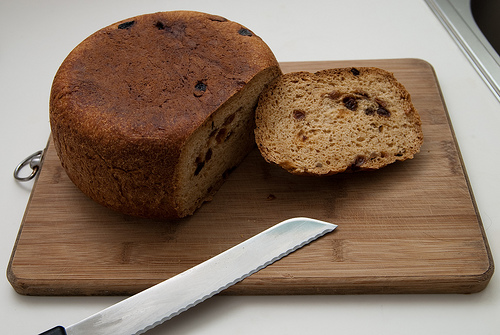
Yes, a loaf of bread can be baked in a rice cooker

So you need to make a cake or bake some bread, but you don’t have a full-size oven. How about using a roaster or a rice cooker instead?

It can be done. And while they may not be your top choices, in some countries, these small appliances may be your best options.

2067859950_2302a07639_m
We used a roaster similar to this one while we were in Taipei.

The Roaster Oven
In Taiwan, most meals are built around things cooked on top of a burner, rather than in the belly of an oven: There aren’t too many nationals cooking a pot roast or broiling steaks. The Taiwanese aren’t big on sweets, like us Americans, so there’s not a lot of cookie and pie baking either. With great bakeries scattered throughout most cities, there’s little need to whip up a cake on your own. And besides all that, the typical Taiwanese kitchen is pretty small, without room for any “extra” appliances.

Before we moved to Taiwan, we considered our options: Bringing over a Western-style range-oven combo and finding a place for it on a balcony of an apartment that we hadn’t found yet would have been troublesome. Besides that, the oven we had at the time wasn’t worth shipping over. Buying a used oven from another expat family who was leaving would have been unpredictable. And buying a new oven there would have been expensive. In the end, we decided on the roaster-oven option.

Turns out, it worked pretty well. In fact, my wife used ours nearly every day for four years—until it wore out and quit heating up. She used it for cakes, cheesecakes, cookies, pies, dinner rolls, casseroles, and, of course, several types of meat. Probably the trickiest project was an angel food cake, but she met even that challenge. (As I recall, the hardest part wasn’t the baking. It was finding something to invert the pan on, since we didn’t have any glass soda bottles.)

Mostly through trial and error, here are some things that she learned:

  • You’ll probably have to leave your food in the roaster longer than the recipe calls for. And lifting the lid to check on your progress releases a lot of heat and adds more time.
  • A small metal rack, or something else that lifts up the baking/cooking pan, will keep foods from burning on the bottom. If you don’t have a rack, you can use an upside-down cake pan.
  • If you can find a rack with legs, you can cook on two levels, with a pan above and one below.
  • It can be difficult to get large pans into and out of the roaster. There’s not a lot of wiggle room, so be extra careful not to burn your hands.

After our roaster gave out, some generous friends bought us a countertop convection oven. We brought it back from the States with our checked baggage, and it worked great for the rest of our time in Taipei. It wasn’t long before we saw a similar oven for sale in a shop near our neighborhood, so if we were to go back to Asia again, we’d probably plan on locating one there.

The Rice Cooker
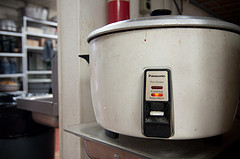
But what if a roaster oven is out of the question? What if your kitchen countertop space is all full? Or what if you don’t even have a kitchen? Don’t despair. A rice cooker can save the day. And if you’re in Asia, you certainly won’t have any trouble finding one to buy.

If you’d like to find recipes and how-to’s for baking with a rice cooker, just do a search on the Internet. You’ll see that it’s not a problem, as the even the simplest model can bake cakes, cheesecakes, and breads.

I’ve never baked with one myself, but here’s some bits of advice I’ve gathered from the sites I looked at:

  • Most recipes will work in a rice cooker without being modified, but you may need to cut back on the size. Cakes won’t cook evenly if they are too deep, and breads will work best if they’re no more than a few inches thick.
  • Bread will need to be flipped over several times during the baking process so that it won’t burn underneath.
  • If it takes more than one cooking cycle to complete a recipe, then let the cooker cool down and start it again. Another option is to wedge something under the switch to prevent it from flipping to “warm.” Be careful with this second method. You’re bypassing the cooker’s automatic shutoff, so it can get too hot if left unattended, and it might shorten the life of your cooker.
A simple, tried-and-true rice cooker
When it comes to choosing a rice cooker, Roger Ebert suggests, “Nothing Fancy.”

Of course, one way to make things easier is to buy a modern rice cooker with a “bake” or “cake” setting. (I didn’t know those existed until I started writing this.) But if you’re old school in your rice-cooker preferences, you’ll go with a more traditional style.

Roger Ebert, the Pulitzer Prize-winning movie critic, was one such devotee of the simple elegance of the basic “Pot.” In fact he was such a fan that he wrote a book dedicated to its multiple uses: The Pot and How to Use It: The Mystery and Romance of the Rice Cooker. In it he advises,

Have nothing to do with anything “Micom Programmable.” Nothing to do with words like “Neuro Fuzzy.” No dials or “settings.” Nothing fancy. You will only cost yourself money and mess things up. If a rice cooker comes with more than two pages of instructions, you’ve overspent. I am saving us money. What you want is your basic Pot with two speeds: Cook and Warm. Maybe it will say it in Japanese. You’ll figure it out.

Though Ebert doesn’t stray into the realm of baking, he does enthusiastically praise the rice cooker for its abilities in preparing such things as vegetables, stews, soups, sauces, and oatmeal.

And the Crockpot, Too

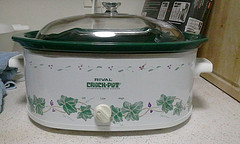
This crockpot is a real "Crock Pot" from Rival.
There are crockpots, and then there’s the Rival Crock-Pot®, “The Original Slow Cooker.”

I was about to finish up this post when I had a thought: I wonder if you can bake with a crockpot (slow cooker). Sure enough, you can do that, too.

I don’t have any experience with this—cooking or eating—but I can point you to a couple sites that give some details. The first one is from Better Homes and Gardens, entitled “Easy Slow Cooker Dessert Recipes.” There you’ll find directions on making cheesecake, pudding cake, brownies, and cobbler, along with the kind of almost-too-good-to-be-true photos you see in magazines like . . . well . . . Better Homes and Gardens.

The second is from Carroll Pellegrinelli at About.com—”Crockpot Baking: Making Breads and Desserts in the Slowcooker.” If you don’t have a slow cooker with a baking insert (again, who knew there was such a thing?), you can use a coffee can, paper towels, and aluminum foil. It’s not fast—it is a slow cooker—but, according to Pellegrinelli, it’s easy.

So . . . what else can you use a roaster oven, rice cooker, and crockpot for? Or what else can you use to bake a cake? Well, that’s up to you.

Experiment.

Try. Fail. Try again.

And remember these two important phrases: “Necessity is the mother of invention,” and “You don’t know how far you can go until you’ve gone too far.”

PS: It Ain’t Over Yet
A friend, former coworker, and long-time missionary to Taiwan, Bev Skiles, commented below that she’s used a rice cooker for cakes and a crockpot for bread. Not only that, but she’s baked cakes in an electric skillet and in cookware on top of the stove. Want more info? Check out these two sites from eHow: “How Do I Bake Bread in an Electric Skillet?” and “How to Bake in an Electric Frying Pan.”

Thanks to Bev for her input. She’s been a great help to expats in Taiwan for many years, showing them how to adjust their Western recipes to Eastern kitchens and cupboards.  She even helped helped put together a cookbook in 1981, “Tips ‘n’ Treats” on Taiwan. If I’d looked in my wife’s copy before I wrote this post, I would have seen several recipes for baking with a rice cooker. I should have consulted her as an expert.

(Roger Ebert, The Pot and How to Use It: The Mystery and Romance of the Rice Cooker, Kansas City, MO: Andrews McMeel, 2010)

[photos: “Currant Bread Made in a Ricecooker,” by Dennis Kruyt, used under a Creative Commons license; “Westinghouse Roaster,” by Julie Weatherbee, used under a Creative Commons license; “Rice Cooker, Peking House, Dudley Square, Roxbury,” by Planet Takeout, used under a Creative Commons license;  “Rival Crock-Pot,” by George Kelly, used under a Creative Commons license]

Language Study: Live (There) and Learn

3797213895_8586cd8e5e_nMan, I really should have studied French harder in college.

That’s how I ended my last post. Actually, I did study hard, got good grades in my three French classes, and was only three hours short of getting a French minor.

The reason I didn’t get the minor was that when I showed up for the first class of The History of the French Language, a 3-hour class taught in English, I realized I was in over my head. It was in the fall, after a summer full of not speaking French, and the girl in front of me asked Professor Honeycutt if he would teach the class in French. She asked this in French, and the girl next to her nodded in agreement. The teacher said he couldn’t do that, but I dropped the class the next day anyway.

It was one of the best decisions of my college career. I’m so glad that today I don’t have to tell people that I have a French minor but about the only thing I can still say is “I speak a little French.”

The problem wasn’t that I didn’t study hard enough. The problem was I didn’t need to use it outside of class. And inside of class, what I said didn’t matter as much as how I said it. You know what I mean: If your teacher asks you to tell about your pet, and you have a dog, but you’ve forgotten the word for dog, but you remember the word for cat, suddenly you have a cat. The professor isn’t asking you because he’s concerned about the animals in your life, he simply wants to see if you can put sentences together.

It’s not a silver bullet, but putting yourself in a place where you need to use a language in a meaningful way is key to learning a language. That’s one of the foundations of Education First, named the official supplier of language programs for the 2014 Winter Olympics in Sochi. EF was founded in 1965 by Bertil Hult in Sweden, “on the principle that cultural immersion was a superior way to study a language.”

Below are five EF commercials about people learning a language where it’s spoken. Granted, they glamorize the whole expat experience, but they are commercials, not documentaries.

I just wish that I could become fluent by watching cool videos about cool people living in cool places—and not have to worry about conjugating verbs.

The commercials are called “Live the Language.”

(By the way, who knew that speaking Australian and Canadian was so easy? Almost as easy as what they speak over in England).

(“About Us” and “EF in Brief,” Education First)

[photo: “cafe,” by  pim van boesschoten, used under a Creative Commons license]

Neighbors Being Neighbors after Joplin Mosque Destroyed by Fire, a Look Back

2711889859_effc34339e_mA year ago, on August 7, a mosque in Joplin, MO, was burned to the ground in an early-morning fire. The cause of the fire has not been determined but was deemed “suspicious,” especially since an arsonist had started a fire on the roof barely over a month earlier, and a sign at the mosque had been set on fire in 2008.

The destruction of the mosque, which made international news, was followed a few weeks later by a “Neighbors” rally, organized by Ashley Carter, a student at Joplin’s Ozark Christian College. As she wrote on the event’s Facebook page, the purpose of the rally was to

show that love is stronger than fear or hatred. In an effort to support our neighbors, we’ve created this event. . . . All in all, this is about paying it forward: giving love before hate crimes can be committed.

On August 6 of this year, the Islamic Society of Joplin posted a documentary on YouTube, focusing on the fire and the rally. It was very interesting to me to watch the video for several reasons: I live in Joplin and attended the event, I know several of the OCC students who helped with the rally, and I know Kimberly Kester, spokeswoman for the Islamic Society, who appears in the documentary. The film also shows local Muslims responding to the tornado that struck Joplin the year before the fire. As a Christian, I have heard many people talk about that tragedy from a Christian point of view, but this was the first time I’d heard someone speak about it from a Muslim worldview.

Rick Love, a Christian and president of Peace Catalysts International, was one of the speakers at the rally. He told the hundreds who attended,

This gathering does not mean we believe in some kind of imaginary One World Religion. We are not expecting or affirming theological compromise. We are expecting each religious community to be authentically faithful to their historic beliefs and find within those beliefs the resources to reach out to one another in love and respect. . . . We believe that our communities of faith should be a force for peace, justice, and reconciliation instead of discord and strife.

Many of the participants in the rally wore t-shirts that read on the front “LOVE—Making things beautiful from things that aren’t.” On the back, they said, “I will . . . ,” with space for each person to complete the phrase with a black marker. I can’t help but be reminded of the topic of my previous post, with its own fill-in-the-blank: “I like ____________.®”

I like good neighbors.

(Rick Love, “Hate Crime Meets Love Rally: The Joplin Mosque Burning,” Peace Catalyst International, August 27, 20012)

[photo: “Row House,” by David Sawyer, used under a Creative Commons license]

Two Great Resources for All Things Member Care and Missions

2164279407_666969752a_tMissionary Member Care
I recently found out about an ebook by Ronald L. Koteskey, Missionary Member Care: An Introduction. Koteskey and his wife, Bonnie, have served in member care for over 16 years and share this and other “resources for missions and mental health” at the website Missionary Care.

There is a wealth of useful information in Missionary Member Care‘s 169 pages, but the parts that interested me the most were

  • An overview of the trials faced by the “father of modern missions,” William Carey, and his family. (I’d read about some of what they went through, but hadn’t known the full extent of it.)
  • The writings of other early missionaries, revealing their struggles and their need for member care.
  • Numerous books and websites dealing with member care.
  • Information on a number of member-care organizations.
  • A list of conferences for member-care givers.

2231790512_109fa60425_tBrigada
And the second great resource? That’s where I heard about Missionary Member Care. In case you’ve never seen it, it’s Brigada, a weekly “web journal offering resources, strategy tips, tools and ‘hacks’ to Great Commission Christians.”

There are a couple ways to read Brigada, edited by Doug Lucas, founder and director of Team Expansion. One is to go to the website, where the newest issues are displayed, as well as a link to the archives, with issues dating back to 1994. The other way is to join thousands of other subscribers by signing up for weekly updates.

Brigada‘s information comes from a myriad of sources, and if you’d like to submit your own items for publication, you can do that, as well.

[photos: “Number One,” by John Ayo, used under a Creative Commons license, and “Copper Number 2,” by Leo Reynolds, used under a Creative Commons license]


Nancy Berns: “Closure Doesn’t Exist,” Let Grief and Joy Be Intertwined

4677361453_f392fc8e47_n“What have you grieved in the past?” asks Nancy Berns, a sociologist at Drake University. “What might you grieve in the future? And some of you are grieving today. It’s not just the death of loved ones that we grieve. Our life is full of losses.”

These include the losses associated with transitioning between homes and cultures, away from family, friends, and the familiar.

When faced with that grief, we usually look for ways to move on, to find closure. But according to Berns, “Closure doesn’t even exist. It’s a made up concept that we use to talk about loss and grief.” And trying to gain closure “can do more harm than good.”

in her TEDxDesMoines talk below, Berns, author of Closure: The Rush to End Grief and What It Costs Us, says that we shouldn’t box up our pain, close the lid, and walk away to look for a separate place of joy. In a previous post I asked, “Can Grief and Joy Coexist?” Berns is convinced that not only do they exist together, but they are intricately intertwined.

Listen to her explain this relationship and open a box to share stories of people expressing their grief . . . and joy. Hers is a message for those who are grieving and for those know others who are dealing with sorrow. And that pretty much includes us all, doesn’t it?

Knowing that joy and grief can be carried together is so important,” says Berns, “because it’s a long journey without the possibility of joy.”

So the next time that you see someone who’s entering that space of grief—might be a family member, might be a friend, a coworker, just someone you recently met—don’t hand them a box. Don’t tell them to find closure. Meet them where they’re at. And they might be broken and down and beaten up.

Then, kneeling on the stage, she continues:

Meet them where they’re at. And while you’re there, take a moment and look around, ‘cause you might be surprised at the view you have when you’re on your knees. And if you’re the one broken, you might be surprised at how comforting it can be to have someone just meet you where you’re at, not to try and get you to stand before you’re ready, not to try and take away your pain or explain it away. Just to be with you. And when you’re ready, to give you a hand up, to take those steps. . . . You see it’s not about closure. Healing? Yes. But that’s different.

[photo: “Box 5,” by Brenda Clarke, used under a Creative Commons license]

Serving Globally: The Tuggings on Our Souls

244870161_2a9468bb74_mI’d like to point you toward two recent thought-provoking articles from Christianity Today. Both appear under CT‘s “This Is Our City” banner.

The first is written by Rachel Pieh Jones, who blogs at Djibouti Jones. It’s titled “You Can’t Buy Your Way to Social Justice,” with the tag, “Why the activism of some fellow Americans scares me.”

At her blog Jones writes,

Today I have an article at Christianity Today and I’m kinda scared about it. [. . .] The article looks at the current trends of using intentional purchases (fair trade coffee, etc) to fight injustice worldwide, from the perspective of someone (me) who has spent more than a decade living overseas, working toward development and human dignity in the Horn of Africa. [. . .] I’m afraid people will be offended or get mad. [. . .] But . . . well . . . there it is. I have a lot to learn, which I hope comes across in the essay and I look forward to learning from you because overwhelmingly, you challenge me to think better, to not be complacent, and you handle my messy process with grace.

From the CT article: “I have a theory about what is partly contributing to the dearth of young Americans willing to spend their lives on behalf of others,” Jones writes. “They think they already are.”

The second article is “Choosing Marriage over the Mission Field,” about “How Tim Kietzman, a successful missionary eye doctor, chose quiet faithfulness despite enormous needs in Pakistan.”

After moving with his family overseas, Kietzman served 10 years as an ophthalmologist in the Pakistani valley of Gilgit. But according to the article, his “boldest act for God may have been coming home from Pakistan to repair his marriage of almost 30 years.”

How he came to make that choice involved re-understanding something Kietzman calls the “Isaac syndrome.” “Missionary kids are the sacrificial child for their parents doing what God wants them to do,” he said. “A lot of times they feel like they’re under the knife . . . like they’re second-class citizens.” Compounded by the sense of missing out on their home culture, the Isaac syndrome can leave missionary kids with spiritual baggage.

The Kietzmans returned to the States when “the Isaac role quietly fell on their marriage,” when it “eventually proved too much.”

Read these articles to have your thoughts challenged on making a difference globally—challenged by people who are not writing about theories, but who are writing about the push and pull and stretch and pressures on their own lives—lived “over there” and “over here.”

(Rachel Pieh Jones, “Why I’m Afraid of American Christians,” Djibouti Jones, May 15, 2013; Rachel Pieh Jones, “You Can’t Buy Your Way to Social Justice,” Christianity Today, May 14, 2013; Anna Broadway, “Choosing Marriage over the Mission Field,” Christianity Today, June 13, 2013)

[photo: “Tug of War,” by toffehoff, used under a Creative Commons license]