Language Apps Beat Flat Abs

Want to become more attractive to the opposite sex? Learn another language. A poll from car-maker smart USA and Harris Interactive shows that 69% of Americans “would prefer their spouse to speak another language than have washboard abs.” And if you’re looking for some high-tech help in becoming bilingual, Wired How-To Wiki provides a list of apps for foreign-language learning, broken down into four sections. (If you want to go for a second language and a flat stomach, I suggest number three, because you’ll be pretty busy at the gym.):

  1. For story-based learners
  2. For visual learners
  3. For the time-strapped
  4. Basic translators

(“Americans’ Attitude towards Consumption May Be Shifting,” BusinessNewsDaily, February 28, 2012; Adrienne So, “Use Apps to Learn a Foreign Language,” Wired How-To Wiki, April 18, 2012)

[photo: “Gym wash,” by Michael Clark, used under a Creative Commons license]

On Second Thought: Your Second-Language Decisions May Be Better

If you learn a second language, there’s evidence that thinking in that language leads to better decisions. Citing research from the University of Chicago, Tom Jacobs reports in Pacific Standard that “using one’s second language reduces or eliminates certain biases that otherwise infiltrate our decision-making.”

In the abstract to their article in Psychological Science, the researchers state that one would assume

that the difficulty of using a foreign language would make decisions less systematic. We discovered, however, that the opposite is true: Using a foreign language reduces decision-making biases. Four experiments show that the framing effect disappears when choices are presented in a foreign tongue. Whereas people were risk averse for gains and risk seeking for losses when choices were presented in their native tongue, they were not influenced by this framing manipulation in a foreign language.

It seems that decisions made in a second, and therefore less familiar, language are more rational, depending less on emotional responses. One of the researchers’ experiments dealt with a game in which participants were presented with a choice to either keep a dollar or to bet it on a coin toss, given certain factors. The statistically wise move would be to take the bet, but those using their first language were less likely to bet the money. On the other hand, those who heard the presentation in their second language were more likely to make the bet. In other words, the first group listened to their ingrained, less-rational fears, while the second group thought through the situation more clearly.

So how would this affect everyday life? “People who routinely make decisions in a foreign language rather than their native tongue might be less biased in their savings, investment, and retirement decisions,” say the researchers. Hmmm. No word on how this would affect our decisions while visiting a foreign casino.

Addendum: While I was looking at the page in Psychological Science, I saw a link to the abstract of “Losing Access to the Native Language while Immersed in a Second Language: Evidence for the Role of Inhibition in Second-Language Learning” (Jared A. Linck, Judith F. Kroll, and Gretchen Sunderman). From what I can tell, the gist of the study verifies that immersion learning is more effective than classroom learning, and that this is in part because immersion learning serves to inhibit the use of one’s native language. That’s somewhat interesting, but that’s not what caught my attention. The opening sentence is what grabbed me: “Adults are notoriously poor second-language learners.” Now that doesn’t pull any punches. I wish I could have had that printed on a t-shirt to wear when I started learning Mandarin at the age of 37.

(Tom Jacobs, “Second Language Translates into Clearer Thinking,” Pacific Standard, April 24, 2012; Boaz Keysar, Sayuri L. Hayakawa, and Sun Gyu An, abstract of “The Foreign-Language Effect: Thinking in a Foreign Tongue Reduces Decision Biases,” Psychological Science, July 21, 2011)

[photo: “think hard,” by Mutiara Karina, used under a Creative Commons license]

Bilingualism for Babies and Grandparents

Here’s some background information for my post “Bilingual Brain Boost.” A couple related articles at The Hot Word  point to research on how bilingualism affects infant intelligence and how knowing two languages may delay the onset of dementia:

[photo: “Grammy & Natalie,” by donireewalker, used under a Creative Commons license]

Somewhere, a Thai Chef Is Laughing

A few days ago I wrote about odd English names for dishes in Chinese menus. Most of the humor comes from what you’d assume are innocent mistranslations. But it seems there has to be another explanation for how a Thai restaurant in New Zealand got it’s unfortunate name. When Fred Bennett hired a Thai chef for his new establishment, he asked him what he should call it. The chef told him the Thai words for “Welcome and Come Again,” or at least that what he said they meant. But after that chef left sometime later and Bennett hired a new one, he found out that what the sign on his restaurant actually said was “Go Away and Don’t Come Back.” Bennett has now renamed the restaurant “Victory Thai,” and it sounds as if he has a pretty good attitude about the whole thing. “I’d like to apologise to the Thai community if I have offended them, which I’m pretty sure I would have,” he said and passes on a lesson that all cross-cultural trekkers should heed: “That’s why it pays to research.”

(Naomi Arnold, “‘Go Away and Don’t Come Back’ Cafe Sign Blunder, stuff.co.nz, February 4, 2012)

[photo: “Ban Phe Stop Sign 3” by quite peculiar, used under a Creative Commons license]

Red Bean Paste, by Any Other Name, Would Taste as Sweet

As a followup to making Beijing more foreigner-friendly for the 2008 Olympics, the Chinese government has published a book to provide restaurants with standardized English translations for over 2,000 dishes. While the publication, titled Enjoy Culinary Delights: A Chinese Menu in English, should clear up some confusion, it will diminish the entertainment value of menus in China. Gone will be “red burned lion head,” which becomes “braised pork ball in brown sauce,” and “chicken without sex life” gives way to “spring chicken.” Other substitutions include “shrimp cooked in rice wine” for “drunken shrimp,” “ground pork with green soya noodles” for “ants climbing the tree,” and “stir fried prawns and chicken” for “gambolling dragon and praying phoenix.” These last two aren’t mistranslations, just examples of poetic Chinese names whose meanings aren’t immediately obvious to foreign readers. (Maybe restaurants should just keep these literal translations and follow up with an explanation.) But others, maybe the best ones, come from a less-than-stellar grasp of English, such as the menu item from the photo in this article, which translates what could be called “sesame seaweed” as “dish of sesame oil connected through one’s female relatives.” Of course, if “seaweed” doesn’t sound good to you, the second name might be more appealing.

I don’t remember any specific examples of funny menu items from our time in Taiwan, but this topic reminds me of a couple of canned drinks that were commonly available in convenience and grocery stores. Both were labeled with unfortunate English names. The first is a sports drink from Japan, called “Pocari Sweat,” and the other is a yellow citrus soda, simply named “P.”

(“No More ‘Chicken without Sex Life’ at Beijing Restaurants,” Xinhua, March 13, 2012; “‘Chicken without Sex’ Becomes ‘Spring Chicken’—State Meddling in China’s Menus,” Worldcrunch, from The Economic Observer, March 29, 2012)

For anyone who’d like to learn more about the unique names of traditional Chinese dishes—and the history and makeup of Chinese characters—I highly recommend Swallowing Clouds: A Playful Journey through Chinese Culture, Language, and Cuisine, by A. Zee. Using the names of foods, the stories behind them, and the stories behind the individual characters, Zee shows how the paths of culture, language, and cuisine intertwine. It will make your mouth water, and it will make menus come to life.

[top photo: “Pocari Sweat” by Dwaasuy, used under a Creative Commons license; bottom photo: “Eight Treasure Vegetables,” by Yoko Nekonomania, used under a Creative Commons license]

Bilingual Brain Boost

Here are a couple related lists. The first one is under the heading “How Learning a New Language Makes You Smarter“:

– The interference caused by having two languages in your head “forces the brain to resolve internal conflict, giving the mind a workout that strengthens its cognitive muscles.”
– Bilingualism improves the brain’s “executive function,” including the ability to focus on more important things while ignoring what else might get in the way.
– The need, and ability, to switch languages develops the ability to better “monitor the environment,” or track changes in one’s surroundings more efficiently.
– Infants raised in a bilingual setting show increased cognitive skills over those raised with one language, even before they learn to speak.
– High-level bilingual skills in elderly adults correlate with a higher resistance to dementia.

(Yudhijit Bhattacharjee, “Why Bilinguals are Smarter,” The New York Times, March 17, 2012)

And now, under the heading “Learning What New Language Will Make You Feel Dumber?

According to the United States Department of State’s Foreign Service Institute, the hardest languages for English speakers to learn are

– Arabic
– Cantonese
– Japanese
– Korean
– Mandarin

These are in no particular order, but the FSI believes Japanese to be the hardest of all.

Published by the National Virtual Translation Center, the complete list of 63 languages includes their estimated learning times. It is no longer available at NVTC, but you can see a copy from October 2007 at The Internet Archive Wayback Machine.

[photo: “Beach Volleyball,” by monstro, used under a Creative Commons license]

Attention Monoglots

What do you call someone who speaks three languages? Trilingual. What about someone who speaks two languages? Bilingual. And someone who speaks one language? American. (It’s an old joke, but when I was teaching ESL, my students thought it was funny.) There’s even a name for a person who can speak more than 10 languages. It’s hyperpolyglot. But hyperpolyglotism is not in everyone’s future. Michael Erard, author of Babel No More: The Search for the Worlds’ Most Extraordinary Language Learners, writes, “Hyperpolyglots are not born, and they are not made, but they are born to be made.” Do you have what it takes? Hyperpolyglots tend to be male and left handed and tend to have high IQs . . . and immune disorders. Not sure why.

(“How Do You Learn to Speak More Than 12 Languages,” The Hot Word, January 9, 2012)

Even though she doesn’t fit the mold (being a girl), ten-year-old Sonia Yang last year won a regional competition in England with her ability to speak 10 languages, including Chinese, Taiwanese, English, and Lugandan (spoken in Uganda). “It gets easier with each language you try out,” said Yang, who prepared for the qualifying rounds of the competition by picking up Kazakh and Portuguese.

(Paul Byrne, “10-Year-Old Schoolgirl Can Speak 10 Languages—and Crowned One of Country’s Top Linguists,” Mirror Online, October 19, 2011)

Update: Just saw an essay by Michael Erard in The New York Times  in which he says that Americans may not be as far behind the rest of the world as we often think. He figures that more US citizens are bilingual than is commonly reported and then cites an estimate that “80 percent of people on the planet speak 1.69 languages—not high enough to conclude that the average person is bilingual.”

(Michael Erard, “Are We Really Monlolingual?,” The New York Times, January 14, 2012)

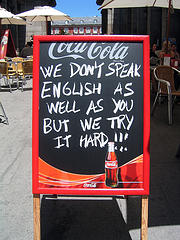
[photo: “English sign” by andreasmarx, used under a Creative Commons license]

The Global Church Is on the Move

According to Peter Crossing of the Center for the Study of Global Christianity, one hundred years ago, the statistical center of Christianity was in Spain, with over 80% of Christians living in Europe and Northern America. But today, broad changes in the Christian population have moved the statistical center to Western Africa. “This 100-year shift is the most dramatic in Christian history,” said Crossing, who spoke in October of last year at the Global Christian Forum in Manado, Indonesia. Other statistics noted at the forum were

• In 1910, less than 2% of Christians were in Africa. Today, 20% live there.

• While 60% of Christians now live outside of Europe and Northern America, their share of Christian income is only 17%.

• The top five languages used in churches are Spanish, Portuguese, English, French, and Chinese.

• 32.39% of the world’s population consider themselves Christian. The next largest group, Muslims, make up 22.9%.

• In 1960, evangelical Christians were 2.9% of the world’s population. Today they have reached 7.9%.

(Mazda Rosalya, “For 100 Years, Christians Make up One-Third of World’s Population” and “Christianity Underwent Greatest Cultural Shift in 2,000 Years, Says Scholar,” Oct. 10, 2011, The Christian Post.)

[photo: “Praying Together” by Boyznberry, used under a Creative Commons license]