6 Sites for Great Global Photos

If you’re someone who likes good photography from around the world, here are six websites I’ve run across that will give you a daily or weekly fix. All are for your viewing enjoyment, and some are hoping for your contributions:

  1. National Geographic photo of the day
  2. National Geographic travel photo of the week
  3. Smithsonian Magazine photo of the day
  4. CNN travel photo of the day
  5. Condé Nast photo of the day
  6. Lonely Planet photo of the week contest

The accompanying photo is of the Empire State Building, named by Cornell University scientists the most photographed landmark in the most photographed city on earth. Number 2 on the list is London and Trafalgar Square, which, given the drawing power of the Olympics, is probably solidifying its position over San Francisco and Union Square, at number 3.

Go here for Budget Travel’s slideshow of the complete top-25 places, with tips on how to capture the best photographs of them.

[photo: “Sun Falls on New York City,” by Thomas Hawk, used under a Creative Commons license]

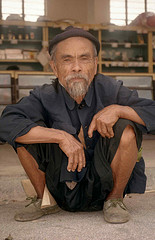
The Asian Squat for the West of the World

If you’re a Westerner who’s traveled to Asia, you’ve probably marveled at the locals’ ability to relax in their preferred alternative to just standing around—the Asian squat. You’ve also probably brought back stories (and photos) of “squatty potties,” and you understand why the bathrooms in international airports have signs that read, “No Standing on the Toilet.”

But if all this is new to you and you see the need for more information, or if you’d like help in pulling off the squat yourself, I refer you to Daniel Hsia’s mockumentary, How to Do the Asian Squat. Watch it because you want to know the history behind the Asian squat. Watch it because you want to know the physics behind the Asian squat. Or watch it simply because “Each and every day, more and more tired-legged, stiff-backed Americans are discovering a new and exciting way to squat!”

And if you really want to get on board (pun intended), take a look at “Nature’s Platform” for how you can convert a Western toilet into your very own squatty potty. The site is complete with testimonials from physicians, anthropologists, and yoga instructors. Unfortunately, it looks as if the company is not accepting new orders at this time. But don’t be disheartened, you can go here for their instructions on how to create your own conversion kit from concrete blocks and plywood. Or as an alternative, you can visit Lillipad of New Zealand, where their trendy (?) looking “squatting platform” is on sale . . . and available. They sell plans for building your own, too. (But hurry, the plans are 50% off till the end of July.)

[photo: “Old Man Squatting on Steps,” by Lon&Queta, used under a Creative Commons license]

Coca-Cola: Selling Soda and Marketing Global Happiness

Remember the Coca-Cola chorus in the 70s singing “I’d like to buy the world a Coke”? Well, The Coca-Cola Company is getting one step closer to that goal. Myanmar, one of only three countries left where Coke is not sold, will soon join the rest of the globe in serving the world’s most popular soft drink. After being gone for more than 60 years, Coca-Cola plans to re-enter the Myanmar market soon, when the US government officially allows investments there, this in response to Myanmar’s recent turn to democracy. This will leave only Cuba and North Korea on the outside of the Coke market.

Buying the world a Coke wasn’t The Coca-Cola Company’s only plan. It also wanted to “teach the world to sing” and “buy the world a home and furnish it with love.” Today, Coke’s hopes are still lofty. Their current campaign is “open happiness,” and they are spreading the message that “There are reasons to believe in a better world.” Below are three videos demonstrating this theme—citing what seem to me to be some odd pairings of vague statistics (“While one scientist is creating a new weapon . . . 1 million moms are baking chocolate cakes”). Oh well. They’re fun videos, and the music is cool. It’s the thought that counts, right? It’s Coca-Cola.

The first video is the global edition. The second is for Africa. The third is for India. And finally, the fourth video is of a guy who traveled around the world and drank a Coke in every country he visited.

(Tony Jordan, “Coca-Cola Announces Will Return to Myanmar after 60 Years,” Yahoo! Finance, June 15, 2012)

[photo: “Faces, Langa, Cape Town,” by Dietmar Temps, used under a Creative Commons license]

Please Don’t Ask Me to Eat That

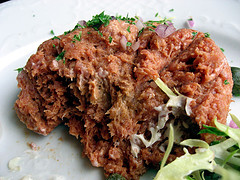
Earlier this year we were with a group of missionaries who were asked to name the worst food in their host country. One lady, who had spent time in Belgium told us about a raw hamburger dish that I remember her calling something like “American beef.” No, not American beef, but American something. . . . Then I saw this article from Public Radio International. Filet américain. That’s what it’s called. Of all the dishes named by the missionaries, this is the one that most kicked in my gag reflex—just to hear about it. Some people eat it with a raw egg on top. That’s just going too far. The author of the article voices his own fear of this Belgian favorite, but not for health reasons. Rather, he’s afraid he’ll actually like it. And then, one thing would lead to another . . . .

Try it once, and soon you’re asking for it regularly at lunch, along with half a liter of red wine. And then you’re having coffee after, along with a digestif. Your afternoon productivity, what’s left of it, starts to slump. Like a good Belgian, you simply shrug your shoulders. . . . Six months go by, and you’re slipping out after you’ve finished a plate for a few quick drags on an unfiltered Lucky Strike. You try to go grow a handlebar mustache. . . .

And then you apply for Belgian citizenship because you know you’ll never get your filet américain fix back in the US.

Maybe it’s not an unwarranted fear, that you’ll become addicted to something that disgusts you. One of the foulest foods in Asia is the durian. Most people can’t even stand the smell. But, they say, try it once, you hate it. Taste it the second time, it’s tolerable. Try it again, and it’s your favorite.

I have a theory. One day our great great great grandparents were going through a famine, and they were forced to eat something that no one had ever needed to eat before. Out of necessity they got used to it. And then when times got better, they still kept it as part of their diet. Maybe it didn’t taste good, but it felt right. It became part of them, part of their story. And then it became part of everyone’s story, kept alive, if by no one else then by the person who could always get attention with “No, I really do think it’s good. Watch me eat some.”

Having grown up on a farm in the Midwest US, I learned to like a few things that might make my city friends squeamish: cow tongue and heart, calf brains (well, I never really enjoyed that one), and Rocky Mountain oysters (fried calf testicles). But I don’t have to go back to old-time examples of Americana to find foods that could gag my international friends. Take for instance a new item soon to be introduced on Burger King’s menu. I’d love to see what my non-American friends would think about their recently announced sundae: vanilla ice cream topped with fudge, caramel, and that all-américain favorite topping, bacon.

(Clark Boyd, “The ‘Américain’ Dream,” PRI’s The World, May 31, 2012; Dylan Stableford, “Burger King to Introduce Bacon Sundae,” Yahoo! News, June 12, 2012)

[photo: “Filet Americain (Raw Beef),” by Kyle Taylor, used under a Creative Commons license]
Inflight Magazines: My Virtual Seat-Back Pocket Runneth Over

Nothing beats a good inflight magazine. It’s kind of hard for me to read a book on a flight, maybe because I’m too easily distracted, and I fall asleep too easily. But magazines . . . that’s different. I love the photos of exotic foods, the stories about eccentric locales, the ads for ridiculously expensive watches. Some time ago, I went on the internet to see if any international airlines offered free subscriptions for their magazines. I didn’t find any, but I did discover that several offer them online. Then, when I  searched some more, those several turned into a whole lot. So I put together this list (English-language only) and tracked down the links. I’d love to have them all spread out on my coffee table, but since that’s not going to happen, this is the next-best thing. (And in case you think your seat-back pocket is still missing something, I know what it is. What inflight library would be complete without a copy of SkyMall?)

(Updated, July 2021)

Any additions? Please let me know.

[photo: “In-Flight Magazine and Sky Time,” by Hideyuki KAMON, used under a Creative Commons license]

Got a Couple Hours? Take Time for Cairo

When it comes to movies, I’m often late to the game, as I usually catch them on DVD well after they’ve been released in the theaters. So only last week did I bring Cairo Time (2009) home from the library and watch it with my wife. I had not heard about it before and only picked it out because of the title and synopsis on the case. Sometimes that leads to disappointment, but this time, it paid off.

Cario Time is directed by Ruba Nadda, an Arab-Canadian, and stars Patricia Clarkson and Alexander Siddig. Clarkson plays Juliette, the wife of a UN worker who travels to Egypt to meet her husband for a long-awaited vacation. When she arrives, her husband is unable to leave his work in Gaza, so his friend, Tareq (Siddig) picks her up at the airport and introduces her to the city. Tareq is a dashing gentleman, and he and Juliette develop a relationship over the next several days. As several reviewers mention, Cairo is another major character in the story, as Juliette is swept off her feet by a city that also frustrates her. In a way, her relationship with Tareq mirrors how she feels about Cairo, enchanted yet perplexed by her own feelings . . . infatuated by the exotic newness while drawn back by her own “culture.”

Included on the DVD is a “Making Of” segment, in which Nadda says that the reason she became a filmmaker was because she “was desperate to shed light on the common misconceptions the West has of the Middle East.” The segment also includes behind-the-scenes footage from a “very Islamic, very religious” part of Egypt where they filmed a scene. The director was warned not to go there, but they did anyway, and she says it turned out being “one of the best days of [her] life.” They met a poor family there who welcomed them, gave them sodas, and asked about Seinfeld. With accompanying footage, Nadda tells this story:

The man’s wife, she’s veiled, she said “I need to be validated, I need to show the world what I look like.” And she began to unveil. And I was like, “But you’re going to be on camera. The West will see you.” And she said, “I don’t care. I want to show people that I exist.”

Cairo Time is not a fast-paced movie. Rather it moves at a deliberate, thoughtful pace. As Clarkson says in “Toronto Q & A” (also on in the “Bonus” section of the DVD), the director “had the courage to let there be silence.” Nadda adds,

I wanted to show a story that wasn’t about immediate gratification, you know, which is, I find, sometimes, a bit North American. It was “Cairo time.” . . . Cairo is so crazy and chaotic and beautiful, bustling, but it’s also an assault to the senses, and that chips away at your guard and it forces you to slow down whether you like it or not.

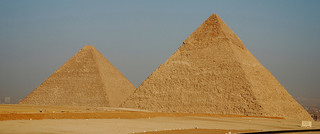
[photo: “Pyramids,” by Wilhelm Joys Andersen, used under a Creative Commons license]
Maybe the Best Exotic Marigold Hotel is #19

When it comes to global best-of lists, I gravitate toward ones that point to something cheap (like “10 Fast Food Items You Can’t Have“), rather than pricey (like “The World’s 50 Best Restaurants“). I think that “The 18 Best Places to Retire Overseas” (Kathleen Peddicord, US News & World Report, March 19, 2012) falls closer to that second category, even though the author promises that these locations are places where “an interesting, adventure-filled lifestyle is available for a better-than-reasonable cost.” But I’m printing the list here anyway, if for no other reason than to show that Jaipur, India, didn’t make the cut.

  1. Panama
  2. Belize
  3. Colombia
  4. Uruguay
  5. Ecuador
  6. Nicaragua
  7. Roatan, Honduras
  8. Argentina
  9. Mexico
  10. Chile
  11. France
  12. Italy
  13. Ireland
  14. Spain
  15. Croatia
  16. Thailand
  17. Vietnam
  18. Malaysia

So what’s so special about Jaipur? That’s the destination of the seven British retirees in the movie The Best Exotic Marigold Hotel, which opened in US theaters this past weekend. Maybe if the film does well, the “Pink City” (as Jaipur is called), or Udaipur, where much of the movie was shot, will find a place on future lists.

Good movie? I haven’t seen it yet, but I’ve heard good things about it. One person who saw it and liked it is an adult TCK who grew up in a place not too far culturally from Jaipur. Read her review at Communicating Across Boundaries.

[photo: “Jaipur Lake Palace,” by jkuba!, used under a Creative Commons license]

World’s Best Airline Awards, Do You Agree?

Last week I wrote about the best airports in the world. But if you want to get to one of them, which airline should you take? Skytrax has that covered, too. Here’s a list of the top five airlines from 2011, followed by the winners in specific categories, all from World Airline Awards, “the most prestigious and coveted awards for the airline industry”:

  1. Qatar Airlines
  2. Singapore Airlines
  3. Asiana Airlines (South Korea)
  4. Cathay Pacific Airways (Hong Kong)
  5. Thai Airways International

(Singapore is the only one of these I’ve had the pleasure of flying. Maybe I took Cathay once, but I can’t remember. Flying Singapore was great for our family of six, but that was several years ago. Too bad they’re so expensive now.)

Best cabin staff:

  1. Asiana Airlines
  2. Malaysia Airlines
  3. Singapore Airlines

(Our family flew Malaysia once, too. In our estimation, it’s pretty close to Singapore overall. It’s hard to beat Asian hospitality.)

And best economy class meals:

  1. Thai Airways
  2. Turkish Airlines
  3. Asiana Airlines

(Any airline that served Dr. Pepper would get a vote from me.)

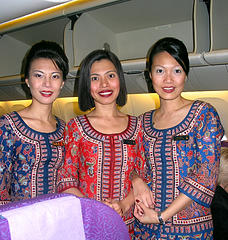
[photo: “Fabulous Flight Attendants,” by Carol Schafer, used under a Creative Commons license]