This Global Footage Comes from Space

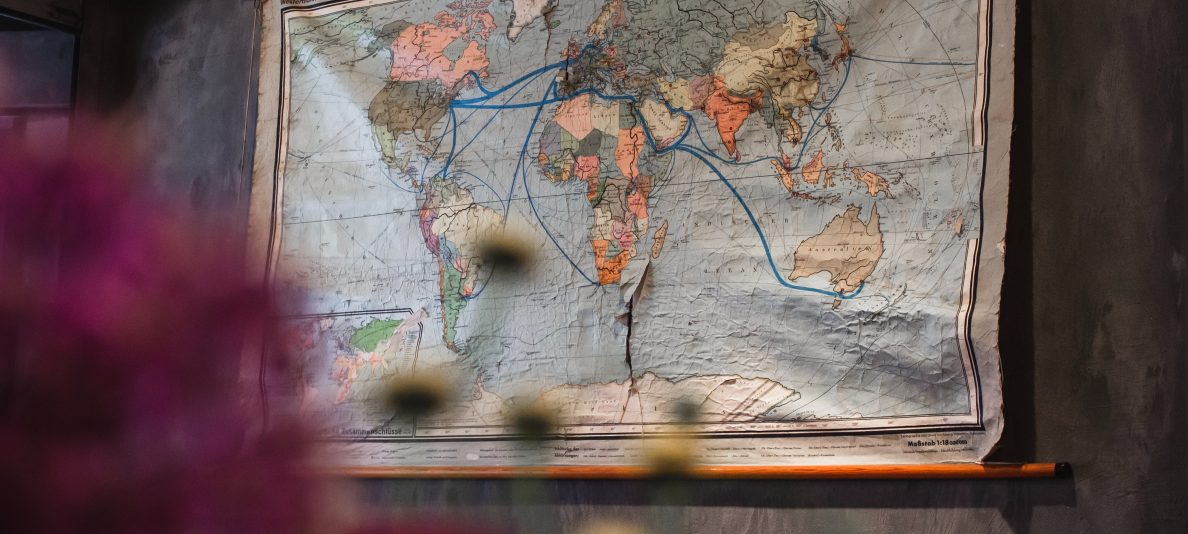
In an extreme case of repatriation, three astronauts returned to earth yesterday following nearly 6 months in the International Space Station. The three, Daniel Burbank (USA), Anton Shkaplerov (Russia), and Anatoly Ivanishin (Russia) landed safely in Kazakhstan—inside a Russian Soyuz capsule.

In honor of their arrival, here’s some time-lapse footage of the earth, taken from the ISS from August to October of last year, compiled and edited—complete with inter-galactic-sounding music—by Michael König:

Airport, Sweet Airport

I have a friend who spent many years overseas as a missionary and learned the ups and downs of bridging cultures. She said that the place she felt most at home was on an airplane. Well, my legs are longer than hers, so it’s hard for an airplane seat to offer me any sense of “home.” But an international airport? That’s my kind of place. Now I’m not saying that I’d actually like to live there*, but airports sure do a good job of catering to travelers’ short-term needs (though it’s not the cheapest place to spend a day). And the walkways and waiting areas vibrate with the echos of goodbyes, the anticipation of hellos, and . . . transition.

So if you like airports—or if you detest them and want to decrease your pain—where should you plan your next layover? What are the best airports in the world? Well, the public has voted, and on April 19 the Global Airport Awards were handed out by Skytrax. Ladies and gentlemen, the top-ten airports are

  1. Incheon International Airport
  2. Singapore Changi Airport
  3. Hong Kong International Airport
  4. Amsterdam Schiphol Airport
  5. Beijing Capital International Airport
  6. Munich Airport
  7. Zurich Airport
  8. Kuala Lumpur International Airport
  9. Vancouver International Airport
  10. Central Japan International Airport

If none of these are on your scheduled routes, go to Skytrax for their full rankings of the top 100 and list of winners in key categories. Surely you’ll find someplace among their recommendations that matches your travel plans.

*Though I enjoyed watching Stephen Spielberg’s The Terminal, I don’t expect that actually living in an airport would turn out so well. Seems that Spielberg’s inspiration for the movie came from the real-life story of the Iranian-born Mehran Karimi Nasseri, who lost his refugee documents in France and ended up stuck at Charles de Gaulle Airport—for 18 years. And from what I’ve read, Nasseri’s story didn’t turn out as happily as The Terminal. Nasseri left Charles de Gaulle in 2006 and now lives in France. Maybe things would have turned out better if he had been in a different airport: Charles de Gaulle ranked only 78th on Skytrax’s list.

To get Nasseri’s full story, you can read his autobiography, Terminal Man, or you can get a much shorter version in the article “Mehran Karimi Nasseri” (h2g2, May 28, 2008)

[photo: “Resting in Red,” by OakleyOriginals, used under a Creative Commons license]

Books in Their Natural Habitats

When we were in Taipei, one of our favorite trips was to visit the huge Page One bookstore at the base of the world’s tallest building, Taipei 101. Time moves on . . . Taipei 101 is now the second-tallest building, Page One has been downsized—and we don’t live there anymore. Oh well.

If you like books, and the places where they reside, Emily Temple at Flavorwire has served up some great photos of libraries and bookstores around the world. Books haven’t gone out of style yet. Here’s hoping they never do. These are some amazing places:

For the next collection of photos, I suggest the biggest and most cluttered used-book stores in the world. Any nominations?

By the way, did you know that today the US is celebrating World Book Night? Here, world means “the US, Britain, Germany, and Ireland.” Night means “day” and “afternoon” and “evening.” And book actually means “book,” as volunteers in the US are giving away 500,000 paperbacks (in Great Britain, they’re handing out 1 million). Anna Quindlen, World Book Night honorary chairwoman, says the event is “like an intellectual Halloween, only better. . . . We’re giving out books, not just Mars bars.”

(Bob Minzesheimer, “World Book Night Celebrates Reading with Paperback Handouts,” USA Today, April 22, 2012)

[photo: “Books,” by Brenda Clarke, used under a Creative Commons license]

One Day, One Earth, One Film

Just as I was getting ready to publish my last post, I saw this trailer for One Day on Earth, and I couldn’t pass up the connection. The film is from a project called, appropriately enough, “One Day on Earth,” and it’s a collection of footage from every country in the world, all taken on 10/10/2010. It’s debuting today, since April 22 is Earth Day. The group is putting these together yearly, so if videography is your thing, maybe you can get in on helping them create their next movie.

Let Your Day Be Part of “A Day in the World”

Are your photos not good enough for Pictures of the Year? Well, how about Pictures of the Day? The folks at ADAY.org invite you to join them on May 15th to “photograph what our lives look like.” Their website says the project is for everyone, all around the world, using any kind of camera:

Professionals, amateurs, school children, farmers, social media fans, astronauts, office workers and you. Cell phone camera, Hasselblad, home made or borrowed. We are looking for the perspectives of everyone who enjoys photography!

The final product?

All images will be displayed online for you and everyone to explore. Some of them will be selected for a book, A Day In the World, others in digital exhibitions. Every single one will be saved for future research and inspiration.

Got to ADAY.org for instructions on how to participate. You’ll need to sign up and get details before the 15th, so you’ll want to get on board soon.

[photo: “The Photographer,” by Elvis Kennedy, used under a Creative Commons license]

That’s What You Are, but What Am I?

We in America know what we think about Europeans, and we think we know what they think about us, but do we know what they think about each other? An interactive site at The Guardian shares the stereotypes that Europeans hold about their neighbors and then lets the labeled parties respond. In answering what the French, Germans, Italians, Poles, and Spaniards have to say about them, the Britons reply, “Despite everything, Britain is not broken. And if that’s hard for some of our European neighbours to accept, then they should hear what we say about them.”

(“European Stereotypes: What Do We Think of Each Other and Are We Right?” The Guardian, January 26, 2012)

[photo: “A Man from English Uniform Store,” by Yunchung Lee, used under a Creative Commons license]

In Praise of Petite Feet

I remember seeing a large advertisement in the Taipei subway station showing a Western model in a swimsuit sporting a dark tan. In the US, a photo of a lady with that kind of complexion might be promoting a tanning product, but in Taiwan, it was an example of what you don’t want to look like. Instead, the ad was for a skin whitener. Beauty really is in the eye of the beholder. But recent research has finally shown us a female trait that everyone around the globe agrees is attractive: little feet.

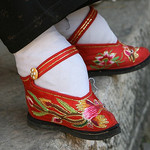
According to a team led by Daniel M.T. Fessler, six studies confirm that “small foot size is preferred when judging women.” In one study, when asked to pick the most attractive women, males and females from eight countries chose the ladies with the smallest feet. That’s because everywhere in the world, small feet represent “youth and femininity, and thus desirability.” . . . Um, well, not everywhere. Seems there is one group of people who disagree. They are the Karo Batak of rural Indonesia, hard workers who often don’t wear shoes. They prefer women with large feet, which are associated with strength and a better ability to work in the fields.
The research was presented in the journal Evolution & Human Behavior, under the title “Testing a Postulated Case of Intersexual Selection in Humans: The Role of Foot Size in Judgments of Physical Attractiveness and Age” (abstract here). (I’m thinking a lot of cultural anthropologists and their ilk have a preference for long titles.)

(Tom Jacobs, “Great Dessert? Depends on the Plate,” Miller-McCune, March 2, 2012)

Evolution and human behavior. Now those are a couple topics that can cause some disagreement around the world. An article published in Science in 2006 reported on studies showing that adults in the US, when compared to people in 32 Europe countries and Japan, are much less likely to accept “the evolution of humans from earlier forms of life.” Back then, only 14% of adults in the US believed evolution to be “true,” while about one third said it was “false.” The only country in the study with a lower opinion of evolution was Turkey. On the opposite extreme of the spectrum was Iceland, where over 80% of adults believed in evolution.

(John Hartman, Eugenie C. Scott, and Shinji Okamoto, “Public Acceptance of Evolution,” originally in Science, August 11, 2006, online at The Richard Dawkins Foundation for Reason and Science)

[upper photo: “Chinese Bound Feet (7)” by DrJohnBullas, used under a Creative Commons license; lower photo: “DanicaPatrick_05” by daisygold2002, under a  Creative Commons license]