The Reports of Mark Twain’s Travel Quotations Are Somewhat Exaggerated

USS_Quaker_City
Quaker City, Mark Twain’s steamship in The Innocents Abroad

In 1866 and 1867, Mark Twain wrote a number of letters to the San Francisco newspaper Alta California, detailing his travels from California to New York, by way of Nicaragua. In 1940 they were collected and published under the title Mark Twain’s Travels with Mr. Brown. In one of those letters, a dispatch from New York dated May 18, 1867, we find what has become one of his more famous quotations on travel:

[N]othing so liberalizes a man and expands the kindly instincts that nature put in him as travel and contact with many kinds of people.

In context, Twain is describing “The Traveller’s Club”:

That is a human institution. Its President is a Californian, and its members hail from more places than there are on the Atlas. They have kindly complimented me with the privileges of the place for a month, and I went up the other night at ten and spent a very pleasant evening till two or three o’clock in the morning.

Of course I met pleasant people, because nothing so liberalizes a man and expands the kindly instincts that nature put in him as travel and contact with many kinds of people. An Englishman, an Irishman, a Scotchman, an Italian or so, several Frenchmen and a number of Americans were present, and you couldn’t ask a question about any possible country under the sun, but some fellow in the crowd had been there and could give the information from personal experience. . . .

They said they were going to send me a formal invitation to make a speech before the Club, as Du Chaillu did, and I said I would be glad to accept it, but I did not know then that they go and invite a whole raft of ladies to be present on such occasions, to look at a poor victim and make him lose his grip, and so I hope they will forget to send the invitation, now.

You ought to start a Travellers’ Club in San Francisco. You have got an abundance of material, and that sort of an organization is much pleasanter than political one-idea affairs, such as clubs generally are.

Subsequent letters to Alta California didn’t need to wait so long to be put into book form. Published in 1869, The Innocents Abroad, or The New Pilgrims’ Progress, chronicles his trip to Europe and the Holy Land and became a classic in travel literature. Volume two of the book contains an even more popular (in my estimation) travel quotation, in the form of

“Travel is fatal to prejudice, bigotry, and narrow-mindedness.”

The full paragraph is as follows:

I have no fault to find with the manner in which our excursion was conducted. Its programme was faithfully carried out—a thing which surprised me, for great enterprises usually promise vastly more than they perform. It would be well if such an excursion could be gotten up every year and the system regularly inaugurated. Travel is fatal to prejudice, bigotry and narrow-mindedness, and many of our people need it sorely on these accounts. Broad, wholesome, charitable views of men and things can not be acquired by vegetating in one little corner of the earth all one’s lifetime.

Twain’s view sounds right, but don’t take my word for it, just ask SCIENCE. As reported in PsyPost, researcher Jiyin Cao says that he and his colleagues were “intrigued” by Twain’s quotation, so they conducted five studies to test the idea. The results suggest that Twain knew what he was talking about:

In this paper, my coauthors and I tested this assumption: Does travel make people more trusting? Does travel lead people to have a more charitable view of humanity? Given the trend toward globalization and the increasing popularity of foreign travel, this will be an important and interesting question to explore. In addition, we compared two aspects of foreign experiences: the number of countries one visits (breadth) and the length of time one spends abroad (depth), and explored which one plays a critical role in the process. Across five studies, using different research methods including a longitudinal study, we found that breadth but not depth of foreign experiences increases generalized trust. In other words, the more countries one travels, the more trusting one is. Breadth is important here, because breadth provides a great level of diversity in people’s foreign travel experiences, allowing them to reach such a generalized assumption.

Earlier in The Innocents Abroad, Twain has more to say about the benefits of travel: self awareness. (This one I don’t see quoted much.)

The gentle reader will never, never know what a consummate ass he can become until he goes abroad. I speak now, of course, in the supposition that the gentle reader has not been abroad, and therefore is not already a consummate ass. If the case be otherwise, I beg his pardon and extend to him the cordial hand of fellowship and call him brother.

And then there’s the well known

Twenty years from now you will be more disappointed by the things you didn’t do than by the ones you did do. So throw off the bowlines, sail away from the safe harbor. Catch the trade winds in your sails. Explore. Dream. Discover.

Yes, Twain had a lot of things to say about travel . . . but this last quotation isn’t one of them. Despite many online and offline sources attributing it to Twain, Quote Investigator‘s Garson O’Toole finds it no earlier than in 1990, when H. Jackson Brown, Jr. included it in his book P. S. I Love You. The inspirational author credits the saying to his mother, Sarah Frances Brown.

And as long as we’re trekking down this path, so to speak, Twain also didn’t say, “A lie can travel halfway around the world before the truth can get its boots on.” (I know, this is stretching the travel theme a bit, but the word is in there.)

Back to O’Toole: He writes that Bonnie Taylor-Blake located the phrase “falsehood will fly from Maine to Georgia, while truth is pulling her boots on” in an 1820 issue of the Portland Gazette. And then in 1821, William Tudor, in The North American Review, ascribed “a Lie would travel from Maine to Georgia while Truth was getting on his boots” to congressman Fisher Ames. In Twain’s writings, though, nothing similar appears.

Bummer! Mark Twain didn’t say everything.

But now I’ll leave this discussion on a more positive note—positive because here’s something that did come from Twain, and positive because it recognizes another beneficial aspect of getting out and about. With Huckleberry Finn as his spokesperson (a passenger, by the way, in a boat held aloft by a balloon, floating around the world), Twain wrote the following in 1894:

I have found out that there ain’t no surer way to find out whether you like people or hate them than to travel with them.

Yes, Huck, you said it. You sure did. And I figger we don’t need no research to know that it’s true.

(Mark Twain, “Letter 18,Alta California, June 23, 1867; Twain, The Innocents Abroad, or The New Pilgrims’ Progress, American, 1869; Eric Dolan, “New Study Confirms Mark Twain’s Saying: Travel Is Fatal to Prejudice,” PsyPost, December 9, 2013; Garson O’Toole, “Twenty Years from Now You Will Be More Disappointed by the Things You Didn’t Do than by the Ones You Did Do,” Quote Investigator, September 29, 2011; O’Toole, “A Lie Can Travel Halfway around the World While the Truth Is Putting On Its Shoes,” Quote Investigator, July 13, 2014; Twain, Tom Sawyer Abroad, Charles L. Webster, 1894)

[illustration: USS Quaker City,” by Clary Ray, c. 1890, public domain]

Missionary Memes: Tea Bags and Coffins [—at A Life Overseas]

6232093565_d5e3507356_b

Some stories seem too good to be true. Some seem too good not to be true. Both seem too good not to be told over and over again. Here are a couple I’m thinking you’ve heard before.

Used Tea Bags

They very well may be the most talked about items to ever be lovingly tucked into a missionary care package. No conversation about odd gifts sent overseas would be complete without their mention. They’re the bless-their-hearts-what-were-they-thinking used tea bags.

Surely you’ve heard somebody somewhere say they know a missionary who received used tea bags from a well-meaning supporter. But is there truth behind the tale? Or is it just an oft-repeated urban legend, used to caution supporters against giving less than their best?

Finish reading this post—and see all the comments—at A Life Overseas. . . .

[photo: “DSC_1968,” by Sarah Han, used under a Creative Commons license]

International Students, Hospitality, and Squishy Statistics

8014375021_4e92cc378b_z

The venerable Ed Stetzer, at Christianity Today, has added his voice to those calling for the need to show hospitality to international students visiting the US. He also brings attention to the squishy statistic of how many students are never hosted in an American home. He writes,

The informal number people in the field quote says that three out of four international students never set foot in a North American home during their time in school. (I can’t find any original statistics to verify it, but most people in the movement say it is true and fits their experience.)

Last year I wrote about this oft-used statistic, but I remembered it as 80% (rather than 75%). Leiton Chinn is familiar with the same figure, and I quoted him, again from Christianity Today:

Ever since I began encouraging the church to welcome and host international students over four decades ago, I have heard the repetitive declaration that 80% of international students never enter an American home. Even though I have sought to find the research that reported such a claim without success, the reality is that the majority of students from other countries do not experience being hosted in an American home.

A quick search of the Internet has the three-out-of-four stat (or something close to it) showing up in quite a few places, though I’ve not found the numbers highlighted by anyone outside the Christian community. They state that “75 percent,” “as high as seventy-five percent,” “nearly 75 percent,” “about 75 percent,” “over 70 percent,” or “70%” of international students never enter—or, as some say, are not even invited into—an American home.

Regardless of the exact number, Stetzer points out that this is an important situation for the church to consider. About the 75% statistic, he says,

If accurate, that’s concerning. These students come from all over the world and we’ve been given an incredible opportunity to show them hospitality. But as far as I can tell, most of our families are not taking advantage of it.

Now I love hospitality, but what I love even more is when people have the chance to hear the good news of the gospel of Jesus Christ. One of the (many) reasons why we should be grateful to have international students on our college campuses here in North America is that their proximity to our homes gives us the opportunity to share that message with them.

Many students are coming from countries where it’s illegal to be a missionary. In some places, Christians are losing their lives even trying to practice their faith, much less share the gospel. For them to be surrounded by churches and believers is a bigger deal than we might recognize at first. We thank God for opening this door of ministry to us and, for the sake of these students, we need to take advantage of it.

Seventy-five percent? Eighty percent? What if it were twenty-five percent? Maybe we should be content just to say “too many,” and then act accordingly.

(Ed Stetzer, “Ministering to International Students,” Christianity Today, August 16, 2019; Leiton Chinn, “Making Room at Your Table for Interventional Students,” Christianity Today, November 9, 2018)

[photo: “Welcome,” by Prayitno, used under a Creative Commons license]

Speculoos Cookie Butter: A Little Bit of Air Travel in a Jar

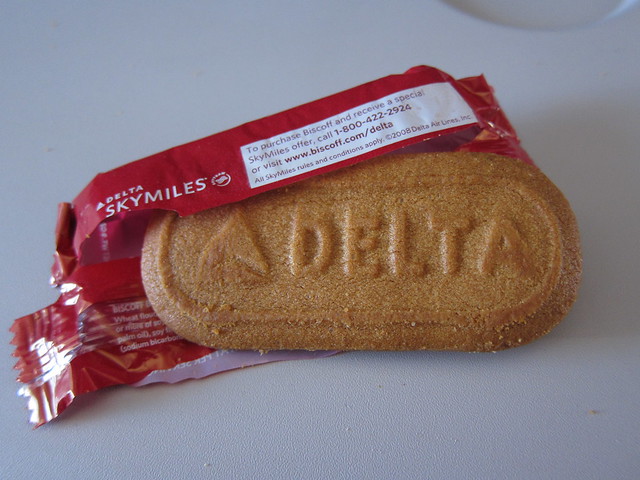
Delta cookie

Sometimes the choices at the grocery store can get downright overwhelming. Take, for instance, the butter section. I’m not talking about butter butter and I-Can’t-Believe-It’s-Not-Butter butter.

No, I’m talking about the I-can’t-believe-there-are-so-many-alternatives-to-peanut-butter butter. A recent trip to the grocery store (and a follow-up search on the web) introduced me to almond butter, pistachio butter, walnut butter, brazil-nut butter, cashew butter, pecan butter, hazelnut butter, macadamia-nut butter, sesame-seed butter, pumpkin-seed butter, sunflower-seed butter, coconut butter, granola butter, and soy butter.

And then there’s the last-but-not-least variety I haven’t gotten to yet, the one that got me looking in the first place, the one that a coworker brought to work to have us try . . . speculoos cookie butter.

This butter variation is made from crushed speculoos—European shortbread—cookies. If that doesn’t ring a bell, think of the Biscoff cookies you get as an in-flight snack. Oh, the flavor. Oh, the memories.

If you’re looking for speculoos cookie butter in the US grocery aisle, start with Lotus Biscoff Cookie Butter or Trader Joe’s Speculoos Cookie Butter or Wal-Mart’s Great Value Speculoos Cookie Butter. And if you’re more of a DIYer, you can make your own.

Eat a spoonful of speculoos cookie butter and the flavor will transport you to a seat on a flight transporting you to a life-changing destination. But don’t limit it to a spoon topping. Try it on waffles, toast, ice cream . . . or Biscoff Cookies. And there are tons of recipes online with cookie butter as an ingredient.

Need more inspiration? Take a look at these websites and videos. And there’s a lot more out there. When it comes to speculoos cookie butter, the sky’s the limit.

50 Ways to Use Trader Joe’s Speculoos Cookie Butter

30 Incredible Desserts to Make with Cookie Butter, the World’s Most Addictive Spread

25 Cookie Butter Recipes to Make ASAP

[photo: “IMG_9255,” by adaenn, used under a Creative Commons license]

If You Send an MK Some Cookies [—at A Life Overseas]

4462063010_7a12343040_b

Inspired by Laura Numeroff

If you send an MK some cookies, she’s going to want to eat a couple.

But first she’ll ask her mom if she can walk down the street to get some apple soda to go with them.

On her way, she’ll see a stationery store.

That will make her think about buying a card to send to you.

In the store she’ll find one that says, “Thanks You! Very! Very!”

Then she’ll decide to make a card herself.

For that she’ll need some glitter, so she’ll ask the clerk (in his language) if he has some “really small colorful things,” while making “sparkly” motions with her hands.

He’ll probably reach under the counter and pull out a bag of marbles.

Finish Reading at A Life Overseas. . . . 

[photo: “Cookies,” by z Q, used under a Creative Commons license]

Streets, 2, 3, 4


8104279874_f648d50f14_z

“The Good, Bad, and Irrecoverable—Romania’s Lost Children”

Nearly three decades ago, Romanian dictator Nicolai Ceaușescu fell, along with his state-run orphanages. The streets were flooded with unwanted children, some who were privately adopted, others who made homes in the sewers and streets. Today, with some reintegrated into society, some still homeless, and some dead, Ceaușescu’ children have grown up.

. . . . .

In the early 90s, street kids boomed as the children flocked to Bucharest, the only city with an underground rail system. Children would visit their family and friends back home, recruiting more children to the city. The average age was just seven-years-old.

“After Ceausescu’s fall it was complete chaos, and we call this chaos freedom,” explains NGO Save the Children social worker Leonard Andreescu.

Under Bucharests’s streets emerged Lord of the Flies-esque societies, organised systems with leaders. According to Andreescu, these systems were arranged “fantastically.”

“The sewer systems are warm, they hooked them up to water and power. They had a long string of lights down the tunnel systems—if you entered, but didn’t know the password, they would turn them off.”

Of the original children living in the streets, Andreescu estimates only 300 remain, with most of these now being adults. But this doesn’t indicate an improvement in social services, said Andreescu.

“One third are dead. One third are reintegrated into society. And one third still live on the street.”

Samantha Dixon, Euroviews, April 27, 2017

[photo: “|1|2|3|4|5|6|7|8|,” by Gerry Dincher, used under a Creative Commons license]

In-Flightisms


Plane toy on blue sky

Here’s one more installment of travel “isms”—created words and terms to help travelers talk the talk . . this time while they fly the flight. And if you’d like to get caught up on my past entries, check out Expatisms, Airportisms, and Pre-Tripisms.

passenger of imminent domain
This is the person directly in front of you on a plane who, upon sitting down, immediately pushes his seat back as far as it will possibly go. Intuiting that something must be hindering it, he tries to force it back farther, again and again. There. Must. Be. Something. Keeping. The. Seat. From. Reclining completely flat (possibly your knees). Finally, leaving the seat fully back, he leans forward to watch a movie.

chipillow
The bag of snacks that you bring from home that bloats up once you reach higher altitudes. With care, it can be used to rest your head on, due to the fact that it’s in the same food group as the neck croissant.

single-entré seating
The rows in the far back of the plane where you no longer get a choice between the brazed beef medallions over a wild-rice pilaf and the broiled fish and mashed potatoes. You get the fish.

cartnering
This is the act of hovering next to the food cart as it’s making its way down the aisle. Timing a trip to the bathroom with the distribution of meals is truly an art form, and it is best done passive-aggressively (such as by wearing a smile while dancing from one foot to the other).

silent gotcha port
The “SGP” is the small screw hole on the seat armrest that looks as if it must be the place where you plug in your earphones.

Queen Ramona’s veil
The dark mesh curtain that separates business class from coach. Its main purpose is to protect those in the front of the plane from projectiles thrown by the riotous mob behind, who are known to catapult dinner rolls at each other using slingshots fashioned from their airline-provided sleep masks and who sometimes divide into teams for prolonged games of ultimate Frisbee. In small planes, the curtain, only a few inches across and resting next to the cabin wall, is known as Queen Romana’s Veilette. Its purpose is purely psycho-social.

The term “Queen Ramona’s Veil” comes from the name commonly used for the wood-and-iron gate employed by the overly paranoid and little-known British Queen Ramona II to separate her highness from the filthy hordes sometimes present in the steerage portion of her royal sailing ship. Mention of the barrier is made in the English dirge “The Death of Queen Ramona at the Hands of the Filthy Hordes.”

FASL
Flight Attendant Sign Language. Includes such specialized hand maneuvers as indicating the exits by extending the arms to the side, palms forward, pointing with two fingers, Boy Scout style, and mimicking the pulling of life-vest inflation cords using the crook of the thumb and first finger with the other fingers fanned out, subliminally showing that everything will be “OK.”

seatemic
(pronounced see-uh-tehm-ic) Your connecting flight is delayed and you have no time to spare so when it lands you run as fast as you can (and by “as fast as you can” I mean a combination of running, jogging, speed walking, walking, stopping, and wheezing) across the airport and arrive at your gate just as they’re closing the door and you speed down the gangway and board the plane and force your carryon into something close to an available slot and find your seat and quickly strap in so the plane can take off. . . . Now all you can do is sit still, sweating, with your heart racing and your veins coursing with adrenaline. Your body is in a fight-or-flight response but something tells you this is a different kind of flight. If you are suffering from these symptoms, you are seatemic.

no-watch list
Movies that are not allowed to be shown in-flight. The list includes Red Eye, AirborneNon-Stop, FlightplanSnakes on a Plane, Quarantine 2: Terminal, and Plane of the Living Dead. And, yeah, some of these shouldn’t be shown on the ground, either.

post-ping che-klatches
The sound of seatbelt buckles popping open the instant the plane stops at the gate and passengers hear the OK-now-you-can-get-up tone. This allows those in window seats to immediately grab their carryons, put them where they were just sitting, and wait, hunching under the overhead bins.

[photo: “Plane Toy on Blue Sky,” by Marco Verch, used under a Creative Commons license]

Too Much Member Care—Can There Be Such a Thing? [—at A Life Overseas]

43484154311_512cb86e8f_k

It’s a question I’m reluctant to ask, because I’m a strong proponent of more effort and resources devoted to caring for cross-cultural workers. But here it is: Can there be too much member care?

To help with the answer, I’ll dip once more into the deep well of data from ReMAP and ReMAP II, studies conducted by the World Evangelical Fellowship/World Evangelical Alliance. And more specifically, I’ll consult the analysis of those results by Detlef Blöcher and Jonathan Lewis, who first asked the question more than twenty years ago. The pair examine the effects of member care on attrition in Too Valuable to Lose: Exploring the Causes and Cures of Missionary Attrition, and Blöcher addresses the issue in Worth Keeping: Global Perspectives on Best Practice in Missionary Retention.

Cutting to the chase, here is what they found: An increase in time and money devoted to missionary care, as a proportion of a sending organization’s total resources, tracks with a decrease in “preventable” attrition. That’s true, though, only until a tipping point is reached. Above that percentage, more care actually correlates with more workers leaving the field. While the first finding seems obvious to me, I have to say that the second one doesn’t align with my general assumptions and seems to fly in the face of my advocacy for more and more member care. But I can’t ignore information just because it doesn’t easily fit my personal views.

Read more at A Life Overseas. . . .

[photo: “Coffee Beans Falling into a Cup,” by Bryon Lippincott, used under a Creative Commons license]