Two Who Help International Students in Small Ways That Turn Out to Be Very Big

I’m going to brag on a couple friends of mine. Both of them are shining examples of devoted service to the international students who come to our communities. Both of them live in small cities in the Midwest: one in Pittsburg, Kansas, and the other in Joplin, Missouri. And while they are content to serve in quiet ways, each has recently been highlighted in local media.

Helping Students Get Around . . . on Two Wheels

1653027386_4dba5e754a_qFor over three decades, Don Smith—through Campus Christians—has been ministering to the students at Pittsburg State University in Pittsburg, Kansas. Throughout that time, more and more of those students have come from other countries.

In fact, today, a significant part of Don’s work is collecting, repairing, and distributing bicycles to the more than 450 international students at PSU. It was this bicycle ministry that caught the attention of The Joplin Globe, which ran a story about him.

Don told The Globe that he got the idea to loan bikes to international students 30 years ago, when he saw a similar program at the University of Missouri. That story means something to me, as I was a student at MU 30 years ago, living at the Christian Campus House, the place where Don got his inspiration. A few years later, I became the campus minister to inernationals at CCH and took over the bike ministry. But Don’s efforts go well beyond anything that I was able to do.

One of the first lessons he learned was how to keep bikes in the program. It was easy to give bicycles out. “But the first year,” Don told The Globe, “not one bike came back. Not one.”

The solution came in two parts: using stronger locks and charging a deposit of $35, which is refunded when the bike is returned. That’s increased the return rate to about 75%.

Since the beginning of July, Don has distributed 200 bikes. And as word has gotten around, American students are taking advantage of the ministry as well.

Word certainly has gotten around, not only about the bikes but about all the work that Don is doing. Two years ago, he received the Ralf J. Thomas Distinguished Service Award from PSU, and last month he and his wife were honored by Ozark Christian College, their alma mater, with the Seth Wilson Outstanding Alumnus Award.

(Andra Bryan Stefanoni, “Have Bike, Will Travel: Campus Minister Provides Wheels to Students,” The Joplin Globe, February 14, 2014)

A Mom to Many

2956042901_4e983192a0_q“Mom.” That’s what scores of international students at Joplin’s Missouri Southern State University call Linda Keifer. For nine years, she and her husband, Jerry, have invited guest from around the world into their home.

“It started with a few, and then they invited their friends,” Linda told The Chart, Missouri Southern’s student newspaper. “This is what God wanted us to do.”

Several students also shared in the article what they liked about being part of the Keifers’ extended “family”:

“It’s family Sunday: to eat, relax, listen to each other, to talk about worries, hopes, dreams and wishes,” said Stephanie Kiessling from Germany. “They are sharing the American tradition and the international students [are] sharing theirs as well.”

And Lei Lei, from China, said, “When I speak to them, I feel like I’m talking to a genuine mother and father. They make me feel appreciated, welcomed, and at home.”

Linda’s ministry came full circle last year when she and Jerry traveled to Asia, becoming the guests and receiving hospitality from the students and their families.

Being part of a family means sharing in the highs and lows. So when Linda was diagnosed with colon cancer last year, the students gathered around the Keifers and comforted them. That comfort has continued as Linda has gone through surgery and receives treatment.

Just a few weeks ago, Jerry told me how much the students’ kindness has meant to them. That’s often the way it is: When we reach out to help others, we often receive as much, if not more, than we give.

(Xiaoyu “Jamie” Wu, “Mom Opens Home to Students,” The Chart, October 31, 2013)

Don and Linda wouldn’t meet a strict definition of “globally famous,” but that doesn’t mean they haven’t gained international fame, at least among those who have been touched by their simple generosity, by those who call them friends . . . and sometimes “Mom” or “Dad.”

[photos: “Bicycle,” by JMC Photos, used under a Creative Commons license; “Door Knob,” by zizzybaloobah, used under a Creative Commons license]

“Let It Go”: Dubbing Disney’s Oscar-Nominated Toe Tapper in 25 Languages

Speaking of films, there is that Academy Awards thing tomorrow night. I’m predicting a sweep for Frozen in its nominated categories: best animated feature and best original song.

If you haven’t heard “Let It Go,” the nominated song from the Disney film, then you 1) haven’t seen the movie, 2) don’t spend much time on YouTube, and 3) don’t live with a seven-year-old who’s memorized all the lyrics.

And if you haven’t heard the original, then you probably haven’t heard the version dubbed into 25 languages. Even if you have heard it, it’s worth another listen.

The English version of “Let It Go” is sung by the Tony Award winning singer and actress Idina Menzel, who voices the movie’s character Elsa. She’s the one singing the English at the beginning of the multi-language video. But even though the rest of the song sounds as if it is sung by her, believe it or not, it isn’t.

So who in the world was tasked with finding all those talented songstresses? Look no further than Rick Dempsey, senior vice president of creative for Disney Character Voices International.

“In a lot of cases I think we fooled some people into thinking that it’s Idina in all those languages,” Dempsey told NPR. “And that, of course, is the goal, to ensure there is character consistency and the voices are all very similar around the world.”

But all that work isn’t a one-man show. Dempsey told The Hollywood Reporter, “We have 76 people around the world in 19 offices that oversee films in 55 languages. Our goal is to make every audience feel like Frozen was made in their country for their people.”

10152920204_d766fbe52c_qThe Los Angeles Times reports that the array of voice talents in “Let It Go” include Gisela (Castilian and Catalan), Serena Autieri (Italian), Willemijn Verkaik (German, Dutch), Takako Matsu (Japanese), Carmen Sarahi (Latin American Spanish), Marsha Milan Londoh (Malay), and Anna Buturlina (Russian).

And the impressive work of Dempsey’s crew on Frozen didn’t end with the only 25 versions of the feature song. While most stories report that Frozen has been dubbed into 41 languages, a Disney UK tweet puts the total at 43.

(“Let It Go’: A Global Hit in Any Language,” NPR, February 24, 2014; Tim Appelo, “‘Frozen’ Composer Robert Lopez on the Perils of Translating ‘Let It Go,’” February 25, 2014; Rebecca Keegan, “‘Frozen’: Finding a Diva in 41 Languages,” Los Angeles Times, January 24, 2014)

[photo: “Snowflake Macro: Silverware,” by Alexey Kljatov, used under a Creative Commons license]
World’s Best Documentaries Come to the Heartland

8519355784_bc3fdc805b
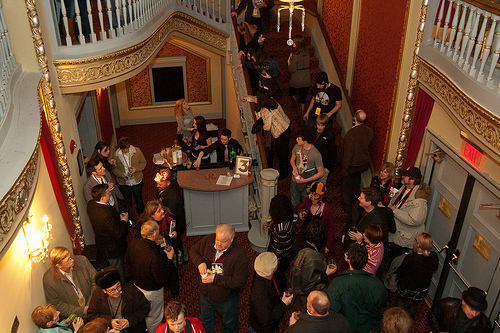
Attendees of last year’s True/False Film Fest in Columbia, Missouri, gather in the lobby of the historic Missouri Theatre.

True/False. There’s a big film event this weekend.

The correct response, of course, is True/False.

The event I’m talking about isn’t the Oscars. It’s the 11th annual True/False Film Fest in Columbia, Missouri, running today through Sunday.

Each February/March, thousands of movie lovers converge on theaters in Columbia to watch the best documentaries of the year.

The nearly fifty films being screened in this weekend’s festival naturally include some that deal with people and places outside the US. Here, for your enjoyment, are a sampling:

L’Escale (Stop-Over)
Undocumented Iranians in Athens, left on their own by their smuggler, fear the police and long for a new life in Europe. . . and wait.

Manakamana
In these real-time clips, the camera follows the people in eleven cable cars as they travel up a mountain in Nepal to visit the Manakamana temple. It’s like riding in a car with strangers, and staring at them the whole time.

Cairo Drive
What’s it like driving in Cairo? This film shows you the triumphs and trials of making your way around Egypt’s largest city. And as if the traffic weren’t chaotic enough, much of Cairo Drive takes place during the tumultuous happenings of the Arab Spring.

Forest of the Dancing Spirits
Director Linda Västrik lived with the Congo’s Aka pygmies for seven years. The result is this glimpse into the lives of an isolated tribe, as it holds on to its culture in the face of encroachment by the “modern” world.

[photo: “True/False Film Festival, Missouri Theatre, Columbia,” by Missouri Division of Tourism, used under a Creative Commons license]

The Vibrant Palette of Our World

311074381_96cf2f219a

For those of you caught in the whites and greys of a brutal winter, know that the bright colors of spring will be here soon.

But until then, just to tide you over, here are two reminders of how colorful our world can be.

If Your City Were Covered by Post-it Notes

When I use a Post-it Note—usually canary yellow—it’s most often to remind me about something I need to do, such as make a phone call, pick up a gallon of milk, or schedule a doctor’s appointment. But with the introduction of its “Colors of the World” collection, 3M wants to remind us of places we’d like to be.

Each grouping of five complementary colors—sort of like those chips from the paint store—represents one of four cities from around the globe: Bangkok, Mykonos, New York City, and Rio de Janeiro.

As reported in a 3M press release, fashion stylist Brad Goreski, serving as Post-it Brand’s “color ambassador,” says,

Trends in fashion, design and pop culture are taking on more global influence, and of course, one thing that’s always in style is color. I am consistently inspired whenever I travel, and I love seeing how the Post-it Brand Colors of the World collection brings the hues from four very chic destinations to life, offering a color scheme inspired by the energy of these places.

It’s an interesting idea: What colors would your city be?

For a chance to win a trip to New York, enter Post-it’s City Escape Sweepstakes. Just create a name for one of the colors in the collection and write a short essay telling what it means to you in relation to the city it represents (or you can submit a photo or video instead). If I’m reading the rules correctly, the trips will be awarded by a random drawing, but the best entries can also be used in future promotions.

If Color Grabs Your Camera Lens

For another colors-based contest, go to Project World Colors. It’s a photo blog started and curated by world travelers and bloggers Naomi Hattaway and Anne Lowrey. Each month they announce a new color, share their own images, and invite other bloggers to craft their own posts based on that hue. Then, near the end of the month, they pick a blogger to feature (that’s the prize—sorry, no trip), and they also share a post from a guest contributor.

For instance, this month the color is red. The post from the featured blogger is at “Project #Worldcolors 2014, a Red February” at It’s Lynny Kansas. The guest contributor is Annie Griffiths, award-winning photojournalist and founder of Ripple Effect Images, which “document[s] the plight of poor women and girls around the world and highlight[s] the programs that are helping to empower them.”

PWC offers guidelines for participation and shares the following enthusiastic invitation:

We invite you to participate in a photo blogging collaboration that celebrates the places that color shows up in our lives and across the web. . . . The goal is to delve into the texture, the beauty and the diversity that color can bring in different parts of the world. Come play with us!

[photo: “Textiles in Souq,” by Katie and Michael, used under a Creative Commons license]

Not All Ambassadors Start with Degrees in International Studies

2603281699_b8cfbb2d8c_n
The US Embassy in Prague, Czech Republic

Hearing about the death of Shirley Temple Black got me to wondering if any current US ambassadors have such a compelling background. Alas, it’s hard to match Temple Black, who became a film superstar at the age of six and went on to star in over 40 movies before becoming ambassador to Ghana and Czechoslovakia. But I did find several ambassadors whose lives before diplomatic service strike me as interesting.

I guess “interesting” sounds pretty bland. But saying something such as “fascinating,” “captivating,” or “spellbinding” would be a little over the top. If I were going for clicks (like some news sites that will remain nameless), I’d have titled this post “Twelve Ambassadors Whose Backgrounds Will Stun You.” While that’s pretty far from the truth, I really do think that their stories are still, well, interesting.

First, a word about my selections: I started with The American Foreign Service Association’s “List of Ambassadorial Appointments,” where I clicked on the names of people with links to US Department of State bios.

Most of those listed below are political appointees rather than career diplomats. The former seems to offer the larger amount of noteworthy backgrounds. Of course, getting an advanced degree in international relations, attending the National War College, or becoming a career member of  the Foreign Service is pretty impressive. For ambassadors, though, it’s just not uncommon enough to earn a mention here.

By the way, my definition of interesting is purely subjective. No offense to those who didn’t make the cut.

So here’s what it takes, in a roundabout way, to become an ambassador . . . that and the good favor of a sitting president:

Thomas Hart Armbruster
US ambassador to the Marshall Islands
Prior to joining the Foreign Service, Armbruster was a reporter for KGMB-TV, a CBS affiliate in Hawaii.

Matthew Barzun
US ambassador to the United Kingdom
Barzun was the fourth employee at CNET and later became executive vice president and chief strategy officer of the tech website. While there, he launched Download.com and led in the development of Shopper.com.

John Berry
US ambassador to Australia
Berry previously served as director of the National Fish and Wildlife Foundation as well as director of the National Zoo.

James Costos
US ambassador to Spain and Andorra
Before becoming an ambassador, Costos was vice president of global licensing and retail for HBO. Prior to that he served as a vice president for the Italian company Tod’s, seller of shoes and luxury leather goods, and for Hermès of Paris.

Caroline Kennedy
US ambassador to Japan
The daughter of President John F. Kennedy, Ambassador Kennedy is the author and editor of several books, an education advocate, and a supporter of the arts. As president and director of the John F. Kennedy Library Foundation, she helped create the Profile in Courage Award.

Alexandar Mark Laskaris
US ambassador to Guinea
Earlier in his career, Laskaris taught English and mathematics at St. Boniface High School in Galeshewe, Northern Cape Province, South Africa.

Jeffrey Levine
US ambassador to Estonia
Levine was previously a newspaper reporter for seven years and was a founding staff member of USA Today.

Bruce Oreck
US ambassador to Finland
For several years running, Oreck was the winner of the Colorado State men’s masters body building championship. He has also put together one of the leading fine-mineral collections in the US, and he and his wife donate mineral specimens to museums across the country.

David D. Pearce
US ambassador to Greece
Before joining the Foreign Service, Pearce was a journalist, working for the Associated Press in Ohio; the Rome Daily American in Italy; United Press International in Brussels, Lisbon, and Beirut; and the Washington Post. He also worked as a writer-editor in the book service of the National Geographic Society.

Samantha Power
US permanent representative to the United Nations
Born in Ireland, Power came to America when she was nine years old. She has been a journalist, contributing regularly to The Atlantic MonthlyThe New RepublicThe New York Review of Books, and The New Yorker Magazine, and she won the Pulitzer Prize for her book  “A Problem from Hell”: America and the Age of Genocide.

Theodore Sedgwick
US ambassador to Slovakia
Sedgwick founded Pasha Publications and Io Energy and was president of Red Hills Lumber Co., which produces pine flooring. He has also served on the boards of a wide range of organizations, including Inside Higher Ed; the Folger Shakespeare Library; the Shakespeare Theater Co.; the Gennadius Library in Athens, Greece; the Civil War Preservation Trust; and the Ducks Unlimited affiliate Wetlands America Trust.

Alexa L. Wesner
US ambassador to Austria
Wesner was born to a German mother and Latvian father who had immigrated to the United States. In high school she was an all-American in track and cross country, and in 2003 she qualified as a member of the US national team for the World Triathlon Championships.

[photo: “American Embassy in Prague,” by Matt Dell, used under a Creative Commons license]

If You Could Talk to the Animals . . . You’d Know They Have Accents, Too

3256530575_3b4016287d_nLooks like my See ‘n Say needs a regional update.

When a woman from Nevada asked the folks at How to Do Everything, “How would a person moo in a British accent?” the hosts of the podcast looked to none other than Sir Patrick Stewart (of Star Trek and X-Men fame). He turned out to be a good choice, as discerning between cattle accents seems to be one of his areas of expertise. “In England,” he says, “we’re dominated by class, by social status, and by location.” And, according to Stewart, it’s the same for cows, too.

But while Stewart’s imitations of cows from West Oxfordshire, cows from Yorkshire, Cockney cows, urban cows, and well-bred cows were done with a mock earnestness, animal accents is a legitimate field of study. And there are no shortage of specialists—particularly in Great Britain—who take animal accents very seriously. Seriously indeed:

Goats say . . .

[Researchers] found that a goats’ “accent” changed as they grew older and moved in different groups, disproving claims that their voices were entirely genetic.

The team, from Queen Mary University of London, said their findings are the first to suggest that most mammals can develop an accent from their surroundings.

The findings have caused great excitement in the science community amid suggestions that “if goats can do it, maybe all mammals accents can be affected by their surroundings.”

(“Goats ‘Can Develop Their Own Accents,’” The Telegraph, February 16, 2012)

Dogs say . . .

The woof guide found Scouse and Scottish pets have the most distinctive growl—but there were differences in tone and pitch across the country.

Tracey Gudgeon, of the Canine Behaviour Centre in Cumbria, said: “It seems dogs are more able to imitate stronger, more distinctive accents than softer ones. It’s one of the ways they bond with their owner.” Idea for the research came with today’s re-release of 1955 Disney classic Lady and The Tramp on a special edition DVD.

The study even found some dogs have “posh” accents—just like Lady in the animated film. A delighted Disney spokesman said: ‘It seems we were right all along.”

(“Exclusive: Experts Say Dogs Growl with Regional Accents,” Mirror, February 13, 2006)

Cows say . . .

Cows have regional accents like humans, language specialists have suggested.

They decided to examine the issue after dairy farmers noticed their cows had slightly different moos, depending on which herd they came from.

Farmer Lloyd Green, from Glastonbury, said: “I spend a lot of time with my ones and they definitely moo with a Somerset drawl.

“I’ve spoken to the other farmers in the West Country group and they have noticed a similar development in their own herds.”

(“Cows Also ‘Have Regional Accents,'” BBC News, August 23, 2006)

Apes say . . .

Gibbons have regional accents, a new study suggests. While not a sexy Southern drawl, these accents can help scientists identify the species of gibbon singing and where they are from.

“Each gibbon has its own variable song but, much like people, there is a regional similarity between gibbons within the same location,” lead researcher Van Ngoc Thinh, from the Primate Genetics Laboratory at the German Primate Center, said in a statement.

(Jennifer Welsh, “Singing in the Rain Forest: Gibbons Have Accents,” LiveScience, February 7, 2011)

Bats say . . .

Researcher Brad Law of the Forest Science Center found that bats living in the forests along the east coast of the state of New South Wales had different calls.

He said scientists had long suspected bats had distinctive regional calls—as studies have shown with some other animals—but this was the first time it had been proven in the field.

(“Australian Scientists Find Bats Have Regional Accents,” Reuters, September 13, 2010)

Whales say . . .

Dalhousie Ph.D. student Shane Gero has recently returned from a seven-week visit to Dominica. He has been traveling to the Caribbean island since 2005 to study families of sperm whales, usually spending two to four months of each year working on the Dominica Sperm Whale Project. One of the goals of this project is to record and compare whale calls over time, examining the various phrases and dialects of sperm whale communities.

When they dive together, sperm whales make patterns of clicks to each other known as “codas.” Recent findings suggest that not only do different codas mean different things, but that whales can also tell which member of their community is speaking based on the sound properties of the codas. Just as we can tell our friends apart by the sounds of their voices and the way they pronounce their words, different sperm whales make the same pattern of clicks, but with different accents.

(“Whales Have Accents and Regional Dialects: Biologists Interpret the Language of Sperm Whales,” May 12, 2011)

Dolphins say . . .

Dolphins on the east and west coasts of Scotland have different “accents.”

White-beaked dolphins use a complex system of tail slaps, whistles and clicks which were believed to be common among the species. But expert Olivia Harries said: “They use different clicks on the east coast than those on the west coast.”

(“Study Reveals Dolphins on Scotland’s East and West Coasts Have Different ‘Accents,'” Daily Record, November 9, 2013)

Birds say . . .

The [yellowhammer’s] song differs in terms of pitch and tone, especially in the final part, depending on where an individual bird is found. Birds can also add in various “phrases” to their song, according to their dialect.

Experts believe that dialects can be so thick they may hinder the chances of birds breeding with partners from other areas.

(Jasper Copping, “Britain’s Birds Boast a Colourful Array of Regional Accents,” The Telegraph, May 19, 2013)

City Birds say . . .

A group of scientists from Aberystwyth University studying the great tit’s dulcet tones have discovered that the birds sing their songs at a higher pitch in built-up areas to help them travel further. . . .

Researchers from the West Wales university, working alongside colleagues in Copenhagen, have found that it is the buildings that are changing the way birds sing in cities. . . .

“Our cities are packed with reflective surfaces, open spaces and narrow channels, which you just don’t get in woodland,” said researcher Emily Mockford. . . . “The higher notes mean the echoes disappear faster and the next note is clearer.”

(“Urban Birds Find Their Voice with a New Kind of Twitter,” Wales Online, December 13, 2011)

and Ducks say . . .

“Cockney” ducks from London make a rougher sound, not unlike their human counterparts, so their fellow quackers can hear them above the city’s hubbub. But their Cornish cousins communicate with a softer, more relaxed sound, the team from Middlesex University found.

(“Ducks ‘Quack in Regional Accents,’” BBC News, June 4, 2004)

So, what are the practical ramifications of all these findings? I’m not quite sure, but I have come up with one thing: Whenever you’re faced with that crucial question of our time, “What does the fox say?” you should reply, “That depends on where the fox is from.”

[photo: “See ‘N Say,” by Chris Murphy, used under a Creative Commons license]

Eyes: LensCrafters Commercial Gives Us a Closer Look

It didn’t cause quite the stir that Coke’s “America the Beautiful” in eight languages did, but LensCrafter’s new-this-week “Anthem” commercial also represents the mosaic of humanity. Instead of using voices, the eye-care company (as you might expect) uses eyes.

All people should have somebody who will, at some time or another, look deeply into their eyes.

While we’re on the subject of eyes . . .

Award-winning photojournalist Steve McCurry posts photos, grouped by theme, at his blog. For a collection of amazing photographs of eyes, interspersed with quotations and comments, go to his post from last July, “Eloquence of the Eye.”

You probably didn’t know . . .

  • The human eye is less than one inch in diameter and weighs only around 1/4 ounce.
  • Each blink closes the eye for 0.3 seconds. That totals about 30 minutes a day.
  • An eye has over 100 million photoreceptors (rods and cones).
  • 285 million people in the world are visually impaired, meaning they are blind or have moderate or severe impairment.
  • Blind people in the world number 39 million. 82% of them are over the age of 50.
  • The visually impaired in developing countries account for about 90% of the world’s total.
  • Preventions and cures are possible for 80% of visual impairment in the world.

(“NEI Calendar,” National Eye Institute; “Visual Impairment and Blindness, Fact Sheet No. 282,” World Health Organization, October 2013)

Doing the Culture Slide: Living with the Confusing Effects of Globalization

5043651435_3d6a657c89
Donald McDonald at an iCon’Chicken event in Japan

The culture slide. It’s not a dance for expats—though sometimes it may feel like it.

Culture slide is the name I’ve given to the confusion and shifts in thinking brought about by globalization.

It’s when your kids grow up in Taipei and think that Giordano clothing stores must be from Italy (they’re actually from Hong Kong) and they must have outlets in the US (they don’t). Likewise, Napoli sounds Italian, but the pizza chain is Taiwanese. Then there’s NET (from Taiwan), Fnac (from France), and B&Q (from the UK). And as much as they may feel like GAP, Best Buy, and Home Depot, the kids didn’t find any of them when they traveled to the US.

It cuts the other way, too. Back in the States, we think we should be able to order corn soup and extra-spicy extra-crispy chicken at KFC. . . and tuna and peas should be available as toppings at Pizza Hut. And we’re pleasantly surprised to find out that IKEA and Yoshinoya are in the good ol’ US of A, too—even if they haven’t made it to our part of the country yet.

That last part reminds me of a story attributed to Den Fujita, founder of McDonald’s in Japan. In Asian Brand Strategy: How Asia Builds Strong Brands, Martin Roll writes about Fujita saying, “Once a group of Japanese Boy Scouts visited the United States and were asked by a local television station what their impression of America was. One boy replied, ‘I didn’t know that they had McDonald’s in the United States, too.’” Maybe you’ve heard that story before, but that time it was a Japanese boy in Florida or a Japanese girl in Los Angeles or a French girl in Times Square or a European boy or a little boy from Indonesia. It’s all so confusing.

Donald McDonald

Ahhh, McDonald’s, the king of globalization, and the instigator of so much culture slide.

Not only does McDonald’s localize their menus wherever they go—which might make Germans think that all the world’s restaurants have McCurrywurst—but they’re selections also cross borders in some fairly strange ways. A couple years ago, Germany’s McDonald’s introduced bubble tea, a drink with chewy tapioca balls that was invented in Taiwan. Here’s the commercial:

As others have pointed out, why is the actor yelling, “Bubblezzaaiii”? Is he trying to sound Japanese?

So that brings us back to Japan, the country with the second most McDonald’s restaurants, next to the US. Fujita brought “Donald McDonald” (it’s easier to pronounce that way) to his country in 1971, writes John Love in McDonald’s: Behind the Arches, with the idea that the restaurants would have to look “100 percent Japanese.” Love quotes Fujita as saying, “If I insisted that this was something that came from America, the Japanese would say, ‘This is American, and we don’t like it because we don’t like Americans.'” It seems that in Fujita’s eyes, they didn’t disdain all things Western, as he’s also credited in Love’s book with telling reporters,

The reason Japanese people are so short and have yellow skins is because they have eaten nothing but fish and rice for two thousand years. If we eat McDonald’s hamburgers and potatoes for a thousand years, we will become taller, our skin will become white, and our hair blond.

It will be some time before that can be proven or disproven, but it didn’t take nearly as long for McDonald’s in Japan to warm up to its American roots. Right now it’s in the middle of a campaign with throwback menus featuring “American Vintage” food from the ’50s, ’70s, and ’80s—or at least it features what some in Japan think is vintage American food. The offerings include a burger with two beef patties, an egg, and mashed potatoes between the buns (’50s), “Hot & Groovy” chicken sandwiches topped with salsa (’70s), and sandwiches with the addition of BBQ sauce (’80s).

Now that’s the way, uh-huh, uh-huh, I like it, uh-huh, uh-huh.

Sing Along with Me: “Baseball, Hot Dogs . . .”

I’m just glad that here in the US, we’ve got a pretty good handle on who we are and what is ours. We know that McDonald’s is a genuine American export, even if the menu changes around the globe. We also know that no matter how much the world tilts on its cultural axis, we’ll always be able to count on things like baseball, hot dogs, apple pie, and Chevrolet. Remember that chorus from the Chevy commercial in 1975?

To review, that’s baseball (where all the balls used in the Major Leagues are made in Costa Rica), hot dogs (which originated in Germany), apple pie (first made in England), and Chevrolet (which is the third-best-selling auto brand in the US, behind Toyota).

In 2006, Chevrolet came out with a new version of their song, once again advertising America’s “favorite brand.” The chorus was updated with several new versions, such as “stolen bases, goat-cheese pizza, bottled water, and Chevrolet.” The commercial ended with the tagline “The world has changed. But the love affair continues.”

I can’t attest to the love affair, but, boy, the world sure has changed.

Step, two, three, four. Doing the culture slide.

(Martin Roll, Asian Brand Strategy: How Asia Builds Strong Brands, New York: Palgrave Macmillan, 2006; John F. Love, McDonald’s: Behind the Arches, New York: Bantam, 1995; Michelle Lynn Dinh, “McDonald’s Japan Serving ‘American Vintage’ Burgers Starting This January,” RocketNews24, December 28, 2013)

[photo: “iCon’ Chiken FES._064,” by TAKA@P.P.R.S, used under a Creative Commons license]