At the Night Market, Some Flavors Are Better Left Untried

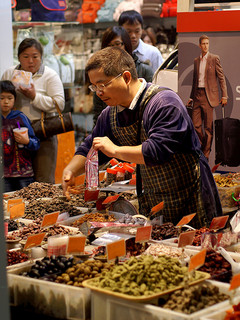
3387528058_9e0064f799_nWhile living in Taipei, we got many opportunities to try new and (to us) strange foods, especially at the night markets. I was game for tasting most things at least once. But sometimes it took me a little while to work up my nerve—like when I waited a few years before trying “stinky tofu.” (Ends up it’s not as bad as it sounds, or smells.)

For a long time, I’d seen mounds of small black spiral shells sold as a snack at night markets, and I wondered what they tasted like. Actually, I also wondered how you’d eat them. I figured a snail, or some sort of other creature, was cooked inside, so maybe you sucked the meat out, or maybe the shell was cooked to the point where it was soft and you were supposed to eat the whole thing. I didn’t know, but I saw the locals walking around with plastic bags full of them, so I assumed they tasted good.

One evening I finally gave in to my curiosity and confidently walked over to the lady selling the black shells. It’s the custom for vendors at the markets to provide a small bowl of samples for potential customers to try. This lady was no exception, as she had a paper bowl holding a few shells sitting on the front of the table. I grabbed one of the samples, put it in my mouth, and sucked on it as I walked away. While the shells looked spicy piled up on display—with a few peppers mixed in—I tasted nothing. Flavorless. And I was disappointed to find no meat inside.

The next night, I was at the same market, and I wanted to try one more time. So I grabbed another sample from the shell lady. Again, no matter how much I worked it around in my mouth, no meat, no flavor, just a shell. Come on. Why do people buy those things? I walked back to my family and told them how I’d wasted my time and was glad I hadn’t wasted my money.

That’s when my son looked back at the table . . . and said, “Dad, that’s not the bowl for samples. That’s where people put the shell after they’ve tried one and need to throw it away.”

[photo: “Taiwan 2009,” by bill_bly_ca, used under a Creative Commons license]

Exporting Fast Food: The Biggest American Chains

Ronald McDonald in Thailand

You already know that McDonald’s is the global king of fast-food success, but do you know which US chains are next in line outside of America’s borders?

Well, the answer depends on how you define success. If overall non-US sales is important to you, then number two is KFC, followed by Burger King (according to figures from 2011).

But if you’re more of a How-many-international-restaurants-do-they-have? kind of person, then Subway comes after the Golden Arches and KFC.

Or maybe you care about who’s expanding the most. In that measurement, McDonald’s isn’t in the top five. The three American companies that opened the most non-US units—from 2009 to 2010—are Subway, Dunkin’ Donuts, and KFC.

All this information comes from QSR‘s “Global 30,” a sortable list ranking the top American “quick-service” restaurants outside the US.

Below are the ten American chains with the most restaurants outside the US. That’s the list I’m most interested in, since that gauges your chance of running into one of them overseas. Most are in Taiwan, so I’m adding embellishments from my experiences during my time in Taipei. We had more than our fair share of American fast-food outlets in the capital city, but there were still some gaps. I mean, how can a city of 6 million be Taco Bell-less?

  1. McDonald’s – 18,710 units
    When we first arrived, we didn’t have the vocabulary to order individual items, so we just ordered meals by number. This meant a soda for even our smallest child, and we had four children. One day I walked up three flights of stairs (most McDonald’s in Taiwan are vertical) balancing 6 Cokes on a tray. I was pretty proud that I’d made it and pretended to stumble when I got to our table . . . and spilled the whole tray. . . . On another day we went to our local McD’s to find out that they’d run out of hamburger. I didn’t know that was possible.
  2. KFC – 11,798
    The extra crispy chicken at Taiwan’s KFCs is spicy hot, which we grew to like more than its American counterpart. And because the Taiwanese like dark meat better than white meat, when we ordered a bucket of chicken, we could substitute white for dark at no extra cost. One negative is that their KFCs don’t have slaw. I love KFC’s slaw.
  3. Subway – 10,109
    You could almost replace your vegetable-vocabulary unit in language learning with several trips to Subway. If you want the right toppings on your sandwich, you simply have to learn the words. Pointing at “that green thing” won’t do. Building a sandwich at Subway is like a chapter test. . . . By the way, a Subway near us in Taipei also ran out of meat. For a few days it was a salad shop.
  4. Pizza Hut – 5,890
    We had a Pizza Hut around the corner from our last apartment in Taiwan. Loved their pepperoni pizza. Not so crazy about toppings with peas or corn . . . or squid . . . or tuna.
  5. Starbucks – 5,727
    Most of what I have to say about Starbucks I’ve already said here. The chain has made a big enough impact on the tea-drinking island of Taiwan that several coffee shops have sprung up with circular green logos and/or copycat names (ecoffee, for example). My favorite was the shop that had a sign that said, in a small font, something like, “We’re Not,” over the very large, “STARBUCKS.”
  6. Burger King – 4,998
    For a while, my absolute favorite sandwich was a bacon cheeseburger from the Burger King in Keelung next to the train station, eaten on the train as I and a teammate rode back to Taipei after our evening Bible studies with students at the National Taiwan Oceanic University. My second favorite sandwich near the station was a da chang bao xiao chang, or “big sausage wrapped around a small sausage” (the outer “sausage” was made from sticky rice).
  7. Domino’s – 4,422
    After serving for two years as a Mormon missionary in Taiwan, Scott Oelkers returned to Minnesota and double majored in Chinese and economics. Following his graduation, he got a job as a buyer for Domino’s Pizza International and worked his way up to vice president. He sold franchise rights in Taiwan to a private equity firm, and the firm asked him to run the business for them. He did, and in the process became a minor celebrity in Taiwan with his humorous TV commercials. Now Oelkers is president and CEO of Domino’s in Japan. He’s still making commercials, like the one below that just came out last month. Betsy Isaacson of the Huffington Post calls it “the most awkward ad in the universe.” I guess one man’s awkward is another man’s profitable.
  8. Dunkin’ Donuts – 3,005
    When the first Mister Donut opened in Taipei in 2004, the lines were so long that there was a sign a ways back on the sidewalk that read, “240 minutes from this point.” Dunkin’ Donuts came not long after, and we were glad to see one open in our neighborhood. We held our team meetings there for a while because we usually had the upstairs mostly to ourselves. Not a good sign. It closed.
  9. Dairy Queen – 802
    There’s no DQ in Taiwan that I know of (and we usually heard about those kind of things). I do see from an article in Taiwan Today that one was slated for opening in 1986 “located near Church’s Texas Fried Chicken and Lotteria in Taipei.” Someone else with a longer history in Taiwan would have to say whether it ever opened its doors.
  10. Papa John’s – 755
    We’re getting farther down on the list, and neither is there a Papa John’s in Taiwan. But that doesn’t mean there’s not room for another pizza franchise, or room for some other kind of fast-food chain. The question is, which one should it be? . . .

For those of you living outside the US, are there any restaurants that you long for? For you American expats, what tastes do you miss, and what do you think would go over well among the locals?

Wendy’s? It comes in at number 11. Taipei used to have at least one. I’ve heard stories from my former coworkers, and a Taipei Wendy’s is even the setting for a short scene in Ang Lee’s 1994 movie, Eat Drink Man Woman.

Or how about Long John Silver’s? It didn’t make the Global 30. One came to Taipei for a short time. We ate there a couple times just to try it out. As I recall, it didn’t last more than a year.

Oh, yeah. There’s Taco Bell (#19). Why can’t you find more Taco Bell’s overseas? I can’t count how many times I heard American expats say that when they get back home the first thing they want to do is eat at a Taco Bell.

I asked a good Taiwanese friend—who had studied at a US university—if he thought Taco Bell would do well in Taiwan. He wasn’t sure that it would, as Mexican flavors don’t always fit the Asian palate. Then I asked him about Arby’s (#21). It seems to me that roast-beef sandwiches could fit in in a lot of cultures, and I like them a lot, too. He said, no, that he didn’t think that there would be enough room for parking. That seemed strange since most fast-food restaurants in Taiwan don’t have any dedicated parking at all. When I questioned that, he said that Arby’s are just too big for Taiwanese. I was confused. Were we talking about the same thing? They’re too big, he said again. Who in Taipei would have room to park an RV?

Hmmmm. Maybe our miscommunication has birthed an idea. How about setting up a fleet of mobile Arby’s in RVs around the globe. I wonder. . . .

(“The Global 30,” QSR Magazine, April 30, 2013; “Scott Oelkers: Bringing Something Extra to the Table,” College of Liberal Arts, University of Minnesota; “Personality, Pizzaz Mixes with Pizza,” Taipei Times, September 9, 2002; Ashley Chang, Tiffany Huang, and Alan Wu, “Mister Donut—Worth the Wait?” Centered on Taipei, December 2004/January 2005; Betsy Isaacson, “Domino’s Ad Featuring Japanese Computer-Generated ‘Vocaloid’ Hatsune Miku Is Incredibly Awkward,” March 8, 2013; “Dairy Queen Joins American Parade of Food Chains to ROC,” Taiwan Today, December 29, 1986)

[photo: “Sawatdee Khrab!” by iamagloworm, used under a Creative Commons license]

Back Home to Papua, 50 Years after Peace Child

Home is an elusive concept for many Third Culture Kids. Paul Richardson, who was born in Papua, Indonesia, is no exception.

“Because I lived so many places in different parts of the world, traveled so much,” he says, “I’d never been able to really say where’s home.”

5712238389_d4bb32ba5f_nBut this summer, he, along with his father and two brothers, returned to the place where he was “born and raised.” That return is the subject of the 15-minute film Never the Same: Celebrating 50 Years since Peace Child.

Paul is part of a famous family, at least among evangelical Christians and the missionary community. Don and Carol, his parents, moved to Papua in 1962 to take the gospel to the Sawi, a tribe of cannibals and headhunters. Their story is the subject of the book Peace Child: An Unforgettable Story of Primitive Jungle Treachery in the 20th Century, later made into a movie, also called Peace Child.

When missionary historian Ruth Tucker wrote From Jerusalem to Irian Jaya: A Biographical History of Christian Missions, it was the work of the Richardsons in Papua (formerly Irian Jaya) that made up the final chapter.

Ministering to a warring tribe was not easy, and at one point, Don told the Sawis that if they didn’t stop fighting, he and his family would have to leave. In order to keep the missionaries there, each Sawi village gave an infant boy to its enemies as a sign of peace. This idea of the “peace child” became a door for the message that the Richardsons were trying to tell them, that God, likewise, had given the world a peace gift, his only son.

This experience among the Sawi formed the basis for Don’s belief that every culture has a “redemptive analogy,” a story, practice, or tradition that can be used to help the people understand the gospel of Christ.  He expounds on this concept in his book Eternity in Their Hearts: Startling Evidence of Belief in the One True God in Hundreds of Cultures throughout the World.

Fifty years after first arriving in Papua, Don revisited the Sawi tribe, which had not only embraced Christianity but had become a base for reaching out to the tribes around them with the message of Christ. Making the trip with him were his sons: Steve, who was seven months old when his family moved to be with the Sawi, and Paul and Shannon, who were born in Papua.

Steve is now the president of the mission agency Pioneers-USA, and he serves as the narrator for Never the Same, which you can view below. It begins with a short overview of the Richardson’s work with the Sawi people and then shows their reunion with their old friends. This is where Paul talks about returning to the place where he lived as a child:

There’s no electricity except for a little generator, and . . . there’s no emails, there’s no text messages . . . just, you know . . . it’s just quiet here. And it’s beautiful, and . . . and there’s a connection with the people here. And, uh, just waking up in the morning, hearing the sounds of the jungle, and, I don’t know, I slept better last night than I have in years, even though I’m just sleeping on the floor in this village.

So there is something to going back. I . . . Because I lived so many places in different parts of the world, traveled so much, I’d never been able to really say where’s home. But I think this would probably be more than anywhere else . . . is where I was born and raised. So this will always be special for me.

I heard about this video from Brian Stankich at Fulfill. In response to my post on eating insects, he pointed to a scene where Steve is eating some grubs on a stick, given to him by his Sawi hosts. Showing his snack to the camera, he says,

Oh this is um . . . these are grubs. And inside they’re just full of grease, and the heads are really . . . very strange, actually, the more I think about it. But [chewing and clearing his throat] they grow on you.

[photo: “Papua-Indonesia, 2008,” by CIFOR, used under a Creative Commons license]

Go Eat a Bug! Seriously

WEBSITEento_cubes2_1259“Most of the world already eats insects,” says Arnold van Huis, entomologist at Wageningen University in the Netherlands and collaborator with the UN’s Food and Agriculture Organization. “It is only in the western world that we don’t. Psychologically we have a problem with it. I don’t know why. . . .”

These comments from van Huis appeared in The Observer, in 2010. Two years later, it seems that we westerners are not much closer to wide-scale acceptance of edible bugs. In a post last month, I had fun writing about entomophagy, but for people like van Huis, the eating of insects is a very serious topic.

It’s a serious topic for the folks behind the Ento project, too. If they have their way, insects will be an accepted part of our menus and shopping lists in the next ten years. Seriously.

The team behind Ento is made up of four postgraduate students at London’s Royal College of Art and Imperial College London. They are Aran Dasan, Jacky Chung, Jonathan Fraser, and Julene Aguirre-Bielschowsky, working with Kim Insu, a chef-in-training at Le Cordon Bleu.

They’ve put together a video, explaining their goals and methods, embedded below. In it, they lay out reasons for why we should all be eating insects, including the following:

  • The rapid growth in the world’s population requires us to look into alternatives for meeting the increasing demand for sustainable foods.
  • Compared to cattle, edible insects can provide nine times the amount of protein for the same amount of feed.
  • Insects are also lower in fat than beef.
  • Raising insects uses much less energy and space than traditional livestock and produces far less greenhouse gases.

But even with this information, and even though over 1000 different insects are already being eaten in 80% of the world’s countries, we in the West have a general disgust at the thought of eating bugs. Van Huis, a westerner himself, understands this. “It is very important how you prepare them,” he says. “You have to do it very nicely, to overcome the yuk factor.”

That’s where Ento comes in. They have developed a “roadmap,” consisting of 6 steps for introducing edible insects into the mainstream, culminating in the year 2020:

2012: Travel to festivals and markets WEBSITEento_entobox-closeup_1259to grab the attention of “adventurous eaters”
2013: Create the first Ento restaurant, serving insects in the form of innovative “entocubes”
2015: After opening more restaurants, market entocubes in “takeaway entoboxes” for lunch
2017: Sell a line of “ready meals” in supermarkets
2018: Introduce Ento ingredients for use in cooking
2020: Sell fresh insects as an accepted staple in the supermarket meat aisle

This seems like a rather aggressive plan, so I asked Fraser how things are going so far. He tells me that they are in the process of developing the roadmap above into a business plan. “Festivals and markets will still be a major goal for us in 2013, but we have also added event catering and pop-up restaurants to our plans.” All this to create a buzz about Ento. “Primarily we want as many people as possible to experience our food in a fun and social context,” he says.

So when will the first Ento restaurant be open for business? “As we improve our recipes and refine the Ento brand, a London restaurant will be our next major milestone,” says Fraser. And at this point in the progress, the restaurant opening is still on schedule: “We can’t reveal much about it at this stage, but it is in the works for later next year.”

And even though the group sees overcoming westerners’ aversion to entomophagy as a major obstacle, Fraser believes that once eating insects becomes more popular, then will come the biggest challenge: keeping up with demand. “At the moment we use external suppliers to source our insects, and currently the infrastructure base is quite small,” Fraser says. “This is why we proposed the creation of an adaptable network of urban farms that could meet the growing demand requirements as insects become accepted by more and more western eaters.”

The Ento team’s 10-year plan seems rather aggressive, but in an article in the design magazine Core77, they point out that something similar has happened before: Just three decades ago, they write, “tourist guides warned British tourists about the strange and off-putting Japanese habit of eating raw fish.” But now, sushi has become a global phenomenon.

Maybe, with the help of these creative students, it won’t take quite so long to get us eating bugs.

(Damian Carrington, “Insects Could Be the Key to Meeting Food Needs of Growing Global Population,” The Observer, July 31, 2010; “Case Study: Ento, the Art of Eating Insects,” February 27, 2012)

[photos from Ento, used with permission]
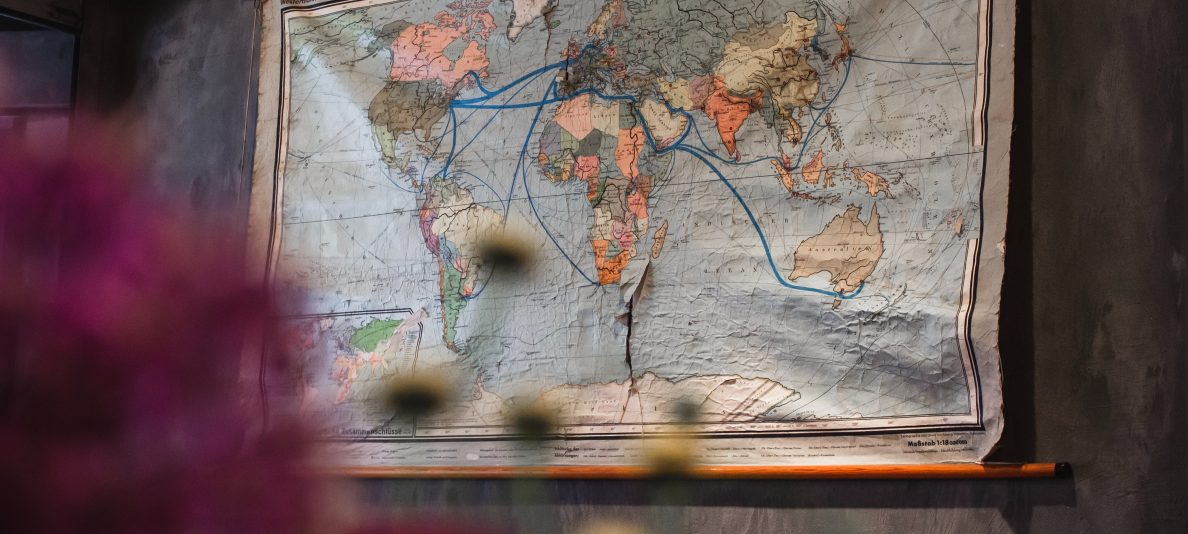
Cooking Up a Trip “Around the World”

8050162462_87cdc95d86_nBack when I was a kid, waaaaay back before self-serve soda dispensers, we used to ask our friends behind the counter for an “Around the World.” That meant we wanted a little bit of every flavor in one cup. Can’t say that it tasted so great, but it was fun. I see that others call it a “Suicide” or “Swamp Water.” As I said, it wasn’t the flavor that made us order it.

This past weekend, my family and I were at a Burger King that had a “Coca-Cola freestyle,” serving over 100 flavors of drinks out of one machine. It’s just one example of how our kids’ globe is shrinking. My Around the World recipe had only about six ingredients. Now there’s a lot more “world” available for them to go “around.”

So much for my intro. What I’m really looking at in this post are other kinds of recipes—ones that don’t make an Around the World, but ones that come from around the world. Want to cook up some piri-piri sauce, vartabit, or bun ho? Here are some recipe sites I’ve found that will show you how, and take you on a world tour along the way. (Each of these sites is searchable by ingredient, recipe name, or country, and a couple have background information on each region and its food.)

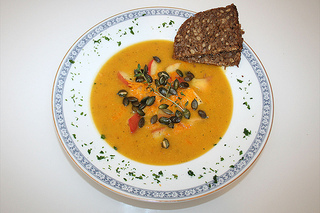
And in honor of the tradition that’s become a part of this time of the year—putting pumpkin flavor in just about everything that’s edible—here are some pumpkin recipes, one from each site:

Who knows, maybe Coca-Cola will take a cue from Maine Root Handcrafted Beverages and add another soda flavor to their drink machine: Pumpkin Pie.

[photo: “Pumpkin carrot soup with cheddar, fried apples & pumpkin seeds,” by Blake JaBB, used under a Creative Commons license]

Waiter, What’s This Maggot Doing in My Soup?

As a boy growing up in rural Missouri, I was very interested in insects and ended up with a rather sizable collection of mounted specimens that I took to the local 4-H fair. Later, when I became a 4-H leader to a younger friend nearby, I passed on what I’d learned. I remember once, after running out of ideas, spicing things up with a snack of deep-fried insects. As I recall, we ate grasshoppers, bees, and possibly cicadas. Little did I know that I could have been on the brink of a future career.

If you travel much outside the US and Europe, you run a good chance of running across insects served up as snacks or side dishes. But if people like China’s Li Jinsui have their way, edible insects will become a global main course.

As reported in Le Monde, Li runs an “insect factory,” which has as its focus the housefly—in particular, the immature housefly, or maggot. You can read the entire article here, but if you need some coaxing, let me whet your appetite with some quotations. Where else can you read such phrases as this?

China’s Maggot Factories Hoping to Feed the World (the headline)
Li says he can deliver about 150kg of maggots a day . . .
As he walks into a room filled with two million flies . . . , and
With the price of wasp larvae on the rise . . .

For Li, raising insects for human consumption isn’t just a novelty. He’s hoping to educate his countrymen, develop his business, and become “the industry’s world leader.” One obstacle that he has to overcome on the maggot front, though, is to figure out how to raise his flies on a diet of rice. That’s because housefly maggots typically feed on animal feces, which makes them unsuitable for human consumption.

Sounds like Li has a lot of educating and persuading to do.

But he’s not alone. There’s a whole movement devoted to “entomophagy,” or the eating of insects. It touts the health and environmental benefits of insect eating and presents it as an effective solution to the problem of feeding a rapidly growing world. For more information, check out these interesting sites:

Also, at NOVA’s “Bugs You Can Eat,” you can follow a couple American journalists, Peter Menzel and Faith D’Aluisio, as they trek around the world trying a variety of insect and spider dishes. With a twist on the “tastes like chicken” meme, Menzel describes deep-fried tarantulas in Cambodia, saying,

If day-old deep-fried chickens had no bones, had hair instead of feathers, and were the size of a newborn sparrow, they might taste like tarantulas.

And finally, if you’re in the States and want to get your taste buds ready for the insect-eating future, go to HOTLIX to order some “larvets,” hand-dipped chocolate crickets, or other varieties of insect candy. Or go to Hollywood location scout Scott Trimble’s Entomophagy, inspired by “the seeming lack of a concise smartphone-friendly list of American restaurants that serve insect options on their menus.”

Who knows, maybe someday you’ll ask, “Waiter, what’s this fly doing in my soup?” and his answer will be “Why, adding flavor, protein, and pizazz, of course!”

(Harold Thibault, “China’s Maggot Factories Hoping to Feed the World,”  Worldcrunch, October 1, 2012, translated from “Des Usines d’Insectes pour Nourrir les Chinois,” Le Monde, September 28, 2012;

[photo: “Fly larva,” by Susannah Anderson, used under a Creative Commons license]

Click.Click.Click: Do.Something.Good

With only a click—here—you can test your vocabulary at Word Dynamo. Not a bad return on your investment.

With the same click—here—you can not only test your vocabulary but also facilitate a donation of 10 grains of rice to the UN World Food Programme, and it continues for every definition you choose correctly.

That’s because the second click takes you to Free Rice, one of the many Web sites that make a donation to a charity in exchange for you clicking a link. That link sends you to a page with advertisements, and the advertisers are the ones that make the donation, not you.

While Free Rice’s word game might keep you clicking, you might prefer something less challenging, like, say, just pressing your finger without having to read any words other than click here. If that’s more your speed, bookmark some of the sites below, several of which support causes that reach beyond the borders of the US.

The Greater Good Network:

Another place with opportunities to click for several issues is Click to Give, with these categories:

And finally, there are these options at Care2:

Looking for even more choices? Go to these lists:

Of course, if all this benevolence gives you “mouse finger,” take a look at eHow.com for treatment and prevention.

[photo: “air:alone in Kyoto,” by Lali Masriera, used under a Creative Commons license]

Starbucks: Designing a Global Concept

Last week, after a particularly long day, I bought a bag of Chips Ahoy! chocolate-chip cookies and had myself some cookies and milk. Nabisco is an American company, and chocolate-chip cookies are an American original, but eating them made me feel as if I were . . . back in Taiwan. That’s because one evening in Taipei, after a particularly long day, I needed some comfort food. So I grabbed a (very small) box of Chips Ahoy! cookies from the supermarket. It wasn’t that they were a staple of mine in the States. In fact, I don’t remember eating them before moving overseas. That’s why, now that I’m back in Missouri, Chips Ahoy! reminds me of Taiwan. Funny how the mind works.

Something else that reminds me of Taiwan is Starbucks. I’d never been inside one before moving to Taipei, but when we moved to Yong He (now part of New Taipei City), the cafe in our neighborhood became the default location for our weekly team meetings. So now, whenever I see a Starbucks, I think of some I’ve visited in Taiwan: the one underneath Taipei Main Station, the one with the huge second story in downtown Taipei, the one overlooking the harbor in Keelung, the one in the Xi Men Ding night market, and, of course, the one on the corner of an extremely busy intersection in Yong He, just a few blocks from our apartment.

I like Starbucks. I know their drinks are too expensive. And I don’t fit in with the true Starbucks aficionados. But it feels good to me. It feels international to me.

Since its humble origins in Seattle in 1971, Starbucks truly has become an international chain. The Starbuck’s company, which already has over 7,000 cafes outside the US, is making a move to beef up its international presence and plans to open 1,200 stores in the current fiscal year, which started this month. More than half of these openings will be outside the US, with about 500 in Asia. Over half of these 500 will be in China.

Wherever Starbucks opens a cafe, they alter their interiors and menus to fit the country. Take for instance in India, where the country’s first Starbucks just opened in Mumbai this month, serving Indian-grown coffee, murg tikka panini, and tandoori paneer rolls in a cafe that features furniture made from Indian teakwood. And then there’s Taiwan, where the Asian-inspired creations on the menu have given the world green-tea lattes and Frappuccinos.

Take a look at the following video to see how the company’s store designers work to connect each store to its community. Sounds like a cool job to have.

Click here to see a map from The Seattle Times showing Starbucks’ expansion around the world. Or go here for an interactive map from Loxcel that gives statistics for each country and store markers that show addresses and hours of operation. Load the Loxcel map on your smartphone and you can even search for stores that are currently open and click the phone icon to call them directly.

(Melissa Allison, “Starbucks Opens Its First Cafe in India,” The Seattle Times, Oct. 19, 2012; Melissa Allison, “Starbucks Maps Future of Venti-Sized Global Expansion,” The Seattle Times, Aug. 4, 2012)

[photo: “Starbucks Green Tea Cream,” by awee_19, used under a Creative Commons license]