If You Could Talk to the Animals . . . You’d Know They Have Accents, Too

3256530575_3b4016287d_nLooks like my See ‘n Say needs a regional update.

When a woman from Nevada asked the folks at How to Do Everything, “How would a person moo in a British accent?” the hosts of the podcast looked to none other than Sir Patrick Stewart (of Star Trek and X-Men fame). He turned out to be a good choice, as discerning between cattle accents seems to be one of his areas of expertise. “In England,” he says, “we’re dominated by class, by social status, and by location.” And, according to Stewart, it’s the same for cows, too.

But while Stewart’s imitations of cows from West Oxfordshire, cows from Yorkshire, Cockney cows, urban cows, and well-bred cows were done with a mock earnestness, animal accents is a legitimate field of study. And there are no shortage of specialists—particularly in Great Britain—who take animal accents very seriously. Seriously indeed:

Goats say . . .

[Researchers] found that a goats’ “accent” changed as they grew older and moved in different groups, disproving claims that their voices were entirely genetic.

The team, from Queen Mary University of London, said their findings are the first to suggest that most mammals can develop an accent from their surroundings.

The findings have caused great excitement in the science community amid suggestions that “if goats can do it, maybe all mammals accents can be affected by their surroundings.”

(“Goats ‘Can Develop Their Own Accents,’” The Telegraph, February 16, 2012)

Dogs say . . .

The woof guide found Scouse and Scottish pets have the most distinctive growl—but there were differences in tone and pitch across the country.

Tracey Gudgeon, of the Canine Behaviour Centre in Cumbria, said: “It seems dogs are more able to imitate stronger, more distinctive accents than softer ones. It’s one of the ways they bond with their owner.” Idea for the research came with today’s re-release of 1955 Disney classic Lady and The Tramp on a special edition DVD.

The study even found some dogs have “posh” accents—just like Lady in the animated film. A delighted Disney spokesman said: ‘It seems we were right all along.”

(“Exclusive: Experts Say Dogs Growl with Regional Accents,” Mirror, February 13, 2006)

Cows say . . .

Cows have regional accents like humans, language specialists have suggested.

They decided to examine the issue after dairy farmers noticed their cows had slightly different moos, depending on which herd they came from.

Farmer Lloyd Green, from Glastonbury, said: “I spend a lot of time with my ones and they definitely moo with a Somerset drawl.

“I’ve spoken to the other farmers in the West Country group and they have noticed a similar development in their own herds.”

(“Cows Also ‘Have Regional Accents,'” BBC News, August 23, 2006)

Apes say . . .

Gibbons have regional accents, a new study suggests. While not a sexy Southern drawl, these accents can help scientists identify the species of gibbon singing and where they are from.

“Each gibbon has its own variable song but, much like people, there is a regional similarity between gibbons within the same location,” lead researcher Van Ngoc Thinh, from the Primate Genetics Laboratory at the German Primate Center, said in a statement.

(Jennifer Welsh, “Singing in the Rain Forest: Gibbons Have Accents,” LiveScience, February 7, 2011)

Bats say . . .

Researcher Brad Law of the Forest Science Center found that bats living in the forests along the east coast of the state of New South Wales had different calls.

He said scientists had long suspected bats had distinctive regional calls—as studies have shown with some other animals—but this was the first time it had been proven in the field.

(“Australian Scientists Find Bats Have Regional Accents,” Reuters, September 13, 2010)

Whales say . . .

Dalhousie Ph.D. student Shane Gero has recently returned from a seven-week visit to Dominica. He has been traveling to the Caribbean island since 2005 to study families of sperm whales, usually spending two to four months of each year working on the Dominica Sperm Whale Project. One of the goals of this project is to record and compare whale calls over time, examining the various phrases and dialects of sperm whale communities.

When they dive together, sperm whales make patterns of clicks to each other known as “codas.” Recent findings suggest that not only do different codas mean different things, but that whales can also tell which member of their community is speaking based on the sound properties of the codas. Just as we can tell our friends apart by the sounds of their voices and the way they pronounce their words, different sperm whales make the same pattern of clicks, but with different accents.

(“Whales Have Accents and Regional Dialects: Biologists Interpret the Language of Sperm Whales,” May 12, 2011)

Dolphins say . . .

Dolphins on the east and west coasts of Scotland have different “accents.”

White-beaked dolphins use a complex system of tail slaps, whistles and clicks which were believed to be common among the species. But expert Olivia Harries said: “They use different clicks on the east coast than those on the west coast.”

(“Study Reveals Dolphins on Scotland’s East and West Coasts Have Different ‘Accents,'” Daily Record, November 9, 2013)

Birds say . . .

The [yellowhammer’s] song differs in terms of pitch and tone, especially in the final part, depending on where an individual bird is found. Birds can also add in various “phrases” to their song, according to their dialect.

Experts believe that dialects can be so thick they may hinder the chances of birds breeding with partners from other areas.

(Jasper Copping, “Britain’s Birds Boast a Colourful Array of Regional Accents,” The Telegraph, May 19, 2013)

City Birds say . . .

A group of scientists from Aberystwyth University studying the great tit’s dulcet tones have discovered that the birds sing their songs at a higher pitch in built-up areas to help them travel further. . . .

Researchers from the West Wales university, working alongside colleagues in Copenhagen, have found that it is the buildings that are changing the way birds sing in cities. . . .

“Our cities are packed with reflective surfaces, open spaces and narrow channels, which you just don’t get in woodland,” said researcher Emily Mockford. . . . “The higher notes mean the echoes disappear faster and the next note is clearer.”

(“Urban Birds Find Their Voice with a New Kind of Twitter,” Wales Online, December 13, 2011)

and Ducks say . . .

“Cockney” ducks from London make a rougher sound, not unlike their human counterparts, so their fellow quackers can hear them above the city’s hubbub. But their Cornish cousins communicate with a softer, more relaxed sound, the team from Middlesex University found.

(“Ducks ‘Quack in Regional Accents,’” BBC News, June 4, 2004)

So, what are the practical ramifications of all these findings? I’m not quite sure, but I have come up with one thing: Whenever you’re faced with that crucial question of our time, “What does the fox say?” you should reply, “That depends on where the fox is from.”

[photo: “See ‘N Say,” by Chris Murphy, used under a Creative Commons license]

Studying Abroad: The Who, the Why, and the Why Not

OT-Open-Doors-2013-US-study-abroad-Infographic
Click for the full infographic from Open Doors

When the  Institute of International Education (IIE) releases its yearly statistics on international education, those concerning international students in the US get the most buzz. But another set of numbers, those on American students studying abroad, should get our attention, as well.

In 2011/12, over 280,000 students from the US took classes overseas. While this is an all-time high, overall only 9% of US students study abroad during their time as undergraduates.

Who are these students, and why do they study abroad while most others do not? First, I’ll talk about the who, and then I’ll move on to the why.

Who Decides to Study Abroad?

A look at the groups that make up the biggest proportions of study-abroad students gives a snapshot of who they are. Here are some of the largest percentages, along with the group in second place:

  • Females – 65%
  • Whites – 76% (Asians, Native Hawaiians, or Other Pacific Islanders – 8%; Hispanics or Latinos – 8%)
  • Undergraduates – 86% (Graduate students—excluding doctoral students – 13%)
  • Juniors – 36% (Seniors – 24%)
  • Students in the social sciences – 22% (Business and management – 21%)

And here, for good measure, are some numbers on where and how long:

  • The United Kingdom as host country – 12% (Italy – 11%)
  • For the summer, or eight weeks or less – 59% (One quarter to one semester – 38%)

Why Do They Go, while Others Don’t?

Several factors affect students’ plans to study abroad and their follow through. As would be expected, several studies show that socio-economic status plays a large role. Mark Salisbury, et al., in his oft-referenced research, found that a student’s intention to study abroad is positively related to family income and parental education. Other qualities that have positive effects on a student’s study-abroad plans are a high interest in reading and writing, and an openness to diversity concerning ideas and people. He also found that Asian Pacific Islanders are less likely than other races to make plans to study abroad

In a doctoral dissertation at the University of Minnesota, Jinous Kasravi presents findings indicating that barriers to studying abroad include the cost of study-abroad programs and restrictions on the use of financial aid, family resistance and the restrictions of cultural norms, concerns about being able to transfer courses, and lack of parental experience traveling internationally. The main focus of Kasravi’s study was factors influencing students of color in study-abroad decisions. His findings indicate that, in spite of the obstacles, a key determining factor for non-white students is “personal internal drive and determination to have this type of overseas experience.”

A study by April Stroud further adds to the findings, showing that negative factors for studying abroad include having plans for a graduate degree, living with family while going to school, and having majors such as engineering, architecture, or medicine.” Positive factors include wanting to better understand other cultures and countries and attending a college or university over 100 miles from one’s home.

This last point, the distance school is away from home, is the topic of a recent New York Times article. It discusses whether students who attend college far away from their home are more likely to choose a more “challenging” country (say, Cambodia  vs England) as a study-abroad destination. Bruce Poch, former dean of admissions at California’s Pomona College, says that going to a challenging country requires a certain level of independence in a student, the same kind of independence that would cause a student to pick a college far from home. “And there’s still an adventuresomeness to students who choose that path,” he says, “There are just a lot of kids who don’t want to go to school with the same people they went to high school with, and they do that against a lot of pressure.”

Richard Bright is director of off-campus study at Grinnell, where most students come from out of state and 65% of juniors study abroad. “[W]e do know that most of our students are taking a flight here,” says Bright in the article. “So plenty of students are coming from distant parts of the country, and then they really go all over the world.”

Joseph Brockington is the director for the center for international programs at Kalamazoo College in Michigan. He brings the whole discussion—about choosing a country or even to go abroad at all—back to the importance of parental influence. Parents, Brockington tells The New York Times, are concerned “about whether their kids will be taken care of. So we try hard to dispel the rumors, but if Mom’s against it, it’s not going to happen.”

(Open Doors 2013: Report on International Educational Exchange, Institute of International Education, 2013; Mark H. Salisbury, “Going Global: Understanding the Choice Process of the Intent to Study Abroad,” June 2008; Jinous Kasravi, “Factors Influencing the Decision to Study Abroad for Students of Color: Moving beyond the Barriers,” August 2009; April H. Stroud, abstract of “Who Plans (Not) to Study Abroad? An Examination of U.S. Student Intent,” Journal of Studies in International Education, November 2010; Michael A. Wilner, “Are Students Who Go Far Away to College More Likely to Study Abroad?The New York Times, June 10, 2013)

[Infographic courtesy of Open Doors 2013: Report on International Educational Exchange, Institute of International education, 2013]

If You Can’t Take a Walk in Someone Else’s Shoes, Try Taking a Good Look at Them

111377949_149f00bba9
A pair of shoes on display at Toronto’s Bata Shoe Museum, which houses the world’s largest collection of shoes and footwear-related objects..

When my family first moved to Asia, I seemed to see Americans every time we rode the subway. Later, I lost some of my cultural myopia and realized that a lot of those “Americans” were Europeans, or South Africans, or . . . . Of course the biggest giveaway was to hear them speak. Hairstyles and clothing helped, too.

Then I started looking at shoes. There’s just something telling about our shoes. Maybe it’s flip-flops vs dress shoes, or Nikes vs a brand of indoor soccer shoes I’ve never heard of. I’m no expert on footwear, and I can’t always put my finger on what’s different, but I know it when I see it.

You can tell a lot by looking at people’s shoes.

Take, for instance, the “array of worn-down, ill-fitting, and jerry-rigged shoes” worn by refugees fleeing military campaigns in Sudan, escaping into South Sudan in 2012. Shannon Jensen chronicled their journey by photographing their shoes. Her series of photos, “A Long Walk,” won an Award of Excellence from Pictures of the Year International (POYi).

Take, for instance, Yuxin Horatio Han’s Unifold shoes. Han grew up in China and developed his “origami” shoes, inspired by Indian moccasins, at Pratt Institute’s School of Art and Design in Brooklyn. Each of Han’s shoes—he’s created two different prototypes—are made from a single piece of foam rubber. After the pattern is cut with a die, the shoe can be folded together in a two-minute process. Han is currently tinkering with the design and looking at alternate fabrics, and when he’s done, cheap, easily assembled shoes could become available to the world market.

Take, for instance, the thousands of pairs of footwear on display at the Bata Shoe Museum in Toronto. If you’re in the area, check out their exhibit “Collected in the Field: Shoemaking Traditions from around the World.” Or online, browse through “The Shoe Project,” a collection of stories by 14 women who have immigrated to Canada from several countries, including Nigeria, Panama, Pakistan, Afghanistan, and Turkey. Each contributor, aided by novelist Katherine Govier, writes about a significant pair of shoes and how they help give insight into a special occasion in her life.

Konsentrasjonsleiren KS Auschwitz I
Some of the over 110,000 shoes at the Auschwitz-Birkenau Memorial and Museum.

And take, for instance, the 110,000 shoes of Holocaust victims on display at the Auschwitz-Birkenau Memorial and Museum . . . or the pile of 4,000 shoes exhibited at Washington, D.C.’s United States Holocaust Memorial Museum—shoes collected by the Nazis in the concentration camp in Majdanek, Poland. According to the museum’s website, visitors often say that seeing the shoes and smelling the shoes “is the most searing memory from their time in the Permanent Exhibition.” Also from the site:

When Soviet troops liberated the Auschwitz-Birkenau and Majdanek camps, they discovered huge mounds of shoes, hundreds of thousands of pairs, but very few living prisoners. At the sight of these inanimate witnesses, veteran CBS News correspondent Edward R. Murrow commented, “One shoe, two shoes, a dozen shoes, yes. But how can you describe several thousand shoes?”

You can tell a lot by looking at people’s shoes.

(Andrew Lampard, “Check Out These New Origami Kicks!” Yahoo! News, November 22, 2013; Katherine Boyle)

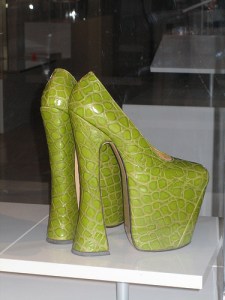
[photos: “Crocodile Shoes,” by Sheila Thomson, used under a Creative Commons license; and “Shoes from Prisoners – Auschwitz I,” by Jorge Láscar , used under a Creative Commons license]
What Marcel Proust Really Said about Seeing with New Eyes

In his TED Talk—on home, travel, and stillness—author Pico Iyer refers to the words of the French author Marcel Proust:

The real voyage of discovery consists not in seeing new sights, but in looking with new eyes.

When I Googled that phrase, I came up with several similar, though slightly different, versions. The most popular one comes up on over 800,000 sites, often used, as Iyer did, in the context of travel:

The real voyage of discovery consists not in seeking new landscapes, but in having new eyes.

487786787_c63e03fe2c_nBut I wasn’t done yet. I don’t trust “famous quote” sites, nor do I trust the democracy of the Internet. A little more searching led me to the actual quotation, and the original source. It’s Proust’s seven-volume work, Remembrance of Things Past (or In Search of Lost Time). The quotation above is a paraphrase of text in volume 5—The Prisoner—originally published in French, in 1923, and first translated into English by C. K. Moncrief.

In chapter 2 of The Prisoner, the narrator is commenting at length on art, rather than travel. Listening for the first time to a work by the composer Vinteuil, he finds himself transported not to a physical location, but to a wonderful “strange land” of the composer’s own making. “Each artist,” he decides, “seems thus to be the native of an unknown country, which he himself has forgotten. . . .” These artists include composers, such as Vinteuil, and painters, such as the narrator’s friend, Elstir. He continues:

This lost country composers do not actually remember, but each of them remains all his life somehow attuned to it; he is wild with joy when he is singing the airs of his native land, betrays it at times in his thirst for fame, but then, in seeking fame, turns his back upon it, and it is only when he despises it that he finds it when he utters, whatever the subject with which he is dealing, that peculiar strain the monotony of which—for whatever its subject it remains identical in itself—proves the permanence of the elements that compose his soul. But is it not the fact then that from those elements, all the real residuum which we are obliged to keep to ourselves, which cannot be transmitted in talk, even by friend to friend, by master to disciple, by lover to mistress, that ineffable something which makes a difference in quality between what each of us has felt and what he is obliged to leave behind at the threshold of the phrases in which he can communicate with his fellows only by limiting himself to external points common to us all and of no interest, art, the art of a Vinteuil like that of an Elstir, makes the man himself apparent, rendering externally visible in the colours of the spectrum that intimate composition of those worlds which we call individual persons and which, without the aid of art, we should never know? A pair of wings, a different mode of breathing, which would enable us to traverse infinite space, would in no way help us, for, if we visited Mars or Venus keeping the same senses, they would clothe in the same aspect as the things of the earth everything that we should be capable of seeing. The only true voyage of discovery, the only fountain of Eternal Youth, would be not to visit strange lands but to possess other eyes, to behold the universe through the eyes of another, of a hundred others, to behold the hundred universes that each of them beholds, that each of them is; and this we can contrive with an Elstir, with a Vinteuil; with men like these we do really fly from star to star.

So there you have it. Maybe this adds to the meaning of the more-familiar “quotation.” Or maybe it lessens it, in your mind.

Maybe, for you, this is no longer a phrase about travel. Or maybe it is now much, much more so.

[photo: “New Eyes,” by Brian Talbot, used under a Creative Commons license—the photo’s caption at Flickr.com is the “most popular” version of Proust’s words, above]

So That’s How You Say It: Find Foreign Words and Names Pronounced Online

2788433360_9dc6cc602aIt all started when I asked one of my sons what he wanted for Christmas. He said a Moleskine journal. (By the way, this story would be better if I could tell it, rather than write it out.) I’d heard about them before, but come on. Moleskin?!! Do I look like I’m made out of money? I can’t afford a book with a cover made out of mole skins!

I looked it up on Amazon anyway, and I saw that it wasn’t as expensive as I’d expected, nor was it spelled the way I’d thought. Come to find out, it’s not mole skin, the fur. It’s Moleskine, the Italian company in Milan.

So, what’s the right way to say Moleskine? “The answer,” say the folks at the Moleskine website,”is: there is no predetermined answer.”

Moleskine® is a brand name with undefined national identity. And that’s the way we like it. As a literary name, it was used by British travel writer Bruce Chatwin in his book “The Songlines”, referred to the little black notebooks he usually bought from a stationery store in Paris.

Everyone should feel free to pronounce it as he/she prefers. Enjoy.

Well, that’s settled. (Or not.)

But what about all those other foreign words and names that escape obvious pronunciation? You can’t always just look them up. And even if you find them, how can you hope to decipher all the hieroglyphics of phonetic spelling? What do they really sound like? If only we could hear someone say them.

Fear not. There is help—and it’s only a couple clicks away.

Here, for your listening and learning pleasure, are 8 sites that will have you sounding like a native in no time—or at least you’ll sound like an intelligent non-native to your friends.

As the Moleskine people say, “Enjoy.”

Forvo

“The largest pronunciation guide in the world.” Boasts over 2 million pronunciations in more than 300 languages. Gives you the ability to add words, pronunciations, and ratings. From their blog, “Pronuncionary,” here are the top pronunciations of 2013:
1. denigrated
2. Chag Sameach
3. 把手拿回
4. djävligt
5. Karadayı
6. مهذبة
7. præstekonen
8. ムーン香奈
9. Geschke
10. Guillaume

Pronounce Names

Started by Pinky Thakkar, a San Jose State graduate student from Mumbai. Includes people and place names. You can submit names for inclusion. Has its own YouTube channel, as well.

The Name Engine

Good for names of celebrities, sports figures, politicians, and the like. Created for radio and TV professionals. Gives “Americanized” version of foreign names.

Hear Names

Surnames and given names from over 50 languages. Started by Elizabeth Bojang, an American who served in the Peace Corps in West Africa, to “help executives and customer service representatives compete in the global marketplace.”

Pronounce It Right

Celebrity names and commonly used foreign words, with pronunciations that are “irreproachable replicas as produced by non-native speakers.” Run by Italians Patrizia Serra, a well-traveled journalist, and Laura Mazzoni, a translator and editor of linguistic dictionaries.

Pro•nounce

Voice of America’s guide to pronouncing names and places in the news. “The first of its kind on the Internet.”

Audio Eloquence

Maintained by Judith West and Heather Henderson to provide resources for their colleagues in audiobook narration. An index of links to a slew of sites on pronouncing words in multiple languages, people and place names, food names, biblical names, and more.

World Food Pronunciations—Foreign Cuisine Language Dictionary

A collection of sites from About.com. Includes entries for German, Italian, Japanese, and French cuisine.

[photo: “Mouthing Off,” by Caitlin Regan, used under a Creative Commons license]

11 Ways Moving Abroad Is like Skiing to the North Pole

34961051_5302f8458a
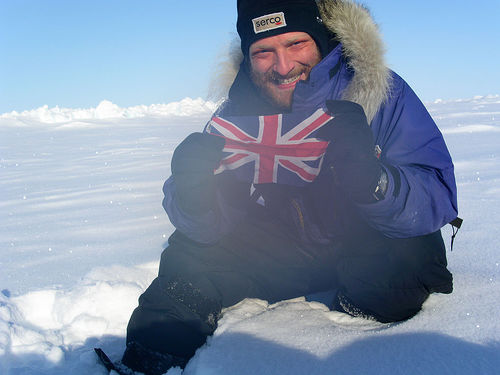
Ben Saunders sits on top of the world, the youngest person to reach the North Pole alone and by foot.

In 2004, 26-year-old Briton Ben Saunders became only the third person, and the youngest ever, to ski unaccompanied to the North Pole. As it turns out, there are a lot of ways that making a solo trek to the North Pole is a like moving to another country. Here are 11 things that the two adventures have in common, all taken from Saunder’s February 2005 TED Talk, “Why Did I Ski to the North Pole?”

  1. Luggage is a drag
    Saunders describes his specialty as “dragging heavy things around cold places.” He says, for his trip to the North Pole, “I was dragging all the food I needed, the supplies, the equipment, sleeping bag, one change of underwear—everything I needed for nearly three months.” That sounds like trying to put every necessary item in your carry-on bag, just in case your checked luggage gets lost. (If you think your bags are heavy, Saunder’s supply of food and fuel weighed 400 pounds.) Sometimes your destination has harsh conditions. And sometimes it doesn’t have chocolate chips. How many bags of those should you bring? Can’t be too prepared.
  2. It can be lonely out there
    One of the challenges of Saunder’s voyage was that he had to make it alone. Very alone. When he arrived at the northern-most point on the globe, he was the only “human being in an area one-and-a-half times the size of America, five-and-a-half thousand square miles.” Most of us don’t go to such remote places, but even if you’re in the biggest city, surrounded by millions of other souls, you can easily feel all by yourself.
  3. No, Virginia, there isn’t a Santa Claus
    When Saunders got to the top of the world, he didn’t find Santa. No Santa’s workshop. No elves. In fact, he says, “There isn’t even a pole at the Pole. There’s nothing there, purely because it’s sea ice.” When you go to another country, expect the unexpected. Don’t be surprised when what you find doesn’t match the photos in the magazine article. “I’d read lots of books,” says Saunders. “I studied maps and charts. But I realized on the morning of day one that I had no idea exactly what I’d let myself in for.” Photoshopped and cropped pics don’t do us any favors. If GPS and street signs say we’re in the right place, don’t waste time—or emotions—trying to find something that doesn’t exist.
  4. Sometimes it’s one step forward, two steps back
    According to NASA, during the year of Saunders journey, the ice conditions were the worst on record. Ninety percent of the time he was skiing into headwinds and the drifting ice pulled him backwards. “My record,” he says, “was minus 2.5 miles. I got up in the morning, took the tent down, skied north for seven-and-a-half hours, put the tent up, and I was two and a half miles further back than when I’d started. I literally couldn’t keep up with the drift of the ice.” When you’re in a new place, learning the language and culture, get used to those backward drifts. But always keep your compass set on your true north.
  5. The only constant is change
    Because the ice is constantly drifting over the North Pole, Saunders says that if he’d planted a flag there, it wouldn’t be long before it would be heading toward Canada or Greenland. Like Saunders, don’t be surprised when the emotional flags you plant aren’t permanent. The ground may not move under your feet (earthquakes not withstanding), but other kinds of landscapes certainly will. Find a special restaurant that serves your favorite dishes? Wake up the next day and it’s become a plumber’s shop. Make friends with some other expats? You may soon have to say goodbye. But, repeat after me, “Change can be good. Change can be good. Change can be good.” Maybe, just maybe, that plumber’s shop will end up being exactly what you need.
  6. Culture stress can be a bear
    Literally. On his first try at the North Pole, Saunders went with a partner, but they failed to reach their goal. Saunders says that from the outset “almost everything that could have gone wrong did go wrong. We were attacked by a polar bear on day two. I had frostbite in my left big toe. We started running very low on food. We were both pretty hungry, losing lots of weight.” Yup. Sounds like culture stress to me.
  7. Coming back can feel like the bear wins
    When his first attempt fell short, Saunders says he “was physically exhausted, mentally an absolute wreck, considered myself a failure, in a huge amount of debt personally to this expedition, and lying on my mum’s sofa, day in day out, watching daytime TV.” His brother texted him an encouraging quotation from Homer Simpson:
    “You tried your hardest and failed miserably. The lesson is: don’t even try.” Repatriation can feel that way. Maybe all the people who’d said you shouldn’t go were right. But Saunders didn’t let his failure define him. Instead, three years later he made history.
  8. People aren’t sitting around waiting to hear your stories
    When Saunders reached the North Pole, he got out his satellite phone. After warming up the battery in his armpit, he made three calls: “I dialed my mum. I dialed my girlfriend. I dialed the CEO of my sponsor. And I got three voicemails.” OK, that’s unfair to say they didn’t want to hear what he’d done. They were just busy at the time, that’s all. But . . .
  9. Some people really do want to listen
    “I finally got through to my mum,” says Saunders. “She was at the queue of the supermarket. She started crying. She asked me to call her back.” There are special people who will make time to listen—when they can focus on your story without distractions. Thanks, Mum.
  10. Don’t let others draw boundaries on your map
    When Saunders was 13, he got a school report that said, “Ben lacks sufficient impetus to achieve anything worthwhile.” Saunder’s response—”I think if I’ve learned anything, it’s this: that no one else is the authority on your potential. You’re the only person that decides how far you go and what you’re capable of.”
  11.  One of the three most important questions will always be “Where is the bathroom?”
    Saunders gave his TED Talk to answer three questions:
    (1 ) Why?
    (2) How do you go to the loo at minus 40?
    (3) What’s next?
    That second question is very important at the North Pole, because it seems that “at minus 40, exposed skin becomes frostbitten in less than a minute.” Your question number two will be more like “Where’s the bathroom?” or just “Bathroom? Bathroom?” Then, once you see the facilities, you may ask yourself, “How?”

As for the answers to those question, in short, Saunder’s responses go something like this:

(1) “For me,” says Saunders, “this is about exploring human limits, about exploring the limits of physiology, of psychology, and of technology. They’re the things that excite me. And it’s also about potential, on a personal level. This, for me, is a chance to explore the limits—really push the limits of my own potential, see how far they stretch.”
(2) That’s a trade secret, no answer here.
(3) Antarctica. Saunders and Tarka L’Herpiniere are currently on the first leg of their trek from the coast of Antarctica to the South Pole and back again—1,800 miles in all—unsupported and on foot. You can follow Saunder’s daily blog posts here. Why the South Pole? See answer number one above.

Somebody’s got a severe case of wanderlust.

[photo: “North Pole (3),” by Ben Saunders, used under a Creative Commons license]
Air Safety: The Musical, the Comedy, and the Reality Show

Several airlines have decided that typical, stodgy air safety videos aren’t getting the job done, so they’ve gone to great lengths to punch them up with some flair and pinache. And some of those airlines are upping the ante by making their creativity a trend.

I’ve already written about six previous attention-grabbing videos, and here’s a look at three more—the newest offerings from Virgin America and Air New Zealand:

  • Virgin America Safety Video
    A music/dance video featuring past contestants from American Idol and So You Think You Can Dance (with a couple contortionists, too), it’s directed by John M. Chu, the director of Step Up 2, Step Up 3, and Justin Beiber’s  Never Say Never. Future inflight-dancer wannabes can Instagram their best moves with #VXsafetydance to audition for a sequel.
  • Safety Old School Style
    Air New Zealand’s latest offering stars Betty White and Gavin MacLeod (of The Love Boatlook here if you’re too young to remember). It’s set at the “Second Wind Retirement Resort” and has lots of one-liners and sight gags poking fun at the senior-citizen set.
  • The Bear Essentials of Safety
    Man vs. Wild‘s Bear Grylls takes this Air New Zealand video to the great outdoors—New Zealand’s Routeburn Track, to be exact. Take a look if you’d like to see what exit-row lighting would look like if the plane were a cave and glow worms lit the way.

I think it’s time that someone started a set of awards for all these videos. We have the Emmies. We have the Razzies. How about the Safeties?

(Frances Cha, “Step Up’ Meets Robot Dancers in Virgin America’s New Over-the-Top Safety Video,” CNN, October 30, 2013)

It Won’t Be the Same without You: Join The Expat Survey 2013

2444717300_abb533fa6d_mThe logo for The Expat Survey 2013 is a hummingbird, “because just like human beings each one has its own migratory flight pattern.”

If you’re an expatriate, the Expat Survey wants to hear about your migrations, as well as your “remarkable diversity of habitats.”

The survey is made up of three parts, each rolled out separately, with the final section going live tomorrow (update: the third section went live November 27). All portions of the survey will remain available online until December 31.

The three sections are

  • Migration & Lifestyle
    “[H]ave you found it easy to integrate, what do you like or dislike about your adopted home, has life changed considerably and how do you stay in touch with family, friends and the outside world?”
  • Retail & Finance
    “Whether you are working or not, what are your important considerations when it comes to personal or household expenditure, banking and investments; and what information resources do you now tend to turn to when making these decisions and future fiscal planning?”
  • Travel & Health
    “Has your move to a warmer or colder climate changed your perspective of the world and the places and people you choose to visit; and what modes of transport do you use to get there? Do you enjoy a better diet and benefit from improved health and if you have had cause to call upon your local medical services were they sufficient?”

Besides having their voices heard, expats who fill out all three portions of the survey will be entered into a drawing for £1,000.

An independent London organization, i-World Research Limited, is conducting The Expat Survey, and it’s being promoted by 10 “collaborative partners.” One of those partners, Max Media International, calls the survey “the largest and most extensive independent global research programme ever conducted on those residing outside of their country of origin.”

To take part, go to The Expat Survey 2013.

(“Expatriate Specialism Agency Joins Expat Survey 2013,” Max Media International, July 10, 2013)

[photo: “Rufous Hummingbird—All fired up to impress the ladies!,” by Rick Leche, used under a Creative Commons license]