Elisabeth Elliot, December 21, 1926 – June 15, 2015

336418832_7545849366_z

[W]e are sinners. And we are buffoons. . . .

It is not the level of our spirituality that we can depend on. It is God and nothing less than God, for the work is God’s and the call is God’s and everything is summoned by Him and to His purposes, the whole scene, the whole mess, the whole package—our bravery and our cowardice, our love and our selfishness, our strengths and our weaknesses.

These words are from Elisabeth Elliot’s 1986 epilogue to her book Through Gates of Splendor. I found them while writing a blog post nearly two years ago about her and Steve Saint. Elliot wrote and said so many notable words. These will never be her best known, but they speak deeply to me.

(Elisabeth Elliot, Through Gates of Splendor, Carol Stream, IL: Tyndale, 1986)

[photo: “Trees, Fog and Bench,” by Wayne Dixon, used under a Creative Commons license]

A Modest List of Invented Expatisms, Inspired by the Dictionary of Obscure Sorrows

822518337_839b806a79_z

My son pointed me to The Dictionary of Obscure Sorrows, where John Koenig creates words to name before-unnamed emotions and ideas. Many of them are melancholy, such as amenuerosis, “the half-forlorn, half-escapist ache of a train whistle calling in the distance at night”; and chrysalism the amniotic tranquility of being indoors during a thunderstorm. . . .”

Others are more on the humorous side. For instance, a reverse shibboleth, is “the practice of answering a cellphone with a generic ‘Hello?’ as if you didn’t already know exactly who was calling . . .”; and lalalalia is “the realization while talking to yourself that someone else is within earshot, which leads you to crossfade into mumbled singing. . . .”

Expats have their own feelings and experiences that are yet to be named, and I think this needs to be remedied. So while I don’t have Koenig’s talent, here are a few of my offerings:

dyslistening
the condition by which your over preparation for answering an expected question in another language overwhelms your auditory senses and you answer the query you’ve anticipated, no matter what is actually said, as in responding to “How many would you like?” with “Yes, but no ice, please.”

welwelwel-ke-come
the glorious sound of the immigration agent thumbing through your passport looking for an empty page—and then adding the stamp that says you’re free to enter.

altivism
gazing out of an airplane window, seeing the new landscape below, and feeling joyfully overcome with the real and imagined possibilities.

visatrig
the act of trying to predict which agent in the office will be the most likely to give you your visa or other important document and then conducting complex calculations concerning the number of people in line in front of you to see if you will get the agent you hope for. A domestic version of this is sometimes encountered in the DMV.

unchewing
the physical and mental reaction that occurs when you realize that the chocolate-covered, cream-filled donut that you just took a bite of is in fact not a donut and that’s not chocolate and the filling might very well have gristle in it.

Finally, here’s one more from Koenig: onism

[photo: “The Dictionary,” by Bethany King, used under a Creative Commons license]

With Love Locks Leaving Paris, Give Peace a Chance

11567085873_fbb806e33b_z

‘Tis Better to Have Loved and Lost . . .

The French are turning their back on love! Oh, say it isn’t so! Well, it really isn’t so. But as you may have heard, last Monday, the city of Paris began removing the approximately 700,000 padlocks clinging to the Pont des Arts. As a symbol of their undying affection for each other, couples have been adding their “love locks” (not to be confused with “Locks of Love“) to the fencing of the pedestrian bridge, throwing the keys into the Seine river below.

The tradition started in Rome after the 2006 publication of Frederico Moccia’s best-selling novel I Want You, and the following movie adaptation, in which a young couple proclaim their love by fastening a padlock to the Milvian Bridge.

From there the practice has become something of a global phenomenon, with businesses springing up to cash in. For example, there are Lovelocks and MakeLoveLocks, which sell their own lines of locks and post maps showing sites around the globe for locking up love.

Looks as if they’ll need to remove at least one of those map markers, as Paris has decided that enough is enough. Actually, it’s too much, as sections of the Pont des Arts railing have begun to collapse under the padlocks’ 100-ton weight.

If US expats Lisa Anselmo and Lisa Taylor Huff have their way, Paris will soon be love-lock free. In January of last year, the two started No Love Locks with the slogan “Free your love. Save our bridges.” They’ve also started a petition asking the mayor of their city to ban the locks once and for all.

1394749720_aaed67acbb_z

Make Peace, Not Love

Where, oh where, then, will young lovers and tourists go to take selfies in a Paris sans love locks?

Well, the French capital does have another photo-worthy site. You might have heard of it, though probably not. It’s one of France’s best-kept secrets, but it may just turn the City of Love into the City of . . . Peace.

It’s the Mur de la Paix, or the Wall for Peace, situated on the Champ de Mars, in front of the École Militaire. Created by artist Clara halter and architect Jean-Michel Wilmotte, the wall was installed in 2000 to celebrate the arrival of the new millennium.

The structure is made of metal and glass panels and 20-foot-tall stainless-steel columns, all displaying the word peace in 32 languages. Inspired by the Wailing Wall in Jerusalem, the Wall for Peace contains slits so that visitors can leave messages in them. And virtual guests can leave their messages at the wall’s site to be displayed on monitors and online.

When it was built, the monument was supposed to be temporary, lasting only a few months. Some of the locals regret that its removal hasn’t happened, and a few are very vocal about it. In 2011, Rachida Dati, mayor of the area surrounding the Wall for Peace, was found guilty of defamation after accusing the wall’s creators of lying to keep their work in place. The wall has also been the target of vandalism. And yet, 15 years after its construction, it still stands.

3372837834_f11dcbdd97_zIf you look from the right vantage point, you’ll see that the Wall of Peace frames a nice view of a rather tall radio and TV antenna at the end of the Champ de Mars, opposite the École Militaire. It also was built as a temporary structure, to commemorate the 100-year anniversary of the French Revolution at the 1889 World’s Fair. Originally meant to stay for only 20 years, it was saved from the scrap pile when it’s creator realized how useful it could be for broadcasting. The tower’s still there, and if you’d like to get a glimpse of it, just go to the Wall for Peace and look southeast.

Ahh, Paris. What a fickle city. That which is meant to be forever is taken away. And that which is meant to be temporary lives on. C’est la vie.

C’est l’amour. C’est la paix.

(Emanuella Grinberg, “Paris Ends Relationship with ‘Love Locks,'” CNN, May 31, 2015; Angela Diffley, “Rachida Dati Libelled Peace Wall Couple, Court Rules,” RFI, November 22, 2011)

[photos: “Paris: Love Lock Bridge,” by Abi, used under a Creative Commons license; “Paris—Champ de Mars: Le Mur pour La Paix and Eiffel Tower,” by Wally Goetz, used under a Creative Commons license; “The Tower with Letters for Peace,” by Vincent Brassinne, used under a Creative Commons license]

Humanitarian Aid: Caring for Those Who Care for Others

8025828509_cf94e8dc5c_z

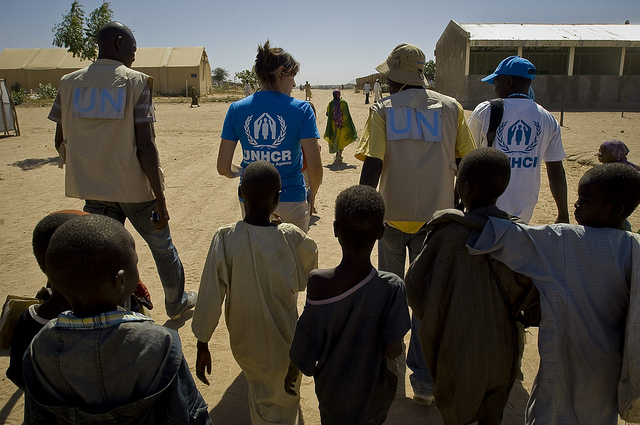
My hat goes off to humanitarian aid workers serving in the world’s neediest places as they face the very threats that call for their help: war, terrorism, poverty, disease, famine, natural disasters, and the list goes on.

My heart goes out to them, too, as they face not only those dangers, but mental and emotional stresses, as well.

Outer Turmoil

In their latest “Aid Worker Security Report,” Humanitarian Outcomes announced that 2013 marked an all-time high for the number of civilian aid workers who were victims of violence. The 460, an increase of 66% over the previous year, were the targets of 251 separate attacks, including shootings, kidnappings, bodily assaults, and explosives.

Those working in their own countries accounted for the vast majority, 87%, of the victims, but the 13% who were expats represented a greater rate of attack, as they made up less than 8% of workers in the field.

A study by the Johns Hopkins Bloomberg School of Public Health, looking at 18 humanitarian organizations for the period between 2002 and 2005, found that deaths, medical evacuations, and hospitalizations due to violence occurred at the rate of 6 per 10,000 aid worker person-years.* Of all deaths reported by the organizations, 55% were caused by intentional violence. Coincidental illness accounted for 27% of the deaths, and accidents made up 15%.

In another study, researchers from Geneva University Hospitals surveyed expats returning from their missions with the International Committee of the Red Cross (ICRC). They found that 36% reported having worse health than when they began, 16% said that they had been exposed to violence, and 10% reported injury or accidents.

A look at these numbers highlights the real need for physical care for aid workers. But the risks of humanitarian work also takes its toll on mental and emotional health. Another finding of the Geneva survey was that 40% of the ICRC workers reported that their service had been more stressful than they had expected. Certainly, attention to mental and emotional well being is also an ongoing need.

*Simply put, a “person-year” is a unit of measure representing the number of people involved in a study multiplied by each individual’s time spent in that study.

(Abby Stoddard, Adele Harmer, and Kathleen Ryou, “Unsafe Passage: Road Attacks and Their Impact on Humanitarian Operations,” Aid Worker Security Report 2014, Humanitarian Outcomes, August 2014; E.A. Rowley, et al., “Violence-Related Mortality and Morbidity of Humanitarian Workers,” American Journal of Disaster Medicine, Jan-Feb 2008; A.H. Dahlgren, et al., “Health Risks and Risk-Taking Behaviors among International Committee of the Red Cross (ICRC) Expatriates Returning from Humanitarian Missions,” Journal of Travel Medicine, Nov-Dec 2009)

Inner Turmoil

The causes of stress on humanitarian aid workers are many and varied. There are acute stressors, such as those from the events shown above, as well as chronic stressors, relating to day-to-day pressures and environmental and workplace factors.

When UNHCR, the UN Refugee Agency, surveyed aid workers in Pakistan and Bangladesh in 2012, they asked them which of the following items were “a common cause of stress.”

  • Exposure to suffering of persons of concern
  • Exposure to incidents when you were seriously injured or your life was threatened
  • Political situation in the county where you are presently working
  • Relationship with supervisors
  • Relationship with work colleagues
  • Family concerns
  • Health concerns
  • Safety concerns
  • Financial concerns
  • Feeling undervalued
  • Feeling unable to contribute to decision making
  • Status of employment contract
  • Workload
  • Working hours
  • Ability to achieve work goals and objectives

While no one would argue that exposure to suffering, violence, and threats are not legitimate stressors, the aid workers’ responses showed that more-mundane factors played a greater role in harming their mental health. The top-five stressors they reported were

  1. Workload
  2. Status of employment contract
  3. Feeling undervalued
  4. Family concerns
  5. Feeling unable to contribute to decision making

Respondents were also asked about symptoms that commonly show up with depression and post-traumatic stress disorder (PTSD). At least half reported “feelings of sadness, unhappiness, or ’emptiness'” (57%), “irritability or frustration, even over small matters” (54%), and “fatigue, tiredness and loss of energy” (50%).

In a study published in 2012 (referred to by UNHCR), researchers from the U.S. Centers for Disease Control and Prevention (CDC), among other organizations, asked participants from 19 international NGOs about their mental health before and after their period of service. Before deployment, 3.8% of respondents reported symptoms of anxiety; immediately after they returned from deployment that figure had risen to 11.8%; and a follow-up 3-6 months after deployment showed 7.8% with symptoms. Before deployment, 10.4% reported symptoms of depression, 19.5% post-deployment, and 20.1% at the follow up. And finally, in the area of psychological distress, the rates were 6.5%, 14.7%, and 17.6%, respectively.

Another study from 2012 looked at national aid workers serving in northern Uganda with 21 humanitarian-aid agencies. The researchers, from Columbia University, Fuller Theological Seminary, and the CDC, found that 68% of respondents reported symptom levels associated with a high risk for depression, 53% for anxiety disorders, and 26% for PTSD.

What Can Be Done?

What steps can be taken to help humanitarian aid workers facing threats to their physical and mental well-being?

Giving a comprehensive list of protocols for tackling the threats of violence is well beyond my abilities, but I can point in the direction of a few resources.

For instance, on the subject of combating violent situations, Humanitarian Outcomes’ annual “Aid Worker Security Report” tackles specific threats, such as kidnappings (2013) and road attacks (2014). Staying Alive: Safety and Security Guidelines for Humanitarian Volunteers in Conflict Areas, written by a decorated member of the British Army and former operational security advisor for the ICRC, gives a comprehensive look at avoiding threats. And “To Stay and Deliver: Good Practice for Humanitarians in Complex Security Environments,” published by the United Nations Office for the Coordination of Humanitarian Affairs/Policy Development and Studies Branch, was written for “aid practitioners and their organisations seeking practical solutions to gain, maintain, and increase secure access to assist populations in a range of complex security environments.”

While the physical and mental consequences of traumatic events has long been recognized, as the UNHCR report points out, only recently have the debilitating effects of chronic stressors for aid workers begun to come into focus. “Humanitarian agencies,” it states, “are increasingly concerned about the potential impact of staff stress on effectiveness and efficiency of service delivery.”

In developing their study and evaluating their organization’s reduction of and response to worker stress, UNHCR used stress-management guidelines formulated by the Antares Foundation. Antares, a Netherlands-based non-profit providing staff care to humanitarian and development organizations, was also involved in the two 2012 studies previously cited here. Its eight guidelines for agencies are

  1. Having a written and active policy to prevent or mitigate the effects of stress.
  2. Systematically screening and/or assessing the capacity of staff to respond to and cope with the anticipated stresses of a position or contract.
  3. Ensuring that all staff have appropriate pre-assignment preparation and training in managing stress.
  4. Ensuring that staff response to stress is monitored on an ongoing basis.
  5. Providing training and support on an ongoing basis to help its staff deal with their daily stresses.
  6. Providing staff with specific and culturally appropriate support in the wake of critical or traumatic incidents and other unusual and unexpected sources of severe stress.
  7. Providing practical, emotional and culturally-appropriate support for staff at the end of an assignment or contract.
  8. Having clear written policies with respect to the ongoing support offered to staff who have been adversely impacted by exposure to stress and trauma during their assignment.

After assessing UNHCR’s shortcomings in these areas, the writer of the UN agency’s report presented four recommendations for improvement. Each of these is presented in greater detail in the publication:

  • Ensure appropriate response and follow up for survivors of critical incidents
  • Increase availability and utilization of formal mental health and psychosocial support
  • Encourage informal social support amongst staff
  • Enhance accountability of staff welfare related services through regular rigorous evaluation, clear staff welfare policies, and role distinction between sections

As a result of their own findings, the researchers behind the first CDC study above also present a list of recommendations for aid organizations, designed to “diminish the risk for experiencing mental illness or burnout during deployment”:

  • Screen candidates for a history of mental illness and family risk factors pre-deployment and provide expatriate employees psychological support during deployment and after the assignment is completed. Although possibly controversial given the considerable stigma associated with mental illness, screening allows organizations to alert candidates to the risks associated with deployment and to consider means for managing and supporting such workers during and after their employment.
  • Staff should be informed that a history of mental illness and family risk factors may create increased risk for psychological distress during deployment.
  • Provide the best possible living accommodations, workspace, and reliable transportation.
  • Ensure, when possible, a reasonable workload, adequate management, and recognition for achievements.
  • Encourage involvement in social support and peer networks.
  • Institute liberal telephone and Internet use policies, paid by the organization [to] help increase social support networks of deployed staff.

If only all of these could be implemented. Maybe they can. But even if that happens, care for humanitarian aid workers needs to go beyond what their organizations might be willing or able to provide. Care needs to extend beyond the workers’ time with the organization, and it needs to aim for the health of the workers for the workers’ sake, not just for the sake of the service they are providing.

This will take more groups and individuals who can provide the “formal mental health and psychosocial support” (see UNHCR’s list). To this I would add spiritual support, as well. It will also take groups and individuals who can become part of the “social support networks” (see the CDC list).

Both of these will require those groups and individuals, and the workers themselves, to be proactive in implementing the necessary relationships.

May we continue to document and understand the problem, may we continue to draw attention to the risks faced by humanitarian aid workers, and may we continue to seek solutions. These workers are a valuable resource for a needy world. They are also deserving of help when they become the ones with needs.

May we provide them with safe people and safe places in the midst of the dangers.

(Courtney E. Welton-Mitchell, “UNHCR’s Mental Health and Psychological Support for Staff,” United Nations High Commissioner for Refugees, July 2013; Barbara Lopes Cardozo, et al., “Psychological Distress, Depression, Anxiety, and Burnout among International Humanitarian Aid Workers: A Longitudinal Study,” PLoS One, September 2012; Alastair Ager, “Stress, Mental Health, and Burnout in National Humanitarian Aid Workers in Gulu, Northern Uganda,” Journal of Traumatic Stress, December 6, 2012; Managing Stress in Humanitarian Workers: Guidelines for Good Practice, Third Edition, Antares Foundation, March 2012)

[photo: “Darfurian Refugees in Eastern Chad,” by European Commission DG ECHO, used under a Creative Commons license]
McDonald’s, You’re like Framily

13988001407_c5579a5d5d_z

Growing up on a farm, we didn’t eat out much, but I seem to remember enjoying a few Quarter Pounders with fries during my high-school days.

Then, during my time as a student at the University of Missouri-Columbia, my go-to lunch was a salad with a side of fries at the basement McDonald’s on Lowery Mall, across from the library. When I took my daughter for a campus visit to MU a few weeks ago, our student tour guide (who did an excellent job, I might add) pointed out where the McDonald’s used to be. He said at one time it was the highest-grossing McDonald’s location in the US. In the 80s, when I was there, we heard it was the busiest McDonald’s in the world. I think both statements are part of a Columbia urban legend—though I’d love someone to prove me wrong with some documentation.

When my family lived in Taiwan, we found McDonald’s in every city. That was especially welcome when we first arrived and couldn’t speak Chinese. It’s a lot easier to ask for a “Number 5” than to learn the vocabulary for ordering à la carte.

655846832_58ee159407_zMcDonald’s was popular with the locals, too, especially high school kids. It was common to see them gather there to study or work on class projects. It was a new experience for us to see young people in that group-centered culture pour all their french fries into a pile and share them together.

McDonald’s certainly is a global juggernaut. According to the company website, their more than 33,000 restaurants in over 100 countries serve over 69 million people each day. But there’s more to McDonald’s than just huge numbers. In honor of the chain’s 75th anniversary this year, Reader’s Digest ran a list of “75 Mind-blowing Facts.” Here are my favorites:

#2. The first McDonald’s drive-thru—in Sierra Vista, Arizona—didn’t open until 1975.

#22-22. French fries, McDonald’s best-selling item, were added to the menu in 1949. Before that, it was potato chips.

#50. As the result of a 1973 lawsuit, McDonald’s paid Sid and Marty Kroftt $1 million because the brothers claimed that McDonaldland had stolen the “concept and feel” of their Saturday-morning TV show H.R. Pufnstuf. (Remember that one?)

#58. Giving away (selling?) 1.5 billion toys each year in its Happy Meals makes McDonalds’ the largest distributer of toys in the world. (OK, that’s one of those “huge numbers.”)

#60. One out of every eight workers in the U.S. has at some time had a job at McDonald’s.

#66. Have you heard of the “Big Mac Index”? It was developed by The Economist in 1986 to use the local cost of a Big Mac to compare economies around the world.

I used to tell my Asian college-age friends that I don’t actually like McDonald’s, that most people in the US don’t actually like McDonald’s. But here’s what happens: You’re in a van with a bunch of young people on a trip and you ask them where they want to stop and eat and they say “Anywhere but McDonald’s” and they name other possibilities but when you exit the highway you don’t see any of the places they suggested and you’re running out of time and you decide to eat at the next place you see and—guess what?—it’s a McDonald’s. There’s always a McDonald’s close by, so that’s where you stop. It’s just too convenient.

This guy notwithstanding, McDonald’s burgers don’t garner much praise. In fact, when readers of Consumer Reports rated the hamburgers of 21 fast-food chains, they put the ones from McDonald’s dead last. The magazine called them a “Mc-disappointment.” When our local McDonald’s in Taipei ran out of hamburgers one day (I kid you not), maybe it wasn’t such a bad thing after all.

But there are those “world-famous fries.” McDonald’s calls them “golden on the outside, soft and fluffy on the inside.” I don’t disagree. And a whole lot of other people seem to be on board, as well.

Mark Eichenlaub, a graduate student in physics, decided to figure out just how many french fries McDonald’s has sold. He used the formula

equation

and came up with the figure “4 trillion, give or take a few.” I have a hard time following his detailed explanation (he lost me when I saw that squiggly S-thing before the numbers), but I’m pretty sure his estimate doesn’t even count fries sold outside the US.

Of course, McDonald’s gets knocked for a lot of things besides what’s on their menu. For instance, right now they’re the target of protests over low wages. Sometimes their negatives are symptomatic of the ills of American culture, but they’re magnified with McDonald’s because of the franchise’s large scale. And abroad, their ubiquity and visibility often make them a symbol of Western encroachment.

McDonald’s does give us plenty of reasons not to be “Lovin’ it.”

But again . . . there are those fries.

My second oldest son graduated from university last week. He drove about seven hours round trip to pick up my mother so she could attend the ceremony. The next day I took her back home, with an extra hour added on each way. After I dropped her off, she was worried that I’d fall asleep on the way back, but I told her I’d pull over and rest if I got tired.

4011734182_dc8d2f9bde_zA couple hours from home, in Lebanon, MO, I decided to stop and get something to eat. I parked at a McDonald’s, to go inside and stretch my legs and to use the free wifi. That and I got an order of fries.

The lady at the counter greeted me with “Welcome back.” How many businesses can say that to every customer and rarely, if ever, be wrong?

Sounds like framily. And when I say “framily,” I’m thinking of the Sprint commercials with their odd collection of characters—Ronald McDonald, Grimace, Hamburglar, Mayor McCheese, Captain Crook and the rest of the citizens of McDonaldland. It’s an imperfect, dysfunctional framily at times, but it’s still framily.

In the Lebanon McDonald’s, the fries were good, as they nearly always are.

There’s something to be said about consistency. And there’s something to be said about always being close by.

Framily.

(Daryl Chen and Brooke Wanser, “75 Mind-Blowing Facts about McDonald’s to Celebrate Its 75th Anniversary,” Reader’s Digest; “Best and Worst Fast-Food Restaurants in America,” Consumer Reports, July 2014; Mark Eichenlaub, “How Many Fries Has McDonald’s Served?Quora)

[photos: “McDonald’s,” by Mike Mozart, used under a Creative Commons license; “4 Combos Fries Mix,” by Shippou, used under a Creative Commons license; “plexi • burger.dude,” by Don Shall, used under a Creative Commons license]

When Grandma’s Lap Is Far Away

8263620238_4df2a740c8_z

Diane Stortz knows a thing or two about being separated from family. She’s the co-author of Parents of Missionaries: How to Thrive and Stay Connected when Your Children and Grandchildren Serve Cross-Culturally.

She also knows a thing or two about children’s books, having written Words to Dream OnThe Sweetest Story Bible, and a couple for Roman Downey’s Little Angels series, among others.

By my reckoning, that means that she knows two things or four about finding books to send to grandchildren overseas.

If you’d like some good advice, go to her blog and read her five points on what to look for when choosing the right storybook for children.

And at Christian Children’s Authors, she puts in a plug for recordable children’s books. Maybe it’s because I don’t have grandchildren yet, but I never knew there was such a thing. What a great idea for staying in touch with faraway granddaughters and grandsons, nieces and nephews.

In this post, Stortz mentions three publishers that produce recordable books: Hallmark, DaySpring, and Publications International. Using that as my starting point, here’s a sampling of what I found (it includes lots of grandmas and lots of bears)—

Conversations to Keep: Grandma and Me
That’s What Grandmas Do
My Grandpa and Me
Guess How Much I Miss You

Guess How Much I Love You
Under the Same Moon
What Aunts Do Best/What Uncles Do Best
I Love You So Much

I Love You Head to Toe
Wherever You Are: My Love Will Find You
Bright and Beautiful
All Day Long with Jesus

Bedtime Prayers and Promises
Sesame Street, Together at Heart
If . . . 

And here are a couple for sending back the other way—

I Love You Grandma
My Grandma Is Special

Susan Adcox, “Grandparents Expert” at About.com, writes that Hallmark recordable books are “pure magic.” “What child wouldn’t be entranced to open a storybook and hear it read in a grandparent’s voice?” she asks.

She goes on to compliment the recording process, calling it “practically foolproof.”

The Top Baby Names of 2014: There’s Poetry in the Meanings

5317791293_7fc9b47ff6_zIn some languages, most names carry an understood meaning. For instance, the name of the president of Taiwan is Ma Ying-jeou, which literally means Horse Brave-nine.

While some given names in English have recognizable meanings (e.g., Hope, Pearl, Colt), for most, the definitions come from non-English origins and are long forgotten.

So when we look at the list of top-ten baby names for 2014, announced yesterday by the Social Security Administration, we don’t think much about the meanings behind them. We’re more inclined to think about their sounds or the feelings they evoke or maybe people we know of with the same names.

But the meanings are meaningful, so here’s the list from the SSA . . . with a twist. Instead of showing the names themselves, I’ve lined up those meanings.

The Boys’ names are first, then the girls’.

It’s rather poetic.

(If this reverese-look-up-style list leaves you in the dark, I’ve got the actual names and their languages of origin, too. Just use your cursor to highlight the list, and they’ll magically appear.)

Rest     Hebrew: Noah
Will and protection    Irish, Germanic: Liam
Stoneworker     French: Mason
Deceiver     Hebrew: Jacob
Desire and helmet     Germanic: William
Enduring     Hebrew: Ethan
Who is like God?     Hebrew: Michael
Defender of man     Greek: Alexander
Supplanter    Hebrew:  James
God’s judgment     Hebrew: Daniel

Universal     Germanic: Emma
Olive     Latin: Olivia
Wisdom     Greek: Sophia
God is her oath     Hebrew: Isabella
Giver of life     Hebrew: Ava
Rebellious     Hebrew: Mia
Rival     Latin: Emily
Father’s joy     Hebrew:Abigail
Child of God’s gift     English: Madison
Man     Germanic: Charlotte

(Doug Walker, “Two New Arrivals: Our New Blog and Top Ten Baby Names for 2014,” Social Security Matters, May 8, 2015)

[photo: “Baby N – 5 Days New,” by RebeccaVC1, used under a Creative Commons license]

Let’s Hear It for Mundaneness!

4524690685_6a89580df5_z

You’ve seen those images of all the fish swimming in one direction with one fish swimming agains the flow. The message: That one fish is the only one going the right way, despite the crowd.

It’s not always a lot of fun being that fish, especially when it seems as if you’re the one going in the wrong direction.

During what would become our last State-side service, I and my wife had decided that our time as missionaries would come to an end. But before making that public, I attended a missionary convention held by our fellowship of churches. I remember sitting with several thousand others in Lexington’s Rupp Arena, listening to a plenary speaker give a passionate call to the audience of potential missionaries. “Let someone else build the houses,” he said. “You follow Christ, go into ministry.”

Let someone else be a doctor or an attorney and argue cases in court. You go follow Christ. Let someone else teach in the public schools. You follow Christ. Listen, there will always be people who will go into all those other occupations. But there are a rare few who will say, “I’ll follow my Christ wherever he leads me.”

I’d said similar things, at least to myself. I should be on the front lines. Others would fill in behind. I’d told myself I could never settle for regular work. How could I ever be satisfied living a commonplace life in the US?

And yet, here I was traveling in the opposite direction, burned up and burned out. I was leaving the mission field, not heading to it. I was stepping away, hoping someone might hire me to build that house or teach that class. . . and in time, hoping just to get hired, for just about any job.

Five years ago, David Platt, mega-church pastor and now president of the Southern Baptist Convention’s International Mission Board, wrote Radical: Taking Back Your Faith from the American Dream. I have a copy on my bookshelf, but I’ve never read it. I’ve heard good things about Platt’s book, and I’m sure it’s challenging. But it’s not the kind of challenge I’m looking for right now. The book I chose to read instead has a different kind of title. It’s The God of the Mundane: Reflections on Ordinary Life for Ordinary People.

Pastor Matt B. Redmond wrote The God of the Mundane as a response to what he had heard himself preach many times:

Change your world. Change the world of someone. Anyone. Sell everything. Sell anything. Give it away. Do something crazy. Be radical. Make people stand up and notice. Take a risk. Jesus moved from heaven to earth and gave up his life and yet you—you just go about your daily life.

But in time, his ponderings, expressed in his blog, Echoes and Stars, led him to ask if there is a God for the bulk of people who live out their lives performing mundane tasks. “Is there a God, for instance, for those who are not changing anything but diapers?”

In his book, Redmond answers the question with a “Yes,” writing to and about stay-at-home moms, dental hygienists, plumbers, children taking care of elderly parents, and bankers. In a blog post, he addresses the youth of a church where he once ministered:

Don’t be afraid of being small. Too often I probably made it sound like if you were really serious about your faith, you should think about ministry. Being a teacher or doctor or farmer was not worthy of your time. Well, that’s just stupid. Don’t be afraid to be in a “small” part of the kingdom. Be ordinary and unknown and be content. That’s more radical than anything else you will hear in the church today.

When he wrote The God of the Mundane, one of the images in Redmond’s mind was of a banker, frustrated and stuck in a job he doesn’t love. After writing his book, he left his career in ministry and became that frustrated banker.

Before reading his book, I had left my position as a missionary and had become frustrated, too. So often in Christian circles, the missionary life is considered the opposite of mundaneness. Redmond refers to it that way, too. But he doesn’t believe that a mundane life, lived in devotion to God, is unimportant.

Neither does he believe that we should stop asking people if they are “willing to give it all and go overseas as a missionary.” “It’s not a bad question to ask,” he says. “There is no question in my mind that this question needs to be out there.” But he also wants other questions asked:

[A]re you willing to be numbered among the nameless believers in history who lived in obscurity? Do you have the courage to be forgotten by everyone but God and the heavenly host? Are you willing to be found only by God as faithful right where you are? Are you willing to have no one write a book about you and what you did in the name of Christ?

When someone studying for a non-missionary career asked him his advice on selecting a missionary biography, Redmond suggested she begin by reading one about a Christian banker.

By that I meant she needed to read a book about a Christian living a mundane life. She told me she could not find one. Figures.

I would characterize Redmond as someone who is trying to be content in his present occupation, but who is not satisfied. He struggles with wanting to do something that better fits who he is, but he doesn’t want to turn his back on those like him who are not doing the BIG THING. He admits that it’s often hard for him to accept his own advice with confidence.

I find myself in the same place. I miss so much of being a missionary and still want to be a part of that work and community. And yet I don’t believe that God loved me more, valued me more then than he does now.

I still have my copy of Radical. I plan to read it someday. Someday, but not today. Today I’m reading and rereading Redmond’s book.

Maybe he’s written the closest thing you’ll find to a biography about a “Christian banker.” But rather than writing about something he’d lived, he wrote it first and now he’s living it. And as he’s been writing in his blog, it’s the living of it that has given him a real understanding of his own words.

Life often works out that way. Figures.

(Barry Cameron, closing session, National Missionary Convention, Lexington, KY, November 21, 2010; Matt B. Redmond, The God of the Mundane: Reflections on Ordinary Life for Ordinary People, Kalos, 2012; Matt B. Redmond, “Tuesday’s 10: What I’d Like to Tell My Former Youth,” Echoes and Stars, August 13, 2012)

[photo: “Fish Vane,” by Mike Gifford, used under a Creative Commons license]