The City with the Most Cosmopolitan Skyline in the World—Gets an Update

519MBW3HVQLIt’s the most globalized, most international, most architecturally inclusive city in the world. The fact that it’s fictional is irrelevant.

It’s Babe’s city, and it’s the setting for one of the best cross-cultural films ever made—Babe: Pig in the City. When Babe and Esme Hoggett travel from their English farm to big-city USA, it’s not just Europe and the Americas colliding. There’s all sorts of collisions between species as well, with—to name a few—humans, dogs, cats, apes, mice, a duck, and, of course, a pig.

A wide shot of Babe’s city shows a wonderfully crowded skyline of landmarks from around the world. There’s the Chrysler Building, Big Ben, the Sydney Opera House, the Eiffel Tower, Christ the Redeemer, and more, all brought together in one metropolis.

Babe’s city was first revealed in  1998, and now, years later, it looks as if several skyscrapers have been added to its horizon. Not only that, but Franklin Templeton Investments has joined the neighborhood. The evidence is the Franklin Templeton commercial “Global Perspective,” which shows the additions of Burj Khalifa, the Petronas Towers, London’s “Gherkin,” and the list goes on. Of course, development comes with a price, as it seems that several structures had to be razed to make room for the new arrivals (Christ the Redeemer’s outstretched arms are nowhere to be seen). Makes sense. Rarely do you have enough real estate available to put in your own Mount Fuji.

So where exactly is Babe’s city? Well, in the movie, it looks as if it’s on the East Coast. And in the commercial, we can narrow it down to an area above Ben Franklin’s left eye. If that doesn’t make sense, you’ll need to watch the ad—and while you’re at it, see how many landmarks you can identify.

Brian Stokle at Urban Life Signs has analyzed the Franklin Templeton commercial and shows some pretty good evidence that the city has been built up on Downtown Vancouver. But I’m not convinced. To my knowledge, Babe has never set foot in Canada. (Visit Stokle’s post, “World Skyline,” for a rundown of the landmarks in the commercial, as well as a shot-by-shot description and other “geeky analysis and research.”)

“Global Perspectives” has been around for a couple years, and I may have seen parts of it before, but it caught my eye two weekends ago when I saw Taipei 101 sporting Benjamin Franklin’s face. That’s not as far-fetched as it might seem: According to a recent China Post article, Franklin Templeton Investments occupies office space in the Taiwan skyscraper. No word yet on when Ben’s face will actually adorn the facade.

(Brian Stokle, “World Skyline,” Urban Life Signs, June 20, 2012; Ted Chen, “Chinese Company to Establish Office in 101,” The China Post, July 5, 2014)
Storytelling: The Bosphorus Bridge between Cultures

8594010074_38522b8612_z

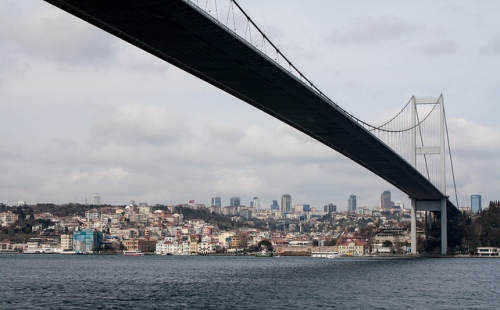
At one end of Istanbul’s Bosphorus Bridge, says Elif Shafak, is a sign that says “Welcome to Europe.” At the other end, another sign reads, “Welcome to Asia.” Shafak, the most widely read female author in Turkey, knows well this city that spans the Bosphorus Strait and connects two continents. She also knows well the push and pull of Eastern and Western cultures in Istanbul. She writes in Time Asia:

East and West are not water and oil. They do mix. And in a city like Istanbul they mix intensely, incessantly, surprisingly. That can leave the city confused about its identity. We Turks like to brag about straddling past and present, East and West, but we are not quite sure what we mean by that. We think of these two civilizations as boroughs we can go in and out of randomly. . . . But things are not so simple.”

Expanded Circles: Elif Shafak

Shafak has lived out her own cross-cultural experience. Born in France to Turkish parents, she was later raised by her mother in Turkey. Then, after her mother became a diplomat, they moved to Spain, Jordan, Germany, and back to Turkey.

Everywhere I went,” she says in a TED Talk, “The Politics of Fiction,” “I felt like my imagination was the only suitcase I could take with me. Stories gave me a sense of center, continuity, and coherence, the three big Cs that I otherwise lacked.”

While living in Madrid, Shafak attended an international school where she was the only Turk. While she describes the school as “a miniature United Nations,” it was not “a cosmopolitan, egalitarian classroom democracy.” Rather, she first encountered cultural stereotypes there. In her later moves with her mother, she saw more and more the general human penchant for retreating into “cultural ghettos”:

Now we all live in some kind of a social and cultural circle. We all do. We’re born into a certain family, nation, class. But if we have no connection whatsoever with the worlds beyond the one we take for granted, then we too run the risk of drying up inside. Our imagination might shrink; our hearts might dwindle, and our humanness might wither if we stay for too long inside our cultural cocoons. Our friends, neighbors, colleagues, family—if all the people in our inner circle resemble us, it means we are surrounded with our mirror image.

Shafak’s tool for helping break us all out of our cocoons is her fiction. She is the author of a number of novels, including The Forty Rules of Love: A Novel of Rumi, which bridges 13th-century Persia and present-day Boston, and Honor, which tells the stories of Kurdish twins, one who grows up to live in London, the other staying in a small village in Turkey.

I’m not saying that fiction has the magnitude of an earthquake,” says Shafak, “but when we are reading a good novel, we leave our small, cozy apartments behind, go out into the night alone and start getting to know people we had never met before and perhaps had even been biased against.”

Intersecting Journeys: O. Z. Livaneli

I have not read any of Shafak’s novels, but I did recently finish Bliss: A Novel, written by O. Z. Livaneli in 2006. (It was made into a film in 2007.) Livaneli, like Shafak, is one of Turkey’s most prominent and most-read authors. And, like Shafak, his works often investigate the meeting of cultures.

In Bliss, the cultures are embodied by three characters: Meryem is a fifteen-year-old from a small Turkish village. After being raped by her outwardly pious uncle, she is shunned by her community. Then she is taken to Istanbul by her cousin to be killed. Cemal, a soldier, newly returned from fighting rebels in the mountains, is the cousin chosen to carry out the “honor killing.” And Irfan is a Western-educated professor who abruptly leaves his wife—and his wealthy lifestyle—to sail the Aegean Sea. It is on his journey that he meets Meryem and Cemal.

At first the novel tells three seemingly unrelated stories, each from a distinct viewpoint. Then, as the characters come together, their stories, and their perspectives, intertwine. The settings are varied as well: the shack where Meryem is imprisoned, given only meager food and a rope for hanging herself; the dangerous mountains where Cemal kills ruthlessly so that he won’t be killed; and the university offices populated by the colleagues whom Irfan despises. And then there are the locations that bring them together and expose them to people of still other backgrounds: the train compartment on the way to Istanbul, the chaotic city center and its decrepit surroundings, the home of an eccentric retired ambassador, and the close quarters of Irfan’s rented sailboat.

Through it all, the three have their worlds expanded, in dramatic and often very painful ways.

The Gift of Bridges

Thankfully there are storytellers around the globe such as Shafak and Livaneli, authors whose works juxtapose cultural differences and uncover similarities. These writers allow us to pick up their books and step outside the mirrored walls of our houses and onto bridges that traverse oceans and connect cultures.

By walking these bridges, we reach distant shores, and when our feet touch foreign ground, we find signs that read, “Welcome,” even when it’s not so simple.

(Elif Shafak, “Pulled by Two Tides,” Hurriyet Daily News, August 13, 2006, first published in Time Asia, August 7-14, 2006)
[photo: “Bosphorus Bridge,” by Simon Q, used under a Creative Commons license]

Have Glasses Will Travel

Hey, kids, the next time somebody makes fun of your glasses, just tell them you’re going places. (Then show them this commercial from Glasses.com.)

“The universe is full of magical things patiently waiting for our wits to grow sharper.” —Eden Phillpotts, A Shadow Passes, 1918

Senior Citizens Teach English, Food Photogs Feed the Hungry, and Coca-Cola Makes a Rainbow

When teenagers teach senior citizens about the internet, cultures are crossed.

When the two groups use the internet to communicate between countries, the culture crossing is even greater . . . and the results are very cool.

The global advertising agency FCB and the Brazilian English school CNA have teamed up for the Speaking Exchange, a campaign that matches English learners in Brazil to retirement-home residents in the US, using video chat.

The idea is based on the premise “Students want to practice English, and elderly people someone to talk to.” CNA calls it “an exchange in which everyone wins.” Using the Speaking Exchange program, students find seniors looking to talk and begin their interaction with guided topics. They progress to free chatting and their conversation is uploaded to a private YouTube channel where it is evaluated by a teacher.

Currently, the Speaking Exchange is in a trial period, but retirement communities can sign up at the program site to be notified when “official activities” begin.

Brazil’s Speaking Exchange is just one example of the creative campaigns produced by FCB, which operates in 90 counties. Here’s another.

Food Photos: Share and Share Alike

Next time you snap a pic of your Caesar salad, you photo may just get “liked” by Chamissidini from Niger. This Chamissidini isn’t a real girl, instead her profile is one of many, created by UNICEF New Zealand and FCB, to represent needy children in the developing world. When food photos are uploaded to Instagram, they’re liked by the UNICEF profiles. And when the photographers look to see who their new fans are, they’re invited to visit foodphotossavelives.org.nz. There they can purchase meals for the hungry and download Instagram-style images of emergency aid items to share . . . and continue the conversation.

And here’s one more.

The Colors of a Country

To celebrate 20 years of democracy in South Africa last month, FCB Johannesburg helped Coca-Cola create an actual rainbow in the capital’s downtown—a skyline-sized symbol of what Desmond Tutu dubbed “the Rainbow Nation.” “In South Africa I’m a person because of other people.” says one resident. “We call it ubundu.”

Sprechen Sie Facebook? “Cyber Seniors” Learn a New Language

They are people worlds apart, speaking different languages, living out cultures foreign to each other, coming together in an unlikely place—in the assisted-living center across town.

Cyber Seniors is the story of teenagers who introduce a group of senior citizens to the internet: to YouTube, Skype, and that “Face something,” you know, the one with the friends.

In her new documentary, Canadian director Saffron Cassaday presents a great picture of learning, communicating, expanding horizons—and culture shock. It’s what crossing cultures is all about.

It’s so much fun to watch, and it’s got to be a lot of fun to join in.

How’s this for cross-cultural communication? It’s hard to ask questions when you’re not bilingual.

And here we see that you really are never too old—or too young—to learn a thing or two. Hallelujah!

These clips leave me with the question, When the two groups go “home,” what does reverse culture shock look like?

Superwomen of the Philippines Teach in Baltimore

It’s a not-uncommon cross-cultural story: A child flies away from his home country and is adopted into a whole new world. He grows up trying to be like the people around him, but he’s different. Maybe he should deny his past and just fit in. But denying who he is comes with a price. Embracing his true identity and exploring his heritage comes with a price, too. It’s an epic struggle, and the non-stop battles threaten to become his identity.

It’s the story of Superman.*

This past week, my wife and I watched last year’s Man of Steel on DVD. Following a trend in super-hero cinema, it tells the gritty, complex, discordant story of a superhero. And, of course, there’s action—so much thunderous, building smashing, ground shaking, tank-fisted action. In fact, right before the umpteenth fight between equally matched super people, my wife said, “Oh, not again.” The movie is entertaining, but it’s nearly 2 1/2 hours long, and with battle after battle, with the ultimate outcome never in doubt, all the excitement became . . . uh . . . boring.

A few days later, we watched another film about people landing in a new cultural landscape, leaving friends and family to try to make a difference in their own lives and those around them. This one is a POV documentary from 2011 called The Learning. It’s about four women from the Philippines, some of the 600 Filipino teachers, recruited by the school district, who teach in inner-city Baltimore.

“I only see America in television movies, in pictures of books, or in magazines,” says Dorotea, one of the four. “I haven’t had a picture of what America really looks like. . . . So this is it. This is America, where the dollars are found.”

Yes, these teachers can earn up to 25 times their salaries back home. That means they can send money back to the spouses, children, and parents whom they’ve left behind.

When she returns to her family after the end of the school year, Angel takes her five brothers and sisters, mom, and dad on their first-ever shopping spree. The money doesn’t seem enough to buy all that they want.

Grace, who has stayed in touch with her infant son by video chat during her time in the States, returns to the Philippines to find a boy who looks away and doesn’t want her to hold him.

“I know in the long run I will be in a better position,” she says. “I really have to suffer the consequences of what I did and what I’m doing.”

Rhea, who shares victories with the students in her special-education classroom, faces setbacks in her family life. While she’s away, her husband is arrested for selling drugs and faces the possibility of life in prison.

“I had this dream, you know, of going into a far place, bringing him wherever I go, and we will start something new—just us, no parents, no friends,” says Rhea. But her world has changed. “This is defeat for me. It’s like I’ve been fighting for so long for nothing.”

With tears, Dorotea says that this, her 24th year of teaching, is “full of adjustments, full of disappointments, full of hurts, full of . . . full of ill feelings.”

One of her high-school students tells her, “I wouldn’t leave my family if I was you. I’d stay over there. . . . You like it in the Philippines?”

Dorotea nods her head.

“You like it over here better?”

Smiling, Dorotea says, “It’s a very tough question.”

The four ladies of The Learning are real-life superwomen, which means they’re strong, but they’re not made of steel. It means they’re not actually superwomen. They’re conflicted, vulnerable, less-than-perfect. They fight battles, in the classroom and in their thoughts. One battle comes after another. But the ultimate outcome is certainly in doubt . . . and it’s anything but boring.

Directed by Ramona S. Diaz, The Learning originally aired three years ago. It is currently making an encore appearance online and is available for viewing through May 12.

*For a deeper discussion of Superman as Third Culture Kid, see Katherine Alexander’s “Clark Kent and Third Culture Super Power.”

An Upside Down Globe: The Wait Is Over, Now the Waiting Begins

6476736633_2787abca7b_zWhen I wrote “8 Maps and Globes That Will Change Your Perspective of the World,” I decried the lack of an upside-down globe and suggested that Bellerby & Co. Globemakers might be able to help out. Peter Bellerby read the post and commented, “An upside down globe was actually in future planning!” and added, “Pictures to come soon, just been working on finishing the design today!” Well, five months later, Mr. Bellerby, true to his word, announced in his blog “Exactly Why We Made an ‘Upside-Down Globe.’” He also included a link to an article from Al Jazeera America, “How the North Ended Up on Top of the Map.”

In this month’s issue of United Airlines’ Hemispheres Magazine, Chris Wright tells of his visit to Bellerby and Co., where he saw a bespoke upside-down globe, commissioned by a Brazilian law firm. Rotating and repositioning all the place names, says Mr. Bellerby, was “a challenge.”

Even trickier, perhaps, was coming to terms with the way the new world looks. “It’s crazy,” Bellerby says, his nose inches away from the upward-pointing Cape of Good Hope. Also, unless you approach the globe on your hands and knees, a lot of the interesting stuff is hidden away.

“There’s so much going on in the Northern Hemisphere,” says Bellerby, pointing to a barren expanse of blue. “Even the Antarctic, which is amazing, is just a lot of white.”

I had checked on Mr. Bellerby’s progress after a comment a few days ago from a reader named Lori: “I, too, have been searching for an upside-down globe! I am amazed that nobody has made one. The world is waiting for this.”

Well, Lori, the wait is over, because the upside-down globe is here, not just for a law firm in Brazil but for all of us.

Actually, though, for most of us, the wait continues. Take a look at “The Upside Down Curve,” and you’ll see that it’s an impressive—and expensive—piece of art. Even the base was “designed by the team who made the accommodation pods for the British Antarctic Survey” and is “brought to life by heritage technicians from Aston Martin.” So with its price of £14,950 ($25,000), I’ll still be waiting for quite some time . . . for the exchange rate to collapse or for a dramatic increase in my disposable income.

Mr. Bellerby tells Wright in his article, “The idea of selling a globe with a mistake is my biggest horror.” That must mean that his studio is filled with not-quite-perfect attempts at perfection. So if I could get just a small piece of a discarded upside-down gore, that would be enough for me. I would frame it and display it proudly. Oh, Mr. Bellerby, that would make the minutes go by more quickly as I anticipate a complete upheaval of the global economy or a million-dollar inheritance from the secret rich uncle I’ve never met.

I can dream, can’t I? And I can wait. And I can think.

When I originally wrote about an upside-down globe, I closed with the phrase, “It’s got me thinking.”

I’m still thinking. This time, I’m wondering what would happen if a typical globe and a reversed globe were placed side by side. Would the result be something like this?

(Chris Wright, “Up Is the New Down: A Master Globemaker Turns the World on Its Head,” Hemispheres, April 1, 2014)

[photo: “Untitled,” by GraceOda, used under a Creative Commons license]

“Let It Go”: Dubbing Disney’s Oscar-Nominated Toe Tapper in 25 Languages

Speaking of films, there is that Academy Awards thing tomorrow night. I’m predicting a sweep for Frozen in its nominated categories: best animated feature and best original song.

If you haven’t heard “Let It Go,” the nominated song from the Disney film, then you 1) haven’t seen the movie, 2) don’t spend much time on YouTube, and 3) don’t live with a seven-year-old who’s memorized all the lyrics.

And if you haven’t heard the original, then you probably haven’t heard the version dubbed into 25 languages. Even if you have heard it, it’s worth another listen.

The English version of “Let It Go” is sung by the Tony Award winning singer and actress Idina Menzel, who voices the movie’s character Elsa. She’s the one singing the English at the beginning of the multi-language video. But even though the rest of the song sounds as if it is sung by her, believe it or not, it isn’t.

So who in the world was tasked with finding all those talented songstresses? Look no further than Rick Dempsey, senior vice president of creative for Disney Character Voices International.

“In a lot of cases I think we fooled some people into thinking that it’s Idina in all those languages,” Dempsey told NPR. “And that, of course, is the goal, to ensure there is character consistency and the voices are all very similar around the world.”

But all that work isn’t a one-man show. Dempsey told The Hollywood Reporter, “We have 76 people around the world in 19 offices that oversee films in 55 languages. Our goal is to make every audience feel like Frozen was made in their country for their people.”

10152920204_d766fbe52c_qThe Los Angeles Times reports that the array of voice talents in “Let It Go” include Gisela (Castilian and Catalan), Serena Autieri (Italian), Willemijn Verkaik (German, Dutch), Takako Matsu (Japanese), Carmen Sarahi (Latin American Spanish), Marsha Milan Londoh (Malay), and Anna Buturlina (Russian).

And the impressive work of Dempsey’s crew on Frozen didn’t end with the only 25 versions of the feature song. While most stories report that Frozen has been dubbed into 41 languages, a Disney UK tweet puts the total at 43.

(“Let It Go’: A Global Hit in Any Language,” NPR, February 24, 2014; Tim Appelo, “‘Frozen’ Composer Robert Lopez on the Perils of Translating ‘Let It Go,’” February 25, 2014; Rebecca Keegan, “‘Frozen’: Finding a Diva in 41 Languages,” Los Angeles Times, January 24, 2014)

[photo: “Snowflake Macro: Silverware,” by Alexey Kljatov, used under a Creative Commons license]