World’s Best Documentaries Come to the Heartland

8519355784_bc3fdc805b
Attendees of last year’s True/False Film Fest in Columbia, Missouri, gather in the lobby of the historic Missouri Theatre.

True/False. There’s a big film event this weekend.

The correct response, of course, is True/False.

The event I’m talking about isn’t the Oscars. It’s the 11th annual True/False Film Fest in Columbia, Missouri, running today through Sunday.

Each February/March, thousands of movie lovers converge on theaters in Columbia to watch the best documentaries of the year.

The nearly fifty films being screened in this weekend’s festival naturally include some that deal with people and places outside the US. Here, for your enjoyment, are a sampling:

L’Escale (Stop-Over)
Undocumented Iranians in Athens, left on their own by their smuggler, fear the police and long for a new life in Europe. . . and wait.

Manakamana
In these real-time clips, the camera follows the people in eleven cable cars as they travel up a mountain in Nepal to visit the Manakamana temple. It’s like riding in a car with strangers, and staring at them the whole time.

Cairo Drive
What’s it like driving in Cairo? This film shows you the triumphs and trials of making your way around Egypt’s largest city. And as if the traffic weren’t chaotic enough, much of Cairo Drive takes place during the tumultuous happenings of the Arab Spring.

Forest of the Dancing Spirits
Director Linda Västrik lived with the Congo’s Aka pygmies for seven years. The result is this glimpse into the lives of an isolated tribe, as it holds on to its culture in the face of encroachment by the “modern” world.

[photo: “True/False Film Festival, Missouri Theatre, Columbia,” by Missouri Division of Tourism, used under a Creative Commons license]

Eyes: LensCrafters Commercial Gives Us a Closer Look

It didn’t cause quite the stir that Coke’s “America the Beautiful” in eight languages did, but LensCrafter’s new-this-week “Anthem” commercial also represents the mosaic of humanity. Instead of using voices, the eye-care company (as you might expect) uses eyes.

All people should have somebody who will, at some time or another, look deeply into their eyes.

While we’re on the subject of eyes . . .

Award-winning photojournalist Steve McCurry posts photos, grouped by theme, at his blog. For a collection of amazing photographs of eyes, interspersed with quotations and comments, go to his post from last July, “Eloquence of the Eye.”

You probably didn’t know . . .

  • The human eye is less than one inch in diameter and weighs only around 1/4 ounce.
  • Each blink closes the eye for 0.3 seconds. That totals about 30 minutes a day.
  • An eye has over 100 million photoreceptors (rods and cones).
  • 285 million people in the world are visually impaired, meaning they are blind or have moderate or severe impairment.
  • Blind people in the world number 39 million. 82% of them are over the age of 50.
  • The visually impaired in developing countries account for about 90% of the world’s total.
  • Preventions and cures are possible for 80% of visual impairment in the world.

(“NEI Calendar,” National Eye Institute; “Visual Impairment and Blindness, Fact Sheet No. 282,” World Health Organization, October 2013)

“Clearing Customs,” the Album

OLYMPUS DIGITAL CAMERA

Ever heard of Fred Frith? No? Then prepare to have your horizons expanded.

I Google-stumbled across Frith while looking for other instances of clearing customs on the internet. He’s a world-renowned experimental musician and college professor who, in 2011, released Clearing Customs, the album.

Born in Sussex, England, Frith has traveled the globe composing, performing, and teaching. He now lives in the US with his wife, German photographer Heike Liss, where he teaches at Mills College in Oakland, California.

Clearing Customs is an hour-long improvisational performance by Frith and other musicians using several instruments, including a Chinese gu zheng and an Indian mridangam and tabla.

To give you a taste of Frith’s kind of music, here’s a clip of him performing at a Mozg festival in Bydgoszcz, Poland. In it, he plays a guitar using a drum stick and a thin strap. As I watched it the first time, I thought, Hey, I could play a guitar with a drum stick. But I’m pretty sure Firth has more musical talent in his little finger than I have in my whole body. And I’m pretty sure he uses his little finger to play, as well.

Frith is also in the 2009 Canadian documentary Act of God, about people who’ve been struck by lightning. In the film, his brother, neuroscientist and author Chris Frith, measures the electrical impulses in Fred’s brain while he improvises on a guitar. In this way, the documentary compares the electrical activity of a storm to the electrical activity of the brain.

I wonder if Fred Frith will ever Google clearing customs, find my site, and blog about me. There’s probably about as much chance of that happening as the chance of me being struck by lightning (which, by the way, the National Weather Service says is 1 in 10,000, during my lifetime).

[photo: “Record Player,” by Ralf Heß, used under a Creative Commons license]

Film on Joplin Tornado Named Best Foreign Language Documentary in Beijing

8556513652_dae518ce3d

On May 22, 2011, the southwest Missouri city of Joplin made news reports around the globe when it was hit by an F5 tornado. Before moving to Taiwan, Joplin was our home for 5 years, and it became our home again when we moved back to the States one month after the storm.

On that day a coworker told us we should go to the Weather Channel’s Internet site, and we got our first look at the devastation from a distraught Mike Bettes, a Weather Channel storm chaser who arrived 10 minutes after the tornado had cut a 13-mile long, up to 3/4-mile-wide path through the city. Then we scanned CNN and several other national online news outlets. It was difficult to make sense of all the reports, largely because we were trying to convince ourselves that it couldn’t have been as bad as they reporters were saying. But while there were some inaccuracies in the initial reporting—due to the chaos and difficulties in communication—in the end, most of it was just as bad, or worse, than what we had heard. In a city of 50,000, 161 people had died, and 7,500 homes had been destroyed or damaged.

Our oldest son was back in Joplin, attending college, and we were able to get ahold of him fairly quickly by phone. At one point I might have said he was unaffected by the tornado, but we soon learned that everyone in Joplin, and in nearby communities, was affected somehow.

After we returned, we saw the immensity of the damage, but we know that that did not compare to living through it. We heard so many stories of loss, of hurt, of survival, of fear, of hope, of comfort. So many stories.

Documentary Wins Award on Other Side of the World

One of the groups telling the stories was The Joplin Globe, the city’s newspaper. Even though The Globe lost one of its staff and the homes of 25% of their employees were destroyed, they kept reporting. Their story is told in a documentary, Deadline in Disaster, produced by Orr Street Productions.

The film aired on Missouri PBS stations last year and won a 2013 Emmy in the Cultural Documentary Feature category, presented by the MidAmerica Chapter of the National Academy of Television Arts & Sciences.

But that’s not the only academy that’s taken notice. Last month, the third China Academy Awards of Documentary Film (CAADF) honored Deadline in Disaster as its choice for best foreign language film. The award ceremony, held on December 29, was organized by the China Documentary Research Center and hosted by the Communication University of China.

Beth Pike and Stephen Hudnell, directed and edited the film. Pike told  The Globe that she decided to contact CAADF after the documentary was praised by two employees of China Radio International. The two, Danna Ao, a visiting scholar at the University of Missouri-Columbia’s School of Journalism, and Yinan Yan, saw it when it was screened at a Missouri Press Association conference they attended.

“They were very moved by the resiliency of the Globe staff and the people of Joplin,” Pike told the newspaper. “They could relate since China has had its share of earthquakes, with many deaths and injuries.”

Facts about the 5/22/11 Joplin tornado

  • 161 people killed
  • 4,000 residential dwellings destroyed
  • 3,500 residential dwellings damaged
  • 9,200 people displaced (estimated)
  • almost 3 million cubic yards of residential debris generated
  • 553 businesses destroyed or severely damaged
  • $2,017,564,600 in losses incurred (as of October 31, 2012)
  • 176,869 volunteers registered (as of April 30, 2013)
  • 1,146,083 hours of volunteer work recorded

(“‘Deadline in Disaster’ Wins China Academy Award for Foreign Language Film,” The Joplin Globe, December 30, 2013; “Fact Sheet–City of Joplin, May 22, 2011 EF-5 Tornado,” City of Joplin, Missouri, July 1, 2013)

[photo: “2011 Joplin Tornado,” by Ozarks Red Cross, used under a Creative Commons license]

It’s the New Year, So How About a New Accent?

11678039353_deb2f45a1b_nIf you’re tired of failing your do-or-die New Year’s resolutions, maybe you should make a resolution lite.

Can’t see yourself losing 50 pounds? Why not shoot for 15?

Don’t want to read a book a week? Maybe a page a day is more your speed.

And if you’re not ready to learn a new language, here’s an alternative: Acquire an accent instead.

Learn Accents from a Pro

Professional help is just a couple clicks, and a couple minutes, away. Just listen to Gareth Jameson, London-based actor and voice coach, and you’ll be speaking like a Brit, or an Aussie, or a German speaking English, in no time. Take your pick from Jameson’s series of 19 videos at Videojug.

“The key to any accent,” says Gareth Jameson, “is to isolate the sounds that are specific to that accent.” Isolating—and reproducing—those sounds is tough for me. To my ear, there are two kinds of English: American and non-American. Tell me to imitate a Scott, and it comes out as something like a parody of Ringo Starr. Same for imitating a South African or an Australian. I know they don’t really sound alike, but I just don’t know exactly why.

So hear you go (yeah, I meant to do that). Click on the photos below for a sampling of videos, or go to the complete gallery, and soon you’ll be well on your way to annoyi . . . I mean, impressing your friends.

[photo: “Happy New Year!” by Chris Chabot, used under a Creative Commons license]

An Oscars’ Shortlisted Film on a TCK’s Long “Road Home”—Watch It Online

RoadHome

It’s not easy being shortlisted for the Academy Awards, but that’s what Rahul Gandotra did in 2011 with his live-action short film, The Road Home.

A Hidden-Immigrant Story

Gandotra was born in Belfast, Northern Ireland, and grew up in eight countries, spending time in Europe, the Middle East, Asia, and the US. He attended the University of Michigan and then got an MA in film directing from The London Film School. For his master’s thesis, he returned to Woodstock, a boarding school in the Himalayas, to shoot The Road Home. When Gandotra attended school there in the 10th grade, his class of 52 had students from 26 countries.

The Road Home tells the story of Pico, a Woodstock student who runs away from the school, hoping to get to the airport and return to London. Pico looks Indian on the outside, but on the inside, he is British. He doesn’t speak Hindi, and the culture is foreign to him. He is a “hidden immigrant” who desperately wants to escape this assault on his identity.

In an interview with Jedda Blog, Gandotra says that while he was filming in India, he was introduced to David Pollock and Ruth Van Reken’s book Third Culture Kids: Growing Up among Worlds. “That book described me really well,” he says.

I realized these are the type of people I am making the film for and that this film is for anyone who questions where they are from, at any time of their life. Any one who has had an outsider experience or has left their country can relate to this movie.

Later, when Van Reken previewed The Road Home, she wrote the following on the film’s IMDb site:

Just three weeks ago, I watched as two people watched this with tears of both joy and sadness streamed down their faces. Joy that what they had felt but been unable to articulate for their whole lives was finally given voice. Sadness as they identified so deeply with the pain Pico feels when others assume who he is by outward appearance rather than by his life experiences.

They also understood only too well how the frustration Pico felt of not being known by other [sic] as he knows himself to be and how that frustration comes out in a way others see as anger instead of pain. . . .

Best of all, The Road Home reminds us of one of the most fundamental truths for our globalizing world: until we know each person’s story, we cannot make judgments of who that person is regardless of skin color or apparent ethnicity. That’s why this film is so needed and important.

Watch The Road Home for Free

At the film’s website, you can enter your email address to receive a “sampler” packet of commentaries, interviews, web resources, and—best of all—a link to watch the entire 23-minute film online.

In Gandotra’s “Welcome” clip, he tells how Van Reken was instrumental in getting the packet put together. When he sent the video to her, he was, he says, “floored and shocked by what she said.” She wanted him to put the film on DVD so everyone could see it, and even though he was busy with the film-festival circuit she persisted. “She felt,” he says, “that she had the right to literally push and harass me into making this DVD. . . .”

He demurred, but it did no good. On her own, Van Reken recruited people from around the world who created a set of resources for the sampler packet. The final result is the full professional version of the DVD (available for purchase here).

One of the highlights of the packet is a 5-minute commentary on the film, with Van Reken, Gandotra, and Third Culture Kid expert Heidi Tunberg talking about TCKs. The professional DVD includes an additional 92 minutes of commentary.

Gandotra is currently working on a feature-lengh film based on the story of The Road Home, calling it a “a coming-of-age, adventure road movie.” In the new version, Pico runs away from Woodstock with Rachel, an American female classmate. The two come to the attention of a terrorist organization that wants to kidnap them. As they are pursued across India, Rachel discovers the nation, while Pico discovers his own identity.

Gandotra’s “Feature Preview” page says, “Although the feature script is faster paced than the short, it stays true to the ‘flavor’ and themes of the original film.” I look forward to hearing more about this longer version, and I hope to see it someday.

I also hope that amid the chase scenes it does, in fact, hold on to The Road Home‘s poignant insights. Because it is Pico’s inner journey—as he tries to reach the airport—that brings the most power to his search for home.

(Emily Rome, “Oscar Shorts: An Autobiographical Journey in ‘The Road Home,'” Los Angeles Times, January 14, 2012; Zareen Muzaffar, “The Road Home. An Exclusive Interview with Director and Film-maker Rahyl Gandotra,” Jedda Blog, October 2013; )

[photo courtesy of The Road Home / Rahul Gandotra]
11 Ways Moving Abroad Is like Skiing to the North Pole

34961051_5302f8458a
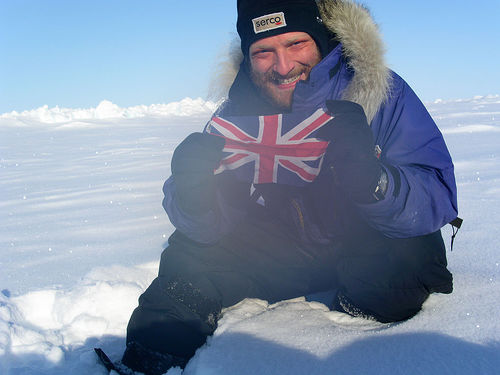
Ben Saunders sits on top of the world, the youngest person to reach the North Pole alone and by foot.

In 2004, 26-year-old Briton Ben Saunders became only the third person, and the youngest ever, to ski unaccompanied to the North Pole. As it turns out, there are a lot of ways that making a solo trek to the North Pole is a like moving to another country. Here are 11 things that the two adventures have in common, all taken from Saunder’s February 2005 TED Talk, “Why Did I Ski to the North Pole?”

  1. Luggage is a drag
    Saunders describes his specialty as “dragging heavy things around cold places.” He says, for his trip to the North Pole, “I was dragging all the food I needed, the supplies, the equipment, sleeping bag, one change of underwear—everything I needed for nearly three months.” That sounds like trying to put every necessary item in your carry-on bag, just in case your checked luggage gets lost. (If you think your bags are heavy, Saunder’s supply of food and fuel weighed 400 pounds.) Sometimes your destination has harsh conditions. And sometimes it doesn’t have chocolate chips. How many bags of those should you bring? Can’t be too prepared.
  2. It can be lonely out there
    One of the challenges of Saunder’s voyage was that he had to make it alone. Very alone. When he arrived at the northern-most point on the globe, he was the only “human being in an area one-and-a-half times the size of America, five-and-a-half thousand square miles.” Most of us don’t go to such remote places, but even if you’re in the biggest city, surrounded by millions of other souls, you can easily feel all by yourself.
  3. No, Virginia, there isn’t a Santa Claus
    When Saunders got to the top of the world, he didn’t find Santa. No Santa’s workshop. No elves. In fact, he says, “There isn’t even a pole at the Pole. There’s nothing there, purely because it’s sea ice.” When you go to another country, expect the unexpected. Don’t be surprised when what you find doesn’t match the photos in the magazine article. “I’d read lots of books,” says Saunders. “I studied maps and charts. But I realized on the morning of day one that I had no idea exactly what I’d let myself in for.” Photoshopped and cropped pics don’t do us any favors. If GPS and street signs say we’re in the right place, don’t waste time—or emotions—trying to find something that doesn’t exist.
  4. Sometimes it’s one step forward, two steps back
    According to NASA, during the year of Saunders journey, the ice conditions were the worst on record. Ninety percent of the time he was skiing into headwinds and the drifting ice pulled him backwards. “My record,” he says, “was minus 2.5 miles. I got up in the morning, took the tent down, skied north for seven-and-a-half hours, put the tent up, and I was two and a half miles further back than when I’d started. I literally couldn’t keep up with the drift of the ice.” When you’re in a new place, learning the language and culture, get used to those backward drifts. But always keep your compass set on your true north.
  5. The only constant is change
    Because the ice is constantly drifting over the North Pole, Saunders says that if he’d planted a flag there, it wouldn’t be long before it would be heading toward Canada or Greenland. Like Saunders, don’t be surprised when the emotional flags you plant aren’t permanent. The ground may not move under your feet (earthquakes not withstanding), but other kinds of landscapes certainly will. Find a special restaurant that serves your favorite dishes? Wake up the next day and it’s become a plumber’s shop. Make friends with some other expats? You may soon have to say goodbye. But, repeat after me, “Change can be good. Change can be good. Change can be good.” Maybe, just maybe, that plumber’s shop will end up being exactly what you need.
  6. Culture stress can be a bear
    Literally. On his first try at the North Pole, Saunders went with a partner, but they failed to reach their goal. Saunders says that from the outset “almost everything that could have gone wrong did go wrong. We were attacked by a polar bear on day two. I had frostbite in my left big toe. We started running very low on food. We were both pretty hungry, losing lots of weight.” Yup. Sounds like culture stress to me.
  7. Coming back can feel like the bear wins
    When his first attempt fell short, Saunders says he “was physically exhausted, mentally an absolute wreck, considered myself a failure, in a huge amount of debt personally to this expedition, and lying on my mum’s sofa, day in day out, watching daytime TV.” His brother texted him an encouraging quotation from Homer Simpson:
    “You tried your hardest and failed miserably. The lesson is: don’t even try.” Repatriation can feel that way. Maybe all the people who’d said you shouldn’t go were right. But Saunders didn’t let his failure define him. Instead, three years later he made history.
  8. People aren’t sitting around waiting to hear your stories
    When Saunders reached the North Pole, he got out his satellite phone. After warming up the battery in his armpit, he made three calls: “I dialed my mum. I dialed my girlfriend. I dialed the CEO of my sponsor. And I got three voicemails.” OK, that’s unfair to say they didn’t want to hear what he’d done. They were just busy at the time, that’s all. But . . .
  9. Some people really do want to listen
    “I finally got through to my mum,” says Saunders. “She was at the queue of the supermarket. She started crying. She asked me to call her back.” There are special people who will make time to listen—when they can focus on your story without distractions. Thanks, Mum.
  10. Don’t let others draw boundaries on your map
    When Saunders was 13, he got a school report that said, “Ben lacks sufficient impetus to achieve anything worthwhile.” Saunder’s response—”I think if I’ve learned anything, it’s this: that no one else is the authority on your potential. You’re the only person that decides how far you go and what you’re capable of.”
  11.  One of the three most important questions will always be “Where is the bathroom?”
    Saunders gave his TED Talk to answer three questions:
    (1 ) Why?
    (2) How do you go to the loo at minus 40?
    (3) What’s next?
    That second question is very important at the North Pole, because it seems that “at minus 40, exposed skin becomes frostbitten in less than a minute.” Your question number two will be more like “Where’s the bathroom?” or just “Bathroom? Bathroom?” Then, once you see the facilities, you may ask yourself, “How?”

As for the answers to those question, in short, Saunder’s responses go something like this:

(1) “For me,” says Saunders, “this is about exploring human limits, about exploring the limits of physiology, of psychology, and of technology. They’re the things that excite me. And it’s also about potential, on a personal level. This, for me, is a chance to explore the limits—really push the limits of my own potential, see how far they stretch.”
(2) That’s a trade secret, no answer here.
(3) Antarctica. Saunders and Tarka L’Herpiniere are currently on the first leg of their trek from the coast of Antarctica to the South Pole and back again—1,800 miles in all—unsupported and on foot. You can follow Saunder’s daily blog posts here. Why the South Pole? See answer number one above.

Somebody’s got a severe case of wanderlust.

[photo: “North Pole (3),” by Ben Saunders, used under a Creative Commons license]

Air Safety: The Musical, the Comedy, and the Reality Show

Several airlines have decided that typical, stodgy air safety videos aren’t getting the job done, so they’ve gone to great lengths to punch them up with some flair and pinache. And some of those airlines are upping the ante by making their creativity a trend.

I’ve already written about six previous attention-grabbing videos, and here’s a look at three more—the newest offerings from Virgin America and Air New Zealand:

  • Virgin America Safety Video
    A music/dance video featuring past contestants from American Idol and So You Think You Can Dance (with a couple contortionists, too), it’s directed by John M. Chu, the director of Step Up 2, Step Up 3, and Justin Beiber’s  Never Say Never. Future inflight-dancer wannabes can Instagram their best moves with #VXsafetydance to audition for a sequel.
  • Safety Old School Style
    Air New Zealand’s latest offering stars Betty White and Gavin MacLeod (of The Love Boatlook here if you’re too young to remember). It’s set at the “Second Wind Retirement Resort” and has lots of one-liners and sight gags poking fun at the senior-citizen set.
  • The Bear Essentials of Safety
    Man vs. Wild‘s Bear Grylls takes this Air New Zealand video to the great outdoors—New Zealand’s Routeburn Track, to be exact. Take a look if you’d like to see what exit-row lighting would look like if the plane were a cave and glow worms lit the way.

I think it’s time that someone started a set of awards for all these videos. We have the Emmies. We have the Razzies. How about the Safeties?

(Frances Cha, “Step Up’ Meets Robot Dancers in Virgin America’s New Over-the-Top Safety Video,” CNN, October 30, 2013)