To Augustine the World Is a Book, but Is It a Travel Book?

7544403302_cde12b749f_z

One of my father’s favorite jokes was to say a phrase of dubious meaning, and often questionable grammar, and tag William Shakespeare as the source. It went something like this:

No matter where you go, there you are . . . Shakespeare.

Seems that Dad was ahead of his time. All over the Interwebs, there are oft-used quotations attributed to oft-quoted people—Mark Twain, Martin Luther, Martin Luther King, Jr., Winston Churchill, Erma Bombeck . . . and Shakespeare. The trouble is, the pairings are oft-wrong.

Take, for instance, this popular quotation:

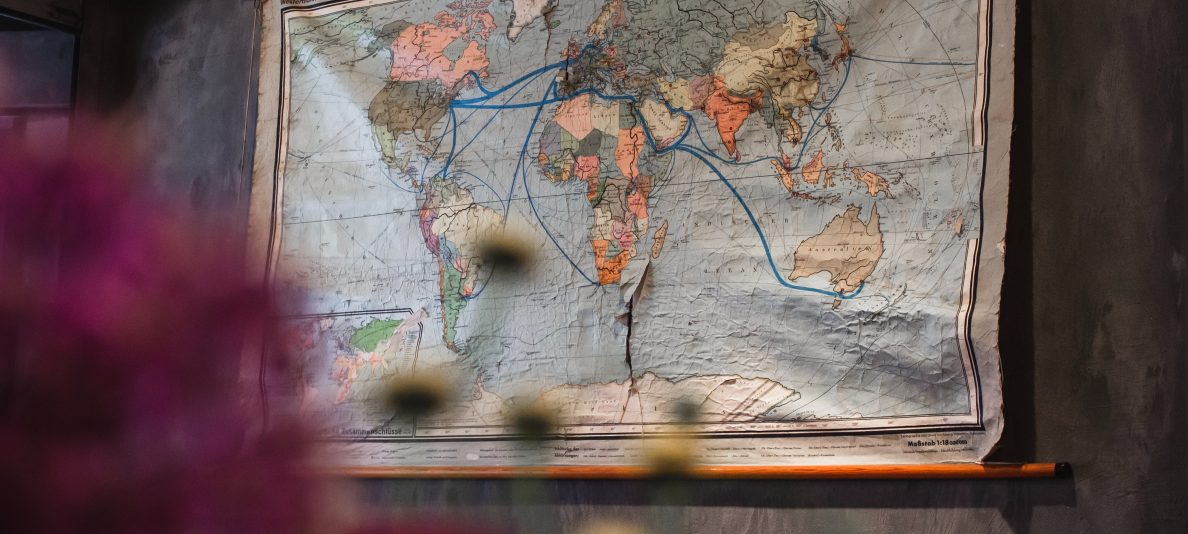
The world is a book and those who do not travel read only one page.

Nearly every online citation says it comes from the pen of St. Augustine, but as far as I can tell, no one has been able to find it in his writings.

The closest I’ve seen is in his Letter 43, written circa 397. While discussing schisms in the church in Africa and recounting some church history, he refers to the world as a book. But rather than using that as a metaphor to promote travel, he is proclaiming that the world shows the working out of biblical principles. Translated from Latin, he writes,

If, after all that you have read, you are still in doubt, be convinced by what you see. By all means let us give up arguing from ancient manuscripts, public archives, or the act of courts, civil or ecclesiastical. We have a greater book—the world itself. In it I read the accomplishment of that of which I read the promise in the Book of God: “The Lord hath said unto Me, and I shall give Thee the heathen for Thine inheritance, and the uttermost parts of the earth for Thy possession.

Jump ahead to 1750, and Louis-Charles Fougeret de Monbron writes Le Cosmopolite ou le Citoyen du Monde (The Cosmopolitan or the Citizen of the World), which opens with the following paragraph (as translated into English):

The universe is a sort of book, whose first page one has read when one has seen only one’s own country. I have leafed through a great many that I have found equally bad. This inquiry has not been at all unfruitful. I hated my country. All the oddities of the different people among whom I have lived have reconciled me to it. Should I gain no other benefit from my travels than this, I will have regretted neither the pains nor the fatigues.

British travel writer John Feltham joins our discussion with his publication of English Enchiridion in 1700. His collection of “apothegms, moral maxims. &c” includes one that seems to tie together Augustine and the thoughts of Fougeret de Monbron (it is not a direct quotation of either), and attempts to bring the early church father into the travel-writing fold:

St. Augustine, when he speaks of the great advantages of travelling, says, that the world is a great book, and none study this book so much as a traveller. They that never stir from their home read only one page of this book.

A few years later, Le Cosmopolite caught the attention of the young poet Lord Byron. In a letter to R. C. Dallas in 1811, he writes, “I send you a motto” and quotes the work’s opening paragraph. He tells Dallas, “If not too long, I think it will suit the book.” The book turned out to be his Childe Harold’s Pilgrimage, published in installments from 1812 to 1818, and the passage, still in French, became the work’s epigraph.

And finally, in 1824, Thomas Fielding gave us a more familiar rendering of the phrase in his Selected Proverbs of All Nations, crediting it to Augustine:

“The world is a great book, of which they that never stir from home read only a page.”

Simplify the language and you have “The world is a book and those who do not travel read only one page.” Oversimplify the authorship and you have Augustine.

Bring on the inspirational photos.

16791158072_73f7c8bd5d_z


[photos: “Atlas,” by Ian Carroll, used under a Creative Commons license; “Dyrhólaey Arc,” by Andrés Nieto Porras, used under a Creative Commons license]

Airport Voices: Two Friends Who Help You Get Where You Want to Go

11521252453_360dba9f8d_z

I know of a man who has an airport ministry. All day long he tells traveller’s that The End Is Near. You’d think that the authorities would silence him, but not only is he tolerated, he’s openly encouraged. In fact, airport officials around the world let him use their PA systems.

Of course, “The End” that Jack Fox is talking about isn’t the Second Coming. It’s a much more mundane finale. Close you’re eyes and imagine a voice saying, “Caution. The moving walkway is ending.” That’s him. Jack’s is the calm, helpful voice behind the announcements in hundreds of airports across the globe.

Why do I call it a ministry? Because Jack does. When he prepares for a recording session, he tells The Verge, “I picture someone standing on a moving sidewalk and I’m talking to that person with a friendly quality to my voice, so it won’t be so cold and sterile.” And then he adds, “My father was a minister, and I think of this as my airport ministry.”

Fox is not alone in his airport exhortations. His good friend, Carolyn Hopkins, has been lending her voice to announcements even longer than he has. Both work for Louisville’s Innovative Electronic Designs (IED), which supplies computerized paging systems for airports and other transit systems the world over. The Verge article describes them as “two cheerful, church-going retirees who also happen to be longtime buddies.”

Like Fox, Hopkins started in radio before joining IED, and like Fox, she was influenced in her career by a parent: “I got into it because my father had a magnificent, deep voice,” she tells the Bangor Daily News (she lives in Maine, now). “I loved to listen to it, so I liked doing that kind of thing. I would practice. I would create radio programs, with intros and segues. I did voices. It was a lot of fun.”

So that you can put faces with their voices, below is an interview of Fox on WHAS11 and a “CBS This Morning” story on Hopkins.

Now that I know who these two are, I’m going to appreciate their suggestions more the next time I’m thinking about parking in the unloading zone.

Jack Fox and Carolyn Hopkins: two of the best-known yet least recognized people in the world . . . kind of like this guy:

(Lesley Anderson, “The Speakers: How Two People Became the Voice of 110 Airports and the NYC Subway,” The Verge, July 18, 2013; Abigail Curtis, “From a Tiny Studio in Maine, Her Voice Is Heard around the World,” January 11, 2016)

[photo: “Faces in Dublin Airport,” by Giuseppe Milo, used under a Creative Commons license]

Remember when We Wore Our Sunday Best to the Airport and Had Manners to Match? Yeah, Me Neither

8164044950_2090d07690_z

We’ve all seen people with poor etiquette at airports. Of course, you and I would never be guilty of such boorish behavior. I do have a friend whose cousin knows someone who does that kind of stuff. I hope he gets to see these JetBlue videos below.

You might like to watch them, too, just for fun. You’ll enjoy them more if you’re comfortably seated—but don’t get too comfortable.


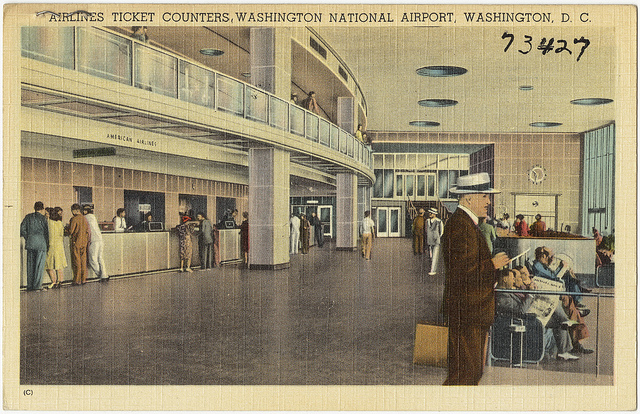
[photo: “Airline ticket counters, Washington National Airport, Washington, D. C.,” by Boston Public Library, used under a Creative Commons license]

Airportisms: New Words for Your Travel Lexicon

20068868814_3ee691764e_z 

Following up on my Modest List of Invented Expatisms, here are nine new terms to help you describe your traveling experiences. So the next time you’re in an airport, remember

Do not leave your bags unattended.
Do not stand on the toilet seats.
And do not let your words fail you.

Here for your vocabulary building . . . airportisms.

duffling
Upon hearing that your checked bag is three pounds overweight, you feign frantic action by grabbing zippers, patting your pockets, turning in circles, and saying things such as “I could . . . ,” “Well, I . . . ,” and “What can . . . ,” hoping that the ticket agent will take pity on you and say it’s OK. Be careful that your duffling isn’t too aggressive or the agent will actually let you follow through on solving the problem.

terminal fowliage
Birds that have somehow gotten into an airport and fly around amongst the rafters and indoor trees. Birds stuck inside a place where people come to fly. Sense the irony?

flaggle
A flaggle of tourists is a group of middling to senior travelers, led by a tour guide with a flag and bullhorn. The flag is akin to the kind I and my friends used to bolt onto our banana-seat bikes when we were kids. Oh, if only we’d had megaphones, too. You can tell that the flaggle is on the return leg of their trip when you see them bringing home food and souvenirs packed in large, branded gift bags or boxes with tied-on handles.

making a this-line’s-not-for-you-turn
After standing patiently in a line for fifteen minutes and realizing that it doesn’t lead where you need to go, you nonchalantly walk away—as if standing in lines is simply your hobby and you’re now looking for another place to queue up for more pleasant amusement. (Aren’t you glad you came early?)

shuftle
The standing-room-only shuttle bus at some airports that shuffles passengers on the tarmac from plane to airport terminal (or vice versa). This word can also be used as a verb.

Sadow-Plath effect
Happens in the moment when you accidentally kick a pulled carry-on with your heel and it flips onto one wheel and mo.men.tar.i.ly balances before flipping completely over or wobbling back to both wheels. This brief pause at the top of the carry-on’s arc is actually a tiny breach in the space-time continuum, caused by the rapid upturn of the luggage in combination with the forward motion. The effect is named after Bernard D. Sadow, inventor of the wheeled suitcase, and Bob Plath, creator of the rollaboard.

glizing
Glizing is the act of experiencing the wonderfully smooth exponential forward motion as you stride confidently on a moving walkway. This only happens when you’re not in a hurry, in part because, as studies show, the walkways do little to speed you up, and often slow you down.

BlackNSquare
When you try to describe your piece of luggage at the lost-luggage counter, all you can remember is that it’s part of the BlackNSquare line made by the Yuno company. Question: “What Kind of luggage do you have?” Answer: “Yuno, BlackNSquare.” Yuno also makes the upscale models BlackNSquare with handle and BlackNSquare with wheels.

preseating
To sit down, with plenty of time before boarding, able to relax because your bags are checked, you’re definitely at the right gate, and a quick look shows that your passport is right where it’s supposed to be. You take a deep breath and contemplate the hopeful possibilities of your trip. You can charge your phone, read, or people watch. You’re free to walk about and might grab a cup of coffee, browse the bestsellers in the bookstore, or window shop expensive luggage and watches . . . and on the way, you can go glizing.

[photo: “Opportunities | Airport Moment,” by John Ragai, used under a Creative Commons license]

Football, 2, 3, 4

“How the World Sees American Football: Foreign Students Throw the Pigskin”

The glee of Maximilian Bushe of Berlin could have been used for a billboard to advertise the clinic. He had run a pass pattern as if he were a wide receiver in the American game. He snatched the ball thrown to him and scored a make-believe touchdown. He was overjoyed, almost breathless as he stood with the ball he held out in front of him with two hands. The Georgia Tech football players—the real ones helping conduct the clinic—made a boisterous scene of cheering around him for his catch.

Then Bushe did what any good American football player would do. He did an end zone celebration, a little dance.

“I am just surprised I caught the football,” he said, smiling wide. “A little bit is OK, right?” he asked about celebrating. No, not really. In the NCAA, what he did would earn a yellow flag and 15-yard penalty for excessive celebration.

. . . . . .

“Back home, they think it’s boring, and that’s totally wrong,” Bushe said. “We don’t know anything about it in Germany. We just see it in the movies—somebody has the ball, and 20 people jump on him and pile up in a big, big tower. Once you get the whole game, it gets really interesting. You watch the game and cheer for your team, and it’s awesome.”

Ray Glier, Aljazeera America, April 25, 2015

The American Way, Way Up There

8147700813_d9552a7e4b_z

On a recent flight over the Pacific, I perused the October issue of American Way, the inflight magazine of American Airlines. Here are my thoughts:

  1. Gracing the cover, singer/songwriter Jessie J “continues to redefine herself.” I wasn’t familiar with her first definition.
  2. At CashInYourDiamonds.com, I can sell my “unwanted diamonds for cash.” Finally, a place to unload all those gemstones that have been dragging me down.
  3. People Tools, by Alan C. Fox, is not a book about people who are tools.
  4. Reading the tagline “Athlete and TV host Michael Strahan knows how to dress” didn’t quite pull me into that article.
  5. Voodoo comes from vous, the French word for you, and the English do. Who knew?
  6. Judging by all the advertisements, hair loss must be a big deal for travelers.
  7. Oh yeah, Bondi is a beach in Sydney, not just an iMac color.
  8. The mag writers’ favorite shirt is made by Ledbury, with its “fused canvas interlining” in the collar to keep it from collapsing. . . because “crushed collars are a business traveler’s nightmare.” Can you say, “First-world problems”?
  9. It took me a while to realize that Amber Kelleher-Andrews, of kelleher-international.com, has been awarded “top global matchmaker,” not “watchmaker.” By the way, who exactly gave her that award?
  10. The editors let me know that “78% of readers will act on an ad they’ve seen in this magazine.” If that includes people who blog about the advertisements, count me in.

If you’d like to read your favorite inflight magazine from the comfort of your web browser, take a look at Inflight Magazines: My Virtual Seat-Back Pocket Runneth Over.

[photo: “There’s no way like the American way (colorized),” by Whitewall Buick, used under a Creative Commons license]
The Vibrant Palette of Our World

311074381_96cf2f219a

For those of you caught in the whites and greys of a brutal winter, know that the bright colors of spring will be here soon.

But until then, just to tide you over, here are two reminders of how colorful our world can be.

If Your City Were Covered by Post-it Notes

When I use a Post-it Note—usually canary yellow—it’s most often to remind me about something I need to do, such as make a phone call, pick up a gallon of milk, or schedule a doctor’s appointment. But with the introduction of its “Colors of the World” collection, 3M wants to remind us of places we’d like to be.

Each grouping of five complementary colors—sort of like those chips from the paint store—represents one of four cities from around the globe: Bangkok, Mykonos, New York City, and Rio de Janeiro.

As reported in a 3M press release, fashion stylist Brad Goreski, serving as Post-it Brand’s “color ambassador,” says,

Trends in fashion, design and pop culture are taking on more global influence, and of course, one thing that’s always in style is color. I am consistently inspired whenever I travel, and I love seeing how the Post-it Brand Colors of the World collection brings the hues from four very chic destinations to life, offering a color scheme inspired by the energy of these places.

It’s an interesting idea: What colors would your city be?

For a chance to win a trip to New York, enter Post-it’s City Escape Sweepstakes. Just create a name for one of the colors in the collection and write a short essay telling what it means to you in relation to the city it represents (or you can submit a photo or video instead). If I’m reading the rules correctly, the trips will be awarded by a random drawing, but the best entries can also be used in future promotions.

If Color Grabs Your Camera Lens

For another colors-based contest, go to Project World Colors. It’s a photo blog started and curated by world travelers and bloggers Naomi Hattaway and Anne Lowrey. Each month they announce a new color, share their own images, and invite other bloggers to craft their own posts based on that hue. Then, near the end of the month, they pick a blogger to feature (that’s the prize—sorry, no trip), and they also share a post from a guest contributor.

For instance, this month the color is red. The post from the featured blogger is at “Project #Worldcolors 2014, a Red February” at It’s Lynny Kansas. The guest contributor is Annie Griffiths, award-winning photojournalist and founder of Ripple Effect Images, which “document[s] the plight of poor women and girls around the world and highlight[s] the programs that are helping to empower them.”

PWC offers guidelines for participation and shares the following enthusiastic invitation:

We invite you to participate in a photo blogging collaboration that celebrates the places that color shows up in our lives and across the web. . . . The goal is to delve into the texture, the beauty and the diversity that color can bring in different parts of the world. Come play with us!

[photo: “Textiles in Souq,” by Katie and Michael, used under a Creative Commons license]

What Marcel Proust Really Said about Seeing with New Eyes

In his TED Talk—on home, travel, and stillness—author Pico Iyer refers to the words of the French author Marcel Proust:

The real voyage of discovery consists not in seeing new sights, but in looking with new eyes.

When I Googled that phrase, I came up with several similar, though slightly different, versions. The most popular one comes up on over 800,000 sites, often used, as Iyer did, in the context of travel:

The real voyage of discovery consists not in seeking new landscapes, but in having new eyes.

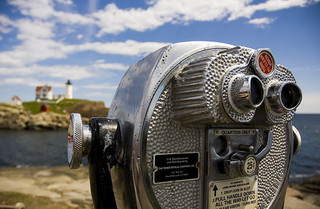
487786787_c63e03fe2c_nBut I wasn’t done yet. I don’t trust “famous quote” sites, nor do I trust the democracy of the Internet. A little more searching led me to the actual quotation, and the original source. It’s Proust’s seven-volume work, Remembrance of Things Past (or In Search of Lost Time). The quotation above is a paraphrase of text in volume 5—The Prisoner—originally published in French, in 1923, and first translated into English by C. K. Moncrief.

In chapter 2 of The Prisoner, the narrator is commenting at length on art, rather than travel. Listening for the first time to a work by the composer Vinteuil, he finds himself transported not to a physical location, but to a wonderful “strange land” of the composer’s own making. “Each artist,” he decides, “seems thus to be the native of an unknown country, which he himself has forgotten. . . .” These artists include composers, such as Vinteuil, and painters, such as the narrator’s friend, Elstir. He continues:

This lost country composers do not actually remember, but each of them remains all his life somehow attuned to it; he is wild with joy when he is singing the airs of his native land, betrays it at times in his thirst for fame, but then, in seeking fame, turns his back upon it, and it is only when he despises it that he finds it when he utters, whatever the subject with which he is dealing, that peculiar strain the monotony of which—for whatever its subject it remains identical in itself—proves the permanence of the elements that compose his soul. But is it not the fact then that from those elements, all the real residuum which we are obliged to keep to ourselves, which cannot be transmitted in talk, even by friend to friend, by master to disciple, by lover to mistress, that ineffable something which makes a difference in quality between what each of us has felt and what he is obliged to leave behind at the threshold of the phrases in which he can communicate with his fellows only by limiting himself to external points common to us all and of no interest, art, the art of a Vinteuil like that of an Elstir, makes the man himself apparent, rendering externally visible in the colours of the spectrum that intimate composition of those worlds which we call individual persons and which, without the aid of art, we should never know? A pair of wings, a different mode of breathing, which would enable us to traverse infinite space, would in no way help us, for, if we visited Mars or Venus keeping the same senses, they would clothe in the same aspect as the things of the earth everything that we should be capable of seeing. The only true voyage of discovery, the only fountain of Eternal Youth, would be not to visit strange lands but to possess other eyes, to behold the universe through the eyes of another, of a hundred others, to behold the hundred universes that each of them beholds, that each of them is; and this we can contrive with an Elstir, with a Vinteuil; with men like these we do really fly from star to star.

So there you have it. Maybe this adds to the meaning of the more-familiar “quotation.” Or maybe it lessens it, in your mind.

Maybe, for you, this is no longer a phrase about travel. Or maybe it is now much, much more so.

[photo: “New Eyes,” by Brian Talbot, used under a Creative Commons license—the photo’s caption at Flickr.com is the “most popular” version of Proust’s words, above]