Put Your Phone under a Bushel

Since having someone to listen to them is so important to missionaries and other cross-cultural workers, I thought I’d put together a list of ways to be a good listener. One of the first things I thought of was

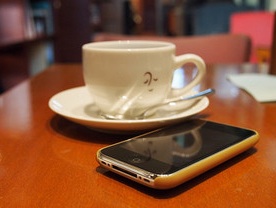
Let the person you’re talking with know that you’re giving him your full attention by turning your cell phone to silent and putting it on the table.
phonecupSounds good, right?

Wrong. And here’s why:

Just having a cell phone in view, even when it’s not being used—even when it’s not turned on—hinders the development of relationships. This is the finding of a study conducted by Andrew Przybylski and Netta Weinstein, of the University of Essex, as published in the Journal of Social and Personal Relationships.

In the first of two experiments, Przybylski and Weinstein paired up strangers and asked them to talk about something that had happened to them over the past month. The participants left their belongings in a waiting area, and then they went to a private booth for their conversations. The booth contained two chairs, facing each other, with a table off to the side. For half of the pairs, on the table was a cell phone on top of a book. For the other half, the phone was replaced  with a pocket notebook.

The result was that partners who had a conversation in the presence of a cell phone felt less close to each other and had a lower quality of relationship compared to their counterparts who talked without a phone nearby.

Since the conversation in the first experiment dealt with a “moderately intimate topic,” the second experiment looked at the effects of a cell phone on less intimate conversations (about plastic trees) and more intimate conversations (about “the most meaningful events of the past year”).

In this exercise, the researchers continued to look at the quality of relationships and also added evaluations of the levels of trust and empathy. The results showed that the phone had little or no effect on those who were talking on the casual topic, but participants reported lower levels of relationship quality, trust, and perceived empathy when the phone was in view. And even though the more meaningful conversation topics encouraged more closeness and trust when the phone was absent, when the phone was present, the levels of intimacy were actually lower than when the topic was focused only on plastic trees.

It’s notable that these effects happened even when participants didn’t remember seeing the phone in the room.

So what is a good listener to do?

Here are some suggestions:

  1. Turn your phone to silent or turn it off. Turning it to vibrate won’t do. Anything that pulls your attention to the phone, even if you ignore it, will disrupt the relationship you’re trying to form.
  2. Don’t put your phone where it can be seen.
  3. You might suggest to your partner that he not get out his phone either. Explain to him how important your meeting is and tell him how you don’t want anything to hinder him or you. (Cross-cultural workers who have visited an embassy know what it’s like to have a meeting and have to leave their cell phones outside. If the meeting’s important enough, the sacrifice can be made.)
  4. If a true emergency requires you to keep your phone on, understand that you will be distracted not only by every call and text that comes in, emergency or not, but by the presence of the phone itself. At the very least, apologize and understand the limitations of a meeting under those conditions.

Don’t let your phone, or anyone’s phone, hinder you from fully investing in someone. Don’t let the Siren song of your social networks pull you away from the person across from you who needs a face-to-face conversation. And, of course, don’t be the person who answers calls, who texts, who tweets, and who checks Facebook while he’s supposed to be paying attention to the person in front of him. That’s not the way to grow a relationship, to foster trust, and to show empathy. And aren’t those the things that a good listener wants to do?

(Anddrew K. Przybylski and Netta Weinstein, “Can You Connect with Me Now? How the Presence of Mobile Communication Technology Influences Face-to-Face Conversation Quality,” Journal of Social and Personal Relationships, July 19, 2012)

[photo: “iPhone + COFFEE,” by Kondo Atsushi, used under a Creative Commons license]

Google and YouTube Are Racing Forward in Translation (but the Finish Line Is Staying Ahead)

As the online community continues to grow, more and more languages are coming online, and power players like Google and its subsidiary YouTube are speeding ahead to keep up. Here are some of the numbers that illustrate this:

  • “To reach 90% of the world’s internet users required at least 19 languages in 2009 and 2010. In 2012, marketers will need 21 languages to achieve that mark. To hit 95%, the number of languages required has jumped from 27 to 34. Finally, to reach 98%, the number rocketed from 37 to 48.”

(Benjamin Sargent, “ROI Lifts the Long Tail of Languages in 2012,” Common Sense Advisory, June 26, 2012)

  • Google Translate currently works between 64 languages.
  • Over 92% of its more than 200 million monthly users come from outside the US.
  • “In a given day we translate roughly as much text as you’d find in 1 million books.”

(Franz Och, “Breaking Down the Language Barrier—Six Years In,” Official Google Blog, April 26, 2012)

  • “Sixty percent of all video views on Google-owned YouTube come from users who select a language other than English as the site’s display language”

(Janko Roettgers, “Most Youtube Views Come from Non-English Users,” GigaOM, November 3, 2011)

And now YouTube has launched a new interface to help in translating its videos into over 300 languages. The first step is to upload a transcript or caption file. Then the next step is to use the translation feature in the YouTube Video Manager to create a translation or invite other online users to help out. For the 64 languages available using Google’s machine translation technology, YouTube will provide a “first draft” to jump start the process. The interface also allows for translation into the 300 plus languages available in the Google Translator Toolkit.

(Jeff Chin and Brad Ellis, “Build a Global Audience on YouTube by Translating Your Captions,” Creators: The Official YouTube Partners & Creators Blog, September 24, 2012)

Those of you who have used Google’s translator in the past will know that the first draft of the translation may be a good starting point, but it will probably need quite a bit of tweaking. If you’re really brave, you can start with YouTube’s automatic captioning, which currently creates onscreen captions for English and Spanish, generating the text from the audio. (Access this feature by clicking the “cc” button at the bottom of the video viewer.) Google admits that all of this is a work in progress, and it often produces humorous results. Take a look at the video below to see Rhett and Link use YouTube for a modern take on the telephone (or gossip) game:

If you do need to create multi-language subtitles for a video project, and you find limitations in YouTube’s approach, take a look at dotSUB and Amara for more options.

[photo: “Race Hard,” by velo_city, used under a Creative Commons license]

Look, Ma, No Hands: An Engineer Brings His Cross-Cultural Creativity to the Ford Escape

While I was watching my alma mater, Mizzou, play South Carolina in football Saturday, a commercial caught my attention. (Actually, the commercial was one of the high points of the game for me, since the Tigers lost in convincing fashion.) The ad was for the 2013 Ford Escape and highlights its hands-free liftgate, which lets you open and close the back hatch by using your foot. This is possible because of a motion sensor under the rear bumper that is programmed to respond only to a kicking motion.

The feature is the brainchild of Ford exterior systems engineer, Vince Mahe, who was born in France and moved to the US at the age of 10. The Escape’s Facebook page says Mahe learned English from watching Sesame Street. Later, he became a fire fighter, then joined Ford, where he developed the “Open Sesame” feature. (Sesame Street. Open Sesame. Sounds like a theme.)

Chalk up another tally for creativity born from cross-cultural experiences. According to the commercial,

Vince Mahe grew up on two continents and noticed that wherever you go, people have their hands full but their feet free. The result, a liftgate you operate with your foot.

See here for yourself:

During a live chat, Mahe was asked how fighting fires helped him in is work at the auto maker. Mahe answered,

Being a fire fighter taught me how to keep calm under pressure and realize there is always a solution. You must keep your calm when collaborating with a team, especially under pressure. . . .

Another question concerned the transition between the two jobs. Mahe:

The transition to Ford was the same as other transitions I had in my life, like moving from France to the United States. It’s another adaptation I had to make in my life, but I have been happy with it. . . .

Of course, not all of the creative people at Ford used to be cross-cultural kids. (There are three other innovators who star in their commercials, with no mention of their backgrounds.) But it’s interesting how much Ford is stressing the effect that Mahe’s past experiences have had on his creativity and problem-solving skills. Here is Mahe explaining the relationship in his own words:

Ford is marketing the Escape outside the US, as well. But in other countries, it is being sold under the name Kuga. Their global strategy also means that Ford is paying attention to place-specific details in the Kuga’s design. One of these variables is color, and Ford is introducing a “global colour”—a “subtle green”—they’re calling Ginger Ale. “Choosing the right colours is crucial, wherever the car is being sold,” says Serife Celebi on Ford’s media site. Celebi, the colour and material design supervisor for Ford of Europe, adds, “Ginger Ale is stylish enough to suit urban landscapes across the world and still have a playful edge.”

Regional factors also affect the planning for interior colors: Ulrike Dahm, colour and trim supervisor, Ford of Europe, says,

In Asia, lighter interiors are more desirable. Many people live in huge cities where space is at a premium, so having a light and airy interior is seen as luxurious. In Europe, colours and trim take a lot of influence from the tech industry and are generally darker. Gloss black is a popular choice.

Maybe the same kind of attention to cultural tastes was not given to the SUV’s name, which has been used by Ford outside the US since 2008. I didn’t find any explanation from Ford for the origin of the name, but several sites point out that kuga is a Serbo-Croation word for “plague.” No word on whether that has affected sales in Serbia and Croatia.

(“Trend-Spotting on a Global Scale: How Ford Designers Tailored All-New Kuga to Suit Customers Worldwide,” media.ford.com, April 19, 2012)

[photo: “2013 Ford Escape,” by Automotive Rhythms, used under a Creative Commons license]

About Your Passport, from Past to Future

The number of US passports in circulation continues rising steadily, which makes sense, as the population is rising steadily, too. In 2011, there were over 109 million valid passports, putting the percentage of US citizens with passports at about 35%. But while the overall number is growing, the number of passports issued last year dropped by over 2 million from 2010. And last year’s total of 12.6 million (including passport cards) is well below the record year of 2007, when more than 18 million passports were issued as new laws were enacted that began requiring passports for travel to and from Mexico, Canada, the Caribbean, and Bermuda.

Passports of the Stars

If you’d like to see some passports from days gone by, go to Tom Topol’s site at Passport-Collector.com, where he has a gallery of celebrity passports, including those belonging to the likes of Marilyn Monroe, Muhammad Ali, Sammy Davis, Jr., and Ernest Hemingway. Topol also has a page showing the prices paid for celebrity passports at auction, the top three being Monroe ($115,000), James Joyce ($98,696), and Albert Einstein ($93,000).

And Indiana Jones, Too

Film and theater prop maker, Anthony “Indy” Magnoli, has his own gallery of vintage passports. But his aren’t of celebrities, they’re of fictional characters, such as Charlie Chan, MacGyver, and, of course, Henry “Indiana” Jones (young and old). Each replica is complete with stamps and details corresponding to the character’s time period and global travels.

Future Tech

While all that gives a glimpse at where passports have been, where are they going? One possibility comes from the German company Bundesdruckerei, which two years ago rolled out an e-passport containing an AMOLED display. The thin, flexible display, showing a rotating headshot, does not need batteries, but instead the image begins moving when the card is placed close to an RF power source.

This does look cool, and I’m sure it provides increased security, but if (when?) something like this goes into effect, I’ll miss the look and feel of the “old” passports: the visa stamps, the weathered pages, the memories.

(“Passport Statistics,” U.S. Department of State; Juniper Foo, “E-Passport Gets AMOLED Screen,” CNET News: Crave, March 11, 2010)

[photo: “Passport User’s Manual,” by Cowtools, used under a Creative Commons license; chart courtesy of U.S. Department of State, public domain]

Global Stats and Stuff: Technology and the Internet

  • “In October 2011, 1.2 billion users around the world visited social networking sites, accounting for 82 percent of the world’s [internet] population. Nearly 1 in every 5 minutes spent online around the world is now spent on social networking sites, making Social Networking the most popular content category in engagement worldwide.”

(“Carmela Aquino, “It’s a Social World: A Global Look at Social Networking,”  comScore Voices, January 6, 2012)

  • Any two people in the world on Facebook are separated by an average of 4.74 “hops,” meaning that for “even the most distant Facebook user in the Siberian tundra or the Peruvian rainforest, a friend of your friend probably knows a friend of their friend.”

(Lars Bakstrom, “Anatomy of Facebook, November 21, 2011)

  • 60 Second Marketer contributing writer Nicole Hall took a deep look at the claim that the world has more mobile phones than toothbrushes. Her conclusion is “that there are almost certainly more mobile phone subscriptions than there are toothbrushes on the planet. And, if you make some additional assumptions based on our research, in all likelihood, more people own a mobile phone on the planet than own a toothbrush.”

(Nicole Hall, “Are There REALLY More Mobile Phones Than Toothbrushes?60 Second Marketer)

  • Globally, “22% of online shoppers made their first online purchases within the past year.”
  • Chinese online consumers lead the world with an average of 8.4 purchase online each month. This compares with 5.2 purchases in the US and 4.3 in the UK.

(“Global Multi-Channel Consumer Survey 2011,” PwC)

[photo: “Internet & Tacos,” by lecates, used under a Creative Commons license]

The Asian Squat for the West of the World

If you’re a Westerner who’s traveled to Asia, you’ve probably marveled at the locals’ ability to relax in their preferred alternative to just standing around—the Asian squat. You’ve also probably brought back stories (and photos) of “squatty potties,” and you understand why the bathrooms in international airports have signs that read, “No Standing on the Toilet.”

But if all this is new to you and you see the need for more information, or if you’d like help in pulling off the squat yourself, I refer you to Daniel Hsia’s mockumentary, How to Do the Asian Squat. Watch it because you want to know the history behind the Asian squat. Watch it because you want to know the physics behind the Asian squat. Or watch it simply because “Each and every day, more and more tired-legged, stiff-backed Americans are discovering a new and exciting way to squat!”

And if you really want to get on board (pun intended), take a look at “Nature’s Platform” for how you can convert a Western toilet into your very own squatty potty. The site is complete with testimonials from physicians, anthropologists, and yoga instructors. Unfortunately, it looks as if the company is not accepting new orders at this time. But don’t be disheartened, you can go here for their instructions on how to create your own conversion kit from concrete blocks and plywood. Or as an alternative, you can visit Lillipad of New Zealand, where their trendy (?) looking “squatting platform” is on sale . . . and available. They sell plans for building your own, too. (But hurry, the plans are 50% off till the end of July.)

[photo: “Old Man Squatting on Steps,” by Lon&Queta, used under a Creative Commons license]

Language Apps Beat Flat Abs

Want to become more attractive to the opposite sex? Learn another language. A poll from car-maker smart USA and Harris Interactive shows that 69% of Americans “would prefer their spouse to speak another language than have washboard abs.” And if you’re looking for some high-tech help in becoming bilingual, Wired How-To Wiki provides a list of apps for foreign-language learning, broken down into four sections. (If you want to go for a second language and a flat stomach, I suggest number three, because you’ll be pretty busy at the gym.):

  1. For story-based learners
  2. For visual learners
  3. For the time-strapped
  4. Basic translators

(“Americans’ Attitude towards Consumption May Be Shifting,” BusinessNewsDaily, February 28, 2012; Adrienne So, “Use Apps to Learn a Foreign Language,” Wired How-To Wiki, April 18, 2012)

[photo: “Gym wash,” by Michael Clark, used under a Creative Commons license]

This Global Footage Comes from Space

In an extreme case of repatriation, three astronauts returned to earth yesterday following nearly 6 months in the International Space Station. The three, Daniel Burbank (USA), Anton Shkaplerov (Russia), and Anatoly Ivanishin (Russia) landed safely in Kazakhstan—inside a Russian Soyuz capsule.

In honor of their arrival, here’s some time-lapse footage of the earth, taken from the ISS from August to October of last year, compiled and edited—complete with inter-galactic-sounding music—by Michael König: