how the people and parts of our world cross cultures
Author: Craig Thompson
Interested in cross-cultural issues, particularly the emotional process of adjusting to new cultures, whether that’s brought about by a move to another country or a move back “home.”
It’s been over two years since we moved back to the US, and we’ve finally relieved our friends/forwarding agents of the things that we’ve had stored in their basement. Inside the boxes and Rubbermaid containers were several items that I’d forgotten about. But there were others that I knew we had—I just couldn’t figure out where they were.
One of those that I’d been looking for was a DVD set that I’d bought in Taiwan and left in Missouri during one of our times in the States. It’s the first season of the French series, Miniscule: The Private Life of Insects.
So why would an English-speaking American in Taiwan buy DVDs of a program from France?
First of all, while Miniscule is produced by the French company Futurikon, it’s not in the French language. Actually, it’s not in any language at all . . . unless you count bug sounds. And second, with—according to Encyclopedia Smithsonian—around 10 quintillion (10,000,000,000,000,000,000) insects on the planet at any given time, the program’s storylines have near universal appeal.
Combining computer animation and live footage, the award-winning series has been aired around the globe, counting young—like my son—and old—like me—among its fans. According to the Futurikon Website, the production company has sold Miniscule for broadcast in over 80 countries, including a deal with the Disney Channel in the US.
To watch Miniscule at your leisure, you can buy a 6-disc set of DVDs at HIDVDS.com.
Or . . . you can fly to Spain this week for the San Sebastián Film Festival, where Futurikon’s first feature-length, 3-D film, Miniscule: Valley of the Lost Ants, will have its world premiere (September 20 and 21).
Or . . . you can just take a look at these clips below:
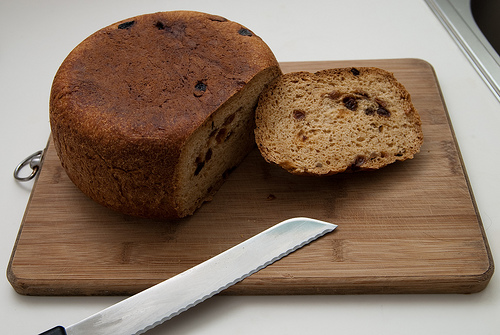
Yes, a loaf of bread can be baked in a rice cooker
So you need to make a cake or bake some bread, but you don’t have a full-size oven. How about using a roaster or a rice cooker instead?
It can be done. And while they may not be your top choices, in some countries, these small appliances may be your best options.
We used a roaster similar to this one while we were in Taipei.
The Roaster Oven In Taiwan, most meals are built around things cooked on top of a burner, rather than in the belly of an oven: There aren’t too many nationals cooking a pot roast or broiling steaks. The Taiwanese aren’t big on sweets, like us Americans, so there’s not a lot of cookie and pie baking either. With great bakeries scattered throughout most cities, there’s little need to whip up a cake on your own. And besides all that, the typical Taiwanese kitchen is pretty small, without room for any “extra” appliances.
Before we moved to Taiwan, we considered our options: Bringing over a Western-style range-oven combo and finding a place for it on a balcony of an apartment that we hadn’t found yet would have been troublesome. Besides that, the oven we had at the time wasn’t worth shipping over. Buying a used oven from another expat family who was leaving would have been unpredictable. And buying a new oven there would have been expensive. In the end, we decided on the roaster-oven option.
Turns out, it worked pretty well. In fact, my wife used ours nearly every day for four years—until it wore out and quit heating up. She used it for cakes, cheesecakes, cookies, pies, dinner rolls, casseroles, and, of course, several types of meat. Probably the trickiest project was an angel food cake, but she met even that challenge. (As I recall, the hardest part wasn’t the baking. It was finding something to invert the pan on, since we didn’t have any glass soda bottles.)
Mostly through trial and error, here are some things that she learned:
You’ll probably have to leave your food in the roaster longer than the recipe calls for. And lifting the lid to check on your progress releases a lot of heat and adds more time.
A small metal rack, or something else that lifts up the baking/cooking pan, will keep foods from burning on the bottom. If you don’t have a rack, you can use an upside-down cake pan.
If you can find a rack with legs, you can cook on two levels, with a pan above and one below.
It can be difficult to get large pans into and out of the roaster. There’s not a lot of wiggle room, so be extra careful not to burn your hands.
After our roaster gave out, some generous friends bought us a countertop convection oven. We brought it back from the States with our checked baggage, and it worked great for the rest of our time in Taipei. It wasn’t long before we saw a similar oven for sale in a shop near our neighborhood, so if we were to go back to Asia again, we’d probably plan on locating one there.
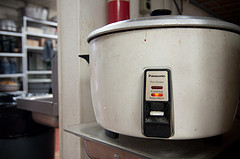
The Rice Cooker But what if a roaster oven is out of the question? What if your kitchen countertop space is all full? Or what if you don’t even have a kitchen? Don’t despair. A rice cooker can save the day. And if you’re in Asia, you certainly won’t have any trouble finding one to buy.
If you’d like to find recipes and how-to’s for baking with a rice cooker, just do a search on the Internet. You’ll see that it’s not a problem, as the even the simplest model can bake cakes, cheesecakes, and breads.
I’ve never baked with one myself, but here’s some bits of advice I’ve gathered from the sites I looked at:
Most recipes will work in a rice cooker without being modified, but you may need to cut back on the size. Cakes won’t cook evenly if they are too deep, and breads will work best if they’re no more than a few inches thick.
Bread will need to be flipped over several times during the baking process so that it won’t burn underneath.
If it takes more than one cooking cycle to complete a recipe, then let the cooker cool down and start it again. Another option is to wedge something under the switch to prevent it from flipping to “warm.” Be careful with this second method. You’re bypassing the cooker’s automatic shutoff, so it can get too hot if left unattended, and it might shorten the life of your cooker.
When it comes to choosing a rice cooker, Roger Ebert suggests, “Nothing Fancy.”
Of course, one way to make things easier is to buy a modern rice cooker with a “bake” or “cake” setting. (I didn’t know those existed until I started writing this.) But if you’re old school in your rice-cooker preferences, you’ll go with a more traditional style.
Roger Ebert, the Pulitzer Prize-winning movie critic, was one such devotee of the simple elegance of the basic “Pot.” In fact he was such a fan that he wrote a book dedicated to its multiple uses: The Pot and How to Use It: The Mystery and Romance of the Rice Cooker. In it he advises,
Have nothing to do with anything “Micom Programmable.” Nothing to do with words like “Neuro Fuzzy.” No dials or “settings.” Nothing fancy. You will only cost yourself money and mess things up. If a rice cooker comes with more than two pages of instructions, you’ve overspent. I am saving us money. What you want is your basic Pot with two speeds: Cook and Warm. Maybe it will say it in Japanese. You’ll figure it out.
Though Ebert doesn’t stray into the realm of baking, he does enthusiastically praise the rice cooker for its abilities in preparing such things as vegetables, stews, soups, sauces, and oatmeal.
And the Crockpot, Too
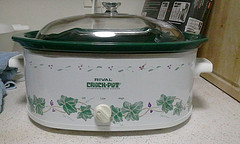
There are crockpots, and then there’s the Rival Crock-Pot®, “The Original Slow Cooker.”
I was about to finish up this post when I had a thought: I wonder if you can bake with a crockpot (slow cooker). Sure enough, you can do that, too.
I don’t have any experience with this—cooking or eating—but I can point you to a couple sites that give some details. The first one is from Better Homes and Gardens, entitled “Easy Slow Cooker Dessert Recipes.” There you’ll find directions on making cheesecake, pudding cake, brownies, and cobbler, along with the kind of almost-too-good-to-be-true photos you see in magazines like . . . well . . . Better Homes and Gardens.
The second is from Carroll Pellegrinelli at About.com—”Crockpot Baking: Making Breads and Desserts in the Slowcooker.” If you don’t have a slow cooker with a baking insert (again, who knew there was such a thing?), you can use a coffee can, paper towels, and aluminum foil. It’s not fast—it is a slow cooker—but, according to Pellegrinelli, it’s easy.
So . . . what else can you use a roaster oven, rice cooker, and crockpot for? Or what else can you use to bake a cake? Well, that’s up to you.
Experiment.
Try. Fail. Try again.
And remember these two important phrases: “Necessity is the mother of invention,” and “You don’t know how far you can go until you’ve gone too far.”
PS: It Ain’t Over Yet A friend, former coworker, and long-time missionary to Taiwan, Bev Skiles, commented below that she’s used a rice cooker for cakes and a crockpot for bread. Not only that, but she’s baked cakes in an electric skillet and in cookware on top of the stove. Want more info? Check out these two sites from eHow: “How Do I Bake Bread in an Electric Skillet?” and “How to Bake in an Electric Frying Pan.”
Thanks to Bev for her input. She’s been a great help to expats in Taiwan for many years, showing them how to adjust their Western recipes to Eastern kitchens and cupboards. She even helped helped put together a cookbook in 1981, “Tips ‘n’ Treats” on Taiwan. If I’d looked in my wife’s copy before I wrote this post, I would have seen several recipes for baking with a rice cooker. I should have consulted her as an expert.
(Roger Ebert, The Pot and How to Use It: The Mystery and Romance of the Rice Cooker, Kansas City, MO: Andrews McMeel, 2010)
I recently received an email from a friend, Sherrie Russell. She and her husband, Glen, have been missionaries in Panama since 1997, working with an indigenous tribe there. They have also served in Puerto Rico (10 years) and have ministered to international students at the University of Missouri-Columbia (6 years).
Sherrie was responding to an email from me, updating her on our transition back to the States. Looking for full-time work over the last two years has been a disappointing process for us, and she and Glen understand, as they were in a similar place when they came back from Puerto Rico. I can’t say the same for myself back then. I was one of those she is talking about when she says, “No one had a clue about what we were going through.”
Sherrie’s openness and honesty is an encouragement to my wife and me. I am grateful to her for letting me post some of her letter here:
I remember so well coming back from Puerto Rico and moving to Columbia and working with Latins at the campus ministry, how I had to take a job at McDonald’s and Glen had to drive a school bus while trying to reacclimate and keep it all together, and trying to understand “why” God didn’t supply what we needed to stay in Puerto Rico, in a work we loved (although it was hard and slow), with a people we wanted to see come to Christ, and in a place that was home.
I’ll never forget feeling so alone among so many kind people after we moved and began to know all of you. . . . It was like no one had any clue about what we were going through (not your fault and we knew that at the time)!
And eventually, when we did decide to go to the Dominican Republic and started trying to raise support . . . I’ll never forget a conversation I had with a friend at DQ. We were there talking, and I was expressing my doubt about raising support (I mean, we couldn’t even raise a little more to stay in Puerto Rico) to her and she said something like, “You know the Lord will provide if it’s His will.” Of course she was just trying to encourage me . . . but out of my mouth and heart came this response, “He didn’t!” And as soon as I said it, I realized how wrong I was! I was so shocked that I felt that way and knew I had to remember that He does provide . . . but it was a very difficult time for us!
Even thought the Russells had made plans to move to the Dominican Republic, Sherrie says, “God took us to Panama instead.” About their six years in the States, she adds, “We began to learn how to wait on the Lord in Columbia, but it’s one of the hardest lessons in my opinion!”
And living abroad, too, hasn’t been easy for Sherrie. In 2007 she contracted mononucleosis and has suffered from bouts of severe exhaustion since then.
I haven’t been able to go to church or Bible studies this week because of my health situation. It’s been six years now, but I know God is faithful, and He is teaching me so much that I couldn’t have learned any other way. One thing is that I’ve become so much more content! Being able to cook sometimes in the morning to help Glen prepare some of the dinner for that day makes me so happy and thankful!!
One morning I posted on my wall on Facebook that I was listening to Andrea Boccelli and making spaghetti sauce with fresh basil and loving it! A friend from Columbia whose child I taught at the preschool where I worked wrote that I was easy to please! I thought about that, and I have become easy to please, and that’s good!
My wife and I enjoy Bocelli’s music, and while we were in Taiwan we bought our first Bocelli CD. Sherrie’s letter got me to look him up on YouTube, and I came across a video for his “Canto Della Terra” (“Song of the Earth”). If Steve McCurry made music videos, they might look like this.
Thanks to my daughter for showing me “It’s Not about the Nail.”
Point taken (all puns intended). It can be frustrating when someone—like a wife—won’t listen to common sense, ignoring a problem that’s as obvious as the nose on her face. She just wants someone to listen. No advice allowed.
Funny stuff. I feel this guy’s pain.
But wait a minute. Don’t I like to talk about the need for people to be heard, without having someone trying to fix everything? What about herpain? What gives?
Here’s what I’ve decided: Sometimes it is about the nail, but that doesn’t mean we should stop listening. Yes, some people, like this woman, won’t listen to reason. They don’t want to hear the truth or take responsibility, and they need to hear the truth clearly.
But much of the time, our friends on the couch know the problem well and already have the solutions. Maybe they’re in the middle of fixing it but it’s taking time . . . or the fixes aren’t as quick as they should be . . . or the most obvious solutions would do more harm than good (anybody got a claw hammer?) . . . or there are other issues that make things more complicated. And in those cases, the person with the nail doesn’t need to be pummeled with advice, they need someone to hear about their hurts and fears.
There are a lot of people in the world who don’t want to listen to the truths that will solve their problems, but there are also a lot of people who don’t want to listen to the problems of others, so they use easy answers to try to make their own discomfort go away.
I know, I know. It’s just a comedy skit, and I shouldn’t try to make too much out of it. But I wanted to post the video, and I just couldn’t do that without tacking on my thoughts.
Oh, and one more thing. The writer and director for “It’s Not about the Nail” (he’s the male actor, too) is Jason Headley. Here’s another one of his videos. It’s called “A Little French.” (This will be the last of my comments about learning French for a while.) It doesn’t have millions of views like the one above, but it’s just as funny.
How can you not appreciate the thought process of a guy who can say, “I don’t want to learn French, I want to speak French”? If only. . . .
Man, I really should have studied French harder in college.
That’s how I ended my last post. Actually, I did study hard, got good grades in my three French classes, and was only three hours short of getting a French minor.
The reason I didn’t get the minor was that when I showed up for the first class of The History of the French Language, a 3-hour class taught in English, I realized I was in over my head. It was in the fall, after a summer full of not speaking French, and the girl in front of me asked Professor Honeycutt if he would teach the class in French. She asked this in French, and the girl next to her nodded in agreement. The teacher said he couldn’t do that, but I dropped the class the next day anyway.
It was one of the best decisions of my college career. I’m so glad that today I don’t have to tell people that I have a French minor but about the only thing I can still say is “I speak a little French.”
The problem wasn’t that I didn’t study hard enough. The problem was I didn’t need to use it outside of class. And inside of class, what I said didn’t matter as much as how I said it. You know what I mean: If your teacher asks you to tell about your pet, and you have a dog, but you’ve forgotten the word for dog, but you remember the word for cat, suddenly you have a cat. The professor isn’t asking you because he’s concerned about the animals in your life, he simply wants to see if you can put sentences together.
It’s not a silver bullet, but putting yourself in a place where you need to use a language in a meaningful way is key to learning a language. That’s one of the foundations of Education First, named the official supplier of language programs for the 2014 Winter Olympics in Sochi. EF was founded in 1965 by Bertil Hult in Sweden, “on the principle that cultural immersion was a superior way to study a language.”
Below are five EF commercials about people learning a language where it’s spoken. Granted, they glamorize the whole expat experience, but they are commercials, not documentaries.
I just wish that I could become fluent by watching cool videos about cool people living in cool places—and not have to worry about conjugating verbs.
The commercials are called “Live the Language.”
(By the way, who knew that speaking Australian and Canadian was so easy? Almost as easy as what they speak over in England).
I can’t speak French, but I like the way it sounds.
And I don’t know much about the French public TV channel France 5, but I like their video logos.
Last year, the branding agency Les Télécréateurs, helped rebrand the channel and came up with a series of 25 “idents” to show between programs. Les Télécréateurs, on their Vimeo site, writes,
The concept is as simple as it is strong; a multitude of things that move in the same direction, one following the other, like a chain reaction between completely different worlds. Its underlying meaning is stated loud and clear: knowledge derives from making new links.
The idents become a voyage in which the viewer experiences the ever changing world. Each shot is just long enough for you to grasp what you’re watching, but not too long that it bores you. It also instills in you the feeling of wanting more. Everything travels from left to right but sometimes a thing can reach the apex of its trajectory and start moving in the opposite direction.
And Alphabetical Order®, who directed the spots, says,
[T]his is of course about moving forward, striving, exploring, fighting, longing, pushing the limits and developing. It symbolizes what makes humanity prosper, what fascinates us in life.
Here’s a “Branding Montage” of idents paired with announcements for some of their programming. I can understand some of the words and can make out several of the locations (the pictures help). But, man, I really should have studied French harder in college.
In an increasingly globalized world, there are several ways to use multi-cultural experiences to help your children get a leg up as they move toward adulthood and future careers. Here are four of them.
None are easy, but the first may be the most difficult.
1. Be an Immigrant to the US
Sociologists at Johns Hopkins University, Lingxin Hao and Han S. Woo, found that children of immigrants in America achieve more academically and have better transitions into adulthood than their peers with native-born parents. The advantage is highest for foreign-born children whose parents move to the States, followed closely by American-born children of immigrants. Hao and Woo’s findings appear in the September/October 2012 issue of Child Development (“Distinct Trajectories in the Transition to Adulthood: Are Children of Immigrants Advantaged?“)
Explaining the difference,
Hao suggests that there is a greater sense of community among immigrants out of necessity—newcomers often need a lot of assistance when they first arrive in the United States. But Hao, who is from China, thinks there is also a great deal of inspiration to be found among the immigrant community: Parents might be working multiple low-level jobs and encourage their children to seek a better life for themselves. The success stories of immigrants who have “made it” are also held up as role models for immigrant children, something other native-born groups might be lacking, Hao said.
This one might go under the category of cultural lessons on what not to do.
Regardless of what Amy Chua writes in her book Battle Hymn of the Tiger Mother, “Chinese-style” tiger parenting is not the best model for raising children. This is according to researchers Su Yeong Kim, Yijie Wang, Diana Orozco-Lapray, Yishan Shen, and Mohammed Murtuza. They compared the developmental outcomes of children from 444 Chinese-American families in northern California, using eight parenting dimensions—”parental warmth,” “democratic parenting,” “parental monitoring,” “inductive reasoning,” “parental hostility,” “psychological control,” “punitive parenting,” and “shaming”—to categorize four parenting styles. In order, from the style that produces the best developmental outcomes to the least, they are “supporting,” “easygoing,” “tiger,” and “harsh.”
Compared with the supportive parenting profile, a tiger parenting profile was associated with lower GPA and educational attainment, as well as less of a sense of family obligation; it was also associated with more academic pressure, more depressive symptoms, and a greater sense of alienation. The current study suggests that, contrary to the common perception, tiger parenting is not the most typical parenting profile in Chinese American families, nor does it lead to optimal adjustment among Chinese American adolescents.
3. Make sure your children learn a foreign language
Bronwyn Fryer, a senior editor at the Harvard Business Review, trumpets the need for “soft skills,” things like “emotional intelligence,” “listening,” and “authenticity,” for global leaders. But, he writes, the top soft skill for executives in global organizations is “sensitivity to culture,” also known as “cultural empathy.” According to Frye,
True cultural empathy springs from personality, early nurturing, curiosity, and appreciation of diversity. But, very importantly, it also springs from deep exposure to more than one language. And this is where American executives fall short.
Learning another language, he says, not only helps in communication, but opens up one’s thinking:
As anyone who has ever learned to speak a foreign language fluently notices how each language shifts one’s consciousness. One day, you wake up and you realize you have been dreaming in the new language. Eventually you realize you are thinking in that language. And when you shift back and forth between, say, your native tongue and the acquired language, you feel like you are driving a car with a stick-shift; you are more involved and engaged in the experience. You take in more; you hear more. And you literally feel different; you are “more than yourself.”
4. Encourage your children to add overseas work experience to their educations
This one comes a little later in their lives, but they’re always your kids, right?
In 2010, Susan Adams, of Forbes, gathered the views of several hiring experts on the value of work experience overseas. She writes that foreign postings, including the Peace Corps, internships, and other types of jobs, give an advantage to people looking for work. One of the reasons is that living and working overseas exposes people to differing leadership styles.
And some who move overseas find opportunities for long-term employment there. Adams talked with Mary Anne Walsh, a global-leaders coach based in New York, and learned that Walsh’s clients “who moved overseas shortly after college and graduate school . . . advanced much more quickly than if they had tried to climb the career ladder in the U.S.”
Others had this to say:
Dan Black, Americas director of recruiting for Ernst & Young—
We definitely see overseas experience as an advantage. Our clients are demanding more of us these days. They want diversity of thought and diversity of values, and many of our clients are multinationals.
Gary Baker, U.S. global mobility leader for PricewaterhouseCoopers—
[Being part of a minority group in another country] gives you a greater respect for other cultures, and you learn to be better at managing teams that are diverse.
Not only does working overseas build character, writes Adams, but being successful in a foreign country also increases one’s confidence. “If you can make your way in Mexico City, Abuja or Sao Paulo, then traditional U.S. organizational issues will be a snap for you.”
It’s been more than a year since I put together my list of online, English-language, international (read, with other than just US destinations) in-flight magazines.
Not long ago, I found 27 more and have added their links to the post. That brings the total to 91.
 It’s been over two years since we moved back to the US, and we’ve finally relieved our friends/forwarding agents of the things that we’ve had stored in their basement. Inside the boxes and Rubbermaid containers were several items that I’d forgotten about. But there were others that I knew we had—I just couldn’t figure out where they were.