Sprechen Sie Facebook? “Cyber Seniors” Learn a New Language

They are people worlds apart, speaking different languages, living out cultures foreign to each other, coming together in an unlikely place—in the assisted-living center across town.

Cyber Seniors is the story of teenagers who introduce a group of senior citizens to the internet: to YouTube, Skype, and that “Face something,” you know, the one with the friends.

In her new documentary, Canadian director Saffron Cassaday presents a great picture of learning, communicating, expanding horizons—and culture shock. It’s what crossing cultures is all about.

It’s so much fun to watch, and it’s got to be a lot of fun to join in.

How’s this for cross-cultural communication? It’s hard to ask questions when you’re not bilingual.

And here we see that you really are never too old—or too young—to learn a thing or two. Hallelujah!

These clips leave me with the question, When the two groups go “home,” what does reverse culture shock look like?

Death by Envelope, and Other Tragic Postal Tales

8029186137_cf6ca85955_zI was wanting to mail a letter to our friends back in the US, but I had a problem. I had just been to the front counter at the post office and told the postal worker my plans. She pointed over my shoulder and said something about “over there.” I turned around, trying to act as if I knew what she’d said. (I’d only been in Taipei a few weeks, and the only thing I understood clearly was her pointing.)

Behind me, against the wall, was a table with a couple bowls of what looked like wall-paper paste, with a small brush in each one. They were for sealing envelopes, since the envelope flaps in Taiwan—and I assume, most of Asia—don’t have adhesive on them. I’ve been told this is because in the high humidity, the envelopes would glue themselves shut while waiting to be used. That explanation sounds perfectly plausible to me.

Behind the paste were two slots in the table. Each had a sign with a few Chinese characters on it. I went to the table and pretended to sort my mail for a while, pondering what I should do. What did the signs say? “Local Mail”? “Air Mail”? But the only time I’d ever seen slots like those were in the tables at the bank where you can fill out deposit slips—you know, the slots for throwing away your trash. So maybe the signs said, “Place Wastepaper Here,” and “Not for Mail.”

Beside the table was the door. Maybe the postal worker had pointed outside—to some mailboxes I hadn’t seen.

I made my decision, tossing my letter into one of the slots. I didn’t look back. I didn’t want to see the lady at the counter shaking her head at me. Instead, I hurried home and emailed our friends: “Let me know if you get a letter from us. Either I mailed one to you or just threw it away.”

A week later, they wrote back and said it had arrived. Sometimes, in spite of myself, I got things right.

It took me quite a while to get over my nervousness going to the post office. For expats, it can be a pretty scary place—in large part because there’s so much at stake. You’re often sending important documents or valuable parcels (like hand-drawn pictures to Grandma and Grandpa). And once you stick on the postage and drop them in the mailbox, there’s no do over.

Lick at Your Own Risk

Not long ago, here in the safety of the US, I was helping a friend from Asia prepare some papers for mailing. I handed him the envelope, and seeing that there wasn’t any paste available, he tried to peel the backing off the self-stick flap. The trouble was, the flap wasn’t peel-and-seal. When he realized he needed to lick it, he laughed and said he’d heard about people putting poison on the adhesive. I told him that’s never happened, because . . . uh . . . that’s never happened . . . right?

Well, I did some research, and I’m sticking by my assertion, but it seems that my friend is more up on American pop-culture than I am. How about you?

First, there’s this cautionary tale that began circulating by email in 1999:

Whenever you go to an automatic teller machine to make deposits, make sure you don’t lick the deposit envelopes. A customer died after licking an envelope at a teller machine at Yonge & Eglinton. According to the police, Dr. Elliot at the Women’s college hospital found traces of cyanide in the lady’s mouth and digestive system and police traced the fatal poison to the glue on the envelope she deposited that day. They then did an inspection of other envelopes from other teller machines in the area and found six more. The glue is described as colourless and odourless. They suspect some sickco is targeting this particular bank and has been putting the envelopes beside machines at different locations. A spokesperson from the bank said their hands are tied unless they take away the deposit function from all machines. So watch out, and please forward this message to the people you care about . . . Thanks

Completely false, says the urban-legend site Snopes.com. But when has that ever stopped an internet fable from gaining traction?

Snopes also tackled another email that made its debut in 2000. It’s about poor lady number two falling victim to the dangers of envelope glue:

This lady was working in a post office in California, one day she licked the envelopes and postage stamps instead of using a sponge.

That very day the lady cut her tongue on the envelope. A week later, she noticed an abnormal swelling of her tongue. She went to the doctor, and they found nothing wrong. Her tongue was not sore or anything. A couple of days later, her tongue started to swell more, and it began to get really sore, so sore, that she could not eat. She went back to the hospital, and demanded something be done. The doctor, took an x-ray of her tongue, and noticed a lump. He prepared her for minor surgery.

When the doctor cut her tongue open, a live roach crawled out. There were roach eggs on the seal of the envelope. The egg was able to hatch inside of her tongue, because of her saliva. It was warm and moist. . . .

This is a true story. . . . Pass it on.

Actually not true, but extra points for the graphic detail.

The Website TV Tropes reports that over the years, the poison-envelope theme has occurred in several TV crime shows. But the most famous example was part of the comedy Seinfeld, when George’s fiancée died after licking the toxic adhesive on some 200 cheap wedding invitations.

So no wonder my friend didn’t want to lick the envelope. Oh, sure, I could tell him his fears are based on urban legends, ridiculous story lines, and misguided fear. I could tell him that expats are especially susceptible to rumors and fantastic stories. But still . . . there was Mr. Fechheimer, mentioned in the 1895 New York Times:

S. Fechheimer, formerly a merchant of New-York, died here yesterday from blood poisoning as a result of cutting his tongue while licking an envelope. He was a rich man until a few years ago, when the panic came and brought ruin. He was the senior member of the firm of Fechheimer, Rau & Co., New-York shirt manufacturers.

So please be careful. And the next time you have to mail a letter, you might want to use a sponge.

(Barbara Mikkelson, “Dial ATM for Murder,” Snopes.com, September 2, 2006; Barbara Mikkelson, “Cockroach Eggs,” Snopes.com, January 22, 2014; “Finger-Licking Poison,” TV Tropes; “Poisoned by Licking an Envelope,” The New York Times, May 4, 1895)

[illustration: “Lick the Envelope,” by Rick & Brenda Beerhorst, used under a Creative Commons license]
11 Ways Moving Abroad Is like Skiing to the North Pole

34961051_5302f8458a
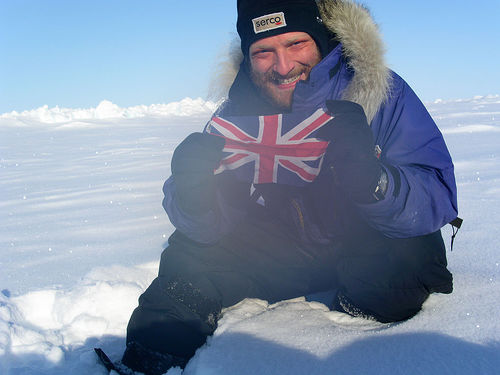
Ben Saunders sits on top of the world, the youngest person to reach the North Pole alone and by foot.

In 2004, 26-year-old Briton Ben Saunders became only the third person, and the youngest ever, to ski unaccompanied to the North Pole. As it turns out, there are a lot of ways that making a solo trek to the North Pole is a like moving to another country. Here are 11 things that the two adventures have in common, all taken from Saunder’s February 2005 TED Talk, “Why Did I Ski to the North Pole?”

  1. Luggage is a drag
    Saunders describes his specialty as “dragging heavy things around cold places.” He says, for his trip to the North Pole, “I was dragging all the food I needed, the supplies, the equipment, sleeping bag, one change of underwear—everything I needed for nearly three months.” That sounds like trying to put every necessary item in your carry-on bag, just in case your checked luggage gets lost. (If you think your bags are heavy, Saunder’s supply of food and fuel weighed 400 pounds.) Sometimes your destination has harsh conditions. And sometimes it doesn’t have chocolate chips. How many bags of those should you bring? Can’t be too prepared.
  2. It can be lonely out there
    One of the challenges of Saunder’s voyage was that he had to make it alone. Very alone. When he arrived at the northern-most point on the globe, he was the only “human being in an area one-and-a-half times the size of America, five-and-a-half thousand square miles.” Most of us don’t go to such remote places, but even if you’re in the biggest city, surrounded by millions of other souls, you can easily feel all by yourself.
  3. No, Virginia, there isn’t a Santa Claus
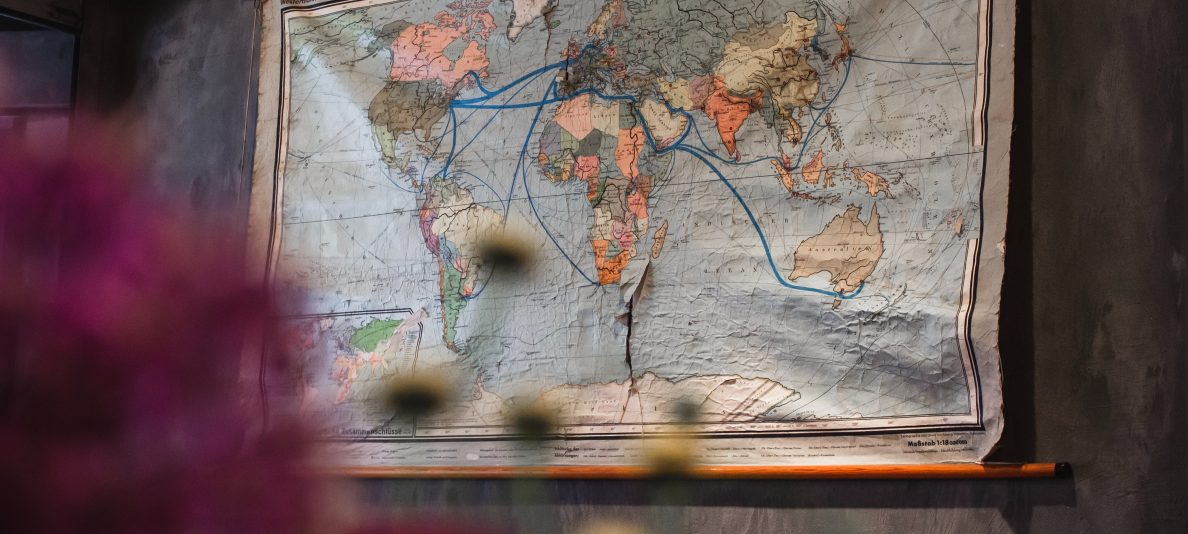
    When Saunders got to the top of the world, he didn’t find Santa. No Santa’s workshop. No elves. In fact, he says, “There isn’t even a pole at the Pole. There’s nothing there, purely because it’s sea ice.” When you go to another country, expect the unexpected. Don’t be surprised when what you find doesn’t match the photos in the magazine article. “I’d read lots of books,” says Saunders. “I studied maps and charts. But I realized on the morning of day one that I had no idea exactly what I’d let myself in for.” Photoshopped and cropped pics don’t do us any favors. If GPS and street signs say we’re in the right place, don’t waste time—or emotions—trying to find something that doesn’t exist.
  4. Sometimes it’s one step forward, two steps back
    According to NASA, during the year of Saunders journey, the ice conditions were the worst on record. Ninety percent of the time he was skiing into headwinds and the drifting ice pulled him backwards. “My record,” he says, “was minus 2.5 miles. I got up in the morning, took the tent down, skied north for seven-and-a-half hours, put the tent up, and I was two and a half miles further back than when I’d started. I literally couldn’t keep up with the drift of the ice.” When you’re in a new place, learning the language and culture, get used to those backward drifts. But always keep your compass set on your true north.
  5. The only constant is change
    Because the ice is constantly drifting over the North Pole, Saunders says that if he’d planted a flag there, it wouldn’t be long before it would be heading toward Canada or Greenland. Like Saunders, don’t be surprised when the emotional flags you plant aren’t permanent. The ground may not move under your feet (earthquakes not withstanding), but other kinds of landscapes certainly will. Find a special restaurant that serves your favorite dishes? Wake up the next day and it’s become a plumber’s shop. Make friends with some other expats? You may soon have to say goodbye. But, repeat after me, “Change can be good. Change can be good. Change can be good.” Maybe, just maybe, that plumber’s shop will end up being exactly what you need.
  6. Culture stress can be a bear
    Literally. On his first try at the North Pole, Saunders went with a partner, but they failed to reach their goal. Saunders says that from the outset “almost everything that could have gone wrong did go wrong. We were attacked by a polar bear on day two. I had frostbite in my left big toe. We started running very low on food. We were both pretty hungry, losing lots of weight.” Yup. Sounds like culture stress to me.
  7. Coming back can feel like the bear wins
    When his first attempt fell short, Saunders says he “was physically exhausted, mentally an absolute wreck, considered myself a failure, in a huge amount of debt personally to this expedition, and lying on my mum’s sofa, day in day out, watching daytime TV.” His brother texted him an encouraging quotation from Homer Simpson:
    “You tried your hardest and failed miserably. The lesson is: don’t even try.” Repatriation can feel that way. Maybe all the people who’d said you shouldn’t go were right. But Saunders didn’t let his failure define him. Instead, three years later he made history.
  8. People aren’t sitting around waiting to hear your stories
    When Saunders reached the North Pole, he got out his satellite phone. After warming up the battery in his armpit, he made three calls: “I dialed my mum. I dialed my girlfriend. I dialed the CEO of my sponsor. And I got three voicemails.” OK, that’s unfair to say they didn’t want to hear what he’d done. They were just busy at the time, that’s all. But . . .
  9. Some people really do want to listen
    “I finally got through to my mum,” says Saunders. “She was at the queue of the supermarket. She started crying. She asked me to call her back.” There are special people who will make time to listen—when they can focus on your story without distractions. Thanks, Mum.
  10. Don’t let others draw boundaries on your map
    When Saunders was 13, he got a school report that said, “Ben lacks sufficient impetus to achieve anything worthwhile.” Saunder’s response—”I think if I’ve learned anything, it’s this: that no one else is the authority on your potential. You’re the only person that decides how far you go and what you’re capable of.”
  11.  One of the three most important questions will always be “Where is the bathroom?”
    Saunders gave his TED Talk to answer three questions:
    (1 ) Why?
    (2) How do you go to the loo at minus 40?
    (3) What’s next?
    That second question is very important at the North Pole, because it seems that “at minus 40, exposed skin becomes frostbitten in less than a minute.” Your question number two will be more like “Where’s the bathroom?” or just “Bathroom? Bathroom?” Then, once you see the facilities, you may ask yourself, “How?”

As for the answers to those question, in short, Saunder’s responses go something like this:

(1) “For me,” says Saunders, “this is about exploring human limits, about exploring the limits of physiology, of psychology, and of technology. They’re the things that excite me. And it’s also about potential, on a personal level. This, for me, is a chance to explore the limits—really push the limits of my own potential, see how far they stretch.”
(2) That’s a trade secret, no answer here.
(3) Antarctica. Saunders and Tarka L’Herpiniere are currently on the first leg of their trek from the coast of Antarctica to the South Pole and back again—1,800 miles in all—unsupported and on foot. You can follow Saunder’s daily blog posts here. Why the South Pole? See answer number one above.

Somebody’s got a severe case of wanderlust.

[photo: “North Pole (3),” by Ben Saunders, used under a Creative Commons license]
Hyper Realism: A Russian Farmer Lands an Esquire Cover and a Trip to New York

9168908261_6e344e2bb4_n
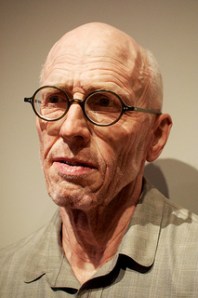
Evan Penny’s Old Self, Variation #2, an example of hyper-realistic art

Ever since, as a child, I saw Duane Hanson’s lifelike sculpture Janitor at the Milwaukee Art Museum, I’ve loved hyper-realistic art. Then last month, when I visited Crystal Bridges Museum of Modern Art, in Bentonville, Arkansas, I was surprised to see another Hanson work, Man on a Bench. (I really was surprised, since it looked for all the world like a museum visitor taking a break from his tour.) And in a room close by, there was an oversized bust by Evan Penny, Old Self, Variation #2. Unlike with Hanson’s pieces, no one will mistake Old Self for an actual person—it’s only a head with shoulders, and it’s way too big. But still, it just looks so real.

Martin Schoeller is another artist in the same vein, except he doesn’t exactly create hyper realism, he captures it—with a camera. Born in Germany, but now based out of New York, Schoeller is best known for his “hyper-detailed” large-scale portraits of celebrities, which have appeared in magazines such as GQ, The New Yorker, and Entertainment Weekly.

But his photographic subjects also include common people, like you and me. In fact, if you’d like to see what you’d look like in a Schoeller portrait, next time you’re in Bed Bath & Beyond, do like I did and take a look at yourself in the 10x-magnification of the Zadro Dimmable Florescent Dual-Sided Mirror. (That’s hyper realism.)

Schoeller recently took a cover photo for Esquire Russia of Vasiliy Ilyn, a retired farmer from Russia, who’s featured in this month’s magazine. Ilyn is one of Schoeller’s non-celebrity subjects, as the September Esquire is devoted to the rules that govern the lives of ordinary Russians.

For three days, Ilyn was something more than ordinary, as he was flown to New York for the photo shoot. His encounter with the city is chronicled in the 20-minute film Vasily, from Stereotactic. (Thanks to Carla Williams for telling me about the video.)

The film shows Ilyn’s first trip outside the Kursk region of Russia, his first time to see the ocean, and, of course, his first visit to America. As he looks around New York, he’s a fish out of water, but he’s an ordinary fish. And I’m not sure that his reactions are much different from those many retired farmers in the flyover portions of the US would have.

Ilyn narrates the documentary, and he has a lot to say about Russia, the US, and life in general. He thinks of himself as a joker, but much of what he says shows a solemn acceptance of the way things are. He’s pretty straightforward and plain spoken. At one point, while talking about his disdain for past Russian leaders, Ilyn drops an F-bomb. Actually, it’s more of an F-hand grenade since we read it in the subtitles.

When he gets back to his home, he tells a woman about the 80,000 Russians who live in New York. “I wish a flood would come and they would die,” she says. “Let the locals survive, but these traitors should die.”

Ilyn replies, “They were just looking for a better life. . . . Let them go.”

Shoeller’s type of hyper-realism doesn’t come from a lack of preparation and artistic manipulation. The lighting and focus has to be just right, and there’s a lot of time spent on Ilyn’s makeup. But the result is striking for its unglamorized detail.

That’s the way the documentary looks to me, too. I can tell a lot of work went into the making of Vasily, but it’s that work—the shot selection, the editing, the scoring of the music—that makes it feel more real . . . much more real than what usually passes for “reality” on TV today.

(“Russian Farmer Lands in Esquire and NYC,” Voices of NY, October 15, 2013)

[photo: Old Self, Variation #2” by Nils Gore, used under a Creative Commons license]

I Love You, I Hate You: “Girl, Adopted”

After writing about some documentaries on adoption that used to be, but are no longer, available for online viewing, I finally went to the PBS site and found one that is still up—but not for long. If you want to see Girl, Adopted, you’ll have to watch it before the end of this month.

girl_adopted-01-thumb-large
Weynsht with her adoptive parents before their flight to the States

Documentaries are at their best when the filmmakers step out of the way and just let the subjects of the films speak for themselves. That seems to be what happens in Girl, Adopted. It presents the story of Weynsht (pronounced win-shet), who, at the age of 13, is adopted from an orphanage in Ethiopia by a family from Pyatt, Arkansas. The ups and downs don’t come in the adoption process itself—with the finalization providing the climax. Instead, the adoption is the beginning of the story, with the relationship between Weynsht and her new parents supplying the joys and frustrations.

Near the beginning of the film, Melanie, the adoptive mother, says, “We feel like everything happens for a reason and in perfect timing, and I think that we were meant for her and she was meant for us.”

After living in Arkansas for some time, Weynsht shares her own view. “Things happen for a reason sometimes,” she says, “and I still just waiting for a reason.”

Throughout the film, covering five years, Weynsht voices competing emotions concerning America, her parents, and her own identity. And, as young people often do, she talks a lot about love and hate.

Soon after her arrival in the States, she voices her love for Usher, her mother, a Barbie doll, and Wal-Mart.

Later, she says to her white girl friends, “I love you hair.” And when she talks about her desire to find another family, she tells her parents, “I never say, ‘I love you, too,’ because I hate you.”

After more time has passed, Weynsht says, “I really like being Ethiopian person, but I hate being black,” and, “I hate my hair.”

girl_adopted-02-thumb-large
Weynsht on her visit back to Ethiopia

When her father takes Weynsht and her sisters to Ethiopia to visit her orphanage, she finds out that she has an older brother, and her confusion deepens: “I don’t care. I do care, actually, but . . . ,” she says. “I’m just . . . so many things in my head.”

Her mixed emotions turn to anger when she thinks that her father is forcing her to meet her brother. And then she’s afraid: “If I met my brother, why would I want you guys? What makes you think I need somebody else? If I have a brother, I’m wanna stay with my brother.” Then she adds, “And I don’t want that ’cause I love you guys, and just stop.”

Girl, Adopted is certainly not a simple advocacy piece for adoption. In fact, while Weynsht’s father, Chris, concludes that adoption is “worth it, even if it’s hard,” he also says,

At one point, I thought that everyone should adopt a child. It’s something that everybody can do. All they’d have to do is just open up their homes and their hearts and let a kid in, but I don’t really hold those same views today. I don’t think that everybody should do it. You have an idealistic view of adoption, and then as you go along, the details of that view are filled in.

Chris, Melanie, and Weynsht are brave to have let the cameras follow their lives for five years. I’m glad they did, because the result is a compelling work that helps the rest of us fill in a multitude of powerful details.

Produced and directed by Melanie Judd and Susan Motamed, Girl, Adopted (2013) is part of the Global Voices series from Independent Television Service (ITVS) and the WORLD channel. The 78-minute video is available for online viewing until October 30. It can also be purchased on DVD.

[photos courtesy of ITVS]

One Missionary’s Emotions . . . Honest, Unedited, and Unsanitized

I’ve been following Under the Big Topp for a while now. It’s from a missionary and mom who is committed to honestly blogging about what she calls her “very unremarkable journey in God’s remarkable mission.”

6032654897_d5d7b008cc_nI appreciate her willingness to let us hear her deep thoughts and feelings, and that is what she does in a recent post, “a secret reluctance of faith.” It’s a look back to the time this past May after her 16-month-old son (whom she calls Roo) pulled a cup of boiling water onto himself, giving him second- and third-degree burns over 25% of his body.

Her story tugs deeply at me, as it brings back memories of what happened to my own son while we were in Taiwan. When he was 14 months old, he grabbed a hot clothes iron, burning the palm of his hand. At first, the hospital staff thought it was not so serious, and we went home with his hand wrapped in bandages. But then he developed an infection and we found out that he had third-degree burns. That led to a hospital stay of over 40 days for him—and because in Taiwanese hospitals the family provides much of the day-to-day care, that meant that my wife spent more than 40 days there, as well. All of this led to several surgeries, skin grafts, and therapy sessions over the next two and a half years.

Mrs. BigTopp writes that her son was flown by air ambulance to a neighboring country for treatment. The surgeon there “predicted months of specialist care, a surgery or two and then more outpatient care. . . . But then suddenly, Roo was healed.”

She then shares what she wrote down the night before flying back to her host country, as she struggled with her emotions. As is often the case, the emotions surrounding trauma are confusing and seem to betray us. With the healing of her little boy came the reality that he would no longer need long-term care back home in Australia. But that also meant she would not be “rescued” from the difficulties she has faced as a missionary.

She apologizes for the “full on” nature of her words—unedited and, she says, unsanitized.

Man! I should just be happy. Happy that Roo is well and safe and healed, and I know I am happy…
….but I am not ready.
I scared again. Inwardly I’m screaming again.
I am hyperventilating and screaming.
I’m screaming, ‘No! No! No! Please God, please’
outwardly I’m quietly packing suitcases and booking flights.
We are going back.

I am so tired and scared and full of guilt and I’m hurting.

And then they flew back to the mission field.

Please go to her blog and read the full post here. What I have shared above is only a small, small taste of her story.

[photo: “Reisdagboek,” by Audringje, used under a Creative Commons license]

Comfort Food, Stress, and Life Expectancy

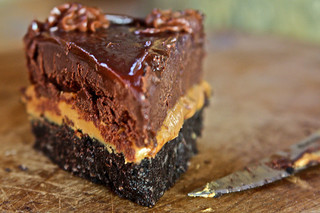
3966115371_47a4d1b1a5_nChocolate. Macaroni and cheese. Ice cream. Potato chips. Hot dogs. Chocolate.

When we feel down, we often turn to familiar foods, junk food, or other “guilty food pleasures” for comfort. The stresses of living in a new culture often provide the emotional downturn, and that, coupled with the fact that our usual feel-good foods are hard to come by, means that we want comfort food even more.

But comfort food, like many things that we enjoy, is a double-edged sword.

First, while we often look to food for a pick-me-up, a recent study suggests that typical comfort foods—which are often not the best health-wise—can actually make you feel worse. Researchers at Penn State University found that among women who are concerned about their body image but also have “high levels of unhealthy eating habits,” negative moods were “significantly higher” after what they called “disordered” eating.

Added to this, more research has found that mildly depressed people can have more difficulty discerning fatty tastes in food. A study, the results of which were published last week in the scientific journal PLOS ONE, used happy, sad, and neutral videos to alter the moods of participants. While those with mild (nonclinical) depression typically had normal perceptions of fat content in foods, after increased positive or negative moods, they lost that ability to discern between high-fat and low-fat foods. Thus, people seeking comfort from food are more susceptible to make unhealthy eating decisions.

But there may be a silver lining: Being somewhat overweight can improve your health. Of course, severe obesity is never good, but according to an NPR report, an analysis of literature by the Centers for Disease Control and Prevention found a 6% decrease in the risk of death for people who are slightly overweight (as measured by body mass index [BMI]). The findings, published in JAMA, have been met with skepticism by some in the medical community, but others find common ground.

As reported in a Worldcrunch article (translated from the German newspaper Süddeutsche Zeitung), since 1999, studies in several countries have shown that overweight people with BMIs of around 27 to 30 have higher life expectancies than their thinner counterparts. It is important to note, though, that the extra weight is helpful when it occurs in places like the arms, legs, hips, and bottom. When it’s around the waist, as in a “spare tire,” though, it does more harm than good.

The article also cites the work of Achim Peters, at Germany’s University of Lübeck, and Bruce McEwen, of Rockefeller University in New York, who have developed a theory called the “obesity paradox.” It states that being overweight is a healthy way to manage stress. That’s because Peters claims that the brain is “selfish,” requiring 50% of the body’s glucose when a person is not under stress. But when stress occurs, the brain wants 90% of the glucose. In an obese person, the glucose is tied up in building fatty deposits, which means the brain demands more energy, and the cycle continues. Thus, according to the theory, obesity is caused by, and is a healthy response to, chronic stress. That means that being skinny isn’t always the best thing. In fact, according to Peters, the worst category to be in is “thin and under pressure.”

If all this leaves you a little confused, and if that confusion has you feeling down, don’t despair.

I’ve already mentioned my fondness for Arby’s and my desire to see them expand around the globe. So just relax and follow me over to Arby’s for a comforting meal of a roast beef sandwich (with horseradish sauce), curly fries, and a Dr. Pepper. After all, it is “Good Mood Food.”

(Matthew Swayne, “Unhealthy Eating Can Make a Bad Mood Worse,” Penn State University, March 15, 2013; Petra Platte et al., “Oral Perceptions of Fat and Taste Stimuli Are Modulated by Affect and Mood Induction,” PLOS ONE, June 5, 2013; Allison Aubrey, “Research: A Little Extra Fat May Help You Live Longer,” NPR, January 2, 2013; “‘Obesity Paradox’—More and More Studies Find the Overweight Live Longer,” Worldcrunch, November 8, 2012, translated from Christina BerndtDicke leben länger,” Süddeutsche Zeitung, November 3, 2012)

[photo: “Chocolate Peanut Butter Cake of Decadence,” by Nora Kuby, used under a Creative Commons license]


Paris: The City and the Syndrome

from Trey Ratcliff at www.stuckincustoms.com

Though I often looked for one, I finally had to admit that there could be no cure for Paris.

These are the opening words of Paula McClain’s novel, The Paris Wife. Told from the viewpoint of Ernest Hemingway’s first wife, Hadley, the book shares the story of the young couple as they dive into life in Jazz-Age Paris.

I’ve not read the book, but I’ve read the first page, on the back of the most recent issue of the travel magazine Afar (which, by the way, I purchased with frequent-flier miles). The page is part of an advertisement, displayed on a Kindle Paperwhite held by a tourist overlooking the iconic white and blue buildings of Santorini, Greece. The caption for the ad reads, “Perfect for Getaways.”

It seems that some Japanese travelers have the same view of Paris as Mrs. Hemingway: It’s a condition in need of a remedy.

Back in 2006, BBC published an oft-quoted story about a phenomenon called “Paris Syndrome.” According to the article, each year, a dozen or so Japanese tourists have a psychiatric breakdown of sorts upon visiting the French capital. First identified by Hiroaki Ota, a Japanese psychiatrist in France, the syndrome is brought about when the realities of Paris don’t match the visitors’ romanticized expectations. While some of the symptoms sound like culture shock, others, such as delusions and hallucinations, are more extreme.

While some deny the existence of an actual syndrome, BBC reports that the Japanese embassy in France has set us a 24-hour hotline to help deal with the situation.

Below is a short documentary from John Menick, Paris Syndrome (2010). It takes a more in-depth—and sometimes sceptical—look at the condition, including interviews with French psychiatric professionals. Besides Paris Syndrome, the video also touches on such topics as Stendhal Syndrome, psychiatric portraiture, and historical views of travel-related mental illnesses. It even looks at Mehran Karimi Nasseri, the inspiration for the movie The Terminal.

So . . . what is the cure for Paris? While some are searching for one, most see no need. The author Gertrude Stein, a friend of the Hemingways from their time in France, saw the City of Light as a place that nurtured her creativity. “America is my country,” she said, “and Paris is my hometown.”

(Paula McClain, The Paris Wife, New York: Ballantine, 2011; Caroline Wyatt, “‘Paris Syndrome’ Strikes Japanese,” BBC News, December 20, 2006)

[photo: “Another Summer Day in Paris,” by Trey Ratcliff at Stuck in Customs, used under a Creative Commons license]