Stealing Cookies and Borrowing Stories

3268761015_02dc6f9be6_z

I recently listened to a TEDx talk by Scott Geller, a psychology professor at Virginia Tech, entitled “The Psychology of Self-Motivation.” In it, he recites “The Cookie Thief,” a poem by Valerie Cox.

Wait a minute. Hadn’t I heard that a-stranger-stole-my-cookies-in-an-airport story before? In fact, several years ago, as I recalled, I had seen an actor on a late-night talk show telling how the thievery had happened to him . . . but maybe it had taken place in a train station. I was unclear on the details. I also couldn’t remember which show it was on, but I was pretty sure it was a British actor, since he called the cookies “biscuits.” It’s a funny story—with a great punch line—and I’ve retold it a few times. But is it true, or too good to be true? And regardless of its truthfulness, who can lay claim to its origin?

I did a little digging, and here’s what I found (with thanks to those who’ve dug before me). . . .

First of all, the British “actor” was actually a British author: Douglas Adams, who wrote The Hitchhiker’s Guide to the Galaxy. He was a guest on Late Night with David Letterman, and videos of his appearance on the web give the show date as February 14, 1985. Adams was there to promote his novel, written in 1984, So Long, and Thanks for All the Fish, “the fourth volume in the Hitch-Hiker Trilogy.”

Letterman asked him if he used his own life experiences in his writing, which was, I’m guessing, a pre-planned question to set up what came next. Adams answered,

Yeah, well occasionally. Actually there’s one story I put in this book, which I fi— I wanted to put in print, because it’s something that happened to me a long time ago. And I’ve told the story pretty regularly now, with the result that other people are beginning to use it, so I wanted to put it in the book to say, “Hands off, guys.”

The gist of his story (minus Adams’ comedic flair) is this: At the train station, Adams buys a newspaper and package of cookies (biscuits). He puts his purchases down on a table and sits down across from a stranger. The man across from him opens the package of cookies and proceeds to eat one. Adams is perplexed, but saying nothing, eats a cookie himself. Back and forth they go, with Adams wondering how anyone could have such gall. Finally, the cookies are gone and the stranger leaves. When his train arrives, Adams picks up his newspaper to depart, and, much to his surprise, finds his unopened package of cookies lying there.

In 2001, Adams again recounted the story in a speech to Embedded Systems, saying that it had occurred in Cambridge in April of 1976. After Adams’ death in 2001, the Embedded Systems retelling was included in The Salmon of Doubt: Hitchhiking the Galaxy One Last Time, a collection of Adams’ previously unpublished works.

So Adams’ story predates Cox’s “Cookie Thief,” which was published in 1996 in A 3rd Serving of Chicken Soup for the Soul. But his rendering is still not the beginning.

Jan Harold Brunvand writes in The Choking Doberman: And Other Urban Legends that the biscuit/cookie story is one of many variations on “the unwitting-theft legend,” a general category for which he finds examples from as far back as 1912. Though the origins of Adams’ account don’t seem to be quite that old, they still precede his 1976 timeframe. Brunvand points to a letter written to the editor of the journal Folklore, in 1975. In it, A. W. Smith writes that he has seen the story in print three times, in July 1974, July 1972, and some indeterminate time earlier. The sources are, in that order, London’s GuardianOxfam News, and (possibly) London’s Evening Standard. Smith notes that in all these versions, the traveler is British (in Oxfam News he’s the director of Oxfam Scotland); the encounter takes place in a train station, near a train station, or in a dining car; the offending stranger is from another country, a West Indian, African, or Pakistani; and the foreigner kindly offers the Brit half of the last cookie. On the last two details, Smith asks, “Does the essence of the story concern the patient and indeed saintly character of the often despised and rejected?”

While Adams’ and Cox’s version leave out the cross-cultural aspect, Cox’s telling does include the stranger’s kind (but irritating) act of breaking the cookie in half.

Back to where we began, here’s Cox’s “Cookie Thief” in video form.

(Douglas Adams, appearance on Late Night with David Letterman, NBC, February 14, 1985; Adams, The Salmon of Doubt: Hitchhiking the Galaxy One Last Time, Del Rey, 2005; Valerie Cox, “The Cookie Thief,” A 3rd Serving of Chicken Soup for the Soul: 101 More Stories to Open the Heart and Rekindle the Spirit; Jan Harold Brunvand, The Choking Doberman: And Other Urban Legends,  Norton, 1984; A. W. Smith, “Letter to the Editor: Yet Another Modern Legend?” Folklore, vol. 86, issue 2, 1975)

[photo: “dark chocolate digestive BISCUITS,” by SimonQ, used under a Creative Commons license]

He Said, She Said: Believe in the Darkness What You Have Seen in the Light

6075056080_1c85ab6011_z
Zermatt, Switzerland

I began my post “In the Light, in the Dark, Remember,” with a quote from Joseph Bayly (1920-1986):

Don’t forget in the darkness what you have learned in the light.

I trust Phillip Yancey, who writes that Bayly said it, but I couldn’t find a specific citation and I was curious if it was original to him. Then I got a copy of Miriam Rockness’s A Blossom in the Desert: Reflections of Faith in the Art and Writings of Lilias Trotter, a collection of the missionary artist’s thoughts, paired with her watercolor paintings. This is the same Lilias Trotter whom I wrote about back in July. In the book, I found these words:

Believe in the darkness what you have seen in the light.

When I saw this, I contacted Rockness, through the blog she writes about Trotter. When I asked her about the source of the quotation, she replied,

This is one of my favorite Lilias quotes. It was taken from her diary, 10 August 1901. She was taking a “break” from the heavy load in N.A. and, after having a reunion with her brother in Zermott (Switzerland) she sought a place even higher in the mountains to “be alone with God.” And, here, as always seemed to be the case for Lilias, God “spoke to her” through His Handiwork. She writes, “‘Believe in the darkness what you have seen in the light’ – That was this mornings ‘first lesson’ – For when I opened my shutters about 5.30, there was a lovely clear happy morning sky above the grey gold rocks a[nd] glistening snow of the Weirshorn & Roth-horn. While a thick bank of white cloud lay below in the valley – Half an hour more & it had risen around us till there was nothing to be seen but a few dim ghosts of trees. Yet one knew having once seen that sky, that a radiant day was coming, & that the clouds could do nothing but melt. And me[lt] they did, the peaks glimmering like far off angels at first, & clearing till they stood out radiant & strong, with the fogs dropped down to their feet like a cast off mantle. All depended on what one had seen first.”

Elsewhere in her blog, Rockness puts the quotation in more context, describing the “heavy load” that Trotter had experienced in North Africa:

It is interesting to note that when Lilias recorded the above statement of faith in her diary, she was in the midst of an unprecedented and sustained period of challenge in ministry. After more than 3 years of political opposition  and spiritual oppression, their work had come almost to a halt. Activities in Algiers and itineration in Algeria were severely curtailed as they were dogged by the shadow of suspicion.  Even their most beloved Arab friends pulled away in fear of being identified with them.

(In this post, Rockness shows the date for Trotter’s journal entry containing the darkness/light phrase as August 16, 1901.)

In A Passion for the Impossible: The Life of Lilias Trotter, Rockness writes that the difficulties faced by Trotter included the investigation of English missionaries by the ruling French government and the targeting of young Algerian converts by sorcerers using poison and “black magic.” Also, a missionary family that had come to help in the ministry left after six months, unable to meet the demands of caring for their three children in Algeria.

Trotter writes in a journal entry from 1897,

One literally could do nothing but pray at every available bit. One might take up letters or accounts that seemed as if they were a “must be”—but one had to drop them within five minutes, almost invariably, and get to prayer—hardly prayer either, but a dumb crying up to the skies of brass.

For Trotter, during difficult times, the skies could turn to brass and clouds could obscure the sun and envelop the world around her. But she had seen the “clear happy morning sky,” and she knew that a “radiant day was coming.” It “all depended,” she writes, “on what one had seen first.”


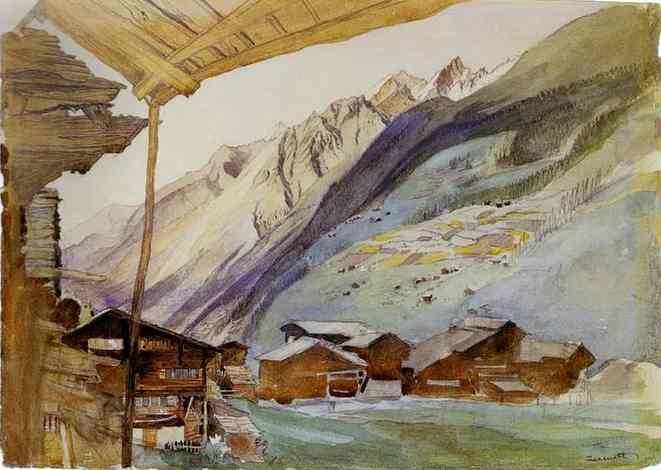
John Ruskin, Trotter’s good friend, and artistic mentor earlier in her life, had had his own encounter with the Swiss town of Zermatt (Zermott) years before. As a young man in 1844, he captured the scene there in the watercolor below.

zermatt

(Miriam Rockness, ed., A Blossom in the Desert: Reflections of Faith in the Art and Writings of Lilias Trotter, Discovery House, 2016; Rockness, in a comment (September 5, 2016) for “Lilias Trotter Symposium,” Lilias Trotter, August 17, 2016; Rockness, “Believe!” Lilias Trotter, July 28, 2012; Rockness, Passion for the Impossible: The Life of Lilias Trotter, Discovery House, 2003)

[photo: “Switzerland-55,” by Strychnine, used under a Creative Commons license; John Ruskin, Zermatt, public domain, from artinthepicture.com]

Look, in the Airport! It’s a Carry-On! It’s a Scooter! It’s Modobag!

2109920125_7c243f2785_z

Build a better mousetrap, and the world will beat a path to your door.

When Ralph Waldo Emerson said that (or at least something like that*) in the 1800s, a new-and-improved mousetrap was a suitable metaphor for innovation. I would submit to you that today’s mousetrap may very well be the carry-on bag, and the door is an Indiegogo campaign.

Ladies and gentlemen, I give you the Modobag. (Sorry, I mean the Modobag!)

The Modobag, the creation of Kevin O’Donnell, with the help of Boyd Bruner, is a TSA- and FAA-compliant carry-on bag that you can ride around the airport. It has an electric motor, telescoping handlebar with thumb throttle and hand brake, and professional motorcycle-grade foot pegs—and it can carry your clothes, too.

Here are some of the specs from Modobag’s Indiegogo page:

  • two speed settings—5 mph indoors, 8 mph outdoors
  • ability to carry a person up to 260 lbs
  • 8-mile range (for a 180-lb person)
  • two USB charging ports

Pre-orders for the Modobag are available at Indiegogo for $1,000. The campaign was set up with a modest goal of $50,000, and with two weeks left, it has already blown past a quarter of a million dollars.

According to CNN, O’Donnell doesn’t want to limit his invention to the airport. He wants people to ride it to the train and  use it to navigate conference venues. And he takes it for spins himself in the bike lanes of Chicago.

It all sounds like a great idea to me, but I do have a few concerns . . . where the rubber meets the airport walkway, so to speak. But I think each one is fixable with the simple addition of an accessory.

First, there are the images in the video above of riders leaning into tight Modobag turns. I can imagine middle-aged travelers (like myself) wiping out on the way to Gate 26. Solution? The addition of fold-down wheeled outriggers—a fancy way of saying they need training wheels.

I’m also wondering about trying to pull two, or more, pieces of checked bags on your way to an international flight. A guy only has two hands, and one is already busy with steering, throttling, and braking. Solution? Some kind of proprietary linkage system to form a giant super luggage trolley.

And finally, I’m worried that airport authorities will step in to shut down Modobag riders in the name of safety (for example, see “wiping out” above), much the way that the anti-progress lobby has unfairly hampered the would be life-changing Segway revolution around the globe. Solution? A simple beeping mechanism and pop-up flashing light. Hey, it works for those airport carts.

The bottom line for me, though, is I’m not much of an early adopter. I’m more of a late follower. So just as with wearable luggage, carry-on child carriers and follow-along bags, and even pillow head coverings, to all you risk takers, you trend setters, you beta testers, I say, Lead the way! And as long as you don’t look too silly, I’ll be right there jumping on board. (I promise.)

(“Modobag: World’s First Motorized, Rideable Luggage,” Indiegogo; Matt McFarland, “You Can Now Ride Your Luggage around the Airport,” CNN, July 22, 2016)


*[and now, for quote geeks like me . . .] According to Garson O’Toole of Quote Investigator, the earliest form in print of

Build a better mousetrap, and the world will beat a path to your door

is from “Current Comment,” in The Atlanta Constitution. The passage, titled “The Value of Good Work,” is ascribed to Emerson and was published on May 11, 1882, a few weeks after his death:

If a man can write a better book, preach a better sermon or make a better mouse trap than his neighbors, though he builds his house in the woods, the world will make a beaten path to his door.

Giving credence to Emerson’s authorship of the sentence, or at least the thoughts behind it, is a journal entry that Emerson wrote in 1855, under the heading “Common Fame”:

I trust a good deal to common fame, as we all must. If a man has good corn, or wood, or boards, or pigs, to sell, or can make better chairs or knives, crucibles or church organs, than anybody else, you will find a broad hard-beaten road to his house,though it be in the woods.

Sarah S. B. Yule and Mary S. Keene include the “If a man . . .” quotation above, crediting it to Emerson, in their book “Borrowings,” compiled in 1989 and published in 1893. The article “The Mousetrap Quotation: The Verdict,” from 1912, quotes Yule telling how she heard it from the lips of Emerson:

To the best of my memory and belief, I copied it in my handbook from an address delivered long years ago, it being my custom to write everything there that I thought particularly good, if expressed in concise form; and when we were compiling “Borrowings” I drew from this old handbook freely. It will seem strange to you, as it does to me, that Emerson never incorporated this in any of his essays. He did use the thought and similar wording, but never exactly the wording, of the quotation I used in “Borrowings.”

(Garson O’Toole, “If You Build a Better Mousetrap the World Will Beat a Path to Your Door,” Quote Investigator, March 24, 2015; “The Mousetrap Quotation: The Verdict,” West Publishing Co’s Docket, Volume 1, West Publishing Company, 1912)


[photo: “Surprising News,” by Edgardo Balduccio, used under a Creative Commons license]

To Augustine the World Is a Book, but Is It a Travel Book?

7544403302_cde12b749f_z

One of my father’s favorite jokes was to say a phrase of dubious meaning, and often questionable grammar, and tag William Shakespeare as the source. It went something like this:

No matter where you go, there you are . . . Shakespeare.

Seems that Dad was ahead of his time. All over the Interwebs, there are oft-used quotations attributed to oft-quoted people—Mark Twain, Martin Luther, Martin Luther King, Jr., Winston Churchill, Erma Bombeck . . . and Shakespeare. The trouble is, the pairings are oft-wrong.

Take, for instance, this popular quotation:

The world is a book and those who do not travel read only one page.

Nearly every online citation says it comes from the pen of St. Augustine, but as far as I can tell, no one has been able to find it in his writings.

The closest I’ve seen is in his Letter 43, written circa 397. While discussing schisms in the church in Africa and recounting some church history, he refers to the world as a book. But rather than using that as a metaphor to promote travel, he is proclaiming that the world shows the working out of biblical principles. Translated from Latin, he writes,

If, after all that you have read, you are still in doubt, be convinced by what you see. By all means let us give up arguing from ancient manuscripts, public archives, or the act of courts, civil or ecclesiastical. We have a greater book—the world itself. In it I read the accomplishment of that of which I read the promise in the Book of God: “The Lord hath said unto Me, and I shall give Thee the heathen for Thine inheritance, and the uttermost parts of the earth for Thy possession.

Jump ahead to 1750, and Louis-Charles Fougeret de Monbron writes Le Cosmopolite ou le Citoyen du Monde (The Cosmopolitan or the Citizen of the World), which opens with the following paragraph (as translated into English):

The universe is a sort of book, whose first page one has read when one has seen only one’s own country. I have leafed through a great many that I have found equally bad. This inquiry has not been at all unfruitful. I hated my country. All the oddities of the different people among whom I have lived have reconciled me to it. Should I gain no other benefit from my travels than this, I will have regretted neither the pains nor the fatigues.

British travel writer John Feltham joins our discussion with his publication of English Enchiridion in 1700. His collection of “apothegms, moral maxims. &c” includes one that seems to tie together Augustine and the thoughts of Fougeret de Monbron (it is not a direct quotation of either), and attempts to bring the early church father into the travel-writing fold:

St. Augustine, when he speaks of the great advantages of travelling, says, that the world is a great book, and none study this book so much as a traveller. They that never stir from their home read only one page of this book.

A few years later, Le Cosmopolite caught the attention of the young poet Lord Byron. In a letter to R. C. Dallas in 1811, he writes, “I send you a motto” and quotes the work’s opening paragraph. He tells Dallas, “If not too long, I think it will suit the book.” The book turned out to be his Childe Harold’s Pilgrimage, published in installments from 1812 to 1818, and the passage, still in French, became the work’s epigraph.

And finally, in 1824, Thomas Fielding gave us a more familiar rendering of the phrase in his Selected Proverbs of All Nations, crediting it to Augustine:

“The world is a great book, of which they that never stir from home read only a page.”

Simplify the language and you have “The world is a book and those who do not travel read only one page.” Oversimplify the authorship and you have Augustine.

Bring on the inspirational photos.

16791158072_73f7c8bd5d_z


[photos: “Atlas,” by Ian Carroll, used under a Creative Commons license; “Dyrhólaey Arc,” by Andrés Nieto Porras, used under a Creative Commons license]

When in Rome, Quote Those Church Fathers . . . and Then Do That Roman Thing

7208901308_80bd938e30_z
It could be the mantra of cultural chameleons:

When in Rome, do as the Romans do.

It’s so well known that all you have to do is say, “When in Rome . . .” and we fill in the rest. But where did the phrase come from? Why Rome? And what is it that we should do when we’re there? To find that out, we have to go all the way back to the fourth century—and delve into the practices of the early church.

When Casulanus wrote a letter to Augustine asking “whether it is lawful to fast on the seventh day of the week,” the early church father replied with his “Letter 36,” written in 396 AD. The passage below is Chapter 14 of that letter:

Since, therefore (as I have said above), we do not find in the Gospels or in the apostolical writings, belonging properly to the revelation of the New Testament, that any law was laid down as to fasts to be observed on particular days; and since this is consequently one of many things, difficult to enumerate, which make up a variety in the robe of the King’s daughter, that is to say, of the Church,—I will tell you the answer given to my questions on this subject by the venerable Ambrose Bishop of Milan, by whom I was baptized. When my mother was with me in that city, I, as being only a catechumen, felt no concern about these questions; but it was to her a question causing anxiety, whether she ought, after the custom of our own town, to fast on the Saturday, or, after the custom of the Church of Milan, not to fast. To deliver her from perplexity, I put the question to the man of God whom I have just named. He answered, “What else can I recommend to others than what I do myself?” When I thought that by this he intended simply to prescribe to us that we should take food on Saturdays—for I knew this to be his own practice—he, following me, added these words: “When I am here I do not fast on Saturday; but when I am at Rome I do: whatever church you may come to, conform to its custom, if you would avoid either receiving or giving offence.” This reply I reported to my mother, and it satisfied her, so that she scrupled not to comply with it; and I have myself followed the same rule. Since, however, it happens, especially in Africa, that one church, or the churches within the same district, may have some members who fast and others who do not fast on the seventh day, it seems to me best to adopt in each congregation the custom of those to whom authority in its government has been committed. Wherefore, if you are quite willing to follow my advice, especially because in regard to this matter I have spoken at greater length than was necessary, do not in this resist your own bishop, but follow his practice without scruple or debate.

Augustine, “Letter 36,” to Casulanus, Chapter 14, 396 AD, in Philip Schaff, ed., Nicene and Post-Nicene Fathers Series I, Volume I, J.G. Cunningham, translator, Christian Literature Company, 1892

Thus, the ultimate source of “When in Rome” is Ambrose, quoted by Augustine, speaking on whether or not to fast on Saturday.

A few years later Augustine returned to the story of his mother and Ambrose in his reply to Januarius, who had posed these questions concerning taking communion (“the sacrifice”) during Lent:

What ought to be done on the Thursday of the last week of Lent? Ought we to offer the sacrifice in the morning, and again after supper, on account of the words in the Gospel, “Likewise also . . . after supper”?

Augustine replied that some practices in the church are authorized by Scripture, and some are set by traditions followed by the global church. But in a third category, there is room for freedom:

There are other things, however, which are different in different places and countries: e.g., some fast on Saturday, others do not; some partake daily of the body and blood of Christ, others receive it on stated days: in some places no day passes without the sacrifice being offered; in others it is only on Saturday and the Lord’s day, or it may be only on the Lord’s day. In regard to these and all other variable observances which may be met anywhere, one is at liberty to comply with them or not as he chooses; and there is no better rule for the wise and serious Christian in this matter, than to conform to the practice which he finds prevailing in the Church to which it may be his lot to come. For such a custom, if it is clearly not contrary to the faith nor to sound morality, is to be held as a thing indifferent, and ought to be observed for the sake of fellowship with those among whom we live.

I think you may have heard me relate before, what I will nevertheless now mention. When my mother followed me to Milan, she found the Church there not fasting on Saturday. She began to be troubled, and to hesitate as to what she should do; upon which I, though not taking a personal interest then in such things, applied on her behalf to Ambrose, of most blessed memory, for his advice. He answered that he could not teach me anything but what he himself practised, because if he knew any better rule, he would observe it himself. When I supposed that he intended, on the ground of his authority alone, and without supporting it by any argument, to recommend us to give up fasting on Saturday, he followed me, and said: “When I visit Rome, I fast on Saturday; when I am here, I do not fast. On the same principle, do you observe the custom prevailing in whatever Church you come to, if you desire neither to give offence by your conduct, nor to find cause of offence in another’s.” When I reported this to my mother, she accepted it gladly; and for myself, after frequently reconsidering his decision, I have always esteemed it as if I had received it by an oracle from heaven. For often have I perceived, with extreme sorrow, many disquietudes caused to weak brethren by the contentious pertinacity or superstitious vacillation of some who, in matters of this kind, which do not admit of final decision by the authority of Holy Scripture, or by the tradition of the universal Church or by their manifest good influence on manners raise questions, it may be, from some crotchet of their own, or from attachment to the custom followed in one’s own country, or from preference for that which one has seen abroad, supposing that wisdom is increased in proportion to the distance to which men travel from home, and agitate these questions with such keenness, that they think all is wrong except what they do themselves.

The above section is Chapter 2 of Augustine’s “Letter 54,” written in 400 AD. In the letter’s Chapter 4, he furthers his argument, not only saying it is inappropriate to take one’s customs into a new setting, but he also cautions against returning home with customs learned abroad and, acting the part of the enlightened traveler, promoting them as superior:

Suppose some foreigner visit a place in which during Lent it is customary to abstain from the use of the bath, and to continue fasting on Thursday. “I will not fast today,” he says. The reason being asked, he says, “Such is not the custom in my own country.” Is not he, by such conduct, attempting to assert the superiority of his custom over theirs? For he cannot quote a decisive passage on the subject from the Book of God; nor can he prove his opinion to be right by the unanimous voice of the universal Church, wherever spread abroad; nor can he demonstrate that they act contrary to the faith, and he according to it, or that they are doing what is prejudicial to sound morality, and he is defending its interests. Those men injure their own tranquillity and peace by quarrelling on an unnecessary question. I would rather recommend that, in matters of this kind, each man should, when sojourning in a country in which he finds a custom different from his own consent to do as others do. If, on the other hand, a Christian, when travelling abroad in some region where the people of God are more numerous, and more easily assembled together, and more zealous in religion, has seen, e.g., the sacrifice twice offered, both morning and evening, on the Thursday of the last week in Lent, and therefore, on his coming back to his own country, where it is offered only at the close of the day, protests against this as wrong and unlawful, because he has himself seen another custom in another land, this would show a childish weakness of judgment against which we should guard ourselves, and which we must bear with in others, but correct in all who are under our influence.

Augustine, “Letter 54,” to Januarius, 400 AD, in Philip Schaff, ed., Nicene and Post-Nicene Fathers Series I, Volume I, J.G. Cunningham, translator, Christian Literature Company, 1892

This English translation of Chapter 4 includes a summary of Ambrose’s advice that gets closer to the wording of our present-day “When in Rome”:

[E]ach man should, when sojourning in a country in which he finds a custom different from his own consent to do as others do.

Many years later, in 1599, the English playwright Henry Porter wrote The Pleasant History of the Two Angry Women of Abington. In it, one of the charactersNicholas Proverbs, says,

Nay, I hope, as I have temperance to forbeare drinke, so have I patience to endure drinke: Ile do as company doth; for when a man doth to Rome come, he must do as there is done.

Henry Porter, The Pleasant History of the Two Angry Women of Abington, 1599, in Charles Mills Gayley and Alwin Thaler, Representative English Comedies: From the Beginnings to ShakespeareMacmillan, 1903

And finally, in 1754, Pope Clement XIV wrote “Letter 44” to Dom Galliard, concerning the monks under his authority. The English translation that followed in 1777 gives us a form of “When in Rome” that brings us nearly to what we have today. This time the topic is the suitability of taking a nap during the day:

The siesto, or afternoon’s nap of Italy, my most dear and reverend Father, would not have alarmed you so much, if you had recollected, that when we are at Rome, we should do as the Romans do.—Cum Romano Romanus eris.

Is it either sin or shame, then, for a poor Monk, in a country where one is oppressed with excessive heat, to indulge in half an hour’s repose, that he may afterwards pursue his exercises with the more activity? Consider, that silence is best kept when one is asleep. You who reckon among the capital sins, the pronouncing of a single word when your rules forbid the use of speech,—take the example of Christ when he found his Apostles asleep: Alas, says he to them, with the greatest mildness, could you not watch with me one hour?

Clement, “Letter 44,” Interesting Letters of Pope Clement XIV (Ganganelli): To Which Are Prefixed, Anecdotes of His Life, Volume I, translated from the French, London, 1777.

Now that I’ve come to the end of my post, I’ve got to give credit where credit is due. Thanks to The Phrase Finder for identifying most of the sources above. And the photo, titled “Rome,” is by Luca Sartoni (used under a Creative Commons license). There’s some pretty nice architecture in the picture, behind the tourists. I’m thinking it took more than a day to build a place like that. By the way, that area is called Campo Marzio. If you’d like to see it in person, it should be pretty easy to find. I’m guessing that once you’re in Italy, all roads will lead there. And when you arrive, you’ll know what to do.

G. K. Chesterton, the Prince of Paradox, on Travel

4824820738_18cf5c7fbc_z

The whole object of travel is not to set foot on foreign land; it is at last to set foot on one’s own country as a foreign land.

So says G. K. Chesterton, prolific British author and Christian apologist, whose life bridged the 19th and 20th centuries.

Chesterton has much to say about travel, largely on how to do it well and how it can affect the traveller.

The quotation above comes from “The Riddle of the Ivy,” a short sketch in his Tremendous Trifles. When a friend asks why he is packing his luggage, Chesterton tells him he is traveling through Paris, Belfort, Heidelberg, and Frankfort, with the aim of finding the Battersea district of London.

Knowing that his destination is their current location, his friend says, “I suppose it is unnecessary to tell you that this is Battersea?”

“It is quite unnecessary,” I said, “and it is spiritually untrue. I cannot see any Battersea here; I cannot see any London or any England. I cannot see that door. I cannot see that chair: because a cloud of sleep and custom has come across my eyes. The only way to get back to them is to go somewhere else; and that is the real object of travel and the real pleasure of holidays. Do you suppose that I go to France in order to see France? Do you suppose that I go to Germany in order to see Germany? I shall enjoy them both; but it is not them that I am seeking. I am seeking Battersea. The whole object of travel is not to set foot on foreign land; it is at last to set foot on one’s own country as a foreign land.

And then the man who deals so much with paradox that he has been called “the prince of paradox” cautions his friend, with threat of physical harm, against referring to his thoughts as paradoxical:

“Now I warn you that this Gladstone bag is compact and heavy, and that if you utter that word ‘paradox’ I shall hurl it at your head. I did not make the world, and I did not make it paradoxical. It is not my fault, it is the truth, that the only way to go to England is to go away from it.”

A month later, his opinion is confirmed when he returns to England and sees it with a wonderful freshness. An American traveling companion is struck by England as well, but for her it is because this is her first time there.

“I have never been in England before,” said the American lady, “yet it is so pretty that I feel as if I have been away from it for a long time.”

For the American it is déjà vu. For Chesterton, is it déjà new?

Not Seeing What You See

Regardless of the destination, believes Chesterton, there is much more to traveling than simply taking a trip. He writes that “true” travelers let the experience of a destination come to them, without manipulating it with expectations and prejudices. He is quoted as saying,

The traveller sees what he sees. The tourist sees what he has come to see.

The actual version of this comes from the following passage in his Autobiography:

I had pottered about in France ever since my father took me there as a boy; and Paris was the only foreign capital I knew. I owe it to him that I was at least a traveller and not a tripper. The distinction is not snobbish; indeed it is one rather of epoch than education; half the trouble about the modern man is that he is educated to understand foreign languages and misunderstand foreigners. The traveller sees what he sees; the tripper sees what he has come to see. A true traveller in a primitive epic or folk-tale did not pretend to like a beautiful princess because she was beautiful. It is still true of a poor sailor; of a tramp; in short, of a traveller. Thus he need form no opinion of Paris newspapers; but if he wanted to, he would probably read them. The tripper never reads them, calls them rags, and knows as much about the rags as the chiffonnier who picks them up with a spike.

I understand why the common version of this quotation uses tourist in place of tripper. We don’t use tripper much today, at least not with this meaning. And I don’t think that Chesterton would mind. He writes,

It is the most sincere compliment to an author to misquote him. It means that his work has become a part of our mind and not merely of our library.

Bevis Hiller, in The Wit and Wisdom of G K Chesterton, gives the origin for this quotation as the December 31, 1927, issue of GK’s Weekly, though I couldn’t track down the original source. While I have no reason not to trust Hiller, wouldn’t it be ironic if Chesterton never said this?

The Broad and the Narrow Ways

They say travel broadens the mind; but you must have the mind.

One of the characters in Chesterton’s stories is the crime-solving poet Gabriel Gale. In “The Shadow and the Shark,” Gale discusses Mr. Amos Boon, a former missionary who has decided he prefers the Philistines of the Bible to those biblical characters who follow God. While defending Boon against charges of murder, he does not defend the “broadening” of his mind.

“Boon is a good man,” said Gale, calmly; “he is very stupid; that is why he is an atheist. There are intelligent atheists, as we shall see presently; but that stunted, stupid, sort is much commoner, and much nicer. But he is a good man; his motive is good; he originally talked all that tosh of the superiority of the savage because he thought he was the under-dog. He may be a trifle cracked, by now, about sharks and other things; but that’s only because his travels have been too much for his intellect. They say travel broadens the mind; but you must have the mind. He had a mind for a suburban chapel, and there passed before it all the panorama of gilded nature-worship and purple sacrifice. He doesn’t know if he’s on his head or his heels, any more than a good many others. But I shouldn’t wonder if heaven is largely populated with atheists of that sort, scratching their heads and wondering where they are.

If “they” say that travel broadens the mind, Chesterton himself says traveling presents the danger of making the mind more narrow:

I have never managed to lose my old conviction that travel narrows the mind. At least a man must make a double effort of moral humility and imaginative energy to prevent it from narrowing his mind. Indeed there is something touching and even tragic about the thought of the thoughtless tourist, who might have stayed at home loving Laplanders, embracing Chinamen, and clasping Patagonians to his heart in Hampstead or Surbiton, but for his blind and suicidal impulse to go and see what they looked like. This is not meant for nonsense; still less is it meant for the silliest sort of nonsense, which is cynicism. The human bond that he feels at home is not an illusion. On the contrary, it is rather an inner reality. Man is inside all men. In a real sense any man may be inside any men. But to travel is to leave the inside and draw dangerously near the outside. So long as he thought of men in the abstract, like naked toiling figures in some classic frieze, merely as those who labour and love their children and die, he was thinking the fundamental truth about them. By going to look at their unfamiliar manners and customs he is inviting them to disguise themselves in fantastic masks and costumes. Many modern internationalists talk as if men of different nationalities had only to meet and mix and understand each other. In reality that is the moment of supreme danger—the moment when they meet. We might shiver, as at the old euphemism by which a meeting meant a duel.

The paradox of travel.

(G. K. Chesterton, “The Riddle of the Ivy,” Tremendous Trifles, Methuen, 1909; Bevis Hiller, The Wit and Wisdom of G K Chesterton, Continuum, 2011; Chesterton, Autobiography, Hutchinson, 1936; Chesterton, “The Shadow of the Shark,” The Poet and the Lunatics: Episodes in the Life of Gabriel Gale, Cassell, 1929; Chesterton, “What Is America?” What I Saw in America, Hodder, 1922)

[illustration: “G.K. Chesterton,” by giveaway boy, used under a Creative Commons license]

Tracing Paul Tillich’s Words on Listening and Love

6898899741_618ff94ef0_z

The first duty of love is to listen.
—Paul Tillich

I really like this quotation. It brings up images in my mind of friends sitting together over cups of coffee. Or maybe they’re a husband and wife, or a parent and child, or a teacher and student . . . or adversaries. Their body language and the expressions on their faces show that they are intent on truly hearing what the other has to say. Simple images for a simple quotation. At least it used to seem simple to me, until I traced it back to its origin.

First of all, did Tillich really say, “The first duty of love is to listen”? The answer is yes . . . and no. He’s the source, but those aren’t his exact words. More on that later.

So who is Paul Tillich, anyway? Born in Germany in 1886, Tillich grew up to be a well-known existential theologian (well-known, at least, among those familiar with existential theologians). After finishing his university education, he was ordained a Lutheran minister and served as a military chaplain during World War I. Following the war, he lectured in German universities, but that came to an end when he was banned from those institutions because of his criticism of Hitler and the Nazis. He then moved to the US to teach at Union Theological Seminary, learned English, and later taught at Harvard and the University of Chicago, in time becoming an American citizen. Tillich often published his thoughts in book form, one of the more famous being his three-volume Systematic Theology.

What is Tillich’s theology? Here’s where it gets a bit tricky. Some describe Tillich as a Christian theologian, some as an unorthodox Protestant, some as an existentialist philosopher, and still others as a pantheist or atheist.

Regardless of the controversy (or maybe because of it), his writings have a cool factor amongst today’s younger, hip Christian set. In Hipster Christianity: When Church and Cool Collide, Brett McCracken puts Tillich on a list of “Things [Hipster Christians] Like.” But like isn’t strong enough for some, as McCracken says that “artistic-minded Christian Hipsters love Tillich.”

And that brings us back to love and listening, and to power and justice, as well.

That’s because the source of the Tillich quotation above is his book Love, Power, and Justice. The book’s subtitle is “Ontological Analysis and Ethical Applications,” and chapter headings include “The Ontology of Love,” “Being as the Power of Being,” and “A Phenomenology of Power.” Sounds rather deep, no?

Here’s the relevant passage about love and listening (with my own emphasis added). In it, Tillich is discussing “the relation of justice to love in personal encounters.” He writes that it

can adequately be described through three functions of creative justice, namely, listening, giving, forgiving. In none of them does love do more than justice demands, but in each of them love recognizes what justice demands. In order to know what is just in a person-to-person encounter, love listens. It is its first task to listen. No human relation, especially no intimate one, is possible without mutual listening. Reproaches, reactions, defenses may be justified in terms of proportional justice. But perhaps they would prove to be unjust if there were more mutual listening. All things and all men, so to speak, call on us with small or loud voices. They want us to listen, they want us to understand their intrinsic claims, their justice of being. They want justice from us. But we can give it to them only through the love which listens.

To be honest, much of Tillich’s writing is over my head. It’s not that I don’t grasp what he’s saying in this passage, it’s when he does things such as explore the concept of being that I lose ground. I had to look up ontological. I found out it means “metaphysical, or the branch of metaphysics that studies the nature of existence,” but you already knew that, right?

So where does this leave us? For me, it’s back to where we started. We still have the popular “quotation,” and I don’t think it will be replaced by the real thing any time soon. It’s nearly accurate and it’s Twitter-sized, with plenty of room to spare for hashtags. Now when I hear it I’ll still imagine those people sharing a conversation over coffee, but while their mugs will say, “The first duty of love is to listen,” next to those mugs will be some books whose titles I don’t quite understand.

[To see why a blog about cross-cultural issues is interested in the topic of listening, go here.]

(Arne Unhjem, “Paul Tillich: American Theologian and Philosopher,” Encyclopaedia Britannica, Brett McCracken, Hipster Christianity: When Church and Cool Collide, Baker, 2010; Paul Tillich, Love, Power, and Justice: Ontological Analysis and Ethical Applications, Oxford, 1960)

[photo: “Rayon de Soleil,” by Dominique Garcin-Geoffroy, used under a Creative Commons license]

TCKs as Prototypical Citizens and Culture Shock as Exaggerated Poop: Ted Ward’s Views on Growing Up Abroad

16241388115_fec39f427a_zQuotation tracing. It’s almost as exhilarating as tracing a river.

According to the Taipei Times, the sport of river tracing may have been birthed in Taiwan in 1982. That year, a Japanese expedition team representing the Osaka Grassshoes Society traced the Nantsi River to the top of Taiwan’s Jade Mountain. (How’s that for an epic-sounding adventure?) Years ago I got to chaperone a group of junior-high-school students in a much less demanding trek, hiking in and up a fast-moving mountain river in northern Taiwan. We had a great time wading, swimming, crawling, and climbing. Not only did we find the spring that was the river’s source, but we also enjoyed—and discovered a lot during—the getting there.

So it is with quotation tracing, finding the origin and context of well-known, though often misquoted and misattributed, quotations. There’s much to be learned from tracking down quotations, and now that I’m older, I find that quotation tracing is more suited to a more sedentary lifestyle, as well.

My target quotation this time is one that we read often in literature about Third Culture Kids. And just like river tracing in Taiwan, it comes from the 80s. It’s Ted Ward’s

TCKs are the prototype citizens of the future.

I used this form of the quotation a few years ago in a blog post that I wrote. Sadly, at the time, I hadn’t checked the source. Had I done so, I would have seen that the original comes from page 57 of “The MK’s Advantage: Three Cultural Contexts,” in Understanding and Nurturing the Missionary Family. The chapter from Ward is an abridged version of a presentation he made in Quito, Ecuador, at the International Conference on Missionary Kids, held in 1987. (David Pollock and Ruth Van Reken, in Third Culture Kids: Growing Up among Worlds, are two who point to this source.) I would have also seen that the quotation has been paraphrased over time.

Speaking about the qualities that define Missionary Kids (MKs) as world Christians, Ward says,

Another characteristic is the loyalty to Christian values, even above the social pragmatics that we deal with in any society. There are characteristics of the internationalizing community of Christ that may very well, in this increasingly shrunken world, become characteristic of the church in general in the twenty-first century. One of my propositions is that the missionary kid of the nineties will be the prototype of the Christian of the twenty-first century [emphasis mine].

Because Missionary Kids are a subset of Third Culture Kids, it’s not a stretch to apply what Ward said to the larger group as a whole, but it’s interesting that his comments in this context refer not to general global citizens but to citizens of the community of Christians. This is understandable, though, as Ward’s audience was missionary families, and if he were talking to expat families in general, I would think it logical that he would apply the same principle to the broader category of all TCKs.

But looking at Ward’s presentation as a whole, I find something even more interesting. It’s his strong pronouncements of how MKs should embrace the advantages of their lives abroad and should not focus on the perceived negatives. “I view the MK growing up experience,” he says, “as very positive and very valuable, in comparison with the experiences available to their cousins who are stuck back home.”

To combat negative stereotypes applied to MKs, Ward uses somewhat blunt language, language that grates against my way of thinking. But one of his goals seems to be to shake up our assumptions, and my discomfort shows that he has been successful in that with me.

At the time that he spoke at the Quito conference, Ward was serving as dean of International Studies, Mission, and Education at Trinity Evangelical Divinity School. Before that, he spent 30 years at Michigan State University, teaching in the areas of education and curriculum research, and taking a leading role in the field of theological education.

While at Michigan State, Ward was a colleague of Ruth Hill Useem, the sociologist and anthropologist who coined the term Third Culture Kid. Ward describes Useem’s technical usage of TCK as being in the context of

cultural variables that are not definable in terms of ours and theirs. She was talking about the dynamic of that which is different because people from outside settings residing in an inside setting do not take their primary identities ultimately from either, but they take it from the commonness that they have with others who are doing the same thing.

But Ward goes on to point out that Useem’s definition of third culture is based on her study of “the overseas intellectual communities of Western European and American people in the sciences and technology.” And he writes that the paper in which she coins the term Third Culture Kid has “no reference to anything like what we would call the MK.” Therefore, he believes that today’s use (or “misuse”) of TCK has made it a “static term,” with “standard values” and “generalizations about it which lead us to the wrong questions.” (edited 5/11/21*)

What are some of the wrong questions? They are nonsense questions. “Is it OK to be an MK?” “What are the problems of being an MK?” They’re dumb questions, but they’re the questions that a static view of culture leads you to.

Then you get preoccupied by rootlessness. Oh, come on. Millions of people in the world are rootless. Don’t get paranoid about thirty thousand kids when ten percent of them are rootless.

It is this kind of negative thinking, especially by parents of MKs, that Ward opposes. For instance, in the area of culture shock:

Words like culture shock—good grief! Talk about popularization of some bad research! Culture shock—for the most part largely exaggerated poop! Incompetency, yes, but incompetency comes in all kinds of forms.

And about American expat parents who are concerned about their children’s lack of understanding of US culture, he responds,

I find more MKs understanding the nature of American society than people who are raised wholly within it. Would that we could get that message across to parents. Paranoid parents have got to be helped.

Ward also laments missionary parents’ worries about reverse culture shock. Years ago, it wasn’t so easy for missionaries or their children to return “home,” so they weren’t so apt to influence their children towards the inevitability of going back. One qualification of MKs as prototypical world Christians, says Ward, is their ability to serve God anywhere, without being tied down to a particular country or culture, especially the one from which they came.

Ward believes that the long-term work of missionaries has changed. “A career missionary today does not get buried in China at age forty-seven under great mounds of Chinese soil,” he states. “He gets buried at age forty-seven at a North American mission office desk under mounds of paper.” Ward doesn’t want this sort of mindset to be passed on to Missionary Kids.

Ward has given me, a former missionary and current parent of several MKs, a lot to think about, and I wonder how I would have responded if I had been in his audience 27 years ago.

While tracing Ward’s quotation to its source, I’ve been challenged, affirmed, and stretched. I’ve learned a few things and I’ve read some things that I’ll be pondering for a while. I’m grateful for the work that Ted Ward has done for and with cross-cultural workers and their families. And while I’m not on board with everything he’s said (for instance, I don’t think that culture shock is “largely exaggerated poop”), I do understand that there can be a tendency toward paranoia and excessive navel gazing.

We need balance. It’s good to look inward, with caution. But it’s also good to look up and out and aim for some mountaintops, to hike some rivers, to look with optimism at the path ahead, and to see the landscape from a different perspective.

(*In my original post, I misunderstood Ward’s view of how Useem defines the term Third Culture Kid, writing “According to Ward, Hill Useem applied it to particular new cultures—new communities in a distinct time and place—that expats form inside their host country. This is different from how we currently use TCK (or MK) to describe a broad group of people raised overseas.” I have rewritten the paragraph above to better express Ward’s objections to today’s usage of TCK.)

(Ian Bartholomew, “Taiwan’s Rivers Offer Vast Potential for Adventure,” Taipei Times, August 19, 2001; Ted Ward, “The MK’s Advantage: Three Cultural Contexts,” Understanding and Nurturing the Missionary Family: Compendium of the International Conference on Missionary Kids, Quito, Ecuador, January 4-8, 1987, Volume I, Pam Echerd and Alice Arathoon, eds., William Carey, 1989.)

[photo: “Consumer Confidence!” by Chris & Karen Highland, used under a Creative Commons license]