Those Friendly, Friendly Drive Throughs and “Food Houses”

75648625_11a6588a48_z

It’s that holiday time of the year, which means lots of traveling and probably some quick meals along the way. If you’re wanting to up your grabbing-a-bite-to-eat game, take a look at Business Insider‘s list of the top 25 US limited-service restaurant chains, published earlier this year. Below are the ten restaurants with the highest customer-satisfaction scores. (By the way, if you’re wondering, “limited service” means pay before you eat and includes fast food and fast casual.)

  1. Firehouse Subs
  2. Chick-fil-A
  3. Papa Murphy’s Pizza
  4. Ben & Jerry’s
  5. In-N-Out Burger
  6. Raising Cane’s Chicken Fingers
  7. Krespy Kreme
  8. Fuddruckers
  9. Jersey Mike’s Subs
  10. The Habit Burger Grill

I guess you could say this is a pretty congenial group of eateries—offering good food at a good price with good service—but if you want to know just how friendly the American food-distribution scene is, you need to look at it from an outsider’s point of view. In his book End of the Spear, Steve Saint tells about his friend Mincaye’s first trip to the States. Mincaye is from Ecuador, a member of the isolated Waodani (Waorani, Huaorani) tribe.

After he and Steve return to Ecuador, Mincaye describes grocery stores to members of his village. To him, “food houses” are wondrous places with endless amounts of food (people take it out but no one brings it in), and taking it out is oh so easy:

The only thing you have to do is when you are leaving, you have to go by the place where the young foreigner girls stand. They look at you very seriously. But if you just stand there and smile, when they smile back, you can take all your food and go eat it happily.

At this point, Steve corrects Mincaye’s story by explaining that the food needs to be paid for and shows the group a credit card.

“Don’t worry,” Mincaye explains. ” They just give that thing right back to you, and then you can go and eat all your food!”

But someone wants to know how food can be gotten when you’re out driving and not close to a food house. Mincaye knows the answer. That’s not a problem for Babae, as he calls Steve:

Babae has friends everywhere. Whenever we are away from the big, big food house and my stomach hurts, telling Babae, he just stops at one of his friend’s houses. They open the little windows in their walls and hand us food. Those people really like Babae, just like we do.

I really feel special now. I guess those people really like me, too!

(I’ve written about Steve and Mincaye before, but if you’d like to know their full stories, read Elisabeth Elliot’s Through Gates of Splendor and Saint’s End of the Spear, or watch the movie of the same name.)

(Emmie Martin, Tanza Loudenback, and Alexa Pipia, “The 25 Best Fast-Food Chains in America,” Business Insider, May 9, 2016; Steve Saint, End of the Spear, Tyndale, 2005)

[photo: “Service with a Smile,” by Broken Piggy Bank, used under a Creative Commons license]

Pre-Tripisms

6498328835_54ccf312d8_z

First expatisms, then airportisms, and now . . . pre-tripisms. Because we simply don’t have enough ways to talk about things.

metapacking
Carrying a suitcase in a suitcase so that you can bring back more stuff than you take. This can be as simple as a duffle bag inside another piece of luggage, but in its purest form, it is a checked bag precisely fitting inside another checked bag. The term metapacking can be extended also to encompass using a cheap or broken suitcase to transport items one way and then disposing of that suitcase after you arrive. Seasoned travelers always keep a broken suitcase lying around.

eurekathing
Something you find inside your luggage when you start packing—something you haven’t seen since your last trip. Discovering it brings out such responses as “Oh, that’s where that is,” or “I do have one of those.” A wad of ten-dollar bills is eurekaching, a piece of jewelry, eurekabling.

flotsam and jetsam and thensam
The abundance of things that people give you and your children right before you leave for the airport or get on the plane. This includes gifts, souvenirs, snacks, word-find and sudoku books, coloring books with a four-pack of crayons, and those faces with metal shavings that you form into a beard with a magnet.

tetrisness
The feeling of accomplishment one feels after packing every necessary item just right in a suitcase. A landmark study out of the University of Gatwick-Hempstead shows that tetrisness activates the same portion of the brain as when one successfully folds a fitted sheet.

bait and glitch
You find a cheap plane ticket online and go through all the steps to buy it, double and triple checking all the details, and then when you select “confirm,” you get that encouraging message that says, “The fare you’ve selected is no longer available.” Maybe it’s because the search site wasn’t up to date or because someone else recklessly grabbed the last seat while you were prudently making up your mind. If it’s the latter, it just proves the old standard, “Time flies when you’re choosing flight times” (or something like that).

vontrappish
How you feel when you’re ready for bed the night before a morning flight, with all your luggage placed neatly (more or less) next to the door—lined up like the von Trapp family ready to sing “So Long, Farewell.” You may have mixed feelings, and you may or may not sleep. In extreme cases, you hear yourself humming the tune.

So long, farewell, auf Wiedersehen, good night
I hate to go and leave this pretty sight

I’m glad to go,
I cannot tell a lie
I flit, I float
I fleetly flee, I fly

So long, farewell, auf Wiedersehen, goodbye
I leave and heave a sigh and say goodbye—Goodbye!

fortnightlies
Countless requests for coffee, a get-together, or a meal made by friends who have just realized that your departure for a long or permanent stay is only. two. weeks. away.

direct flight to the dog house
This is what you receive after you proudly show the money-saving itinerary—that you just booked—to your spouse, and said spouse points out that it includes a 14-hour layover (also known as a “wayover”) and that you and your four children will need to collect all checked baggage between each of the five connecting flights. Travel to the doghouse does accumulate frequent-flyer miles, but they can only be redeemed for undesirable trips, such as to overnight stays on the living-room couch.

disafearance
Leaving your tightly locked up (?) house thinking you might have left the iron on (even though you don’t remember having done any ironing) is one thing, but watching your hand zip your passport into the front pocket of your backpack and then just two minutes later checking to see if it’s actually there because you’re afraid that you didn’t in fact zip your passport into the front pocket of your backpack but instead, due to a muscle spasm, may have opened the car window and tossed your passport onto the shoulder of the highway—or what if it just spontaneously combusted, leaving no smoke or ashes?—that’s disaffearance.

TSAT
The TSAT (pronounced Tee Ess Ay Tee or Tee-Sat) is an oral exam in which family members yell questions and answers from room to room concerning Transportation Security Administration regulations:

Is it the 3-1-1 rule or 1-1-3 . . . or 3-2-1 or 9-1-1? Does deodorant count as a liquid? What about wet wipes? Or snow globes? Or chocolate-covered cherries? Can I take nail clippers in my carry-on? What about tweezers? Duct tape? Scotch tape? Chopsticks? Toothpicks? Javelins?

[photo: “We live in a wonderful world,” by Kate Ter Haar, used under a Creative Commons license]

He Said, She Said: Believe in the Darkness What You Have Seen in the Light

6075056080_1c85ab6011_z
Zermatt, Switzerland

I began my post “In the Light, in the Dark, Remember,” with a quote from Joseph Bayly (1920-1986):

Don’t forget in the darkness what you have learned in the light.

I trust Phillip Yancey, who writes that Bayly said it, but I couldn’t find a specific citation and I was curious if it was original to him. Then I got a copy of Miriam Rockness’s A Blossom in the Desert: Reflections of Faith in the Art and Writings of Lilias Trotter, a collection of the missionary artist’s thoughts, paired with her watercolor paintings. This is the same Lilias Trotter whom I wrote about back in July. In the book, I found these words:

Believe in the darkness what you have seen in the light.

When I saw this, I contacted Rockness, through the blog she writes about Trotter. When I asked her about the source of the quotation, she replied,

This is one of my favorite Lilias quotes. It was taken from her diary, 10 August 1901. She was taking a “break” from the heavy load in N.A. and, after having a reunion with her brother in Zermott (Switzerland) she sought a place even higher in the mountains to “be alone with God.” And, here, as always seemed to be the case for Lilias, God “spoke to her” through His Handiwork. She writes, “‘Believe in the darkness what you have seen in the light’ – That was this mornings ‘first lesson’ – For when I opened my shutters about 5.30, there was a lovely clear happy morning sky above the grey gold rocks a[nd] glistening snow of the Weirshorn & Roth-horn. While a thick bank of white cloud lay below in the valley – Half an hour more & it had risen around us till there was nothing to be seen but a few dim ghosts of trees. Yet one knew having once seen that sky, that a radiant day was coming, & that the clouds could do nothing but melt. And me[lt] they did, the peaks glimmering like far off angels at first, & clearing till they stood out radiant & strong, with the fogs dropped down to their feet like a cast off mantle. All depended on what one had seen first.”

Elsewhere in her blog, Rockness puts the quotation in more context, describing the “heavy load” that Trotter had experienced in North Africa:

It is interesting to note that when Lilias recorded the above statement of faith in her diary, she was in the midst of an unprecedented and sustained period of challenge in ministry. After more than 3 years of political opposition  and spiritual oppression, their work had come almost to a halt. Activities in Algiers and itineration in Algeria were severely curtailed as they were dogged by the shadow of suspicion.  Even their most beloved Arab friends pulled away in fear of being identified with them.

(In this post, Rockness shows the date for Trotter’s journal entry containing the darkness/light phrase as August 16, 1901.)

In A Passion for the Impossible: The Life of Lilias Trotter, Rockness writes that the difficulties faced by Trotter included the investigation of English missionaries by the ruling French government and the targeting of young Algerian converts by sorcerers using poison and “black magic.” Also, a missionary family that had come to help in the ministry left after six months, unable to meet the demands of caring for their three children in Algeria.

Trotter writes in a journal entry from 1897,

One literally could do nothing but pray at every available bit. One might take up letters or accounts that seemed as if they were a “must be”—but one had to drop them within five minutes, almost invariably, and get to prayer—hardly prayer either, but a dumb crying up to the skies of brass.

For Trotter, during difficult times, the skies could turn to brass and clouds could obscure the sun and envelop the world around her. But she had seen the “clear happy morning sky,” and she knew that a “radiant day was coming.” It “all depended,” she writes, “on what one had seen first.”


John Ruskin, Trotter’s good friend, and artistic mentor earlier in her life, had had his own encounter with the Swiss town of Zermatt (Zermott) years before. As a young man in 1844, he captured the scene there in the watercolor below.

zermatt

(Miriam Rockness, ed., A Blossom in the Desert: Reflections of Faith in the Art and Writings of Lilias Trotter, Discovery House, 2016; Rockness, in a comment (September 5, 2016) for “Lilias Trotter Symposium,” Lilias Trotter, August 17, 2016; Rockness, “Believe!” Lilias Trotter, July 28, 2012; Rockness, Passion for the Impossible: The Life of Lilias Trotter, Discovery House, 2003)

[photo: “Switzerland-55,” by Strychnine, used under a Creative Commons license; John Ruskin, Zermatt, public domain, from artinthepicture.com]

Your Little “g” greatness Is Still Worth Finding

I’m only about one and a half olympics behind on this post, but at least I have the editors of Advertising Age’s Creativity Daily Newsletter on my side. Back in 2012 they said,

Arguably, the campaign that will continue to resonate with viewers well after the Olympics are over is Nike’s “Find Your Greatness” campaign. . . .

I’m a little late to the party, since I hadn’t seen any of these videos until a couple days ago, but they still resonate with me—four years after they were made. Do you remember them?

Art director for the campaign, Sezay Altinok, says,

Greatness isn’t reserved for the chosen few in one special city, it can also be found in London, Ohio, and London, Norway, and East London, South Africa, and Little London, Jamaica, and Small London, Nigeria and the London Hotel and London Road and anywhere else someone is trying to find it.

This sounds like little g greatness to me, which must be a close kin to little h heroes.

(Nike: Find Your Greatness – Jogger — Best of 2012 TV #1Creativity Daily Newsletter, August 2, 2012; Find Your Greatness, Sezay Altinok Creative)

Duy Huynh’s Ethereal Art of Displacement

Inspiration can come from almost anywhere. Take, for instance, a recent trip to Kirkland’s, the home-decor store. I’m not talking about their Bible verselettes painted on pallet boards (not that there’s anything wrong with that) (it seems pretty popular right now). I’m talking more about things that get me thinking about crossing cultures, relocating, transitioning, and the like.

So on that trip to Kirkland’s, as I thumbed through the stack of framed art leaning against the wall (stampeding horses, bikes on Paris streets, a flower garden), I saw a print of an Asian lady surrounded by hummingbirds carrying keys. Interesting. I wondered who’d painted it, and I had to look no farther than the tag attached to the frame. It was Duy Huynh, a Vietnamese-born artist who came to the US in the early eighties. According to Huynh’s website,

With difficulties adapting to new surroundings and language, he took refuge in the art of comics, cartoons, and graffiti. His first art commission came in the third grade when a classmate hired him to draw the Teenage Mutant Ninja Turtles. Payment came in the form of 2 dollars and chocolate milk for the week. More importantly, Duy learned it was possible to make a connection through the use of a visual language.

His “about” page goes on to say that a common thread in his art is “geographical and cultural displacement.”

Ethereal characters maintain a serene, precarious balance, often in a surreal or dreamlike setting. With his figures, Duy explores motion along with emotion in order to portray not just the beauty of the human form, but also the triumph of the human spirit. Images that recur, such as boats, trains, suitcases, and anything with the ability of flight relate to travel, whether physical or spiritual.

Below are some of Huynh’s works that grab my imagination. I could tell you how they represent “geographical and cultural displacement” for me, but it’s better that you interpret them yourself. And don’t search online for the artist’s explanation of his images. He wants you to supply that on your own.

Maybe you’d like some of his other works more. He’s got quite a few to choose from. But if you want to buy Fair Trade Frame of Mind, don’t go to Kirkland’s. It sold out a couple weeks ago and isn’t available on their website anymore. That makes me sad, because it never even went on green-tag sale.

Of course, Huyn’s style may not be your cup of tea. Kirkland’s still should have you covered. Maybe you’re more into psychedelic cows. Apparently that’s a thing, since more than one version is available (not that there’s anything wrong with that) (inspiration can come from almost anywhere).

Fair Trade Frame of Mindfair-trade-frame-of-mind

Mindful Migrationmindful-migragion

MindfulNest Cultivationmindulnest-cultivation

Homestead and a Steedhomestead-and-a-steed

Of Wind and Water
of-wind-and-water

Never Mind the Clouds
never-mind-the-clouds

Air China Back-Back-Backtracks from Inflight Article on London

15233755671_71a0b084a9_z

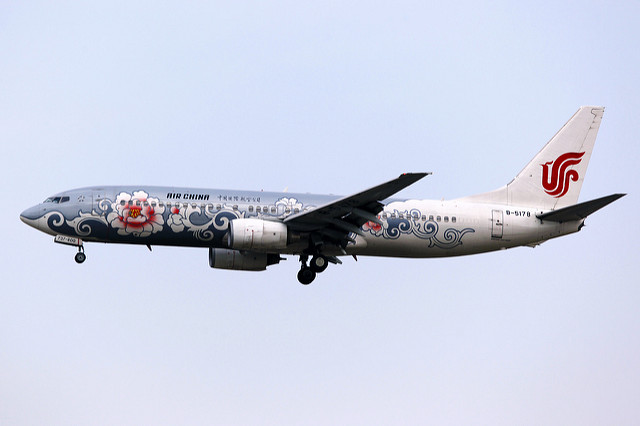
The Interwebs have been in an uproar the last few days over an article in Air China’s inflight magazine Wings of China. As reported by journalist Haze Fan for CNBC, the latest issue of the magazine touts London as a top destination but includes the following “safety” advice in a section called “Tips from Air China”:

London is generally a safe place to travel, however precautions are needed when entering areas mainly populated by Indians, Pakistanis and black people. We advise tourists not to go out alone at night, and females always to be accompanied by another person when travelling.

Fan notes that the capital city is currently being led by a mayor, Sadiq Khan, who was born in London to Pakistani parents.

After Fan’s reporting, Air China North America issued the following apology via Twitter:

We at Air China Limited do not condone discrimination in any shape or form. We regret and apologize for the offensive language. . . .

But Air China was not done reversing its engines. The company also pulled the magazine from their planes and even deleted the above Tweet. Wings of China is now offline, as well.

So . . . I can’t send you to the Wings of China to read the article yourself, but I will remind you that if you’d like to see some other airline mags from around the world, go to my list of over 100 links at “Inflight Magazines: My Virtual Seat-Back Pocket Runneth Over.” Maybe you’ll be the one to scoop the next big piece of travel news.

(Haze Fan, “Air China Magazine Warns London Visitors to Avoid Ethnic Minority Areas,” CNBC, Sept. 7, 2016; Haze Fan, “Air China’s Magazine Says Media, Readers Misinterpreted London Travel Advice,” CNBC, Sept. 8, 2016)

[photo: “B-5178 | Air China | Boeing 737-86N | Grey Peony Livery | PEK,” by Byeangel, used under a Creative Commons license]

Umbrellas, 2, 3, 4

“The Public Shaming of England’s First Umbrella User”

In the early 1750s, an Englishman by the name of Jonas Hanway, lately returned from a trip to France, began carrying an umbrella around the rainy streets of London.

. . . . . .

Hanway was the first man to parade an umbrella unashamed in 18th-century England, a time and place in which umbrellas were strictly taboo. In the minds of many Brits, umbrella usage was symptomatic of a weakness of character, particularly among men. Few people ever dared to be seen with such a detestable, effeminate contraption. To carry an umbrella when it rained was to incur public ridicule.

The British also regarded umbrellas as too French—inspired by the parasol, a Far Eastern contraption that for centuries kept nobles protected from the sun, the umbrella had begun to flourish in France in the early 18th century. . . . Later British umbrella users reported being called “mincing Frenchm[e]n” for carrying them in public.

Michael Walters, Atlas Obscura, July 27, 2016

P.S. I, for One, Welcome Our New Robot-Luggage Overlords

11344262713_5510611064_z

Not being able to leave well enough alone, after my last post, on the Modobag, I gave another look to the suitcase innovations on Indiegogo.

What I found is frightening, simply frightening.

Four years ago, you may recall, I mentioned hop! “the follow along suitcase.” At the time it was only in a prototype stage, and as you can see in the video below, it was a rather bare-bones, timid-looking prototype, at that.

Speaking about advancements in luggage design, I wrote the following:

Regardless, the evolution of the suitcase continues. When USA Today asked what’s “next on the horizon,” Michele Marini Pittenger, president of the Travel Goods Association, said, “Luggage that packs itself? Now that would be a problem-solver.”

Oh, how our carry-ons have evolved since then. Can you say “robot luggage”?

How about “Cowarobot R1“? That’s the name of “the first and only robotic suitcase,” in the middle of its own Indiegogo campaign.

Yes, you read that correctly, robot luggage! All I can do is wonder how long it will be before these “fully autonomous” carry-ons become self-determining—and evil—and force us to pack our clothes against our will. How long before the “find me function” (which I think is pretty cool) becomes the “track me down function”? (not cool)

It’s difficult to tell from this vantage point whether they will consume us on captive Earth or merely enslave us.  One thing is for certain: There is no stopping them. The android carry-ons will soon be here. . . .

And I for one welcome our new robot-luggage overlords. I’d like to remind them that as a trusted blogger, I can be helpful in rounding up others to toil in their underground suitcase-packing sweatshops.[*]

Actually, I can see an alternative ending to this scenario, one in which a plucky teen, with sick video-game skills, uses the USB port on a robot carry-on to upload a virus into our would-be mechanized oppressors, thus shutting down the global computer and GPS infrastructure. And with worldwide computer automation halted, our luggage will be rendered powerless and benign. Yay humans!

(But just in case that doesn’t work, and in case they don’t respond well to my overtures, I have my getaway vehicle already picked out . . . .)

[photo: “The World Shall Be Mine . . . ,” by Emiliano Felicissimo, used under a Creative Commons license]