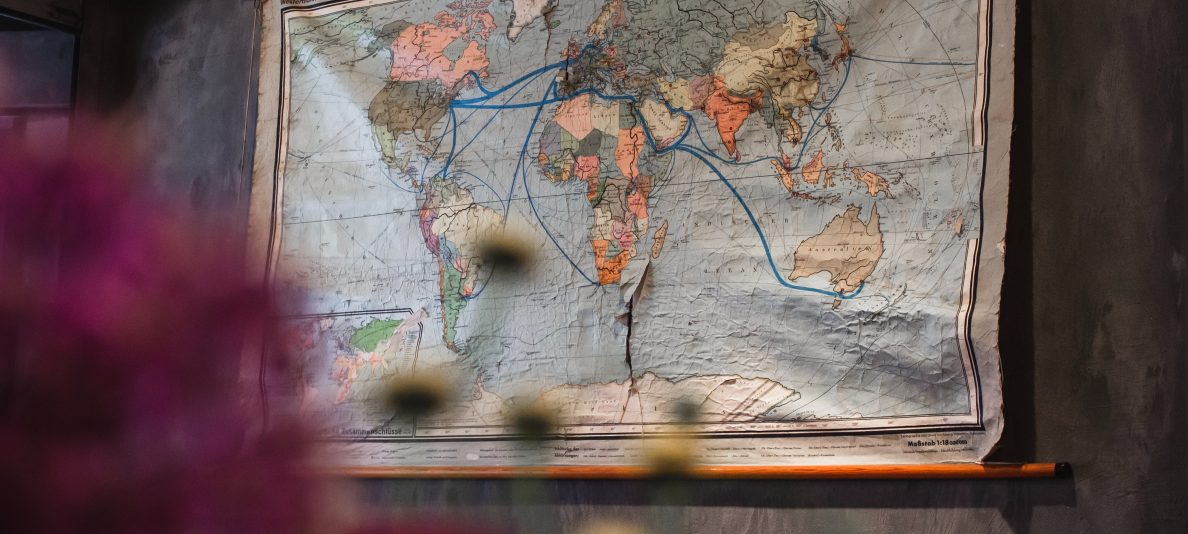
Studying Abroad: The Who, the Why, and the Why Not

OT-Open-Doors-2013-US-study-abroad-Infographic
Click for the full infographic from Open Doors

When the  Institute of International Education (IIE) releases its yearly statistics on international education, those concerning international students in the US get the most buzz. But another set of numbers, those on American students studying abroad, should get our attention, as well.

In 2011/12, over 280,000 students from the US took classes overseas. While this is an all-time high, overall only 9% of US students study abroad during their time as undergraduates.

Who are these students, and why do they study abroad while most others do not? First, I’ll talk about the who, and then I’ll move on to the why.

Who Decides to Study Abroad?

A look at the groups that make up the biggest proportions of study-abroad students gives a snapshot of who they are. Here are some of the largest percentages, along with the group in second place:

  • Females – 65%
  • Whites – 76% (Asians, Native Hawaiians, or Other Pacific Islanders – 8%; Hispanics or Latinos – 8%)
  • Undergraduates – 86% (Graduate students—excluding doctoral students – 13%)
  • Juniors – 36% (Seniors – 24%)
  • Students in the social sciences – 22% (Business and management – 21%)

And here, for good measure, are some numbers on where and how long:

  • The United Kingdom as host country – 12% (Italy – 11%)
  • For the summer, or eight weeks or less – 59% (One quarter to one semester – 38%)

Why Do They Go, while Others Don’t?

Several factors affect students’ plans to study abroad and their follow through. As would be expected, several studies show that socio-economic status plays a large role. Mark Salisbury, et al., in his oft-referenced research, found that a student’s intention to study abroad is positively related to family income and parental education. Other qualities that have positive effects on a student’s study-abroad plans are a high interest in reading and writing, and an openness to diversity concerning ideas and people. He also found that Asian Pacific Islanders are less likely than other races to make plans to study abroad

In a doctoral dissertation at the University of Minnesota, Jinous Kasravi presents findings indicating that barriers to studying abroad include the cost of study-abroad programs and restrictions on the use of financial aid, family resistance and the restrictions of cultural norms, concerns about being able to transfer courses, and lack of parental experience traveling internationally. The main focus of Kasravi’s study was factors influencing students of color in study-abroad decisions. His findings indicate that, in spite of the obstacles, a key determining factor for non-white students is “personal internal drive and determination to have this type of overseas experience.”

A study by April Stroud further adds to the findings, showing that negative factors for studying abroad include having plans for a graduate degree, living with family while going to school, and having majors such as engineering, architecture, or medicine.” Positive factors include wanting to better understand other cultures and countries and attending a college or university over 100 miles from one’s home.

This last point, the distance school is away from home, is the topic of a recent New York Times article. It discusses whether students who attend college far away from their home are more likely to choose a more “challenging” country (say, Cambodia  vs England) as a study-abroad destination. Bruce Poch, former dean of admissions at California’s Pomona College, says that going to a challenging country requires a certain level of independence in a student, the same kind of independence that would cause a student to pick a college far from home. “And there’s still an adventuresomeness to students who choose that path,” he says, “There are just a lot of kids who don’t want to go to school with the same people they went to high school with, and they do that against a lot of pressure.”

Richard Bright is director of off-campus study at Grinnell, where most students come from out of state and 65% of juniors study abroad. “[W]e do know that most of our students are taking a flight here,” says Bright in the article. “So plenty of students are coming from distant parts of the country, and then they really go all over the world.”

Joseph Brockington is the director for the center for international programs at Kalamazoo College in Michigan. He brings the whole discussion—about choosing a country or even to go abroad at all—back to the importance of parental influence. Parents, Brockington tells The New York Times, are concerned “about whether their kids will be taken care of. So we try hard to dispel the rumors, but if Mom’s against it, it’s not going to happen.”

(Open Doors 2013: Report on International Educational Exchange, Institute of International Education, 2013; Mark H. Salisbury, “Going Global: Understanding the Choice Process of the Intent to Study Abroad,” June 2008; Jinous Kasravi, “Factors Influencing the Decision to Study Abroad for Students of Color: Moving beyond the Barriers,” August 2009; April H. Stroud, abstract of “Who Plans (Not) to Study Abroad? An Examination of U.S. Student Intent,” Journal of Studies in International Education, November 2010; Michael A. Wilner, “Are Students Who Go Far Away to College More Likely to Study Abroad?The New York Times, June 10, 2013)

[Infographic courtesy of Open Doors 2013: Report on International Educational Exchange, Institute of International education, 2013]

Another New Year, Another New Record for International Students in the US

4290551550_474fbb9086_nThe number of international students at US colleges and universities is at an all-time high. Again.

In fact, that statement has been true for the past six years.

According to data from Open Doors 2013: Report on International Educational Exchangereleased last month by the Institute of International Education (IIE)—819,644 students from other countries were enrolled in US institutions of higher learning in 2012/13. That represents a 7% increase over the previous academic year.

The top-five sending countries remain the same: China, India, South Korea, Saudi Arabia, and Canada. Students from China, making up 29% of international students in the US, grew their number by 21%, while those from Saudi Arabia increased by 31%. The number of students from India and South Korea fell by 4% and 2%, respectively, while Canada’s total rose by 2%.

Boost to the Economy

The influx of international students means an influx of dollars, as well. NAFSA: Association of International Educators reports that these students and their dependents added $24 billion to the US economy last year, and their spending supported or created.  313,000 jobs. That translates into 3 jobs for every 7 international students who come to the US. (A breakdown of the economic and job impact state by state can be found here.)

By far, the largest means of support for international students last year—constituting the primary source for 64% of students—was personal and family funds. This was followed by US colleges and universities (21%), foreign governments or universities (7%), and current employment (5%). Overall, more than 70% of funding came from outside the US.

US Is Top Destination

In 2011, there were 43 million international students worldwide—as reported by OECD, using data from the last available year. Based in part on OECD’s data, IIE determined that last year, 19% of all college and secondary students studying outside their country of origin were enrolled in the United States. The number-two country in this regard is the United Kingdom. Its 488,380 international students make up 11% of the global total. The next four host countries are China (8%), France (7%), Germany (6%), and Australia (6%).

While international students make up only 4% of the total enrollment in American colleges and universities, in Australia, more than one in four students (26%) come from outside the country. The UK (19%), France (12%), and Germany (11%) also have higher proportions of students from outside their borders. In China, the country sending the most students to the US, internationals make up only 1% of the total student population.

(“Fast Facts,” Open Doors 2013: Report on International Educational Exchange, Institute of International Education; “The Economic Benefits of International Students to the U.S. Economy, 2013” NAFSA: Association of International Educators, 2013; “Primary Source of Funding, 2011/12—2012/13,” Open Doors 2013: Report on International Educational Exchange, Institute of International Education; Education at a Glance 2013: OECD Indicators, OECD, 2013; Project Atlas: Trends and Global Data 2013, Institute of International Education, 2013)

[photo: “Encyclopedia Pages Showing World Flags,” by Horia Varlan, used under a Creative Commons license]

Our TCK Makes Plans for the Peace Corps—Wait, Not So Fast

Here’s another article from my son Peter. It’s about his time at the Summer Peace Institute in San José, Costa Rica, and also about his post-graduation plans. Peter spent nearly half his life overseas before graduating from high school, so another trip to another culture should have been a piece of cake, right? And heading back to Asia with the Peace Corps shouldn’t be a problem, either. Here, Peter shares about how it can be hard to cross cultures alone, even for a TCK.

IMG_0167
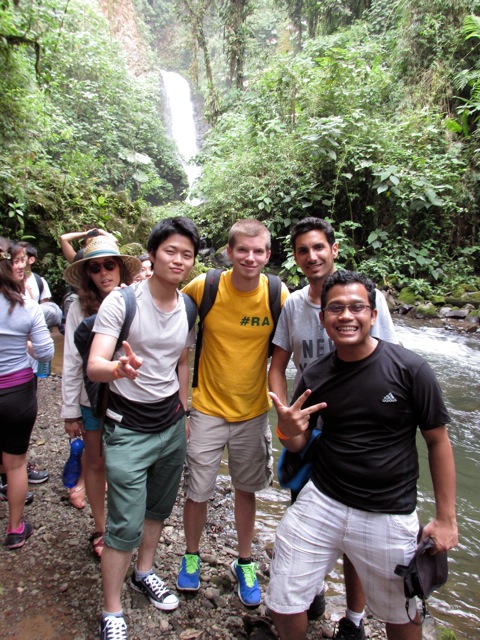
Peter (in yellow shirt) enjoys the Costa Rican outdoors with some of his friends in the Summer Peace Institute.

In 1999, my family and I left Joplin, Mo., for the other side of the world—Taipei, Taiwan. Before that, I’d never been outside the Midwest, let alone the United States.

If you are not familiar with Taiwan, it is a small tobacco-leaf-shaped island off the southeast coast of China, having about one-fifth the land area of Missouri with four times the population.

When we took our first trip to Taiwan, my parents were in the process of considering whether they wanted to become missionaries there. We spent two weeks traveling around the island, sightseeing and meeting Taiwanese friends who had once been international students at Pittsburg State University and at my father’s alma mater, the University of Missouri.

Two years later, my family and I left Joplin again for Taiwan. This time, I stayed for eight years.

After I graduated high school, I returned to Joplin to attend MSSU. I have enjoyed my time at this university more than any other time in my life, but now I am near the end. I will graduate this December with two bachelor’s degrees and, like many of you, still have no idea what I want to do next.

Well, I should not say, “No idea.”

Ever since returning from Taiwan, I have been fascinated by the world outside Joplin, outside Missouri, outside the US. I had tasted another culture—Taiwanese food is delicious, by the way—and I was ready to experience more.

When I heard about the Peace Corps, it sounded like a perfect fit. Started in 1958, the Peace Corps is a US government-run volunteer program that sends American citizens out into the world to learn about other cultures and serve the people of developing countries. Volunteers spend two year stints anywhere from Zambia to China to Peru to Jordan.

About six months ago, I submitted an application for the Peace Corps. Even before that, I had watched as two friends, fellow MSSU students and past McCaleb winners Luke and Caitlan Smith, were sent off by the Peace Corps to Rwanda.

By the time I left for Costa Rica, I was several months into the Peace Corps application process.

During the UPEACE-Berkeley program, I got to talk with two people who have experience with the Peace Corps: Dr. Jerry Sanders, a former Peace Corps volunteer [and co-founder of World Policy Journal and director of the Summer Peace Institute], and Manuel Davila, a former employee of the Honduran Peace Corps office. I asked them about their thoughts on the Peace Corps.

Sanders volunteered in Colombia in the 1970s and became disenchanted with the Peace Corps halfway through his two years there.

“I wasn’t any more satisfied with [the Peace Corps’s] policies—so-called development policies—than I was with the war in Vietnam,” he said.

Sanders felt the policies prevented efficiency. He encouraged me to go into the Peace Corps with a willingness to criticize the system.

Davila said the volunteers he met had great experiences, and he became friends with some of them. He told me the Peace Corps takes very good care of its volunteers.

I thought my time in Costa Rica would make me more excited for the Peace Corps. Instead, it made me realize how hard the Peace Corps would be. Though I had lived and traveled internationally, I had always done it with family or friends.

By the end of my first day in Costa Rica, I had already faced several difficulties.

My luggage was held up in Houston, Texas, so I lacked a change of clothes, toiletries, and even cleaning solution for my contacts. I was overwhelmed by 30 students whom I had never met before and who already seemed to know each other. I could not keep up the lectures on topics I had never studied. I could not speak Spanish. I did not know my way around town and got myself lost wandering home from the bus stop.

As I familiarized myself with my host town, learned a few Spanish phrases and befriended—and was befriended by—the other students, I felt more and more comfortable in Costa Rica.

Some of my favorite moments of the trip were whitewater rafting down the Pecuare River, learning how to say “God bless you” in Spanish, taking walks around my host town, visiting the Caribbean coast, trying new Costa Rican dishes, having intellectual and non-intellectual discussions with fellow students and watching soccer on television with my host family.

Nevertheless, being away from my family, my church community and my other close friends in Joplin was difficult throughout the trip.

While I truly enjoyed my time in Costa Rica, it did open my eyes to the realities of living overseas by myself.

In a Facebook message about the Peace Corps, Luke Smith writes, “The hardest part for me though has just been being away from my family. Diet and living conditions are a cake walk compared to not being able to see the people you love.”

Two weeks into this semester, I received a Peace Corps invitation to volunteer in Indonesia as a secondary English teacher, with a March starting date. I was given seven days to make my decision.

About an hour later, I decided to decline it. It feels like the coward’s move. But right now, I am not ready for the Peace Corps, and that is okay.

Now I am trying to figure out what is next. I will still graduate in December, and I still have no jobs waiting for me. Though I am not yet ready to live in Indonesia for two years, I am ready to explore more of the US, especially her big cities.

I do not plan to give up my aspirations of international studies. I know if I do move somewhere like Chicago or Philadelphia, I will meet people from other countries and cultural backgrounds, and that is exciting.

Maybe I will pursue a master’s degree in international relations. I am still very interested in cross-cultural issues. I follow global current events in my free time, and I try to pick up bits and pieces of other languages.

My thirst for cultural diversity will never be quenched. The Peace Corps may still be in my future, but I am not looking that far ahead. I am looking at what is next, one decision at a time.

From Fukushima to Costa Rica: A Rocket Scientist’s Quest for World Peace

Next month, my son Peter will graduate from Missouri Southern State University. As part of his education, this past summer he attended the Summer Peace Institute at the UN-mandated University for Peace in San José, Costa Rica. As a recipient of MSSU’s McCaleb Initiative for Peace, he reported on his experience for the university’s student-run newspaper, The Chart. Following is one of the eight articles he wrote for the paper. I will post another of his articles on Tuesday.

IMG_0129
Satoshi Miyatani, from Japan, takes a break from classes at this year’s UPEACE Summer Peace Institute in Costa Rica.

Most of the students at the UPEACE-Berkeley summer program came from backgrounds in subjects like peace and conflict studies, economics, politics, sociology, law and anthropology.

Satoshi Miyatani, a rocket scientist, was one of the exceptions.

A recent graduate of aerospace engineering at the University of Tokyo, Miyatani now hopes to attend graduate school at the Massachusetts Institute of Technology.

But why did Miyatani choose to attend a program focused on peace?

Miyatani’s reasoning goes back two years to an event that was significant for him and for Japan.

On the afternoon of March 11, 2011, a magnitude 9.0 earthquake struck off the coast of Fukushima, Japan.

Miyatani was staying at a hotel in Fukushima at the time of the earthquake.

“I have never experienced such a big earthquake,” he says. “The ground was shaking. Everything was shaking.”

Tsunami waves caused by the earthquake battered Fukushima’s coast, even reaching Miyatani’s hotel. The hotel owner drove Miyatani to safety. Thirty minutes after they left the hotel, it was destroyed by the tsunami.

“I almost lost my life,” recalls Miyatani.

For the next week, he slept on a gymnasium floor made cold by the Japanese winter and ate only dry, tasteless cookies.

Before this near-death experience, Miyatani was only interested in developing machines, as most of his fellow engineering students still are. After this experience, he wanted to help victims of natural disasters such as he had endured. He resolved to study the environment and contribute to peace by applying his specialty in aerospace engineering.

Miyatani speaks humbly about his 100-page bachelor’s thesis, which addresses his change of thinking. He describes how satellites can be used to monitor the effects of natural disasters and inform disaster response.

His thesis focuses on the use of many satellites to maximize the information gathered and minimize the time of response.

For the first portion of the UPEACE-Berkeley program, Miyatani says, “Every day I can get a new idea from the lecture.”

His favorite lecture was given by Dr. Bryan Down-Uribe about the environment and climate change. Down-Uribe employed a more scientific approach than previous lecturers, using more statistics, graphs and charts. Miyatani says he was “used to this type of lecture.”

During the field work portion of the UPEACE-Berkeley program, Miyatani went with four other students to work with an indigenous Costa Rican family in Kéköldi.

After a long bus ride toward the Caribbean side of Costa Rica, he and his group hiked an hour into the jungle to reach the research center where they stayed during the field work.

Miyatani says the group worked hard every day— digging and building trails, counting frogs and repairing a bird observation tower.

They also had no electricity during the day time, but “we could survive,” Miyatani says, chuckling.

Drawing a larger lesson from his experience in Kéköldi, Miyatani says, “In the city, there are a lot of things such as supermarkets, Internet, electricity. Everything is useful, but, actually, I don’t think we need to use it.”

Miyatani feels the tension between what he is learning in Japan and what he has learned in Costa Rica: “My major is aerospace engineering, so every day I also study about technology, but there is no technology in Kéköldi.”

“I have no idea how to apply the idea to my life. I have to think more,” he says.

While he is thinking about how to apply his experience in Costa Rica to his life, Miyatani is also planning to commemorate the experience with his work.

As a rocket scientist, Miyatani has launched a satellite into a space and talks excitedly about launching more, proudly declaring what the name of the next satellite will be: Kéköldi.

Language Study: Live (There) and Learn

3797213895_8586cd8e5e_nMan, I really should have studied French harder in college.

That’s how I ended my last post. Actually, I did study hard, got good grades in my three French classes, and was only three hours short of getting a French minor.

The reason I didn’t get the minor was that when I showed up for the first class of The History of the French Language, a 3-hour class taught in English, I realized I was in over my head. It was in the fall, after a summer full of not speaking French, and the girl in front of me asked Professor Honeycutt if he would teach the class in French. She asked this in French, and the girl next to her nodded in agreement. The teacher said he couldn’t do that, but I dropped the class the next day anyway.

It was one of the best decisions of my college career. I’m so glad that today I don’t have to tell people that I have a French minor but about the only thing I can still say is “I speak a little French.”

The problem wasn’t that I didn’t study hard enough. The problem was I didn’t need to use it outside of class. And inside of class, what I said didn’t matter as much as how I said it. You know what I mean: If your teacher asks you to tell about your pet, and you have a dog, but you’ve forgotten the word for dog, but you remember the word for cat, suddenly you have a cat. The professor isn’t asking you because he’s concerned about the animals in your life, he simply wants to see if you can put sentences together.

It’s not a silver bullet, but putting yourself in a place where you need to use a language in a meaningful way is key to learning a language. That’s one of the foundations of Education First, named the official supplier of language programs for the 2014 Winter Olympics in Sochi. EF was founded in 1965 by Bertil Hult in Sweden, “on the principle that cultural immersion was a superior way to study a language.”

Below are five EF commercials about people learning a language where it’s spoken. Granted, they glamorize the whole expat experience, but they are commercials, not documentaries.

I just wish that I could become fluent by watching cool videos about cool people living in cool places—and not have to worry about conjugating verbs.

The commercials are called “Live the Language.”

(By the way, who knew that speaking Australian and Canadian was so easy? Almost as easy as what they speak over in England).

(“About Us” and “EF in Brief,” Education First)

[photo: “cafe,” by  pim van boesschoten, used under a Creative Commons license]

An American Wedding, Up Close and Personal

One of my favorite cross-cultural stories comes from a former colleague in campus ministry at a university. He had taken a group of international students to tour the state capitol building, and when they arrived, they were surprised to see that a wedding was taking place on the capitol lawn. What an opportunity to see up close an American tradition in a beautiful setting.

How “up close”? Well, two students from Korea wanted to get some good pictures, and before my friend could stop them, they walked straight up to the wedding party and sat down in the audience. And of course, the row that had the most available seats was the one in the front, next to the bride’s mother and father. So they sat there through the ceremony, nearly front and center. Best of all was that when it was over, as the usher’s dismissed the crowd row by row, the students followed protocol and walked down the aisle behind the parents.

No word on whether they took a place in the receiving line.

9016622729_00c89fe541
[photo: “QH3C3119,” by Jordan Smith, used under a Creative Commons license]

Pitt Pal: Facilitating Friendships with International Students

4935587436_f4ea98c4df_n
A student worker shares about International Programs and Services at PSU’s annual Community Activities Fair.

Tucked in the southeast corner of Kansas, in the heart of the United States, is Pittsburg State University. Though it’s far from any international borders, this school with an enrollment of  less than 7,300 has become the educational destination for students from around the globe, with 469 internationals attending from 37 countries in the spring of 2012.

In light of statistics that say more than one third of international students have no close American friends, it is easy for students to arrive in the US feeling out of place and to leave feeling the same way. How does a school like Pitt State leverage Midwest hospitality to make its international population feel at home?

One answer is the Pitt Pal program, which facilitates friendships by pairing international students with American students. I asked the coordinator of Pitt Pal, Brenda Hawkins, to share about the program:

Pitt State had its International Friends program, matching up international students with local families, for many years before starting Pitt Pal. What are some of the added benefits of involving American students, rather than just relying on families?

My first day of work here we went to a regional international education conference and I heard K State talk about their buddy program. Realizing that we didn’t have anything like that I did some research on that type of a mentor program and we decided PSU needed one. At first I thought it would be a great opportunity for a domestic student to serve an international student and help them acclimate to the USA and college life here. We also wanted to encourage domestic students to have a global eye and outreach and knew that this would change their lives as well. Having been overseas myself on many trips, I knew that the hospitality of people we met always impressed me and helped us feel welcome.

The local family opportunity is encouraged to meet at least once a month. I felt like international students could also benefit from more frequent interaction with an American-born student. Since they would have in common being students this would provide an initial platform to build a friendship on. Being on campus and perhaps in the same dorm or classes would lend itself to potentially daily contact.

A recent survey found that 38% of international students have “no strong American friendships.” What do you see as the biggest obstacles to friendships between US and international students, and how does Pitt Pal help to overcome them?

In a nutshell, obstacles to friendships between US and international students are language barriers, cultural differences and misconceptions, stereotypes, and indifference to get out of your comfort zone and learn about another culture. Students don’t always see the value in learning about another culture and the effort that takes.

But I think another obstacle is a structural challenge that most universities face because international students arrive on campus up to a week before domestic students return. The first students they have a chance to meet and befriend are other international students. By the time most of the domestic students return to campus, friendships are formed and they tend to sit with other international students in class. To an American student it may appear that internationals prefer to hang together. Another structural challenge in some universities is that international students are separated from domestic students in their freshman experience classes. While this is necessary because some topics are unique to each group, it might put them on unequal footing for making friends.

Pitt Pal helps overcome these obstacles because it becomes a tool to facilitate cultural interaction and challenges each party to a level of commitment. It helps break the ice for students who may not reach out to form friendships with those who do not have as much in common with them. Finding common ground is key to the beginning of a newly forged relationship between an international and domestic student.  In getting acquainted, students relate to each other by finding similar interests like shopping, sports, food, and exchanging stories about their lives.  But having a desire and flexibility to try and learn new things takes the friendship to another level.

Pitt Pal helps students get to know the individual regardless of their culture and not hide behind generalities. They learn to appreciate the differences and similarities of their cultures and personalities.

Also, for the domestic student it appeals to their sense of helping a student in need.  This generation is strong in their desire to volunteer. I believe finding common ground and having a commitment to this responsibility helps overcome stereotypes and misconceptions. When domestic students return from their study-abroad opportunities, they understand the challenges international students face and are quick to volunteer to help them acclimate.

That’s an interesting thought on international students arriving to campus early. I would think that having students get in touch with each other before the international students get to the States helps with that. Of course, in the end, the relationships that develop are dependent on how much the students invest in them. Can you leave us with a couple examples that show the potential of Pitt Pal friendships?

I have several great examples of Pitt Pal relationships. Some American students have even been able to visit their international friends when they were on study abroad in Korea and Finland, etc. But I think I’ll let two students from China tell about their experiences in their own words, from essays they wrote about Pitt Pal:

This was my first time to meet my Pitt Pal. She was in a green shirt with golden hair and sunshine smile. We introduced ourselves to each other and she said she was American and good at volleyball while I like Ping-Pong, but this didn’t affect us talking about our favorite clothes and bags. We also determined that next week I would cook Chinese dishes for her and she would teach me how to bake.

and

I am proud that I built a good relationship with my Pitt Pal over the semester. I am so thankful for her keeping company with me during the fall break, when everyone flew to other places to have an enjoyable holiday except me. Even though the dorm on that day was very cold, I felt warm with my Pitt Pal and not lonely any more.

[photo: “DSC_0018,” by Michael Fienen, used under a Creative Commons license]

Regrets and Remembrances: A Prayer for Those Who Leave Home

With one plane ride the whole world as TCKs have known it can die. Every important place they’ve been, every tree climbed, pet owned, and virtually every close friend they’ve made are gone with the closing of the airplane door.
—David Pollock and Ruth Van Reken, Third Culture Kids

5420666395_e086b79cf9_mThis closing door doesn’t just happen to Third Culture Kids. It’s also the experience of immigrants who leave behind many what-could-have-beens in their old country. Cross-cultural workers feel the door close when they leave their work and return “home.” (What other job requires you to leave the country once you’re no longer on the payroll?) International students close the door with the hopes that new opportunities will open many more. And refugees often see the door slammed and locked by soldiers carrying guns.

5420666545_cd2c078381_mBut while the door is closed, the mind is still open to thoughts about what was left behind. Some thoughts are joyous and life giving. Some are hurtful and life stealing. And often they come intricately, painfully intertwined, called up by a scent, a word, a sound, a flavor, a feeling or a dream. Bittersweet.

For those who find themselves on the other side of a closed door, I offer this prayer, inspired by Reinhold Niebuhr’s “Serenity Prayer.”

God, grant me the confidence to let go of the regrets that I should not hold on to,
The ability to hold on to the memories I should not let go of,
And the wisdom to separate the one from the other. Amen.

(David C. Pollock and Ruth E. Van Reken, Third Culture Kids: Growing Up among Worlds, Boston: Nicholas Brealey, 2009)

[illustrations: (upper) “Joined” and (lower) “Cupped“) by Pete Hobden, used under a Creative Commons license]