Hyper Realism: A Russian Farmer Lands an Esquire Cover and a Trip to New York

9168908261_6e344e2bb4_n
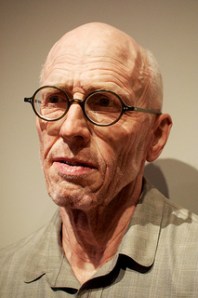
Evan Penny’s Old Self, Variation #2, an example of hyper-realistic art

Ever since, as a child, I saw Duane Hanson’s lifelike sculpture Janitor at the Milwaukee Art Museum, I’ve loved hyper-realistic art. Then last month, when I visited Crystal Bridges Museum of Modern Art, in Bentonville, Arkansas, I was surprised to see another Hanson work, Man on a Bench. (I really was surprised, since it looked for all the world like a museum visitor taking a break from his tour.) And in a room close by, there was an oversized bust by Evan Penny, Old Self, Variation #2. Unlike with Hanson’s pieces, no one will mistake Old Self for an actual person—it’s only a head with shoulders, and it’s way too big. But still, it just looks so real.

Martin Schoeller is another artist in the same vein, except he doesn’t exactly create hyper realism, he captures it—with a camera. Born in Germany, but now based out of New York, Schoeller is best known for his “hyper-detailed” large-scale portraits of celebrities, which have appeared in magazines such as GQ, The New Yorker, and Entertainment Weekly.

But his photographic subjects also include common people, like you and me. In fact, if you’d like to see what you’d look like in a Schoeller portrait, next time you’re in Bed Bath & Beyond, do like I did and take a look at yourself in the 10x-magnification of the Zadro Dimmable Florescent Dual-Sided Mirror. (That’s hyper realism.)

Schoeller recently took a cover photo for Esquire Russia of Vasiliy Ilyn, a retired farmer from Russia, who’s featured in this month’s magazine. Ilyn is one of Schoeller’s non-celebrity subjects, as the September Esquire is devoted to the rules that govern the lives of ordinary Russians.

For three days, Ilyn was something more than ordinary, as he was flown to New York for the photo shoot. His encounter with the city is chronicled in the 20-minute film Vasily, from Stereotactic. (Thanks to Carla Williams for telling me about the video.)

The film shows Ilyn’s first trip outside the Kursk region of Russia, his first time to see the ocean, and, of course, his first visit to America. As he looks around New York, he’s a fish out of water, but he’s an ordinary fish. And I’m not sure that his reactions are much different from those many retired farmers in the flyover portions of the US would have.

Ilyn narrates the documentary, and he has a lot to say about Russia, the US, and life in general. He thinks of himself as a joker, but much of what he says shows a solemn acceptance of the way things are. He’s pretty straightforward and plain spoken. At one point, while talking about his disdain for past Russian leaders, Ilyn drops an F-bomb. Actually, it’s more of an F-hand grenade since we read it in the subtitles.

When he gets back to his home, he tells a woman about the 80,000 Russians who live in New York. “I wish a flood would come and they would die,” she says. “Let the locals survive, but these traitors should die.”

Ilyn replies, “They were just looking for a better life. . . . Let them go.”

Shoeller’s type of hyper-realism doesn’t come from a lack of preparation and artistic manipulation. The lighting and focus has to be just right, and there’s a lot of time spent on Ilyn’s makeup. But the result is striking for its unglamorized detail.

That’s the way the documentary looks to me, too. I can tell a lot of work went into the making of Vasily, but it’s that work—the shot selection, the editing, the scoring of the music—that makes it feel more real . . . much more real than what usually passes for “reality” on TV today.

(“Russian Farmer Lands in Esquire and NYC,” Voices of NY, October 15, 2013)

[photo: Old Self, Variation #2” by Nils Gore, used under a Creative Commons license]
Pico Iyer on Home, Travel, and Stillness (plus, Have You Seen the TED Commandments?)

161335960_3c30374d20_nPico Iyer, best-selling author on the topic of crossing cultures, finds the concept of “home” difficult to describe. It’s no wonder. His parents are Indian. He was born in England. At the age of eight he moved with his family to California. And currently, between his many travels, he lives with his Japanese wife in Japan.

In a TED Talk from 3 months ago, Iyer “meditates on the meaning of home, the joy of traveling and the serenity of standing still.”

Some great writers are not great speakers, but Iyer expresses his thoughts with eloquence in both forms. Here are a few of those thoughts:

On multi-cultural children:
“[T[heir whole life will be spent taking pieces of many different places and putting them together into a stained-glass whole.”

On traveling:
“The real voyage of discovery, as Marcel Proust famously said, consists not in seeing new sights, but in looking with new eyes. And of course, once you have new eyes, even the old sights, even your home become something different.”

On the concept of home:
“[H]ome, we know, is not just the place where you happen to be born. It’s the place where you become yourself.”

On collecting 1 million miles on a frequent-flyer program:
“You all know that crazy system, six days in hell, you get the seventh day free.”

And on spending three days in silence at a monastery:
“I began to think that something in me had really been crying out for stillness, but of course I couldn’t hear it because I was running around so much.”

Following the TED Commandments

I’ve watched several TED Talks, and I’m always impressed with how the speakers seem to present their thoughts articulately and effortlessly. I’ve always wondered if they use teleprompters. I found my answer at Jimmy Guterman’s blog. Guterman, a TED Talk presenter, wrote that the TED Talk stage includes “confidence monitors.” These floor-mounted monitors show the slides used in the presentation, to which presenter notes can be added. He added these notes, but regretted it later, as he was distracted by the monitors and felt that he looked down at them too often.

Guterman goes on to list the “TED Commandments” that TED sends to every speaker. It’s a great list of advice, and most of it applies to even casual conversations:

I. Thou shalt not steal time.
II. Thou shalt not sell from the stage.
III. Thou shalt not flaunt thine ego.
IV. Thou shalt not commit obfuscation.
V. Thou shalt not murder PowerPoint.
VI. Thou shalt shine a light.
VII. Thou shalt tell a story.
VIII. Thou shalt honor emotion.
IX. Thou shalt bravely bare thy soul.
X. Thou shalt prepare for impact.

To this, Guterman adds a number eleven: Trust thyself. (In other words, Don’t use monitors.)

If you’re thinking about brushing up your public-speaking skills and want to imitate that TED Talk style, you might want to take a look at this “Onion Talk,” produced by the folks at The Onion. It’s called “Ducks Go Quack, Chickens Say Cluck” . . . sort of a lesson on cross-cultural communication.

(Jimmy Guterman, “How to Give a TED Talk (and How Not To),” Jimmy Guterman’s blog, March 12, 2002)

[photo: “Loneliness,” by David Jakes, used under a Creative Commons license]

8 Maps and Globes That Will Change Your Perspective of the World

8280671002_19c064bddf_nLast week, out of the blue, my 7-year-old son said, “Guess what?”

(He doesn’t really want me to guess. When I try, I’m always wrong.)

“Guess what? The earth doesn’t have an upside down.”

Of course, he’s right. But you wouldn’t know it if you look at our maps and globes. Isn’t north up and south down? How else would you explain Upstate New York, Manhatten’s Upper East Side,  Sub-Saharan Africa, and Australia’s location “down under”?

And, of course, north is better than south, since up is better than down, right? According to a 2011 study, that seems to be the perception in the US. The results, published in Social Psychological and Personality Science, show that 72.5% of participants in the study would rather live in the northern half of a hypothetical city, because, they assumed, that’s where the more affluent people live. And when the map was flipped, with south at the top, participants no longer saw the northern half as better, since it was now on the bottom.

Also, side to side, we all know where the center is. It’s Europe. So Saudi Arabia is in the Middle East and Japan is in the Far East. Just look at any map, and you’ll see it’s so.

Well, not any map, just most of them . . . at least in the West. But the West doesn’t make up the whole world, or even most of the world.

When I was in Taiwan I saw a wall map centered on Asia. It makes sense, since the Mandarin word for China is Zhongguo, meaning “Middle Kingdom.” That map opened my eyes to seeing the world in a different way.

So here are five maps to help us all see our global neighborhood differently. Each is available for purchase online, though some are quite pricey. Display these and listen to the conversations begin.

  1. Upside-Down Maps

    These are more than just regular maps flipped bottom to top. What makes them special is that all the names and notes are printed right-side up on north-down images of the countries. Get them from Maps.comODT Maps, and Metsker Maps.

  2. Center-Shifted Maps

    These two Pacific-centered maps (physical and political) from Maps.com put the Western Hemisphere on the right. And their Asia/Europe-centered map even has the gall to split North America in two.

  3. Azimuthal Maps

    An azimuthal map puts you at the center, showing the world spreading out from that center in all directions. This means that distances can be measured from you—the center point—to anywhere on the globe using a straight line (unlike with traditional rectangular maps). It also means that the farther away from the center, the more distortion there is. (This map is truly egocentric). ODT Maps offers a USA-centered and an Africa-centered map, as well as custom-made maps centered on any city in the world.

  4. Imaginary-Underground Maps

    Contemporary artist Chris Gray has produced a creative collection of maps showing an imaginary global system of subway lines. Versions include Asiocentric, Eurocentric, and Antipocentric (Asia-centered and upside-down).

  5. Earth at Night Maps

    These cool maps are actually compilations of nighttime photos taken from space and show clusters of light from cities around the globe. Two renditions, with different results, are at National Geographic and PosterRevolution.

  6. City Lights Globe

    This globe puts the “earth at night” map on a sphere. It’s an automatically rotating daytime globe that, when the lights dim, illuminates the cities of the world. Available at Innovatoys. Waypoint Geographic’s Earth by Day and Night, at World Wide Globes, is a similar globe that lights up when turned on.

  7. Replica Globes

    Authentic Models has a line of reproductions that mimic famous and beautiful globes from years gone by. The physical world hasn’t changed, but the borders and place names certainly have. Each of these globes, available at OnlyGlobes.com, is a lesson in history. Replica globes show us the world the way it used to be seen.

  8. Upside-Down Globe
    AS17-148-22727

    I was sure that someone would have made one of these, but alas, I couldn’t find one. Too bad. The closest thing I could come up with is the inflatable Astronaut View Globe from Jet Creations—available at Ultimate Globes. It is, as the name suggests, what the world looks like from space. Since there’s no printing on this globe, you could easily turn it south side up, which is actually the way NASA’s famous “Blue Marble” photo was originally taken (as shown here).

Maybe I’ll have to get somebody to make an upside-down custom-made globe for me. Maybe Mr. Bellerby, of Bellerby & Co. Globemakers, can give me a hand. (Update: see An Upside Down Globe: The Wait Is Over, Now the Waiting Begins)

(My favorite quotation from this video is “The whole way of making anything using a sphere as its base, as its centerpiece, is fraught with different problems and issues because you’re multiplying every error by pi.”)

All this has got me thinking: What else do we in the North and West take for granted? For instance, in my post Les Images de France 5, the creators of the TV idents describe their images this way: “Everything travels from left to right,” and “this is of course about moving forward.” Why is rightward movement usually associated with progress? Is this because we read from left to right? If so, then is it the same in cultures that read right to left, such as in Arabic-speaking countries? Or is progress, for them, a right-to-left thing?

It’s got me thinking.

Bonus Map #9: The Atlas of True Names
This set of maps, from German cartographers Stephan Hormes and Silke Pest, renames places with their original literal meaning. See my later post for a full description.

(Sanette Tanaka, “Study Points to Bias toward a City’s North Side,” The Wall Street Journal, July 4, 2013)

[photos: “World Grunge Map,” by Nicolas Raymond, used under a Creative Commons license; “The Blue Marble from Apollo 17, courtesy of NASA]

Language Study: Live (There) and Learn

3797213895_8586cd8e5e_nMan, I really should have studied French harder in college.

That’s how I ended my last post. Actually, I did study hard, got good grades in my three French classes, and was only three hours short of getting a French minor.

The reason I didn’t get the minor was that when I showed up for the first class of The History of the French Language, a 3-hour class taught in English, I realized I was in over my head. It was in the fall, after a summer full of not speaking French, and the girl in front of me asked Professor Honeycutt if he would teach the class in French. She asked this in French, and the girl next to her nodded in agreement. The teacher said he couldn’t do that, but I dropped the class the next day anyway.

It was one of the best decisions of my college career. I’m so glad that today I don’t have to tell people that I have a French minor but about the only thing I can still say is “I speak a little French.”

The problem wasn’t that I didn’t study hard enough. The problem was I didn’t need to use it outside of class. And inside of class, what I said didn’t matter as much as how I said it. You know what I mean: If your teacher asks you to tell about your pet, and you have a dog, but you’ve forgotten the word for dog, but you remember the word for cat, suddenly you have a cat. The professor isn’t asking you because he’s concerned about the animals in your life, he simply wants to see if you can put sentences together.

It’s not a silver bullet, but putting yourself in a place where you need to use a language in a meaningful way is key to learning a language. That’s one of the foundations of Education First, named the official supplier of language programs for the 2014 Winter Olympics in Sochi. EF was founded in 1965 by Bertil Hult in Sweden, “on the principle that cultural immersion was a superior way to study a language.”

Below are five EF commercials about people learning a language where it’s spoken. Granted, they glamorize the whole expat experience, but they are commercials, not documentaries.

I just wish that I could become fluent by watching cool videos about cool people living in cool places—and not have to worry about conjugating verbs.

The commercials are called “Live the Language.”

(By the way, who knew that speaking Australian and Canadian was so easy? Almost as easy as what they speak over in England).

(“About Us” and “EF in Brief,” Education First)

[photo: “cafe,” by  pim van boesschoten, used under a Creative Commons license]
A Biscoff Cookie, an Inflight Magazine, and Some White Noise. . . Welcome Aboard

5720172830_9a58e44e33

It’s been more than a year since I put together my list of online, English-language, international (read, with other than just US destinations) in-flight magazines.

Not long ago, I found 27 more and have added their links to the post. That brings the total to 91.

So . . .

[photo: “Pink Jet Wing,” by Cyndy Sims Parr, used under a Creative Commons license]

Nando’s: Tastes like Chicken, Looks like an Art Gallery

2791367612_e1be822cbf_nThe Obama family are currently in South Africa, as part of a three-country visit to the African continent. The president will not meet with Nelson Mandela, who is in the hospital, but he has spoken with Mandela’s family by phone. While there, they will also tour Robben Island, where Mandela was a prisoner for 18 years.

I’ve never been to South Africa, but would love to visit. I have, though, found a place (somewhat) closer to home that might some day give me a taste of the country.

In Chris Stark’s interview with Mila Kunis, Stark invites Kunis to a Nando’s for some chicken (to which she responds, “You’re teaching me so much.”)

So what is Nando’s? Why, it’s “Home of the legendary, Portuguese flame-grilled Peri-Peri chicken,” of course.

And what does that have to do with South Africa? Go to the “Story of Nando’s” and you’ll see an animated history of how the restaurant came to be. In a nutshell. . . . Years ago, exploring Portuguese sailors ended up in Mozambique where they discovered the African Bird’s Eye chili pepper. Some 400 years later, some of these Portuguese left Mozambique for Johannesburg, taking with them their peri-peri chicken recipes. (Peri-peri is how they pronounced the Swahili name for the chili.) In 1987, Fernando Duarte and Robert Brozin bought a chicken restaurant—featuring peri-peri sauce—in the Rosettenville suburb of Jo’burg. They changed the name from Chickenland to Nando’s, and the chain was born. Nando’s restaurants are now found around the globe, and while they’re present in the US, they’re (so far) confined to Maryland, Virginia, and Washington, DC.

While each Nando’s is unique, one constant is that they all display artwork from South Africa. Their “art project” started in 2002, and since then, Nando’s has become the self-proclaimed “largest buyer of South African contemporary art in the world.”

What we like most about our art project is that it’s given undiscovered, emerging and established artists from diverse social and economic backgrounds the opportunity to have their work on display in our restaurants around the world. It feels really good to know that we’ve helped give many artists the freedom to focus on their art full time, and that we’ve given our customers something beautiful to look at, without having to set foot in a gallery. (from “Our Restaurants)

Nando’s even has an online display of over 170 pieces of their South African art, produced by “everyone from bushmen on community farms to renowned Johannesburg painters.”

Here’s a recent commercial for Nando’s in South Africa. Eyes down. Now up. Now look closely and you’ll see some of the South African art on the wall.

[photo: “Nando’s Peri Peri Sign,” by Mr T in DC, used under a Creative Commons license]

Paris: The City and the Syndrome

from Trey Ratcliff at www.stuckincustoms.com

Though I often looked for one, I finally had to admit that there could be no cure for Paris.

These are the opening words of Paula McClain’s novel, The Paris Wife. Told from the viewpoint of Ernest Hemingway’s first wife, Hadley, the book shares the story of the young couple as they dive into life in Jazz-Age Paris.

I’ve not read the book, but I’ve read the first page, on the back of the most recent issue of the travel magazine Afar (which, by the way, I purchased with frequent-flier miles). The page is part of an advertisement, displayed on a Kindle Paperwhite held by a tourist overlooking the iconic white and blue buildings of Santorini, Greece. The caption for the ad reads, “Perfect for Getaways.”

It seems that some Japanese travelers have the same view of Paris as Mrs. Hemingway: It’s a condition in need of a remedy.

Back in 2006, BBC published an oft-quoted story about a phenomenon called “Paris Syndrome.” According to the article, each year, a dozen or so Japanese tourists have a psychiatric breakdown of sorts upon visiting the French capital. First identified by Hiroaki Ota, a Japanese psychiatrist in France, the syndrome is brought about when the realities of Paris don’t match the visitors’ romanticized expectations. While some of the symptoms sound like culture shock, others, such as delusions and hallucinations, are more extreme.

While some deny the existence of an actual syndrome, BBC reports that the Japanese embassy in France has set us a 24-hour hotline to help deal with the situation.

Below is a short documentary from John Menick, Paris Syndrome (2010). It takes a more in-depth—and sometimes sceptical—look at the condition, including interviews with French psychiatric professionals. Besides Paris Syndrome, the video also touches on such topics as Stendhal Syndrome, psychiatric portraiture, and historical views of travel-related mental illnesses. It even looks at Mehran Karimi Nasseri, the inspiration for the movie The Terminal.

So . . . what is the cure for Paris? While some are searching for one, most see no need. The author Gertrude Stein, a friend of the Hemingways from their time in France, saw the City of Light as a place that nurtured her creativity. “America is my country,” she said, “and Paris is my hometown.”

(Paula McClain, The Paris Wife, New York: Ballantine, 2011; Caroline Wyatt, “‘Paris Syndrome’ Strikes Japanese,” BBC News, December 20, 2006)

[photo: “Another Summer Day in Paris,” by Trey Ratcliff at Stuck in Customs, used under a Creative Commons license]

Video Poetry

Two wordless videos

One fast

One slow

Striking

Vivid

Lyrical

One from Japan

One from India

Hayaku and

Holi

(Brad Kremer, Hayaku: A Time Lapse Journey through Japan, 2010; Jonathan Bregel and Khalid Mohtaseb, dirs., Holi, Variable, 2012)